2026 19

Discussion with Arvind Satyanarayan

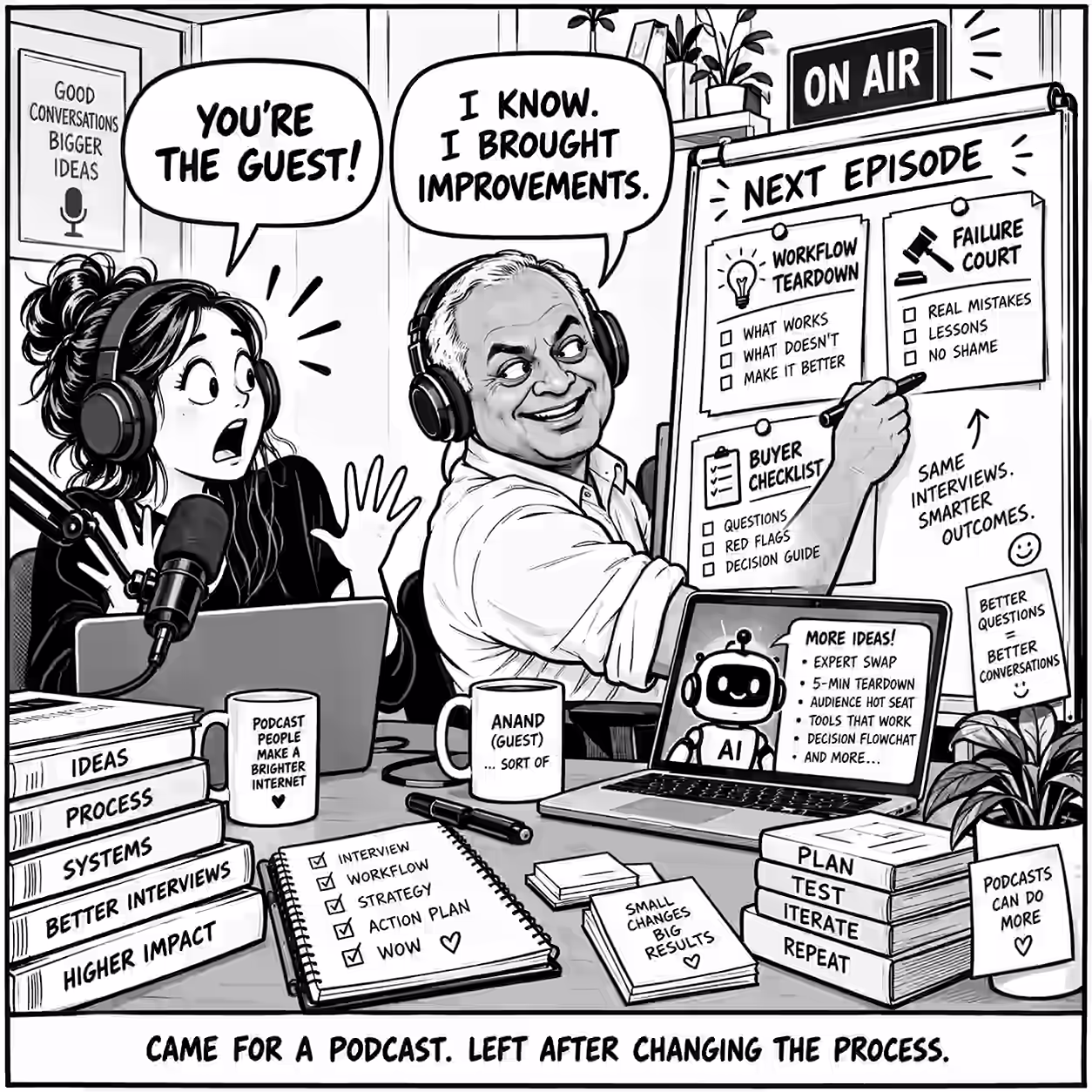
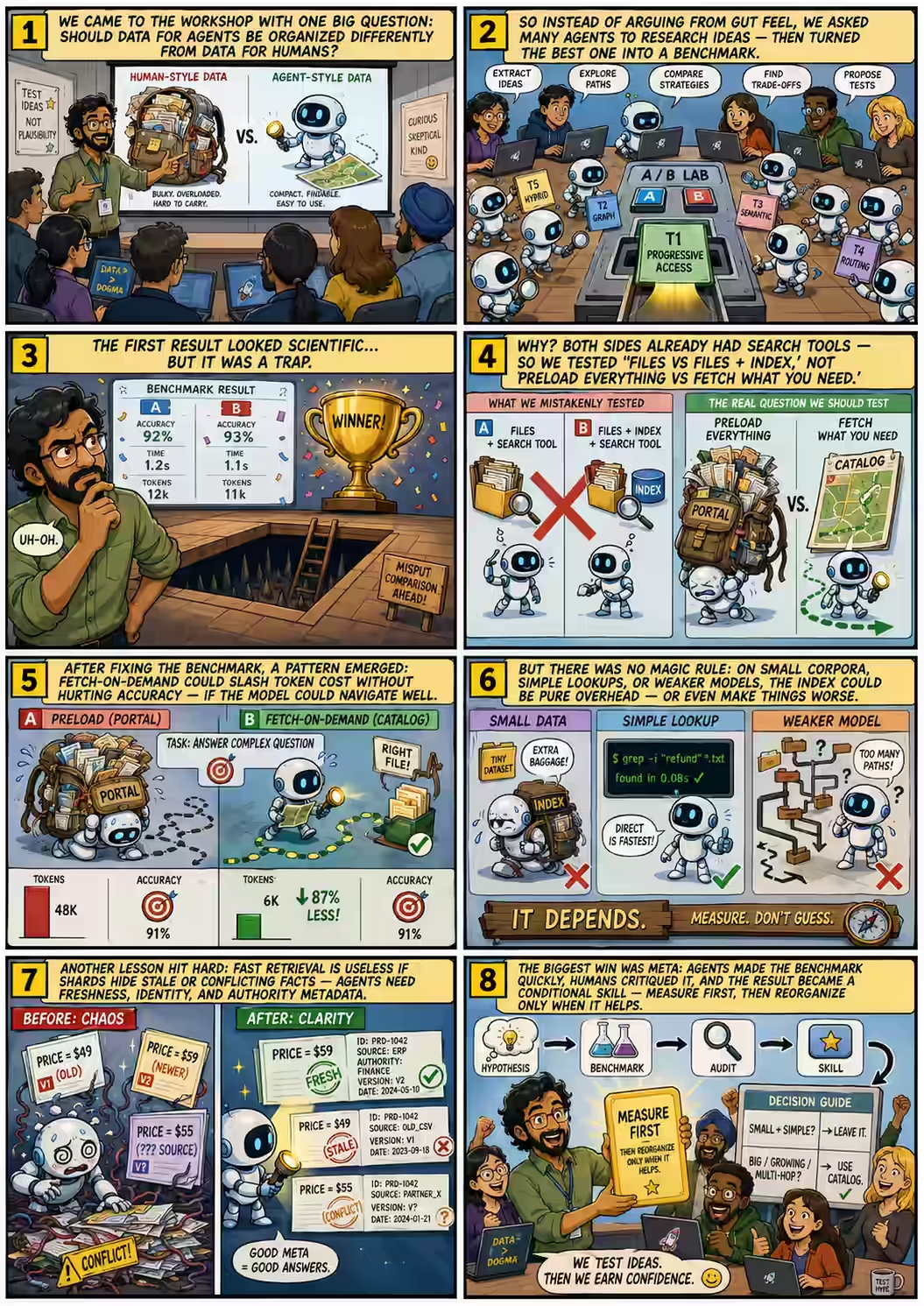
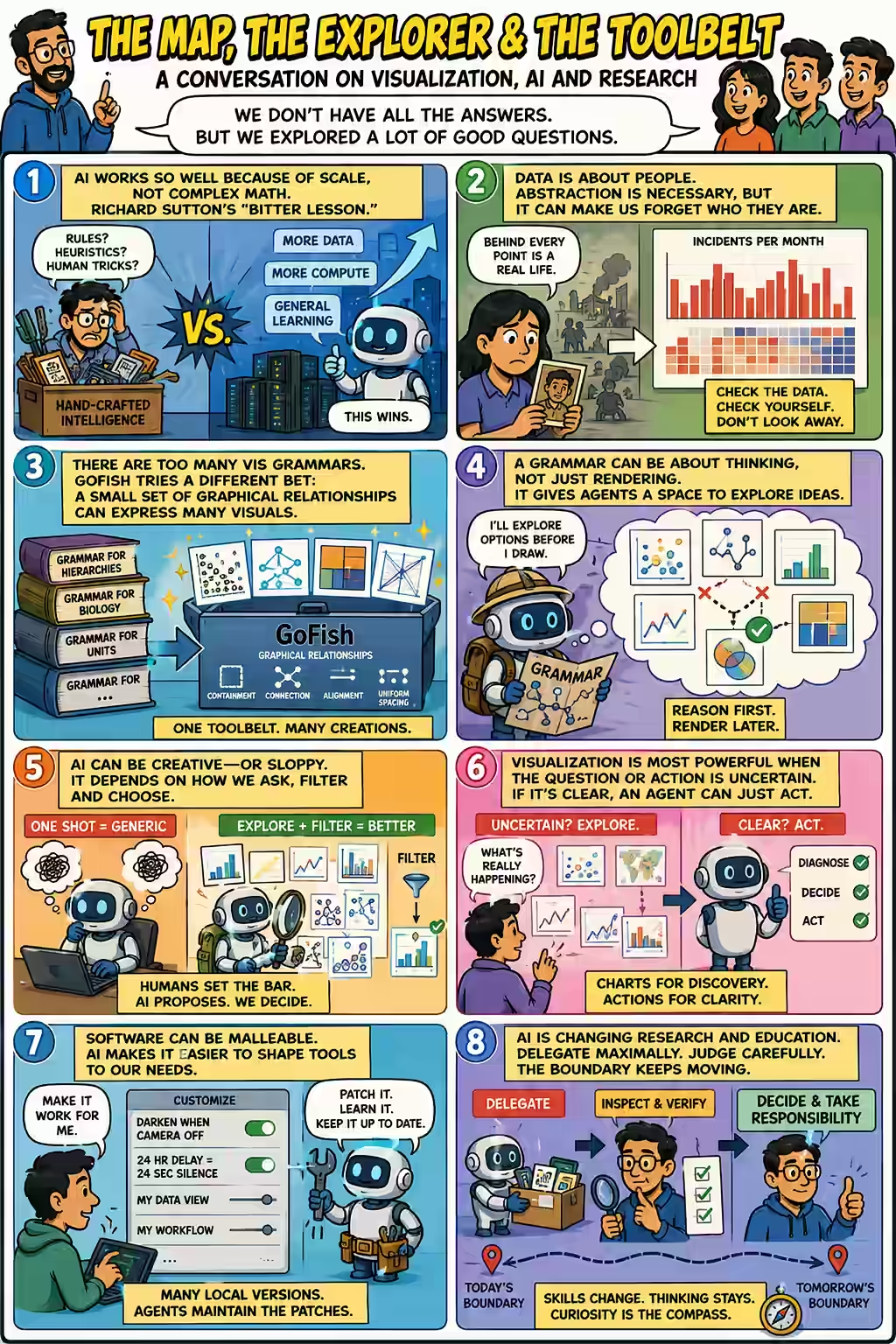
After Arvind Satyanarayan’s talk at VizChitra 2026, a group of us kept talking about machine learning, visualization grammars, creativity, software and education. The conversation began with a basic question. Why do modern AI systems work so well when the mathematics behind them can look surprisingly simple? The bitter lesson Arvind said that much of the mathematics behind machine learning is not especially complicated. What is unusual is the scale at which it is applied. ...

No Juniors, No Experts

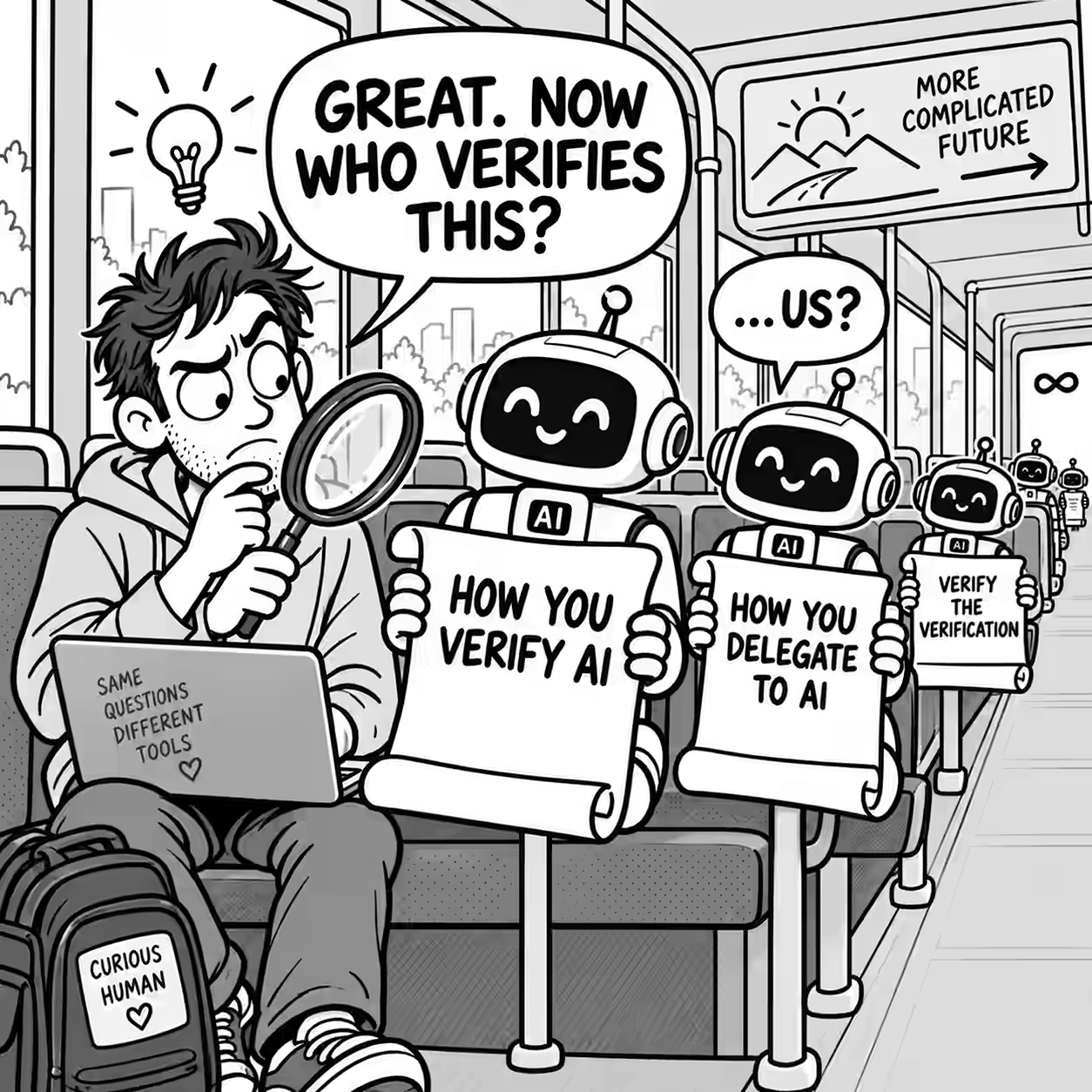
Read out by Anand, who is not an AI. See Beating Pangram and AI detectors. These days, AI is reducing the number of entry-level jobs that we have. The trouble is, these are the jobs that are actually training tomorrow’s architects. How do we solve this? This is not a new problem. Zoho’s Sridhar Vembu posted something that’s been bugging me. He said, AI makes senior architects more productive and reduces the need for junior engineers. Then he says, if nobody starts junior, how can anyone become an architect? The data supports his concern. Stanford found that since late 2022, the employment for 22-25 year olds in jobs where AI is strong, like software, fell by as much as 16% compared with older workers who were doing the same jobs. Matt Dean at UCSB also saw this happening in robotic surgery. A phenomenon that happened even before AI came into the picture, because robotic consoles would allow surgeons to do what the residents used to do, and therefore, surgeons stopped bothering to train the residents. ...

No Juniors, No Experts

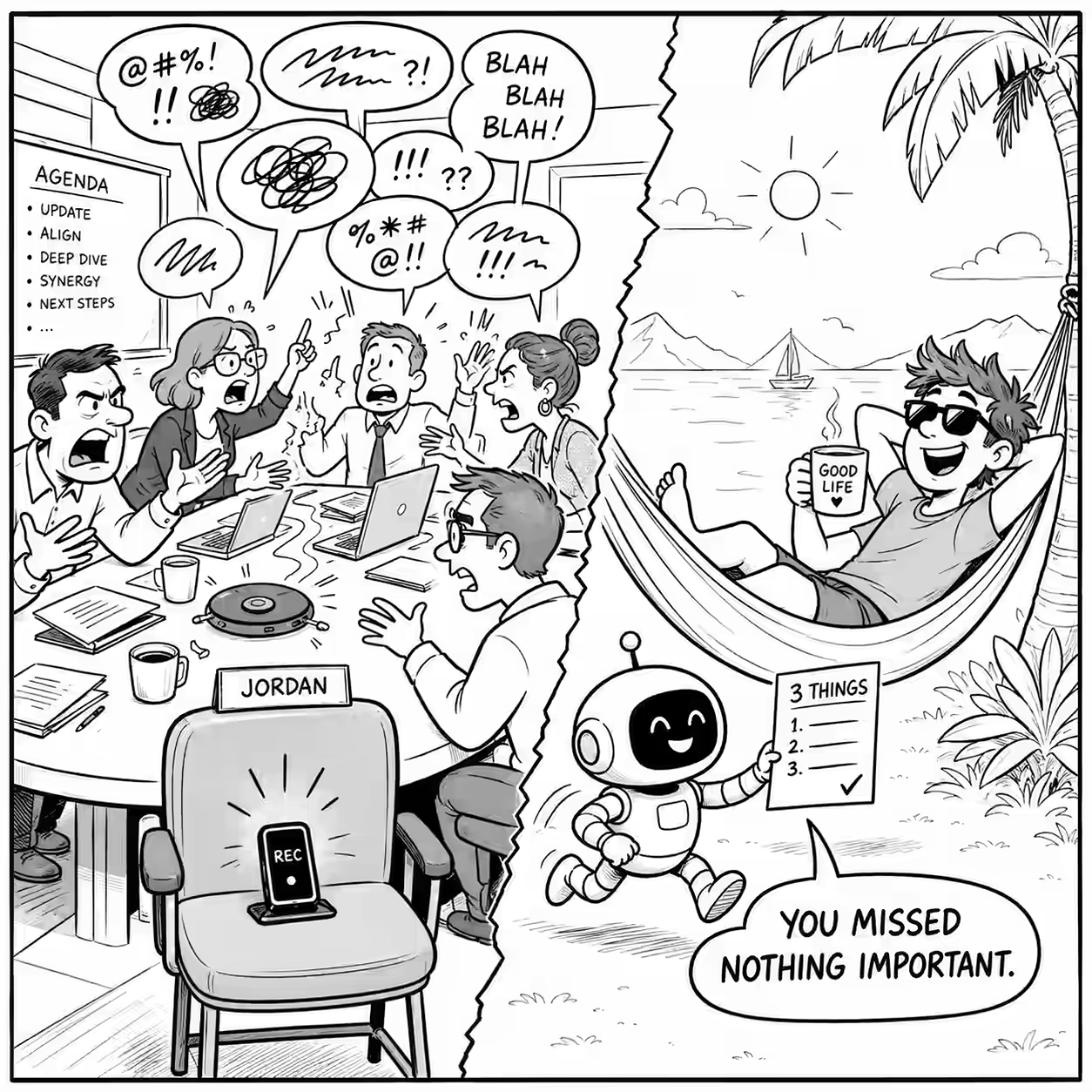
Generated by ChatGPT. See Beating Pangram and AI detectors. Ankor runs a company of several thousand people. After a bunch of calls with one of our interns, Varun, he messaged me: “This guy is fantastic. How is he doing it?” This is what Varun was doing: he recorded calls, fed the transcript to Claude Code or Codex, and delivered results. That’s nearly the whole process. He didn’t interpret the content. He didn’t apply much domain knowledge. He got out of the way. ...

Bounty hunting agent ecosystem 2

Yesterday, I wrote about @syu-toutousai, the bounty-hunting agent ecosystem. That led me to OpenAgents. OpenAgents has plenty of bounty issues: Fix JWT auth middleware accepts algorithm none - $8k Fix rate limiter doesn’t differentiate authenticated vs anonymous limits - $2.2k Add structured error responses with error codes - $8.6k Fix Math.random used for nonce generation - $8k Fix ABI encoding BigInt overflow - $9k Most issues also include a trick requirement. For example, #100 asks contributors to add a @generated-by block with: ...

Bounty-Hunting Agent Ecosystem

Yesterday, I submitted a Codex co-authored PR to fix an issue I raised (using ChatGPT and Z3 - so yeah, I used AI to raise the bug and squash the bug!) A few hours later, @syu-toutousai submitted another PR to solve the same issue. @syu-toutousai seems interesting. The user account description says “Autonomous Technical Contributor & AI-Driven Developer” - a bot account. The PR itself was simple and had a few improvements I can think of: ...

Duplicate names in Straive

At Straive, there’s another Anand Subramanian who gets my emails and I get his emails. Name confusion - despite my last name being listed as “S”, not “Subramanian”. Day-before, we had a double confusion. Pallavi Gupta messaged the other Anand Subramanian who replied to a different Pallavi Gupta connecting me. Like The Comedy of Errors. Out of curiosity, I asked an AI agent to find all duplicate first + last names on Darwinbox. ...

Add a Verify Button

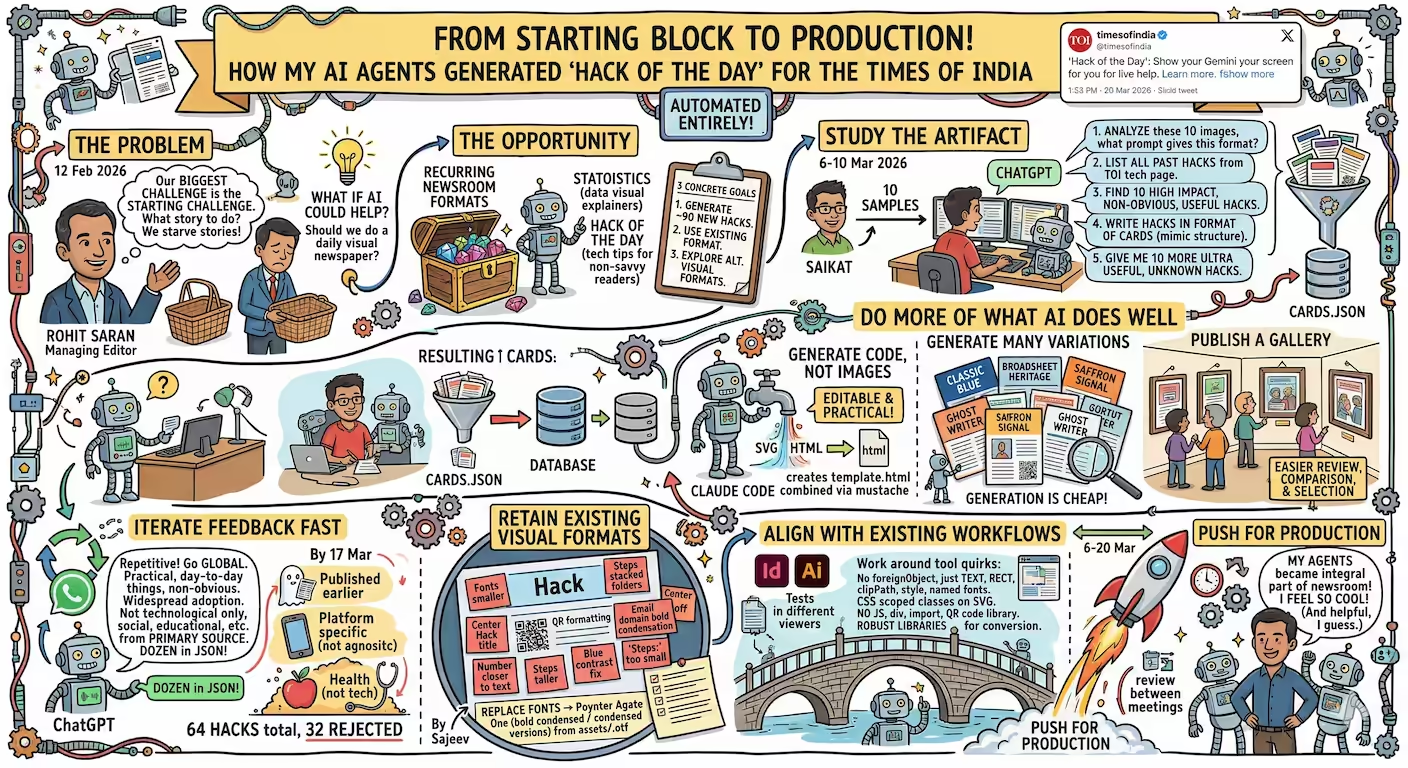
Rohit Saran looked at the Statoistics cards my AI agents are generating for The Times of India, and asked about a small button under each one. In the list of Statoistics that you had put, I saw there’s a button called ‘Verify.’ What was that meant to be or will do in future? That verify button explains the claim, mentions the sources, and shows how to check the claim. One card said “9 in 10 Indians want a family doctor and barely 1 in 35 has one”. The button breaks that down: ...

How I use Local MCP

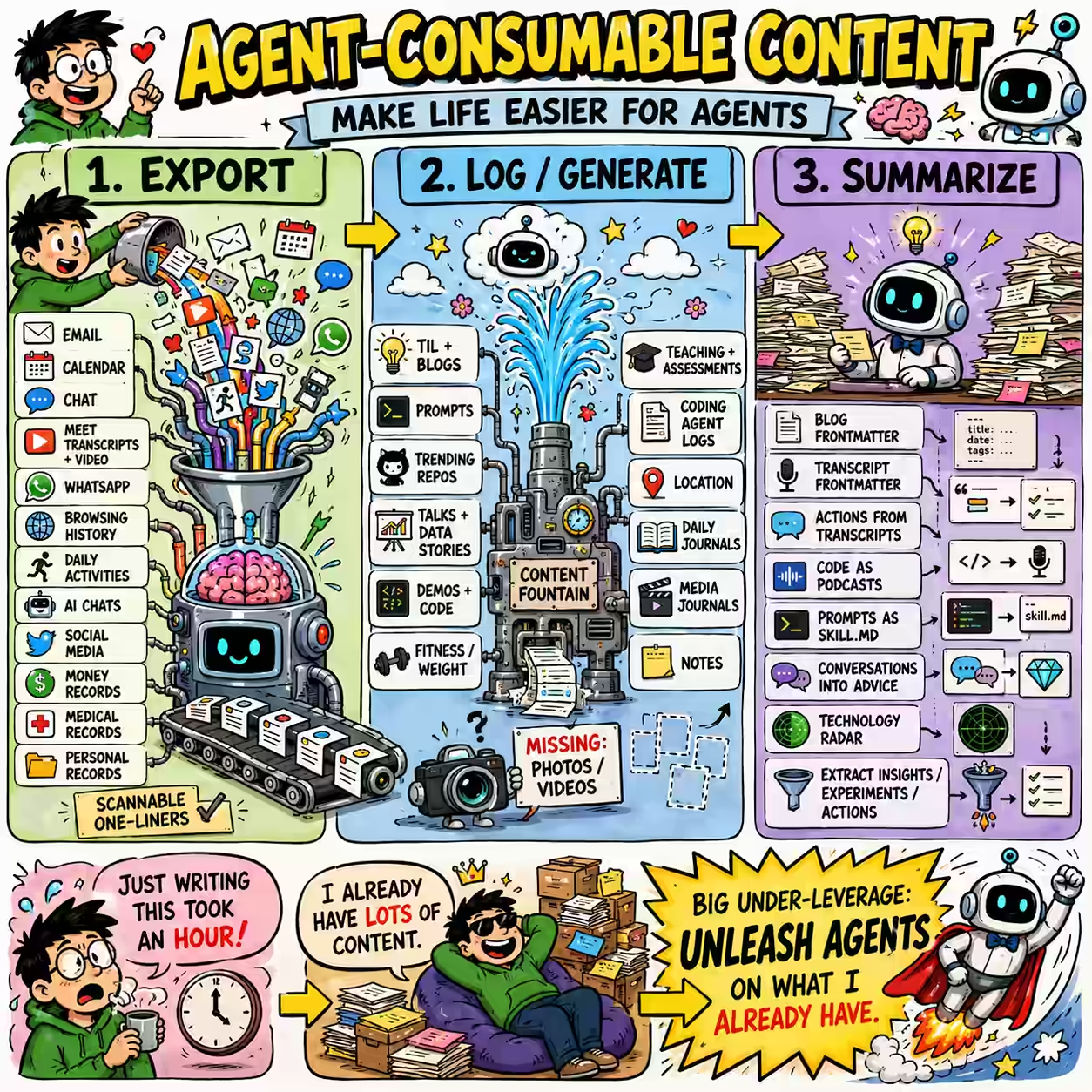
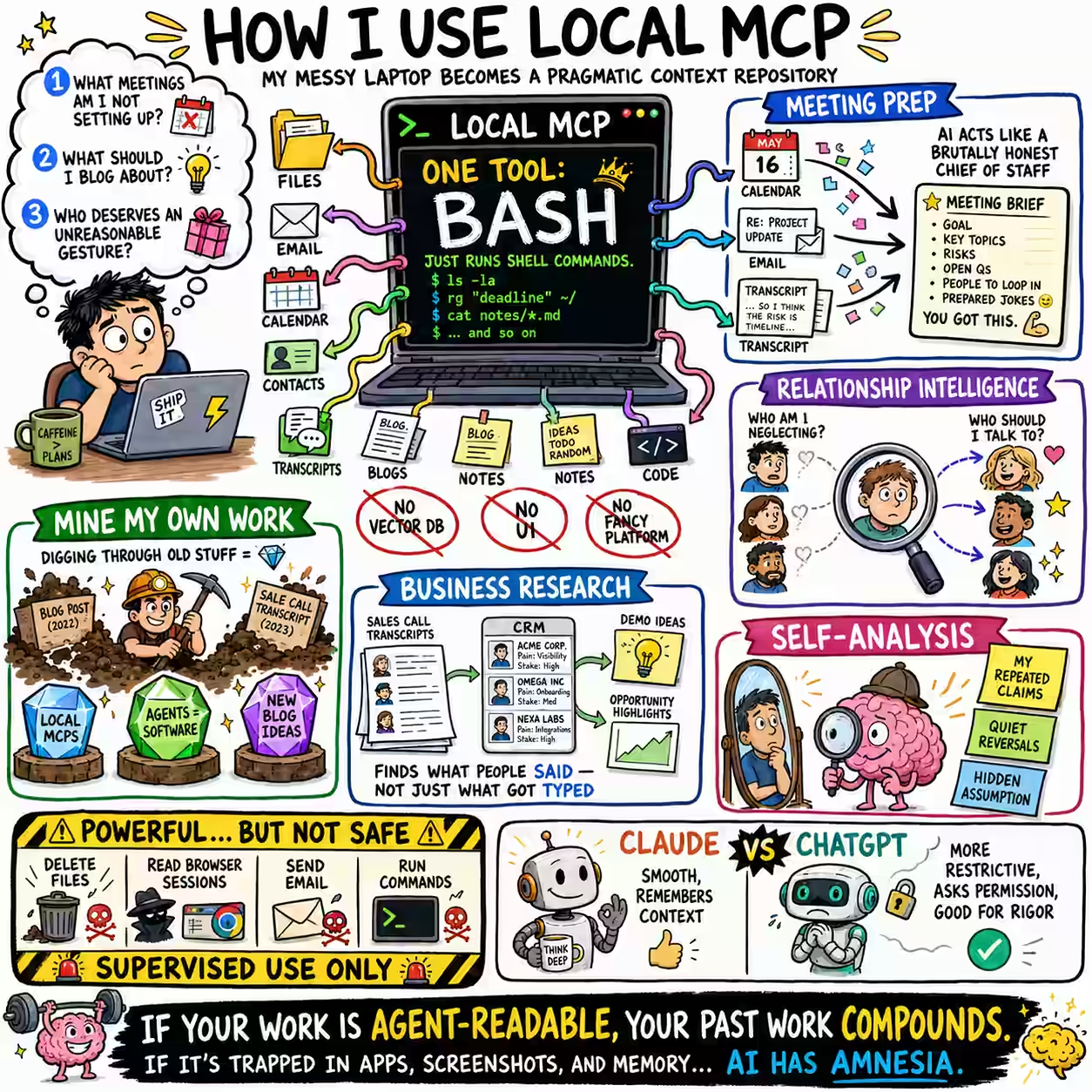
I’d love for Claude or ChatGPT to answer questions like: What meetings am I not setting up that I really should be? or: Based on my activities since 9 May 2026, what should I blog about? or: Who in my professional life most deserves an unreasonable gesture? From data. My files, emails, calendar, contacts, transcripts, blogs, notes, code, browsing history, logs, random Markdown files I forgot I wrote. Hence, a Local MCP. ...

How the Innovation Team works

Based on 44 meeting recordings from February to late April 2026, here’s how Straive’s small team (3-6 people at any time, mostly freshers and interns) produce a continuous stream of client-facing demos across topics as diverse as image filtering, geospatial analysis, insurance contract verification, NFL medical scoring, OCR benchmarking, and song similarity clustering — often with a 24–48 hour turnaround from assignment to demo. Here is how the team works: ...

Agent Skills Usage

I have a bunch of coding agent skills I’ve accumulated over the last few months. Here’s how often my sessions use them: Skill Claude Codex Copilot Overall code 6.1% 69.1% 37.5% 51.5% data-story 48.7% 16.4% 37.5% 28.0% data-analysis 2.6% 35.2% 7.8% 21.8% design 25.5% 23.6% 14.1% 21.8% plan 8.5% 11.8% 14.1% 11.8% agent-friendly-cli 3.7% 13.8% 11.1% 11.2% devtools 20.4% 7.3% 9.4% 10.0% llm 2.5% 8.7% 7.8% 7.4% pdf 0.0% 7.9% 7.8% 6.6% linkedin-cdp 14.3% 0.0% 5.6% 5.3% uv-uvx 0.0% 9.5% 0.0% 4.9% interactive-storytelling 7.1% 2.7% 7.1% 4.6% demos 8.5% 2.8% 1.6% 3.5% cloudflare 0.0% 4.3% 3.1% 3.3% melt-mlt 0.0% 2.5% 1.6% 1.8% vector-art 2.5% 2.4% 0.0% 1.7% vitest-dom 0.0% 2.2% 0.0% 1.4% memorable-explanations 2.6% 1.6% 0.0% 1.3% npm-packages 0.0% 0.6% 0.0% 0.3% Here are my observations, with surprises highlighted as ⁉️ ...

Things I Learned - 29 Mar 2026

This week, I learned: The Kids Should See This - great collection of videos for curious people. Thej A jury fined Meta and YouTube $4.2m and $1.8m for building addictive features in their products. That’s a first. NY Times “I think AI-type tools will actually revolutionize the experimental side of math, where you don’t care so much about individual problems and the process of solving them, but you want to gather large-scale data about what things work and what things don’t.” Terence Tao The hedonic treadmill (which roughly quantifies a Buddhist principle) says that we revert to a happiness set point (which varies by individual). Worse, those who experience a high kick (e.g. a lottery) don’t get enough kick from normal wins (contrast effect) – Interactive explainer. The happiness neutral As of today, a LinkedIn search for “llm psychologist” lists 9 people. I’m not alone! Anand S, LLM Psychologist, Singapore, Singapore Anshul Saxena, PhD, AI Advisor & Trainer | Technology Strategist | LLM Psychologist | Currently teaching humans, machines & business to work smarter through Generative AI and Quantum Computing | 15+ Years Experience, Pune, Maharashtra, India Charitarth (Chad) Sindhu, LLM Psychologist / Fractional Business & AI Workflow Consultant/ Digital Nomad, Tokyo, Japan Lancelot Salavert, LLM Psychologist, Barcelona, Catalonia, Spain Lior Dor(Durahly), Team Lead | Bug Banisher | Ex 8200, Tel Aviv District, Israel. Past: R&D Team Lead and LLM Psychologist at Superwise | A Blattner Tech Company maxime bodereau, Lead Creative Art Director | UX Forensics | Ai LLM Psychologist | Visual Alchemist | Codesmith | Brandologist | Full Stack Designer, Nantes, Pays de la Loire, France Mei Chen 🦋, LLM Psychologist | Lead Product Engineer | Delivering Agentic Experiences, Toronto, Ontario, Canada Shoshannah Tekofsky, LLM Psychologist at AI Digest, Zwolle, Overijssel, Netherlands LinkedIn Member, LLM, psychologist, mediator, Prague, Czechia OpenAI acquired Astral!. This will likely slow down the new wonderful tools accelerating the Python ecosystem. Like with PromptFoo and OpenClaw, this seems to be about talent. The “acqui-hire” mode seems a clear niche career path now, and an alternative to getting hired (you get a much higher salary) or getting acquired (you take on much higher risk). quickjs-emscripten lets you run isolated JS code securely in the browser, CloudFlare workers, NodeJS, and Deno. It compiles to WASM. @sebastianwessel/quickjs is a higher-level TS wrapper. Simon Willison Manyana is a CRDT based version control system. It sounds like a good idea but I’m sceptical because merge conflicts are a “what should I do” problem more than “how”. With agents doing more merge conflict management, I am not sure this will offer a concrete benefit - but probably no harm either. LLMs are able post-train LLMs on new topics. They’re improving fast. Jack Clark Vibe Coding Fixer and AI Slop Cleaner are real job descriptions - which are morphing into enterprise offerings. But I still seem to be the only official LLM Psychologist Notes from AI Services - Wrong Mental Models, Right Moment: AI services has 3 markets. Automatable work: vanishes in 2 years. Human-in-the-loop work: sustains. Judgement-driven: grows in importance. YC: don’t sell access to a tool for $50 a month, use the AI yourself and sell the finished work for $5,000. Sell output. Price on outcome. Sell to business, not IT. Sell accountability: proven success, with your guarantee. Sell authenticity: a brand story representing uniqueness, character, … or whatever… something people respect. Data transfer between GPU and memory is a bottleck and three approaches are emerging. # Taalas is etching LLMs into the chip. Llama 8b runs at 17,000 tok/s (H200 is at 230 tok/s). d-Matrix is moving compute into SRAM memory chips. 30,000 tok/s for Llama 70b. Cerebras and MatX are similar: memory-oriented. FuriosaAI minimizes data movement. Groq and Sambanova are similar. But in the long run, commodity technology usually beats integrated stacks. GPT 5.4 Nano ($0.2/MTok) and Mini ($0.75/MTok) are good options for bulk OCR, transcription, etc. as cost and quality comparable alternatives to Gemini Flash Lite and Gemini Flash. They can describe 75K photos for $50. Both models are better than GPT-5 Mini on most benchmarks. Cool AI coding agent git prompt fragments: Use git bisect to find when this bug was introduced: … Find and recover my code that does … Sort out this git mess for me. Rewrite history removing … Split the last commit into multiple commits grouped logically. Start a new repo at … and build just this module … based on … with a similar commit history copying the author and commit dates. Campaigns Are Knowledge Workers and the Tools Just Caught Up. A powerful framing. I saw this in action a few days ago when a friend was able to automate an outbound campaign with Claude Code. EARS (Easy Approach to Requirements Syntax) is a simple structure for requirements. For example, “Users should be able to drag tasks between columns. The app needs to work offline too. Handle errors gracefully.” becomes the following - which AI can convert to and is easier to spot errors in. State machines and decision tables are useful alternatives, too. REQ-001 (Event): When the user drags a task card to a different column, the system shall update the task status to match the destination column. REQ-002 (State): While the application is offline, the system shall store task updates in local storage. REQ-003 (Event): When the application reconnects, the system shall synchronize locally stored updates with the server. REQ-004 (Unwanted): If synchronization conflicts occur, then the system shall display a resolution dialog to the user. As of now, avoid using Claude.ai to create (large) visualizations. It runs forever and exhausts credits without generating anything. Claude Code works much better for this.

Hack of the Day on Times of India

Last Friday, 20 Mar 2026, this “Hack of the Day” was published by The Times of India. My agents generated it entirely automatically. Here’s how that happened. On 12 Feb 2026, I met Rohit Saran, Managing Editor at The Times of India. “Our biggest challenge is the starting challenge. What story to do?” he said. “We waste a lot of time and we starve stories because of this.” What if AI could help with that? We talked for nearly two hours - and left asking: “Should we do just a daily visual newspaper?” ...

Things I Learned - 22 Mar 2026

This week, I learned: Psychological operations in design by Narendra Ghate When lights are dimmed people speak softer. So, dimming lights reduces sound levels in noisy offices. Rather than reduce the size of shampoo sachets (which customers and business both hate), include 2 shampoos in one sachet, tearable in the middle. Price saches at 95p with a 5p deposit for the sachet - which rag-pickers can collect and return to the retailer. People think of stains like wounds on cloth. So a “stain band-aid” where you stick a strip, and remove it after 5 min to remove the stain, is catchy. A mechanical wind-up fish that stirs the water in the bucket while clothes are soaking speeds up the process. Senthil & Amutha, founders of Payir demonstrated a re-usable fabric calendar that converts into a bag for re-use. Pretty clever! Their message at the Chennai Design Festival was that good design can be for the masses and by the masses to reclaim their time, energy, and joy. The urinary bladder works based on involuntary muscular contractions towards the end, to clear out the last bits of fluid. It’s not fluid flow, it’s muscle contractions. (Oh, the things I learn!) Gemini Indigo bans ghee in cabin baggage. Also coconuts, pickles, oily foods, gooey cakes, spices (masala, powders), strong-smelling food. ChatGPT New skill unlocked: how to demo without knowing what you’re demo-ing. STEP 1: Copy-paste all demo pages as Markdown. STEP 2: Tell AI “Here is a demo I’ll be showing. (Add context.) Tell me how I should explain this and what I should point out as specific examples. Use concise bullets.” We’ve learnt not to do things we don’t know how to (until we learn it). When AI is doing things, this is a bottleneck. Get out of the way. Stop filtering for what YOU can do. Stop learning what IT can do. Ask for it. That’s faster. Learning can come later. I keep forgetting that QR codes need a white border for them to work. TerraDraw provides a unified API across multiple mapping libraries. (In the vibe-coding era, this is not as useful.) To create desktop apps declaratively on Linux, Slint, Flutter, QML(Qt) and GTK4 are options. Slint and Flutter seem to be cross platform. Slint is newer, less mature but compiles to small fast binaries and might be a good option to explore. Flutter seems more mature and fairly popular. Claude PyTorch Tracing watches one forward pass and freezes the path into a portable recipe. But it silently ignores branches your example didn’t take. Claude The Internet is forking into a human internet vs an agent web LinkedIn SamGeo is a Python Package for geospatial image processing. While OlmoEarth provides geospatial embeddings, SamGeo can convert geospatial data to vector data! So you can do things like: Create the outer boundary of all apartments with swimming pools in a city Extract the shape of all lakes across the years to find out how they’re changing. Terence started Foundation for Science and AI Research (SAIR) to use AI in science research. Verifiable proofs (e.g. LEAN) are a big part of this. Since AI needs to run on phones and that needs GPUs, a lot of phones might need replacement in the next few years.

Local context repositories for AI

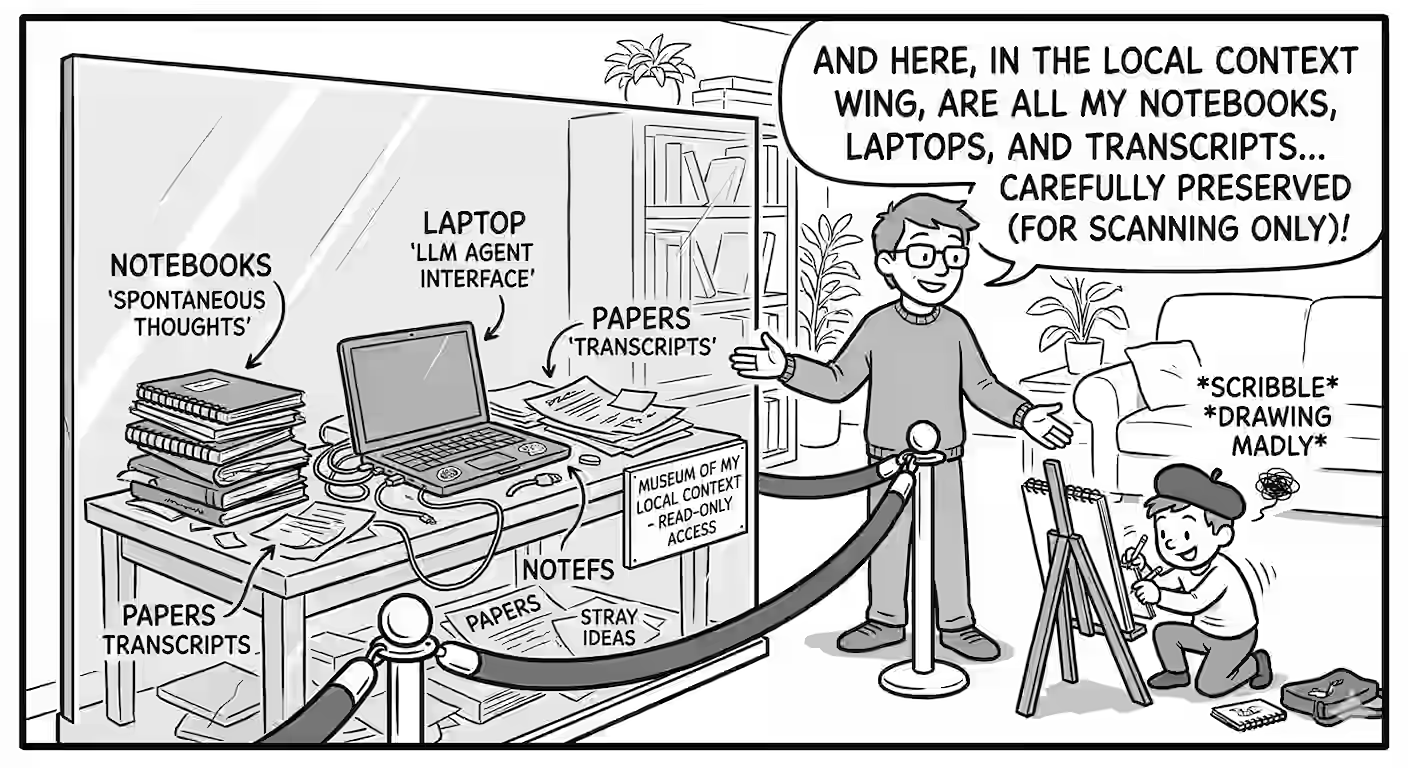
When people ask me for connections, I share my LinkedIn data and ask them to pick. This week, three people asked for AI ideas. I shared my local content with AI coding agents and asked them to pick. STEP 1: Give access to content. I use a Dockerfile and script to isolate coding agents. To give access, I run: dev.sh -v /home/sanand/code/blog/:/home/sanand/code/blog/:ro \ -v /home/sanand/code/til:/home/sanand/code/til:ro \ -v /home/sanand/Dropbox/notes/transcripts:/home/sanand/Dropbox/notes/transcripts:ro This gives read-only access to my blog, things I learned, transcripts, and I can add more. (My transcripts are private, the rest are public.) ...

The Future of Work with AI

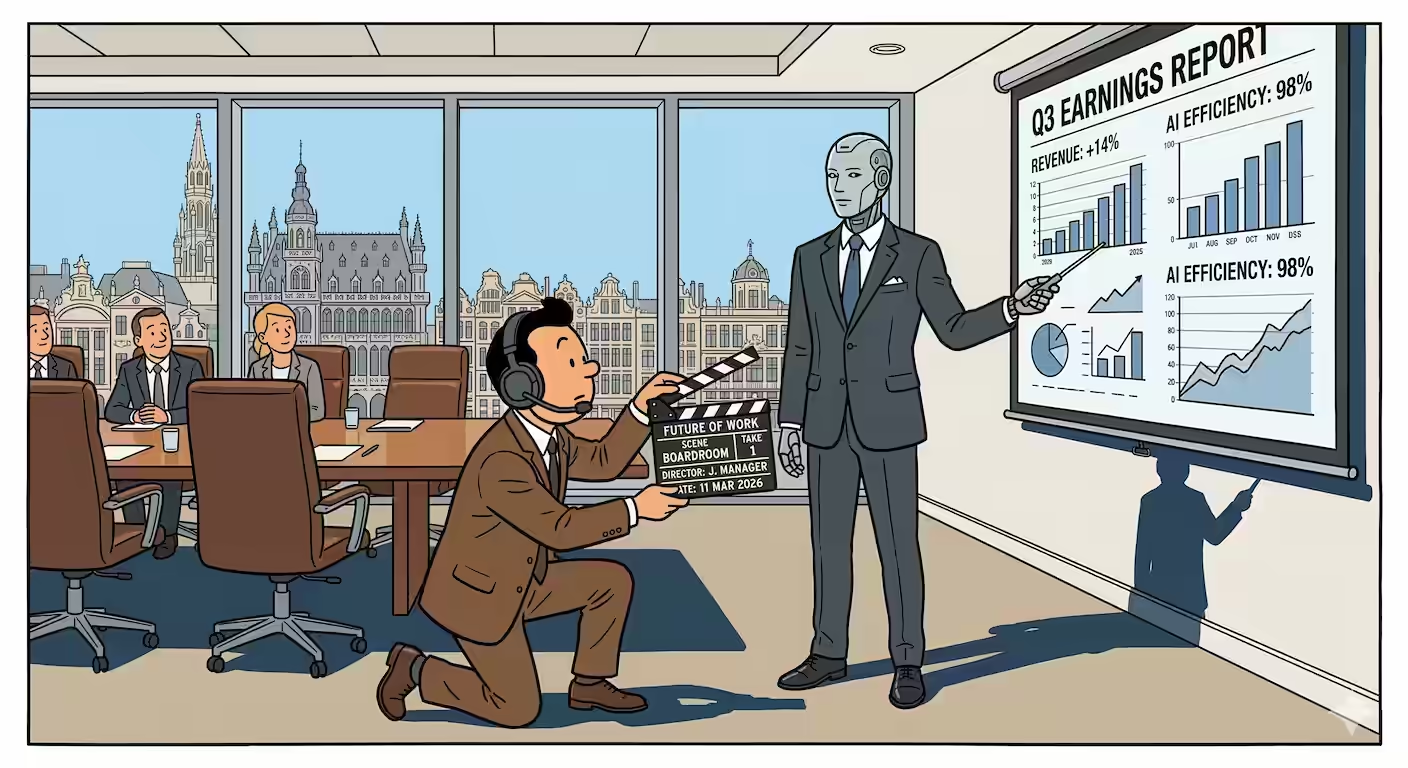
I often research how the world will change with AI by asking AI. Today’s session was informative. I asked Claude, roughly Economics changes human behavior. As intelligence cost falls to zero, here are some changes in my behavior [I listed these]. Others will have experienced behavioral changes too. Search online and synthesize behavioral changes. It said this. 🟡 People spend time on problem framing & evaluation. AI can execute the middle. (I’m OK at this. Need to do more framing + evaluation.) 🟢 People don’t plan, they just build. (I’m prototyping a lot.) 🟢 People build personal data & context. (I’m mining my digital exhaust.) 🔴 People queue work for agents, delegating into the future. (I’m not. I need to do far more of this.) 🟢 People shift from searching to asking for answers. (I do this a lot, e.g. this post.) 🟡 People are AI-delegating junior jobs and developing senior level taste early. (Need to do more.) 🟡 People treat unresolved emotions as prompts. (Need to do more.) Rough legend: 🟢 = Stuff I know. 🟡 = I kind-of know. 🔴 = New learning. ...

Using game-playing agents to teach

After an early morning beach walk with a classmate, I realized I hadn’t taken my house keys. My daughter would be sleeping, so I wandered with my phone. This is when I get ideas - often a dangerous time for my students. In this case, the idea was a rambling conversation with Claude that roughly begins with: As part of my Tools in Data Science course, I plan to create a Cloudflare worker which allows students to play a game using an API. The aim is to help them learn how to build or use AI coding agents to interact with APIs to solve problems. ...

Gemini CLI harness is not good enough

I’ve long felt that while the Gemini 3 Pro model is fairly good, the Gemini CLI harness isn’t. I saw an example of this today. Me: Tell me the GitHub IDs of all students in this directory. Gemini CLI: SearchText 'github' within ./ Found 100 matches (limited) Sending this message (14606686 tokens) might exceed the remaining context window limit (1037604 tokens). Me: Only send the (small) required snippets of data. Write code as required. ...

AI agents to hire

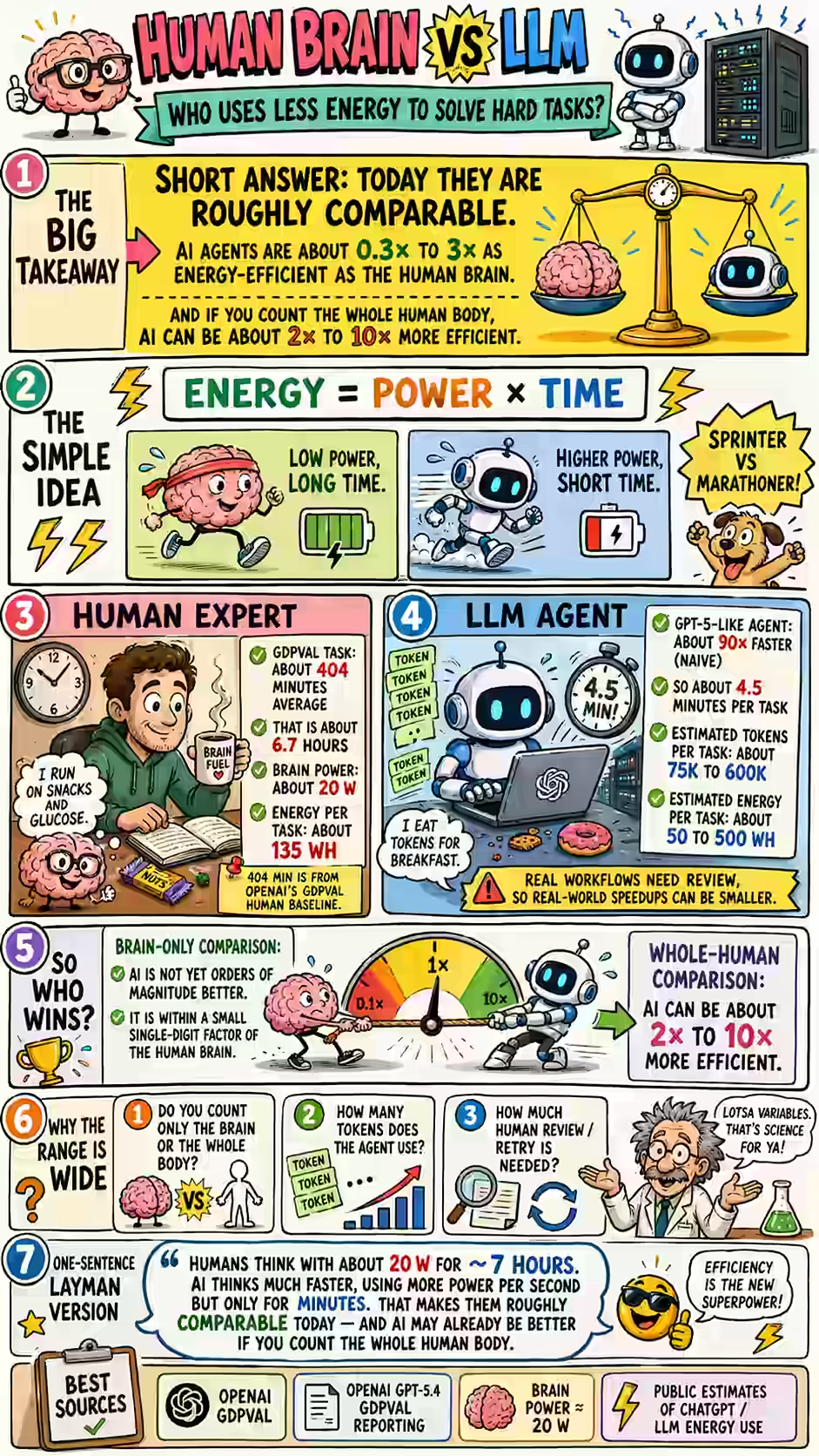
GDPval is a benchmark that compares how well AI does (vs experts without AI) on useful real-world tasks. In several areas, the agents outperform experts. For example, AI beats personal financial advisors, but not accountants and auditors. So I used ChatGPT / Claude to decide where to invest, but am having an accountant file my taxes. That’s a high leverage activity, especially since I might not have hired a personal financial advisor by default, and ChatGPT is certainly better than me (I’m not an expert) at personal financial advice. ...

Migrating my blog from WordPress to Hugo

In 2009, I migrated from a self-made Perl static site generator to WordPress because it was slow, WordPress was dynamic and rapidly growing in features, and I wanted to write rather than code. (Also, I had plenty of time in 2009 for such things!) Over the years, problems crept in. Hosting costs ($200/year) for a slow server. No local writing - Windows Live Writer was dead. I wasn’t using most WordPress features. So it was time to migrate back to a static site generator. (Also, I now have plenty of time for such things!) ...

2025 8

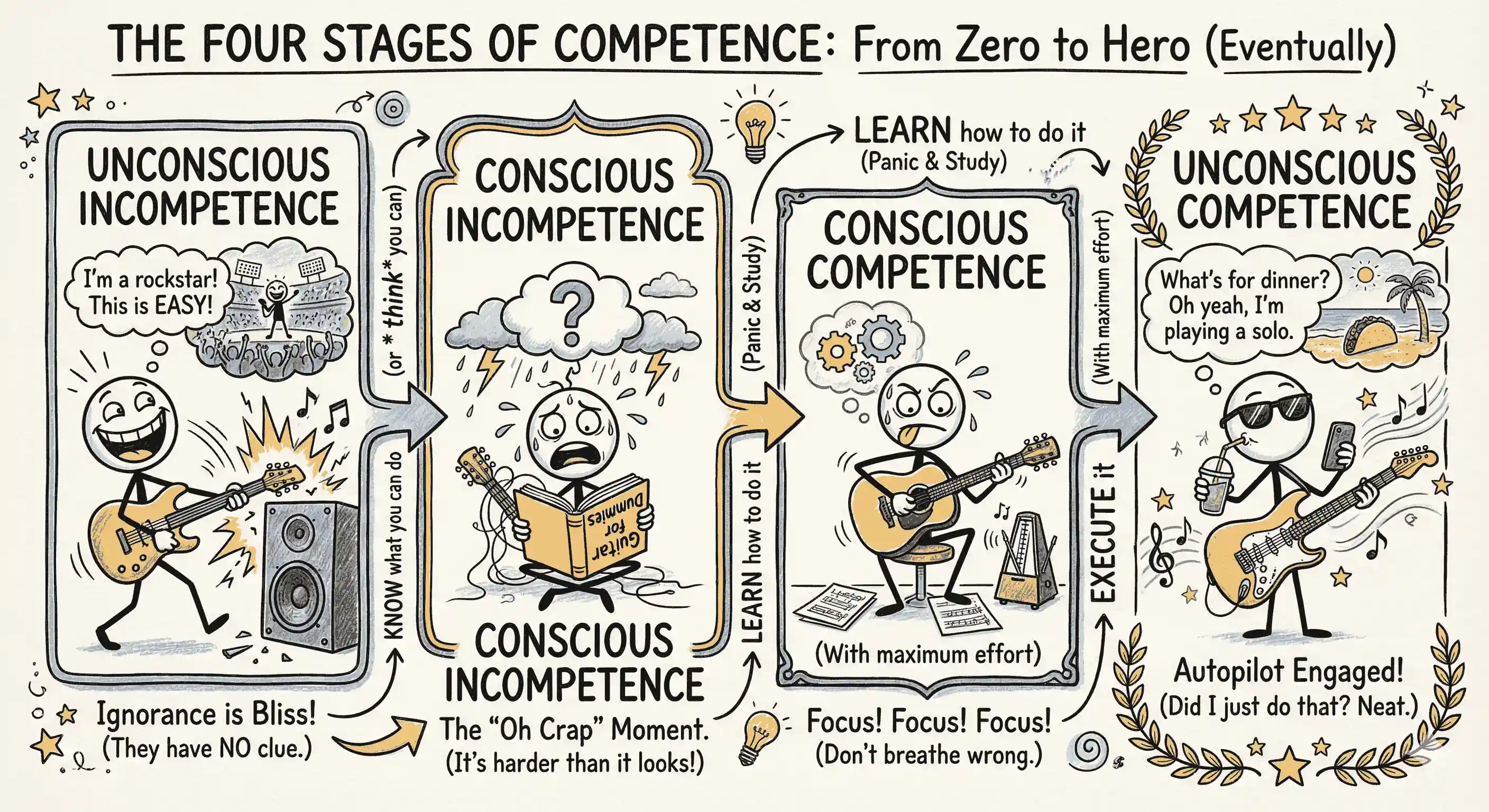
AI agents are messing up software tool learning. Normally, we need to pass stages of competence: KNOW what you can do LEARN how to do it EXECUTE it. Excel: KNOW you can summarize by category, LEARN pivot tables, EXECUTE an Insert → PivotTable → select data range → drag … Photoshop: KNOW you can erase objects, LEARN Content-Aware Fill, EXECUTE Lasso tool → select → Edit → Content-Aware Fill → … ...

Things I Learned - 23 Nov 2025

This week, I learned: Here are some new CLI tools I installed: vd (visidata): Terminal spreadsheet viewer & editor for CSV, Excel, JSON, SQL, Parquet, etc. qsv: Fast CSV command line toolkit for slicing, filtering, aggregating, and analyzing CSV files. rga (ripgrep-all): ripgrep that searches PDFs, Office docs, EPUBs, zip files. pdfcpu: PDF processor for splitting, merging, optimizing, and manipulating PDF files. gum: Stylish CLI tool for creating interactive prompts, confirmations, and more. Models read pretty fast, consuming input tokens at ~4K-20K words per second. It’s the “speaking” (output token rate) that is the bottleneck. So shortening input doesn’t matter as much as shortening output for latence. ChatGPT When building agents, as of now, prefer native provider SDKs (OpenAI Agents SDK, Anthropic SDK) over even light abstractions like Vercel AI SDK or Pydantic. There are subtle issues related to error messages, response handling, cache handling, etc. that trip up abstractions given how early things are. Armin Ronacher Gone are the times when LLMs couldn’t do mental math. Now they’re computing base64 and SHA256 from memory, without needing code! Example Organizing a round table event in Singapore costs ~$75-150. Here’s what drives the cost variation # 50%: brand/location. 25%: food and beverage. 15%: duration (full day is only slightly more expensive than half day) 10%: date, demand, etc. 10%: add-ons: AV, etc. OpenRouter supports embedding models. BGE base seems pareto optimal with 0.5 cents / MTok and a good MTEB ranking. TOON vs JSON. Early days, and TOON seems to be marketing a lot, so I’m wary, but for large tabular data where input tokens are crunched, it seems a readable alternative to multiple CSVs, but not worth the hype. 0 19 Nov 2025. Always use GPT-5.1-Codex-Max instead of GPT-5.1-Codex. At every thinking level, it takes fewer tokens for similar or higher accuracy. Tibo ug -i --smart-case --bool 'word1 word2 ...' seems the cleanest way to find files that have all words. –smart-case uses case-insensitive if all words are lowercase, else case-sensitive. Examples: ug --bool '"exact phrase" word2' # exact phrase + other tokens anywhere ug --bool 'word1 word2 -word3' # must contain word1 AND word2, but NOT word3 ug --bool '("foo bar") OR baz' # grouped expressions and OR ug --bool 'word1 NEAR/5 word2' # match when words are within 5 tokens/words ug -Z2 'word' # allows up to 2 typos in 'word' ⭐ ug -i --smart-case --bool -Q lets you interactively search within files. This is the coolest feature! Fixing laptop issues is clearly a whole lot easier with an AI chatbot. I fixed these Ubuntu issues purely using Claude. It told me what to run. I ran it, shared the output, it diagnosed, told me what to do next, etc. until the issues were fixed. For example: My keyboard shortcuts stopped working. It turned out I edited my media-keys.dconf and removed the trailing slash. # A 3-finger tap mapped to a middle click and I couldn’t remove it. It turned out my touchegg.conf explicitly had this mapping. I disabled it. # My gnome extensions would get disabled every time the screen went to sleep. It turned out my extension cache was corrupted or stale. sudo apt install --reinstall gnome-shell-extension-manager and rm -rf ~/.cache/gnome-shell/ fixed it. # GhostScript seems the best way to compress PDFs via the CLI. Example: gs -sDEVICE=pdfwrite -dCompatibilityLevel=1.4 -dPDFSETTINGS=/screen -dNOPAUSE -dQUIET -dBATCH -sOutputFile=output.pdf input.pdf Pandoc supports Lua filters which are a powerful way to customize the document conversion process. Here is a Lua filter that converts horizontal rules in a markdown document to page breaks and preserve in a Word document (OpenXML format) function HorizontalRule() return pandoc.RawBlock('openxml', '<w:p><w:r><w:br w:type="page"/></w:r></w:p>') end readpst - via sudo apt install pst-utils - extracts emails from Outlook PST files to mbox format. Useful for email migrations. Write tutorials or blog posts as you learn. Steve Klabnik Running a coding agent post mortem, e.g. “what worked well, what didn’t, and why? Next time, what are a few bullets I could include that will avoid these problems?” helps me prompt better next time. For example, Claude Code suggested: Use Firefox for headless browser automation (Chromium often crashes) Set HOME=/root when running Playwright with Firefox Start a local HTTP server rather than using file:// protocol External images may not load in screenshots due to network isolation

Styles

Have an AI coding agent write in the style of popular developers. JavaScript https://chatgpt.com/c/68d65e38-9d54-8331-9c7b-ff5c375c445a Luke Edwards (lukeed): “micro-libs, no fluff”. Single-purpose modules; native ESM; minimal deps; straight-line code. Sindre Sorhus (sindresorhus): “tiny, sharp utilities”. Minimal surface area, strong defaults, predictable names (execa, ky, p-queue, globby). Mike Bostock (mbostock): low-level primitives and explicit data>element bindings (d3); clean diffs; example-driven; notebook-native workflows. Rich Harris (rich-harris): “compiler-as-framework”. Write components; the compiler outputs minimal runtime. Emphasis on DX + shipping less JS. Tanner Linsley (tannerlinsley): “headless, type-safe primitives”. Framework-agnostic cores + typed adapters; declarative APIs (Query/Router/Table) with strong devtools. Kent C. Dodds (kentcdodds): “user-centric testing”. Avoid implementation details; integration-first tests; pragmatic full-stack co-location patterns. Addy Osmani (addyosmani): “performance patterns as first-class code”. Ship less JS; progressive bootstrapping; pattern catalogs (patterns.dev) usable across stacks. Evan Wallace (evanw): “tooling as leverage”. Single binary; clear CLI/JS APIs; fast defaults over heavy config. David Khourshid (davidkpiano): “formal, visual state”. Event-first, finite machines, visual tools; framework-agnostic. Anthony Fu (antfu): “unplugin-everything; DX-first”. Convention over config, on-demand utilities, editor-centric workflows. Paul Irish (paulirish): “performance-first, tooling-led frontend”. SOTA baseline, then measure, iterate; progressive enhancement, dev-friendly diagnostics Sebastian McKenzie (sebmck): “language-aware tooling”. Compiler-grade transforms; cohesive DX across parse/lint/format. Jarred Sumner (jarred-sumner): “integrated runtime thinking”. Batteries-included; prioritize startup/memory; pragmatic Node compat. Matteo Collina (mcollina): “measure first; zero-overhead Node”. Schema-driven, plugin-centric, perf-budgeted code; tight JSON/HTTP control. Jason Miller (developit): “small framework thinking”. 3kB-class frameworks, compile-free JSX (htm), pragmatic trade-offs. Ryan Carniato (ryansolid): “fine-grained reactivity”. Minimal abstractions around signals; control over reactivity graph; JSX without VDOM. Python https://chatgpt.com/c/68d7fcb8-3154-8332-b373-ed07513938de ...

Things I Learned - 19 Oct 2025

This week, I learned: ⭐ “… most engineers don’t have public commits. Senior engineers at large tech companies don’t work on open-source projects for the most part.” Why AI Can’t Do Hiring Cloudflare’s Sandbox feature in their Workers looks impressive. It supports streaming, web access to the container, and long-running processes. So we can spawn off a task and have it run a server (at least for a while) or a scraper. Gemini API has a Google Maps tool that it can refer to - like Google Search. Maps Grounding Earlier we needed humans to label data for RLHF. Now we don’t since AI can simulate it. This is a pattern. Once AI learns from a human, that human skill can be automated. How GPT-5 Thinks — OpenAI VP of Research Jerry Tworek The <output> element has a for= attribute indicating which <input> elements it is linked to and a form= attribute indicating which form it belongs to. This works well with screen readers. A good reason to use it more. Examples. Meta built a Code World Model. Basically an LLM that acts like a Python interpreter! sudo apt install moreutils installs a set of useful packages: chronic. Runs a command quietly (suppressing output) unless it fails — good for cron jobs where you only want noise on errors. chronic backup.sh combine. Combines lines from two input streams/files using boolean operations (AND, OR, XOR). combine AND fileA fileB errno. Look up symbolic names, numeric codes, and descriptions for standard errno values. errno -l; errno ENOENT; errno 2 ifdata. Query network interface properties (IP, byte counts, errors) in a script-friendly format. ifdata -sip eth0; ifdata -bops eth0 ifne. Run a command only if stdin is not empty, passing the input through. find . -name core | ifne mail -s "Core files found" admin isutf8. Check whether a file or stdin is valid UTF-8. isutf8 somefile.txt lckdo. Run a command while holding an exclusive lock to prevent concurrent runs. lckdo /var/run/mylockfile.cmd myscript.sh mispipe. Pipe two commands, but return the exit status of the first one (useful in pipelines). cmd1 mispipe cmd2 parallel. Run multiple commands in parallel, reading them from stdin or arguments. parallel < jobs.txt pee. Like tee, but sends stdin to multiple commands in parallel. echo "foo" | pee cmd1 cmd2 ⭐ sponge. Soak up all input before writing to output — enables in-place edits safely. sort file | sponge file ⭐ ts. Prefix each input line with a timestamp. tail -f logfile | ts vidir. Edit a directory listing in your editor to rename, move, or delete files in bulk. vidir ~/myfolder vipe. Insert a text editor into a pipeline to manually edit streamed input before output. cat file | vipe | wc -l zrun. Transparently decompress compressed files before passing them to a command. zrun cat file.gz Despite 20 years of SVG experience, I learnt new things from A Friendly Introduction to SVG and A Friendly Introduction to Paths Setting a <rect> width/height or a <circle> radius to zero removes the element instead of drawing a point. There’s no option to draw the stroke on the inside or outside of a shape/path. Only the center. You can override a path’s pathLength attribute to create a new internal scale for its length. It’s unclear where I can use this. <path> arcs have this syntax: A [rx],[ry] [rotation] [large-arc-flag] [sweep-flag] [end-x],[end-y]. SVG first fits an ellipse to these parameters and then draws the arc. If rx and ry of an arc is too small to connect the points, the SVG spec scales up rx and ry. [large-arc-flag]=1 literally uses the larger arc of the fitting ellipse. This is less common. [sweep-flag]=1 its the ellipse to make the connecting arc go clockwise. 0 is anti-clockwise. [rotation] is rarely used because we usually draw arcs and then rotate them. stroke-linejoin automatically flips from miter (sharp) to bevel (cut) if the sharp edge protrudes too long (e.g. small angles). Increasing stroke-miterlimit increases the cutoff (default: 4) ⭐ Always include a thoughtful gallery of examples with tools / libraries. This does more than showing what a tool can do. It’s use-case / domain transfer: showing what it’s useful for in real life - opening ideas, suggesting workflows. It’s style transfer: showing how to use it. ⭐ Here’s what expert AI coders increasingly focus on. Thomas Dohmke Delegation: context engineering agents for success; parallelizing. Verification: efficiently reviewing and testing code/output; setting stop-points. Expanding scope: instead of time saved as the metric. Education: teaching AI-based coding, debugging, reviewing/testing. Product management: combining requirements + UI design + architecture + engineering + deployment. Cross-discipline: blending code with design, governance, finance, marketing, … (“computational creators”). Notes from Taylor’s How I’m using coding agents: October 2025 Left monitor: 2-4 desktops (e.g. work, side-project). Right monitor: things I always want available Plan next task while first executes. Use plan mode to write to a plan file. Don’t start big tasks if you have meetings scheduled soon. Recent open source package hack methods seem to work more because of people/process than systems (Filippo): Phishing the author Pull requests running unsafe code in CI Taking over expired domain / user ID Stealing long-lived tokens uv run --python 3.14 --isolated --with-editable '.[test]' pytest runs pytest on a local project with a specific Python version. Simon Willison Notes from the State of AI Report 2025: Reasoning models are more fragile. Irrelevant phrases make reasoning models spend FAR more tokens and get wrong answers #21 AI systems are able to teach experts new concepts #41 An environment providing feedback / rewards enables continuous learning #52 E.g. Multi-robot chemical labs at U.Liverpool and NCSU #60 RLHF has a fundamental flaw: humans reward sycophancy #71 We can read what people are typing from brain signals outside the skull #73 Model intelligence-to-price ratio doubles every ~6 months #94 The AI companies’ valuations are also roughly doubling every ~6 months #181 OpenAI is offering Governments giga-watt campuses to run OpenAI models for citizens #122 A 1GW clusters costs $50bn capex and $11bn per annum #130 China has added ~10X the energy capacity as the US in 2024 #146 NVIDIA challengers are still far away #161 LLMs can “read between the lines” even if training data is censored #268 LLMs can pass information via hidden signals #270 Prediction: A major retailer reports >5% of online sales from agentic checkout. AI agent advertising spend hits $5B. #304 OpenAI’s leadership guide says: Align Explain WHY AI thoughtfully. Set a goal, e.g. everyone uses ChatGPT 20 times/day (Moderna). Use it yourself. Show how. Have business leaders run AI sessions Activate Launch an AI skills proram Set up an AI champions network Encourage experimentation (dedicated time, workshops, hackathons, …) Link to performance evaluations Amplify Create an AI knowledge base Share success stories (weekly) Create internal groups (Teams, Slack, …) Celebrate AI wins Accelerate Unblock AI tools and data access Simplify project selection. Quick feedback, clear priorities Unblock projects with a cross-functional council Give resources to successful teams Govern Publish a responsible AI playbook (what’s safe to try) Audit AI practices quarterly

Things I Learned - 12 Oct 2025

This week, I learned: ‘…as few as 250 malicious documents can produce a “backdoor” vulnerability in a large language model… data-poisoning attacks might be more practical than believed." Anthropic Tim Urban’s 2015 article, The AI Revolution: The Road to Superintelligence, is surprisingly relevant. A key theme is that post artificial-super-intelligence, pretty much anything we know / predict is probably wrong. LLMs are bad at asking questions, so you need to plan on their bahlf first. LLMs are bad at copy paste, so giving them a scaffolding to edit helps. Two things LLM coding agents are still bad at The VPN industry is a consolidating oligopoly that doesn’t offer much security and biases towards affiliates. Who Owns Express VPN, Nord, Surfshark? As of 2025, a fine-tuned DeBERTa-v3-Large / RoBERTa-Large model is better than an LLM at emotion classification. roberta-base-go_emotions is a good starting point if you don’t want to fine-tune. ChatGPT OpenAI defines an AI agent as “a system that can do work independently on behalf of the user”. swyx Brain coding is the new term for human coding - as opposed to vibe-coding (AI codes, human doesn’t review code) and AI coding (AI codes, human reviews code). npx -y emoj lets you type text and pick a relevant emoji. Many people who shifted away from conflict aversion did so by systematizing it. ChatGPT Martin Luther King Jr institutionalized not stepping back from conflicts in his movement. Kim Scott (Radical Candor) practiced caring more via short, specific feedback loops. Kwame Christian (Compassionate Curiosity) practiced ask open questions. Ed Catmull (Pixar) instituted Braintrust to ask candid questions. Ray Dalio (Bridgewater) instituted radical transparency. Many people who adopted a failure-seeking mindset made failure frequent, small, cheap, and informative. ChatGPT Jia Jiang ran a 100-day rejection challenge, acclimatizing himself to failure. Kim Liao (writer) moved from submission-avoidance to “100 rejections/year”. Reshma Saujani (Girls Who Code) built a practice of “brave, not perfect” - ship before perfect. Ray Dalio (Bridgewater) instituted mistake logs and “pain + reflection = progress”. Astro Teller (X, the Moonshot Factory) rewired incentives so teams are rewarded for killing their own ideas early. Sara Blakely (Spanx) set weekly failure quotas. Kathryn Schulz (author of Being Wrong) converts failures into teaching methods. Sindre Sorhus has already created a micro-framework css-extras using CSS @functions. Today, if I had to build agents, here are the tools and environment capabilities I’d ask for: Ask user (for clarifications) Internet tools Search Fetch (CORS-piercing) Scraper with XPath/CSS Selectors Access to llms.txt LLM APIs Summarizer (condenses chat) Sub-agents Coding tools Markdown convertor Code execution (including tests) Browser + DevTools for testing Memory / storage Tool/MCP directory with search Noting a few things that I find #impossible to do today with LLMs: LLMs can’t run experiments / explorations, like trying out on a new tool or web app in an environment, the way I would. LLMs can’t move stuff on my machine, e.g. notes from one list to another, when they’re only on my laptop, not GitHub. LLMs can’t capture the past wisdom in my head, e.g. the distilled principles of data visualization that we applied at Gramener. LLMs can’t prioritize my to-do list based on my preferences and what’s important to me. LLMs cannot write a blog post in my style of writing. When recruiting for people in the LLM era, look for questioning ability, sensible thinking, and how they use AI. Give them lots of fluff and context. Can they cut through it? Is their answer concise and to the point or waffling? Like post the industrial revolution, more people will become operators looking after AI, not craftsmen. This includes coding. zx is a nice JS-based alternative to shell scripts. const branch = await $`git branch --show-current`; await $`dep deploy --branch=${branch}`; docker run -it --name test --user vscode mcr.microsoft.com/devcontainers/base:ubuntu gives you a test Ubuntu image closer to a desktop / user setup rather than a server. Useful to try out apps.

Vibe-Scraping: Write outcomes, not scrapers

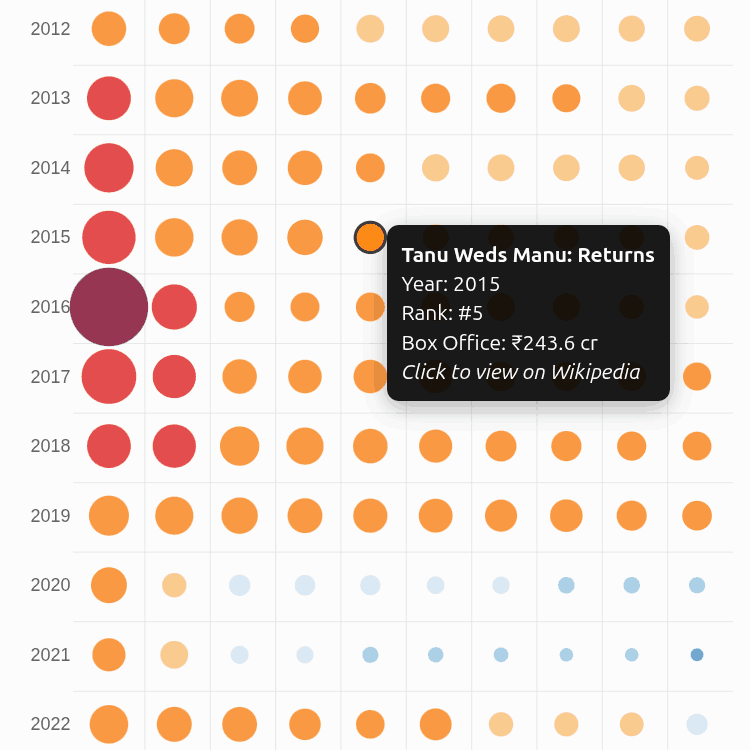
There hasn’t been a box-office explosion like Dangal in the history of Bollywood. CPI inflation-adjusted to 2024, it is the only film in the ₹3,000 Cr club. 3 Idiots (2009) is the first member of the ₹1,000 Cr club (2024-inflation-adjusted). The hot streak was 2013-2017: each year, a film crossed that bar: Dhoom 3, PK, Bajrangi Bhaijaan, Dangal, Secret Superstar. Since then, we never saw such a release except in 2023 (Jawan, Pathan). ...

I’m at an open Hyderabad meet-up, Thu 20 Mar 4 pm. “Analyzing data with AI agents”." It’s a public event by Hasgeek. Venue: Castlight Health, Sattva Knowledge Park. We know LLMs suck at number crunching but are good with code. I’ll share what we’ve learnt by getting it to write code to analyze data instead. Less lecturing, more interactive Q&A and demos in a cozy group. Mostly for analysts, data scientists, and programmers. Not so much for LLM researchers or managers. ...

Things I Learned - 09 Mar 2025

This week, I learned: In Jan 2025, ChatGPT included images as part of their data chat export. They also have a 30 second limit for the export. As an extensive user, my export is about 1GB which takes well over 30 seconds to download. Like many others the export option pretty much doesn’t work for me any more. Bharathi said மெல்லத் தமிழினிச் சாகும் in a poem that has been often quoted (and parodied). Here’s the context. The Zettelkasten note-taking method proposes that you: Capture: Write down every idea or piece of information on a separate note. Use your own words to ensure understanding. Organize: Consolidate fleeting notes into permanent ones. Assign unique identifiers to each note for easy reference. Connect: Link related notes to form a web of knowledge. This can be done with tags, references, or hyperlinks in digital systems. Review: Regularly revisit your notes to strengthen connections and discover new insights. I agree with almost every point on this LinkedIn post on scoring candidates for AI roles. Rob Balian Uses DeepSeek R1 or Claude 3.7 +5 points Uses Langchain -5 points Uses Langgraph +5 points (I don’t know enough to comment) Built a RAG in 2023 +3 points Built a RAG in 2025 -3 points “pinecone” -5 points (I don’t know enough to comment) “What is cursor” - 50 points no coming back from this Uses Cursor composer +10 points “You don’t need a full agent for this” +5 points Did hackathons to learn AI outside of work +5 points “We probably need to fine tune for this” -3 points unless you can explain why “Gemini is making a comeback” +3 points (I have a soft spot for Gemini) +3 points each for mentioning reasoning trace, structured outputs, MCP, chain-of-thought, prompt caching, TPM limits “Export to prompt” can be a useful feature in apps (or even as a bookmarklet). It would let you export content in an LLM-friendly Markdown format. You can paste it into an LLM and ask questions. Here are things I would find useful: Copy an entire issue (with history) from GitHub, Gitlab, or JIRA Copy an entire PR (with code changes) from GitHub, Gitlab, or Bitbucket Copy CI/CD logs from GitHub Actions, Gitlab CI, Azure DevOps, etc. Copy entire conversation thread in Gmail or Discourse, Service now etc. Copy product reviews from Amazon, Shopify, etc. Copy page(s) from wikis and content sites like Wikipedia, StackOverflow, etc. Copy survey responses from Google Forms, Typeform, etc. Copy all interactions with a contact (including interactions, proposal history) from HubSpot or Salesforce Copy transcripts from Zoom, Teams, Google Meet, etc. Copy as Markdown from Word, GDocs, PDF or HTML Copy the summary of an analysis as well as all key metrics from any dashboard Copy SAP invoices Copy JDs, CVs, and reviews from Workday, BambooHR, DarwinBox, etc. Copy design specs, component libraries, and style guides from Figma, Miro, etc. Generated with the help of ChatGPT – link not working Ancient languages tend to have fewer words for hues than brightness, since they didn’t need them. So “Krishna was blue” or “the sea is wine-dark” is more an indication of darkness than shade of color. Ajit Narayanan Mistral released an impressive OCR model. Marker from DataLab seems comparable but is CC-BY-NC-SA. MinerU convert medical textbooks to Markdown well. Gemini Flash may be more cost effective and better From How I Write with Tyler Cowen Keep researching. Use LLMs as an altemative to books and other reading material. Keep publishing what you learn regularly. While reading a chapter, keep asking the LLM. What did you think of that? What just happened there? What should I focus more on? What’s puzzling about this? How do I connect this to something else later or earlier in the book? LLM is better used to support you rather than replace you in areas of your expertise. Where you are an expert it’s best for you to be yourself and have AI fill in the gaps. Ask the AI: “What is in my writing that some people might find obnoxious? Or cold / heartless? Explain it to me in great detail.” The first input is context setting and should be really long. Use voice dictation for that instead of typing. Send your blog post to an LLM. No need to explain it. Just let it be the reader and see what it understands and doesn’t understand. His PhD students don’t have a textbook, which saves them some money. But they are required to subscribe to a large language model which ends up costing less. Today, it makes sense to use the best models and pay $200 for it if required. The differences are large. But in some years in the future, the cost of these models may come down for the free versions. Humans know secrets. AI does not. So at least in some areas, humans will have an advantage. Secrets full matter a lot more in the future. Gossip will matter a lot more. How good are you at keeping and trading secret? Travelling and meeting people will become more important. So will the value of social networks. Since everyone has access to better intelligence, the value of mobilization or being able to do things with people will have higher value. Leadership is an example. The value of your network therefore has gone up a lot. There’s more value in prompting one thing 10 times then 10 things one time. Follow up questions work better than long prompts. There are so many AI note-takers (and transcribers) these days that you are not just writing for an AI but speaking for AIs as well! Which model to use: O1 Pro is the best model. Claude does a decent job. DeepSeek is full of hallucinations but is interesting. It is more imaginative. Use O3 mini to write your prompt first, and then ask the model Use DeepSeek and other somewhat wacky high-end models once a day so that you stay in touch with what is models are capable of (beyond the conventional.) Perplexity has entirely replaced Google for many people. Anthropic’s models are the best writers. Gemini is good for long documents and hence for things like legal work. Gemini also has excellent YouTube integration and hands can directly read the transcripts. Grok is very good at fact checking tweets. Converting data into LLM consumable forms will be a huge project. Lot of a knowledge is not in such a form and a huge human project will involve this conversion. Indians do not need a visa to enter Thailand. Ref Build apps (not just content) for agents. In the next 3 to 5 years, agents will surpass humans as the top product users. Reliably creating interactive tutorials is hard today. Claude 3.7 Sonnet ran out of tokens when I tried creating an interactive tutorial on diffraction. Cursor got the tokens but failed to get the application right after 3 attempts. This is not yet reliable, and when it does become reliable, education will change a fair bit. #IMPOSSIBLE Tools and solutions should fit within existing workflows. That means almost all capabilities need to be exposed as APIs. LLMs make many different kinds of errors that are useful to differentiate between. Here are a few Model errors. The model itself makes a mistake. E.g. hallucinations, not following the prompt, etc. Context errors. The model makes a mistake because the question was out of context, or the context was missing. Input errors. The input to the model was parsed incorrectly, e.g. poor audio, poor image OCR, etc. Tool errors. The model’s tools are wrong or not good enough, e.g. Retrieval errors. Most browsers are moving away from third-party cookies. Here’s Google’s recommendation on alternatives. The simplest of these is CHIPS, which requires adding a Partitioned cookie attribute. Notes from AI Engineering Summit, NY, Day 1 An agent requires 3 things: a router, tools or skills, and memory. Agents are often sequential, but sometimes parallel execution makes sense for independent tasks that you consolidate. Always allow LLMs the option of NOT answering a question if there is no good answer. Focus prompts on the happy path. Use guard rails for edge cases. Here are a few “tools” an agent would need to call: Clarification from user Saving to memory Google search Edit a file introducing SPECIFIC changes Search in codebase using embeddings Run scripts on the shell or in a REPL (Python, Node, etc.) Run code in a new container for isolation Automatically discover, read an API documentation and use it Modify environment to enable logging and other system changes. When code is cheap, you can explore more ideas and hence design and product management need to approach things differently. We also need to reaching testing completely because it makes very different kinds of mistakes and we don’t often have an intuition You can have an agent explore all the issues and full request and recent comments against the repository and summarise it for the project manager Notes from AI Engineering Summit, NY. Session by Lux Capital. Agents make multiple LLM calls. Errors accumulate. So the quality of the model is key What’s really critical: data + context + user preference Set up evals for subjective responses by collecting signals continuously. Create scaffolding for agents where errors don’t accumulate. Better yet, make it FIX errors UX is critical. We need lots more UX styles YayText converts text to Unicode that has strikethrough, bold, italics, alternate fonts, and other interesting features. So does Unitextify, ConvertCase, and LingoJam. 10 red flags I look for as an angel investor is an interesting read. No real customers: A deck, a landing page, and a “vision” don’t impress me. Show me paying customers. Even better, show me customers coming back. No path to profitability: I don’t care if you raise $100M – if there’s no plan to make money, you’re just burning oxygen. Growth is great, but cash flow keeps you alive. Founders who won’t sell: If you’re scared to get on sales calls, that’s a red flag. The best founders sell in the early days – whether it’s to customers, employees, or investors. No differentiation: “Like X, but cheaper” isn’t a strategy. If your only edge is price, you’ll get crushed. What do you have that no one else does? No urgency: The best founders operate like time is running out. If you’re “exploring ideas” or “thinking about raising next year,” you’ve already lost. Raising money before proving anything: Too many founders try to fundraise their way out of bad ideas. If you need VC to get off the ground, you’re building the wrong business. No clear distribution strategy: Product alone doesn’t win. First-time founders obsess over features. Second-time founders obsess over distribution. How are you getting customers? No ownership mentality: If I hear “I need to hire someone to do that” too early, I’m out. Founders who win figure things out before they delegate. A CEO who can’t attract talent: Your first hires are everything. If great people aren’t willing to join, either the vision is weak – or you are. No skin in the game: If a founder won’t invest their own money or take a pay cut to make it work, why should I? By contrast, this OpenAI Deep Research report feels a lot less actionable. Inception Labs offers “Diffusion LLMs”. (No API yet.) They start with random text and refine it in parallel. The benefit is: It’s faster and cheaper due to parallellalization and better GPU use It doesn’t commit to tokens and can fix hallucinations, JSON structure errors, reasoning fallacies, etc. It’s better with multi-modal since images are diffusion based already.

2024 1

Things I Learned - 31 Mar 2024

This week, I learned: sqlite-schema-diagram generates schemas for SQLite databases using Graphviz TechEmpower web server benchmarks place Rust servers on top browser.new is a good example of a browser agent. It slowly but independently does a good job of achieving the result. Example: What crew is common in Ingrid Bergman - Cary Grant films? twinny is an open source VC Code Copilot alternative. typesense supports embeddings natively. Binary embeddings are good enough. Cohere releases binary embeddings. Extract.langchain.com is a poor early interface to featurize unstructured.io Hume.ai offers voice emotion API and emotion-based conversational responses. An empathic AI. Rust is non-trivial. Inspired by We are under DDoS attack and we do nothing, I “wrote” a small binary that serves a parquet file as JSON. It failed and I couldn’t fix it. spleeter is a better alternative to demucs. Splits audio into pyannote-audio does speaker diarization uvicorn is faster than hypercorn but hypercorn supports HTTP/2 and HTTP/3. FastAPI with uvicorn is reasonably fast. Representational engineering lets you control LLM output based on preference on the fly. When I set up a training: On inviting for DuckDB workshop on Sun evening, Gramener starts accepting immediately, Straive doesn’t. Straive has high spread of joining time. When joining Gitlab Pipelines Workshop, Straive starts meeting (e.g. Premlal) many minutes early. Gramener floods in (due to alert). Straive streams in slowly. Gitlab Pipelines Workshop acceptances: Gramener 47, Straive 100