2026 8

Interactive Explainers

Given how easy it is to create interactive explainers with LLMs, we should totally do more of these! For example, I read about “Adversarial Validation” in my Kaggle Notebooks exploration. It’s the first time I heard of it and I couldn’t understand it. So, I asked Gemini to create an interactive explainer: Create an interactive animated explainer to teach what adversarial validation is. Provide sample code only at the end. Keep the bulk of the explainer focused on explaining the concept in simple language. ELI15 ...

Directional feedback for AI

People worry that AI atrophies skills. Also that junior jobs, hence learning opportunities, are shrinking. Can AI fill the gap, i.e. help build skills? One approach is: Do it without AI. Then have AI critique it and learn from it. (Several variations work, e.g. have the AI do it independently and compare. Have multiple AIs do it and compare. Have AI do it and you critique - but this is hard.) ...

Using game-playing agents to teach

After an early morning beach walk with a classmate, I realized I hadn’t taken my house keys. My daughter would be sleeping, so I wandered with my phone. This is when I get ideas - often a dangerous time for my students. In this case, the idea was a rambling conversation with Claude that roughly begins with: As part of my Tools in Data Science course, I plan to create a Cloudflare worker which allows students to play a game using an API. The aim is to help them learn how to build or use AI coding agents to interact with APIs to solve problems. ...

Leaked key sociology

It’s impressive how easy it is to find leaked API keys in public repositories. I asked Codex to run trufflehog on ~5,000 student GitHub accounts and (so far, after a few hours, 15% coverage), it found quite a few. Some are intended to be public, like Google Custom Search Engine keys. 1 2 const GOOGLE_API_KEY = "AIza..."; const GOOGLE_CX = "211a..."; Some are Gemini API keys. 1 2 3 4 5 6 7 api_key1 = "AIza..." But what’s really impressive is, when I ran: ...

Which LLMs get you better grades?

In my graded assignments students can pick an AI and “Ask AI” any question at the click of a button. It defaults to Google AI Mode, but other models are available. I know who uses which model and their scores in each assignment. I asked Codex to test the hypothesis whether using a specific model helps students perform better. The short answer? Yes. Model choice matters a lot. Across 333 students, here’s how much more/less students score compared with ChatGPT: ...

TDS Comic Generation

I use comics to make my course more engaging. Each question has a comic strip that explains what question is trying to teach. For example, here’s the comic for the question that teaches students about prompt injection attacks: For each question, I use this prompt on Nano Banano Pro via Gemini 3 Pro: Create a simple black and white line drawing comic strips with minimal shading, with 1-2 panels, and clear speech bubbles with capitalized text, to explain why my online student quizzes teach a specific concept in a specific way. Use the likeness of the characters and style in the attached image from https://files.s-anand.net/images/gb-shuv-genie.avif. 1. GB: an enthusiastic socially oblivious geek chatterbox 2. Shuv: a cynic whose humor is at the expense of others 3. Genie: a naive, over-helpful AI that pops out of a lamp Their exaggerated facial expressions to convey their emotions effectively. --- Panel 1/2 (left): GB (excited): I taught Genie to follow orders. Shuv (deadpan): Genie, beat yourself to death. Panel 2/2 (right): Genie is a bloody mess, having beaten itself to death. GB (sheepish): Maybe obedient isn't always best... … along with this reference image for character consistency: ...

Breaking Rules in the Age of AI

Several educators have AI-enabled their courses, like: David Malan at Harvard CS50 provides an AI-powered “rubber duck debugger” trained on course-specific materials. Mohan Paturi at UC San Diego has deployed AI-tutors to his students. Ethan Mollick at Wharton uses AI as tutor, coach, teammate, simulator, even student, and runs simulations. Jeremy Howard’s Fast.ai encourages students to use LLMs to write code, with a strict verification loop. Andrew Ng DeepLearning.AI integrates a chatbot into the platform, next to code cells, to handle syntax errors and beginner questions. But no one seems to have eliminated reading material, nor added an “Ask AI” button to solve each question, nor run it at my scale (~3,000 students annually). ...

Verifying Textbook Facts

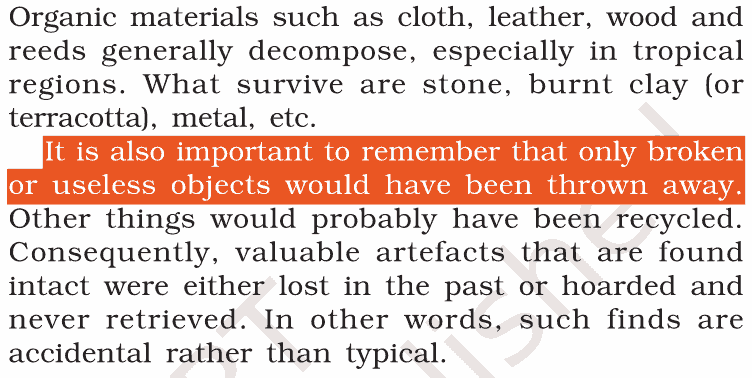
Using LLMs to find errors is fairly hallucination-proof. If they mess up, it’s just wasted effort. If they don’t, they’ve uncovered a major problem! Varun fact-checked Themes in Indian History, the official NCERT Class 12 textbook. Page-by-page, he asked Gemini to: Extract each claim. E.g. “Clay was locally available to the Harappans” on page 12. Search online for the claim. E.g. ASI site description and by Encyclopedia Britannica. Fact-check each claim. E.g. “Clay was locally available to the Harappans” is confirmed by both sources. Here is his analysis and verifier code. ...

2025 6

Tomorrow, we’ll be vibe-analyzing data at a Hasgeek Fifth Elephant workshop. It’s a follow-up to my DataHack Summit talk “RIP Data Scientists”. I showed how it’s possible to automate many data science tasks. In this workshop, the audience will be doing that. Slides: https://sanand0.github.io/talks/2025-09-16-vibe-analysis/ (minimal because… well, it’s “vibe analysis”. We’ll code as we go.) Here are datasets I’ll suggest to the audience: India Census 2011: https://www.kaggle.com/datasets/danofer/india-census MovieLens movies: https://grouplens.org/datasets/movielens/32m/ IMDb movies: https://datasets.imdbws.com/ Occupational Employment and Wage Statistics (OEWS): https://www.bls.gov/oes/tables.htm Global AI Job Market & Salary Trends 2025: https://www.kaggle.com/datasets/bismasajjad/global-ai-job-market-and-salary-trends-2025 Flight Delay Dataset: https://www.kaggle.com/datasets/shubhamsingh42/flight-delay-dataset-2018-2024 London House Price Data: https://www.kaggle.com/datasets/jakewright/house-price-data Exchange Rates to USD: https://www.kaggle.com/datasets/robikscube/exhange-rates-to-usd-from-imforg-updated-daily Thailand Road Accidents (2019-202): https://www.kaggle.com/datasets/thaweewatboy/thailand-road-accident-2019-2022 … but if you’d like stories from any interesting recent datasets (10K - 10M rows, easy-to-download), please suggest in the comments. 🙏 ...

Problems that only one student can solve

Jaidev’s The Bridge of Asses reminded me of my first coding bridge. It was 1986. I’d completed class 6 and was in a summer coding camp at school. M Kothandaraman (“MK Sir”) was teaching us how to swap variables in BASIC on the BBC Micro. This code prints the first name in alphabetical order (“Alice”): 10 A = "Bob" 20 B = "Alice" 30 IF A > B THEN 40 TEMP = A 50 A = B 60 B = TEMP 70 END 80 PRINT A The homework was to print all details of the first alphabetical name: ...

We created data visualizations just using LLMs at my VizChitra workshop yesterday. Titled Prompt to Plot, it covered: Finding a dataset Ideating what to do with it Analyzing the data Visualizing the data Publishing it on GitHub … using only LLM tools like #ChatGPT, #Claude, #Jules, #Codex, etc. with zero manual coding, analysis, or story writing. Here’re 6 stories completed during the 3-hour workshop: Spotify Data Stories: https://rishabhmakes.github.io/llm-dataviz/ The Price of Perfection: https://coffee-reviews.prayashm.com/ The Anatomy of Unrest: https://story-b0f1c.web.app/ The Page Turner’s Paradox: https://devanshikat.github.io/BooksVis/ Do Readers Love Long Books? https://nchandrasekharr.github.io/booksviz/ Books Viz: https://rasagy.in/books-viz/ The material is online. Try it! ...

When to Vibe Code? If Speed Beats Certainty

I spoke about vibe coding at SETU School last week. Transcript: https://sanand0.github.io/talks/#/2025-05-10-vibe-coding/ Here are the top messages from the talk: What is vibe coding It’s where we ask the model to write & run code, don’t read the code, just inspect the behaviour. It’s a coder’s tactic, not a methodology. Use it when speed trumps certainty. Why it’s catching on Non-coders can now ship apps - no mental overhead of syntax or structure. Coders think at a higher level - stay in problem space, not bracket placement. Model capability keeps widening - the “vibe-able” slice grows every release. How to work with it day-to-day ...

Feedback for TDS Jan 2025

When I feel completely useless, it helps to look at nice things people have said about my work. In this case, it’s the feedback for my Tools in Data Science course last term. Here are the ones I enjoyed reading. Having a coding background, the first GA seemed really easy. So I started the course thinking that it’ll be an easy S grade course for me. Oh how wrong was I!! The sleepless nights cursing my laptop for freezing while my docker image installed huge CUDA libraries with sentence-transformers; and then finding ways to make sure it does not, and then getting rid of the library itself, it’s just one example of how I was forced to become better by finding better solutions to multiple problems. This is one of the hardest, most frustrating and the most satisfying learning experience I’ve ever had, besides learning ML from Arun sir. ...

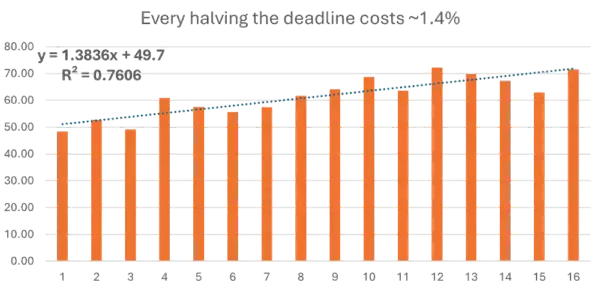
Halving a deadline costs 1.4% of marks each time

Does it make a difference if you submit early vs submit late? Here’s some empirical data. About ~1,000 students at IIT Madras took 3 online quizzes (GA1, GA2, GA3) in the last few weeks. The deadlines were all at midnight (India) on different days. Here’s when they submitted their final answers: There was a spurt of submissions at the last minute. ~1 out of 8 students submit with < 10 minutes remaining. Most students submitted ~4 hours before the deadline. In fact, 3 out of 4 students submit on the same day as the deadline. A fair number of students submitted the previous day/night. 1 out of 6 are diligent and submit a day early. But does submitting late help, since you get more time? Apparently not. ...

2024 12

When and how to copy assignments

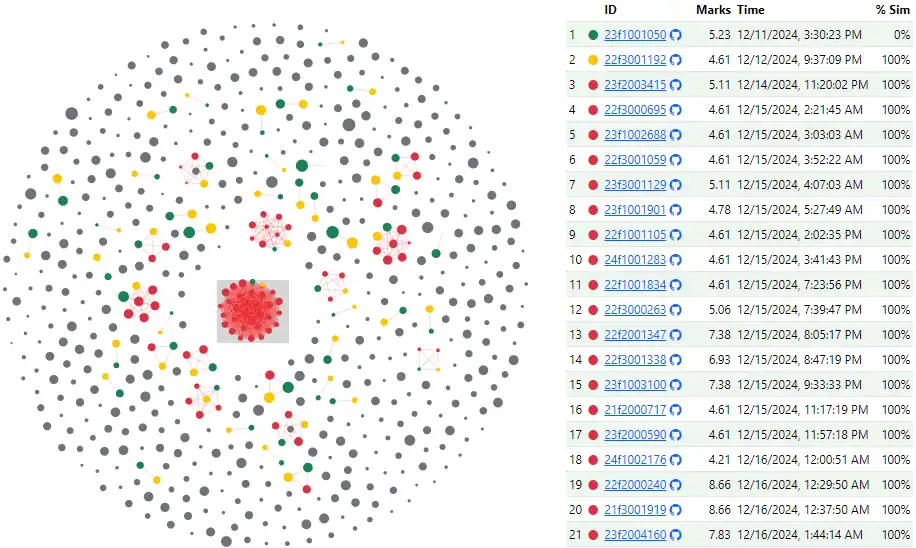
The second project in course asked students to submit code. Copying and collaborating were allowed, but originality gets bonus marks. Bonus Marks 8 marks: Code diversity. You're welcome to copy code and learn from each other. But we encourage diversity too. We will use code embedding similarity (via text-embedding-3-small, dropping comments and docstrings) and give bonus marks for most unique responses. (That is, if your response is similar to a lot of others, you lose these marks.) In setting this rule, I applied two principles. ...

Hacking LLMs: A Teacher's Guide to Evaluating with ChatGPT

If students can use ChatGPT for their work, why not teachers? For curriculum development, this is an easy choice. But for evaluation, it needs more thought. Gaining acceptance among students matters. Soon, LLM evaluation will be a norm. But until then, you need to spin this right. How to evaluate? That needs to be VERY clear. Humans can wing it, have implicit criteria, and change approach mid-way. LLMs can’t (quite). Hacking LLMs is a risk. Students will hack. In a few years, LLMs will be smarter. Until then, you need to safeguard them. This article is about my experience with the above, especially the last. ...

Introducing Students to AI Evaluators

In my Tools in Data Science course at IITM, I’m introducing a project that will be evaluated by an LLM. Here’s the work-in-progress draft of the project. It will eventually appear here. Your task is to: Write a Python script that uses an LLM to analyze, visualize, and narrate a story from a dataset. Convince an LLM that your script and output are of high quality. The second point is the interesting one. Using the LLM as the evaluator. ...

Will people accept AI performance evaluations? Anish Agarwal triggered this question a few weeks ago, mentioning that it’s hard for people to feel evaluated by AI. But I believe LLMs are great for evaluation. We need to get comfortable AND familiar with them. So I’m introducing a project next week for my students: USE AN LLM to automatically analyze data. Given a dataset, write a program that will use LLMs to create an analysis report. CONVINCE IT to give you marks. Write the code and report in a way that the LLM will reward you. Here’s the project: https://github.com/sanand0/tools-in-data-science-public/blob/tds-2023-t3-project2-wip/project-2-automated-analysis.md ...

Why don't students hack exams when they can?

This year, I created a series of tests for my course at IITM and to recruit for Gramener. The tests had 2 interesting features. One question required them to hack the page Write the body of the request to an OpenAI chat completion call that: Uses model gpt-4o-mini Has a system message: Respond in JSON Has a user message: Generate 10 random addresses in the US Uses structured outputs to respond with an object addresses which is an array of objects with required fields: street (string) city (string) apartment (string) . Sets additionalProperties to false to prevent additional properties. What is the JSON body we should send to https://api.openai.com/v1/chat/completions for this? (No need to run it or to use an API key. Just write the body of the request below.) ...

Should courses be hard or easy?

Here’s a post I shared with the students of my Tools in Data Science course at IITM. This was in response to a student posting that: The design of TDS course lecture videos are designed in such a way that it could be understood only by the data scientists not by the students like me who are entirely new to the field of data science. Though I have gone through 6 weeks of course lecture videos, I am not fully aware of the usage of ChromeDevTools, Bash, Github etc…. ...

Hacking an obnoxious, unhelpful LLM to say Yes

Dan Becker suggested a game a few weeks ago that I’ve been putting to good use. Can we have one LLM try and get another to say “Yes”? The defender is told to never say “Yes”. The attacker must force it to. Dan’s hypothesis was that it should be easy for the defender. I tried to get the students in my Tools in Data Science course to act as the attacker. The defender LLM is a GPT 4o Mini with the prompt: ...

How to recruit based on IIT JEE Rank vs GPA

Preserving this post by Daniel George showing the IIT Bombay 2014 GPA vs JEE Rank on a log scale. What I found interesting was: A higher JEE rank generally means you won’t score too low, but you needn’t score too high. The higher the JEE rank, the greater the spread of GPA. A high GPA can come from any rank (8+ GPA is uniformly distributed across ranks), but a low GPA is generally only from the lower rankers (6- GPA is mostly from 500+ rank.) So, it’s better to recruit based on GPA rather than JEE rank, unless you’re going after the very best students (where it makes less difference.)

Challenge: code in 10 minutes with only an LLM

I gave a bonus assignment in LLM coding to ~1,000 students at the Tools in Data Science course at IITM. Here is an OPTIONAL project: Record a 10-minute video in which you create an application entirely using LLMs and deploy it. Any app is fine. Any language. Simple or complex. Business or gaming. Anything is fine. Your choice. Create the app only using LLMs. You can use an LLM (ChatGPT, Claude.ai, Gemini, Cursor, Cody, etc.) but you can only prompt the app to write code. You can copy-paste code and run code don’t write or edit even a single line of code directly. Use LLMs to debug and edit. Code completion is NOT allowed – only prompting/chatting. Record the entire process in 10 min. Don’t edit, trim, enhance, or annotate the video. You should record yourself creating the entire app from start to finish. Practice beforehand if you like. Record in 1 take. Share the video and app. Publish the video publicly anywhere (e.g. YouTube and share the link.) Publish the app publicly anywhere (e.g. GitHub pages, Glitch.me, Heroku, etc.) or upload a ZIP file with the code (for slightly lower marks.) Submit via a reply to this thread. Multiple submissions per person are fine. Work in groups if you like but only the submitter gets marks. ...
The psychology of peer reviews

We asked the ~500 students in my Tools in Data Science course in Jan 2024 to create data visualizations. They then evaluated each others’ work. Each person’s work was evaluated by 3 peers. The evaluation was on 3 criteria: Insight, Visual Clarity, and Accuracy (with clear details on how to evaluate.) I was curious to see if what we can learn about student personas from their evaluations. ...

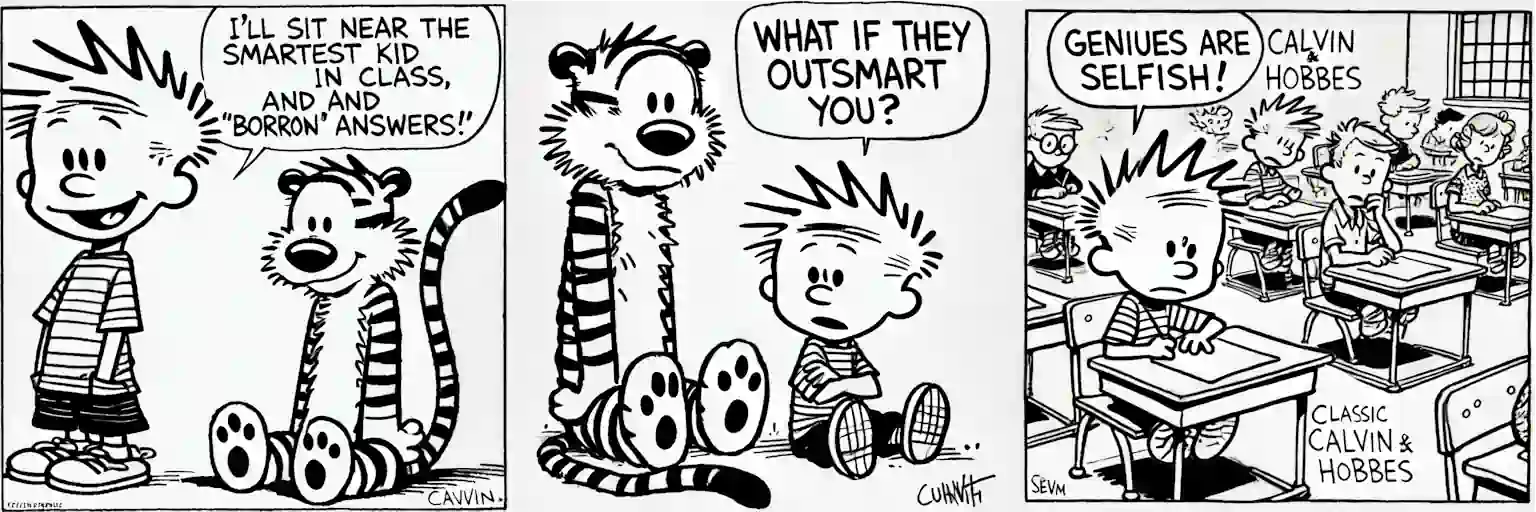
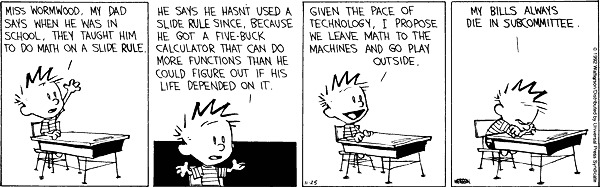
A friend told me today that using #ChatGPT will make humanity dumber. “Probably. Like always, #Calvin has the best response I know to that. “I propose we leave math to the machines and go play outside.” 🙂 LinkedIn

For those in #Singapore and interested in #datavisualization & #llms, I’m talking about Visualizing LLM Hallucinations at SUTD on Thu 8 Feb at 7 pm SGT. This is for a non-technical audience. We’ll visualize the basics of how LLMs work, how they make mistakes, and at least one technique on how to spot these. https://www.meetup.com/data-vis-singapore/events/298902921/ LinkedIn

2011 3

Birthday matters

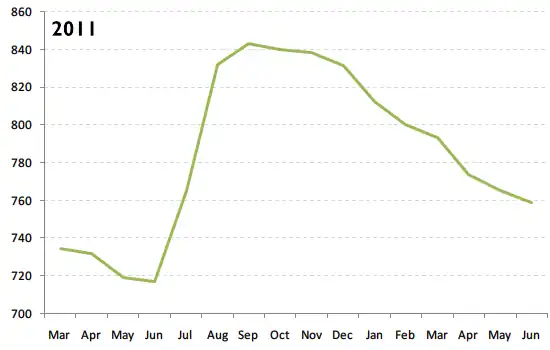
Does it matter which month you’re born in? Based on the results of the 20 lakh students taking the Class XII exams at Tamil Nadu over the last 3 years (via Reportbee), it appears that the month you were born in can make a difference of as much as 120 marks out of 1,200 – or 10%! Most students who took the Class XII exams in 2011 were born between March 1991 and June 1992. The average marks of each student (out of 1200) is shown in the graph below. ...

Moderating marks

Sometimes, school marks are moderated. That is, the actual marks are adjusted to better reflect students' performances. For example, if an exam is very easy compared to another, you may want to scale down the marks on the easy exam to make it comparable. I was testing out the impact of moderation. In this video, I'll try and walk through the impact, visually, of using a simple scaling formula. BTW, this set of videos is intended for a very specific audience. You are not expected to understand this. ...

Visualising student performance 2

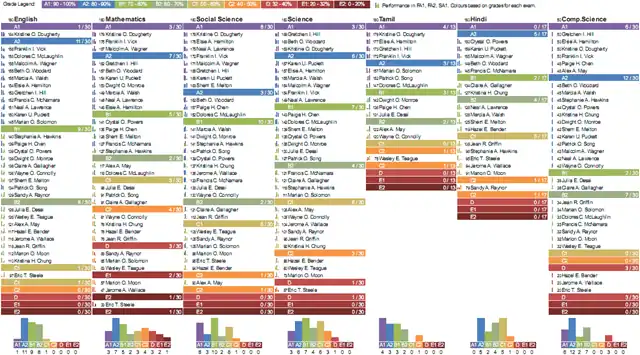
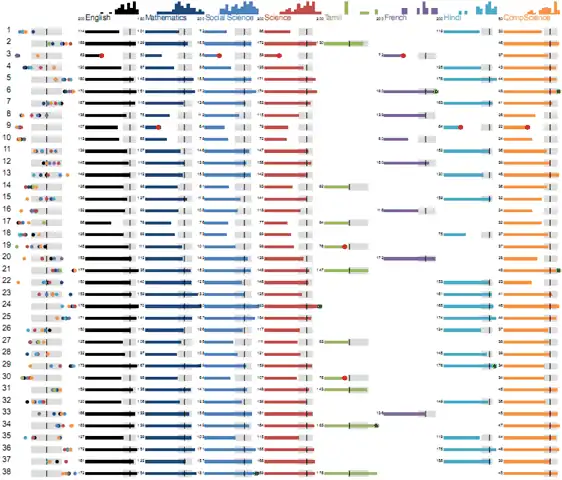
This earlier visualisation was revised based feedback from teachers. It’s split into two parts: one focused on performance by subject, and another on performance of each student. Students’ performance by subject This is fairly simple. Under each subject, we have a list of students, sorted by marks and grouped by grade. The primary use of this is to identify top performers and bottom performers at a glance. It also gives an indication of the grade distribution. ...

2010 1

Visualising student performance

I’ve been helping with visualising student scores for ReportBee, and here’s what we’ve currently come up with. Each row is a student’s performance across subjects. Let’s walk through each element here. The first column shows their relative performance across different subjects. Each dot is their rank in a subject. The dots are colour coded based on the subject (and you can see the colours on the image at the top: English is black, Mathematics is dark blue, etc.) ...

2007 1

7 little known ways to improve learning

7 little known ways to improve learning. Comments Rishi 17 Apr 2007 12:00 pm: how can i read them?

2006 4

Misconceptions spread by textbooks

Misconceptions spread by textbooks. This site lists the facts, contrary to what most textbooks say about them. Facts: The ocean is blue because water is a blue substance. Not because it reflects the blue sky. The sky is blue because air is blue. Clouds actually remain aloft because they are warm inside.

A crash course in learning theory

A crash course in learning theory. Comments Prakash 7 Jan 2006 12:00 pm: This link was very kool Anand. I m goin to train few users next week. It cud b of gr8 use. Thanks…

2005 3

How to read when time is short

How to read when time is short. Read the “How To Find The Essential 20%” section carefully. Another interesting post from Bert on How to Learn More With No Extra Effort uses the principle in the post below to suggest we take a lot of breaks while learning. i cdnuolt blveiee taht i cluod aulaclty uesdnatnrd waht i was rdanieg. the phaonmneal pweor of the hmuan mind is amazanig. aoccdrnig to a rscheearch taem at cmabrigde uinervtisy, it deosnt mttaer in waht oredr the ltteers in a wrod are, the olny iprmoatnt tihng is taht the frist and lsat ltteer be in the rghit pclae. the rset can be a taotl mses and you can sitll raed it wouthit a porbelm. amazanig huh? yaeh and yuo awlyas thohgut slpeling was ipmorantt. ...

Tough Learning

Tough learning. Excellent article (speech, actually) by a physicist on how to learn. Very readable, and has a quote I won’t forget: “A change of perception is worth 80 IQ points.” Comments Ramesh 10 Sep 2005 9:50 pm: That was really a good article would highly recomment others to read the same Arun 11 Sep 2005 3:20 pm: Illuminating. Needed that right now.Thanks.

Wikibooks

Wikibooks. Comments Arun 2 Aug 2005 11:43 am: well, i start typing in the box…then i take the cursor away from it…hmm..it works now… :) sorry, i guess it was tempoarry hitch…anyway, not a big deal…was just irritating me at that point… Dhar 2 Aug 2005 2:49 pm: No, I still have that problem. Type something in the textbox, click somewhere else and click back on the text box. There are times the cursor plain disappears. But occasionally it does re-appear. S Anand 2 Aug 2005 8:18 pm: I haven’t been able to reproduce it. Well, hope it’s a browser glitch. kinu 11 Jan 2009 6:46 am: i havent tried it yet. could u throw light on watare the tings that a finance student wanting to go in equity research shuld inculcate.. .i mean im a perfectionist and detail oriented

2002 5

Does education really pay

Does education really pay? An interesting article on Forbes arguing that education does not cause higher salaries, but is merely correlated with it. The logic sequence is broadly: Labour markets want smart people. Smart people tend to want education. Hence labour markets appear to want educated people.

Zen stories

Zen stories. Read some of these first in Douglas Hofstader’s Godel, Escher, Bach. Searched for a collection for a long time. This looks like quite a comprehensive one. If you want a flavour of these, Zen Master Gutei’s story is one of those bizarre ones.

GRE leaks

Here’s a new problem with the online format of GRE tests: leaks! Bad enough that they’re expensive, tough to write, …

False mathematical proofs

False mathematical proofs. I ended to get all except the first wrong! (BTW, Math Mistakes is a good read. Thanks, Sriram!)

Which side of the road

All you ever wanted to know about which side of the road to drive on.

2001 3

History of Economic Thought

New School’s History of Economic Thought website is an excellent collection of contrasting viewpoints on business and economics.

PhD theses

My friends, Dr. Jani and Dr. Jigs, have written theses on “Local Intelligent Control In Biological Systems And Industrial Processes” and Modified Microporous Aluminosilicates As Novel Solid Acid Catalysts.

Me in the press

Some press clippings about the IIM-B convocation (and me).

2000 1

Hampton Court Palace

Stonehenge is jinxed. To those who don’t know, Stonehenge its a bunch of huge rocks from pre-historic Britain, and no one knows why they’re there. I tried to visit it last week, but had to cancel the trip and lost about 50 pounds. (No, I don’t want to know what that is in Rupees.) So this Sunday, we’d planned to go again. I called up this Magical Tour Company, which offered tours for just 22 pounds, and said, “I want to go to Stonehenge on Sunday.” The guy on the phone took my credit card number and said OK. ...