Andreessen Horowitz published an interesting article titled The Next Frontier of Visual AI Is Code. Here’s the summary.
A lot of our work is visual: ads, slides, dashboards, logos, videos, architecture, etc.
We can generate visual output either as:
- Pixels (like Nano Banana a photo), or as
- Code (like Claude generating an SVG)
Code is more powerful: AI can inspect the output and improve fast in a loop: Code > Render > Inspect > Revise.
For 2D and UI: AI can generate SVG logos, HTML/CSS pages, Figma layers, app, etc. For animation and 3D: AI can generate Lottie JSON, Blender scripts, USD scene graphs, shader code, or 3D programs.
This means design, marketing, and product teams are immediate prospects. Instead of static mockups, they’ll get editable logos, landing pages, design prototypes, motion graphics, onboarding animations, etc.
Emerging industries are robotics, manufacturing, architecture, gaming companies. Agents can build 3D chairs, machine, room, or robot with the right materials, joints and constraints.
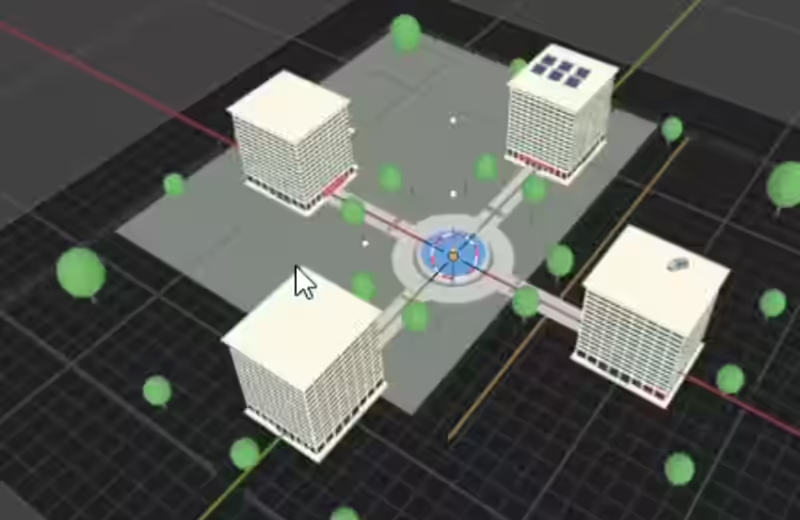
I’ve seen some examples of this approach. Pavan used Blender MCP to build an entire building campus solely by prompting Claude. Also to design a mug from scratch. His approach is called VIGA: Vision-as-Inverse-Graphics Agent.
If you see anyone creating visual assets of any form - manually, or with AI as pixels - please remember this approach.