Priya Dialani interviewed me for a podcast. Here’s the rough summary:
- What do you and Straive do? Straive builds AI and runs AI. I poke at LLMs to learn what they cannot do. My friend calls me an “LLM Psychopath”.
- Why do AI pilots get stuck before production? AI speeds up coding, but less of testing. Making sure it works can take months.
- Why organize enterprise knowledge? Better organized info is good for humans and agents. Duh!
- Can AI organize it? Yes! I’ve had it create one-line summaries of 10K+ docs on Straive Google Drive for easier searching.
- How can India’s GCCs benefit from AI? Put AI lovers next to business teams and give them AI agent access. They’ll solve asked and unasked problems.
- How does AI fail? Unanticipated things happen in production. So, have agents monitor failures and revise the process.
- How is AI software different? Normal software fails reproducibly. AI fails in new ways we haven’t fully understood.
- Where should a company start with AI? Skip AI strategy. Give people agent access, have them try it, and share what they learned.
- What if people don’t know what to try? Ask AI. “How could you improve my work?” Even rubbish ideas waste only 5 minutes.
- How much should we experiment? A lot! Generation is cheap. Ask for 10 options, not one. Who cares even if all 10 fail?
But what happened outside of the interview was just as interesting.
For example, Priya shared a podcast pro-tip: don’t leave when the interview ends (guests apparently do that a lot) - stay on for post-production notes.
She also used “nevertheless”, which I noticed. I was ragged in my first year at IITM for using that in a sentence. “Do people actually say nevertheless?” Anand asked me, before asking me a trick question to find the probability of 3 random points on a sphere lying on the same plane. I mentioned this. (I analyzed my transcripts later. The person who uses “nevertheless” by far the most is an IITM faculty, followed by an MIT faculty and another IITian.)
When I asked her, “How do you use AI to prepare”, she said she gives it the topic and asks for questions. Reasonable - but we tried something more ambitious, live.
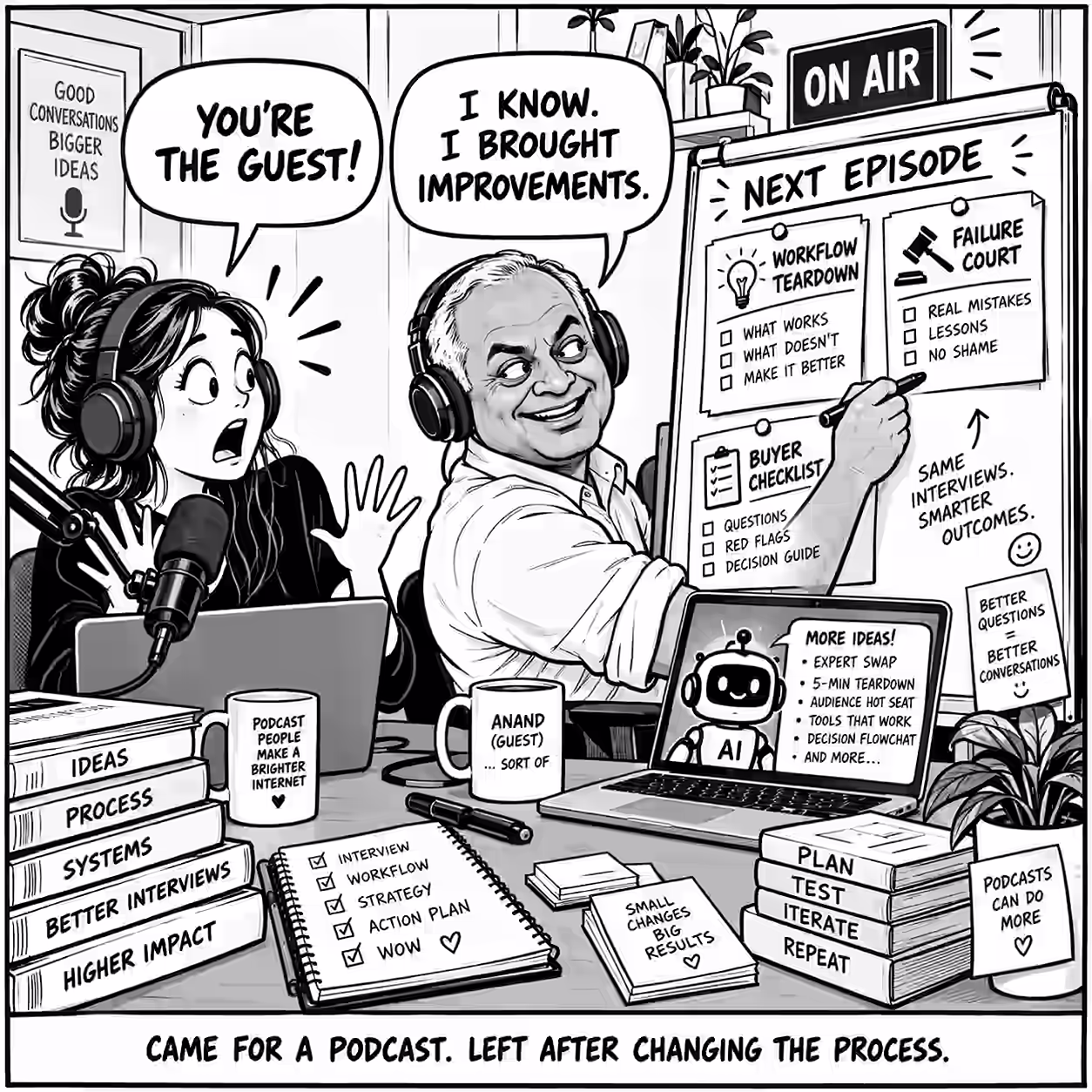
Her next podcast was with Decimal Point Analytics on “Agentic AI embedded into core business workflows.” So I asked ChatGPT:
Priya runs a podcast called Analytics Insight. I want you to research that and identify the style, the theme, etc., of the podcast. Then, I’m sharing a brief below for the company. I want you to suggest insightful questions…
The main difference is that I also asked it to:
- Research Priya’s style and content first.
- Suggest formats, not just topics.
- Suggest tips for improvement.
Some of the formats it suggested were quite interesting. For example:
- Workflow teardown: Give the guest a use case and ask them to narrate AI decisions, step by step.
- Failure court: Ask them to argue for or against a series of claims, providing a number.
It also suggested that she interrupt when guests get too abstract, ask them to provide a case study, and end with a “buyer checklist”. Pretty neat!
It was nice to go into a podcast as a guest and come out changing their workflow!