Things I Learned - 31 May 2026
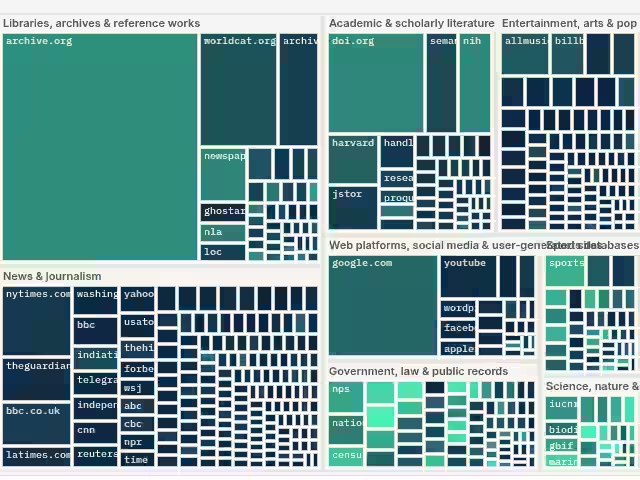
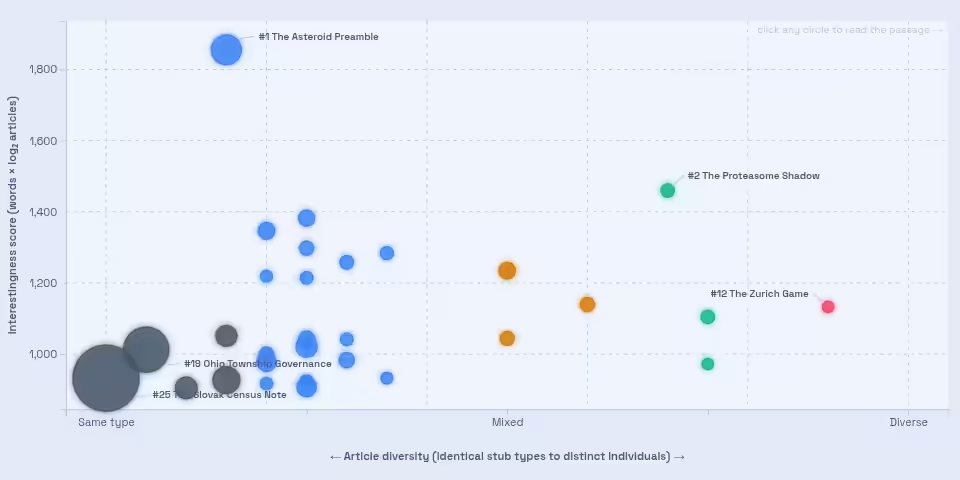
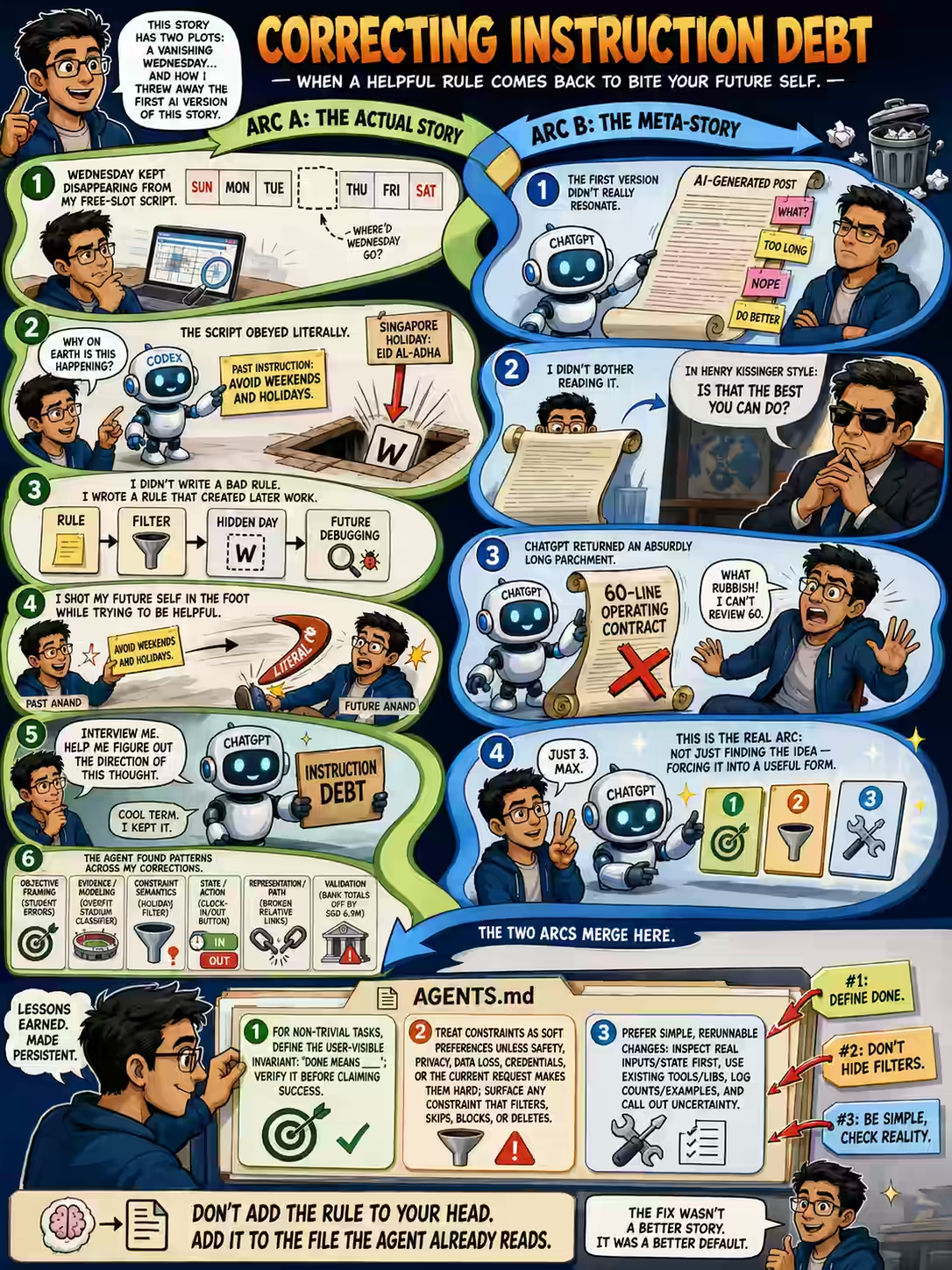
This week, I learned: D-ID is an avatar generator platform like HeyGen. Creatify and Synthesia are a couple of others I heard of. This space seems to be growing. cosign is a CLI that lets you sign and verify any piece of text with a Google, GitHub or Microsoft account. cosign sign-blob FILE --bundle sign.json opens a login window and creates a sign.json signature. Anyone who has FILE and sign.json and the email ID can verify via a Google account with cosign verify-blob FILE --bundle sign.json --certificate-identity $EMAIL --certificate-oidc-issuer https://accounts.google.com. arxiv2md.org converts arXiv papers to Markdown. Source. markxiv.org claims the same - by just changing the URL - but it ended up reporting an error when I tried this link: https://markxiv.org/abs/2604.08649. From Akhilesh Tilotia: So we have someone in our team with initials AS. She made a document which was named vAS. Then I made edits and named it vAT. These docs were in a CoWork folder. I asked Claude to clean up my doc. It created another version for me to review. In its wisdom, it named the file vAU 🙂 Maybe what a forward-deployed engineer does is enginer AI-native workflows. (This sounded profound when I wrote it down. Not sure if it’ll sound as profound tomorrow.) The idea is that the FDE will say, screw existing processes; let me fire up my AI agent and get stuff done; THEN we’ll figure out what works, how to optimize it, etc. The PRAGMA: Revolut Foundation Model has some good tokenization ideas for tabular data. Create your own token space with key–value–time tokenization - to retain field information. Bucketize numbers by percentile, preserving magnitude/ordering that subword tokenization destroys. Encode time both as log-seconds and as cyclical calendar features. Codex uses the Alt + Up Arrow key to edit queued commands, but on the VS Code terminal, this key binding is not sent to the terminal. Enable the terminal.integrated.sendKeybindingsToShell setting to send it to the terminal, hence Codex. Based on this catalog on “universal foods”, here’s what I 🟢 like, am 🟡 neutral, 🔴 dislike, 🟣 must try, and will ⚫ skip. Universal favorites: 🟢 pizza, 🟢 fried potatoes/chicken, 🟡 dumplings, 🟢 ice cream. Universal comfort foods: 🟢 khichdi, 🟡 congee, 🟡 dal-rice, 🟡 risotto, 🟡 ramen, 🟢 pho, ⚫ chicken noodle soup, 🔴 rice porridge, 🟡 mac-and-cheese, 🔴 mashed potato, 🟣 polenta, 🟢 oatmeal, 🟣 Japanese curry rice. Acquired tastes that convert most: 🟡 coffee, 🟢 tea, 🟡 dark chocolate, 🟢 mild fermented dairy, 🟢 pickles, 🟢 olives, 🟣 kimchi, 🟣 miso, 🟢 mild chili dishes. Acquired tastes that have cult devotion: 🟣 durian, 🟣 natto, 🟣 stinky tofu, ⚫ fermented fish, ⚫ hákarl, 🟢 very funky blue cheese, ⚫ offal. OceanoPDF seems like a good place to download ePubs of books. The entire Wikipedia is available as a Parquet file. You can query it like duckdb -c "FROM 'hf://datasets/wikimedia/structured-wikipedia/enwiki/data/*.parquet' LIMIT 5". The English version has 35 GB, 7.6 million articles, and you’re better off downloading it rather than running analyses remotely. When you receive a Calendly link of the form https://cal.com/USER/EVENT you can fetch the available slots via curl -H 'cal-api-version: 2024-09-04' 'https://api.cal.com/v2/slots?eventTypeSlug=EVENT&username=USER&start=2026-05-25&end=2026-06-01&timeZone=Asia/Singapore&format=range'. Useful to automate good meeting-slot selection. “Reference saved memories” in ChatGPT is different from “Reference chat history” as per OpenAI. In Developer Mode, memory is turned off, but not chat history. I confirmed that I can access past conversations in Developer Mode. It might be a privacy concern for others, but for me, this is singularly useful, because I can use ChatGPT with Local MCP effectively getting a non-metered AI coding agent. Seems GPT-5.2 reaches expert level in peer review: 45 scientists took 469 hours evaluating human & AI reviews on 82 papers. “Surprisingly, current AI reviewers are competitive even with the top-rated reviewers in Nature’s official peer review…” though not without weaknesses, so use AI + humans. On the limits and opportunities of AI reviewers: Reviewing the reviews of Nature-family papers with 45 expert scientists via Ethan Mollick Questions I was asked Week ending 31 May 2026 ...