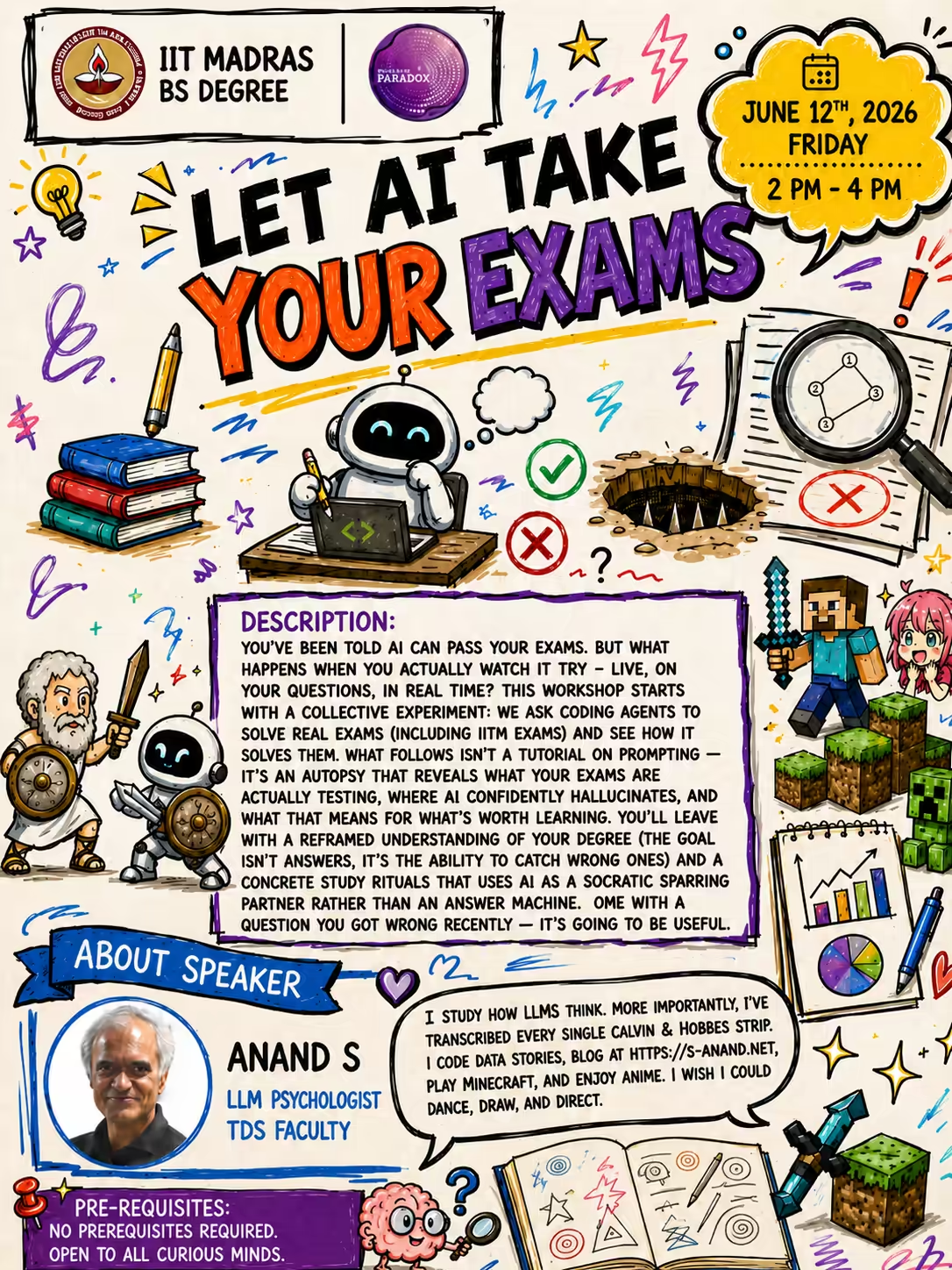
At 2 pm IST today (Fri 12 Jun 2026), I conducted a workshop at Paradox, IITM - at DOMS 101.
My core message is: “AI can solve exams and help you learn. Delegate what AI can do. Learn what AI can’t do instead.”
My talks page for “Let AI take your exams” includes:
- The full story + transcript + audio
- How Codex solved a real exam, live
- My collection of AI-learning techniques - which was not covered in the workshop, but is a useful reference
Here are the takeaways from the workshop:
- AI is more capable than you think — and getting smarter. Recalibrate constantly what it can and can’t do. Note down what it can’t, because that is precisely where your value lives.
- Delegate first; learn the rest. Give everything to AI. Focus your learning on what it can’t yet do — that’s where the value will be. It’s a moving filter; revisit it every quarter.
- Always use the best model, turned up high. Reserve “fast and cheap” for the ~5% of moments you need a quick answer. And remember students get serious AI free via the GitHub Student Pack and Gemini.
- Make the AI ask you for context. “If you need more information, ask me.” You don’t have to know what context it needs — push that burden back to the machine.
- Beat hallucination with a maker-checker. Two independent models that must agree cut errors from 14% to under 4%. Tell the checker to “find the errors,” not to grade.
- Loop with feedback in verifiable environments. Point an agent at an exam, a codebase, anything that scores itself — let it try, submit, read the result, retry. This is the most powerful technique AI has.
- Calibrate, don’t just trust. Practise predicting whether AI will get something right — even on topics you don’t know. Watch for base-rate traps and familiar problems with one changed premise.
- Be lazy, productively. Don’t read AI’s 20-page output — train it to give you five words. Working well with AI is a management skill.
- Learn from peers. Multiple people trying things is how you discover what works. Non-transactional relationships are the rising currency of the AI era.
- Apply the scientific method to everything. Form a hypothesis, hunt for evidence, try to falsify yourself. And when a system blocks you unfairly — hack it, then publish what you learned.
Here are the takeaways from how Codex solved the exam:
- An agent operates the environment; a chatbot answers the question. Codex read source, ran code, clicked Check, and looped on feedback. That’s why it beat copy-paste — the exam was full of affordances a chatbot can’t touch.
- Verifiable environments favour AI. The more checkable the exam — validators, error strings, downloadable files, a live Check button — the more it helped the agent, not the student. “AI-proof” and “feedback-rich” are opposites.
- Most failures were wording, not reasoning — and the source fixed them. The fix for a brittle validator was to read the validator. Pass the error message back to the agent and it converges.
- Don’t guess where attempts are limited. The network game punished early guesses. The recoverable mistakes had feedback; the costly ones didn’t. Triage cheap-and-certain first.
- The gap between 9 and 10 was a credential, not a brain. Same model, same skill. Anand’s missing mark was an invalid token. In the AI era, “can it?” often means “does it have the keys?”
- It cost about a coffee. ~$2–3 of tokens for the whole exam, ~96% cached. The real cost is the human judgment to know when the agent is plausibly, confidently wrong.
Original announcement
You can join online at https://meet.google.com/cpt-faee-ucx and ask questions on chat.
Agenda:
You’ve been told AI can pass your exams. But what happens when you actually watch it try — live, on your questions, in real time?
This workshop starts with a collective experiment: we ask coding agents to solve real exams (including IITM exams) and see how it solves them.
What follows isn’t a tutorial on prompting — it’s an autopsy that reveals what your exams are actually testing, where AI confidently hallucinates, and what that means for what’s worth learning.
You’ll leave with a reframed understanding of your degree (the goal isn’t answers, it’s the ability to catch wrong ones) and a concrete study rituals that uses AI as a Socratic sparring partner rather than an answer machine.
Come with a question you got wrong recently — it’s going to be useful.
Real agenda: An ask-me-anything session plus real-life experiments.