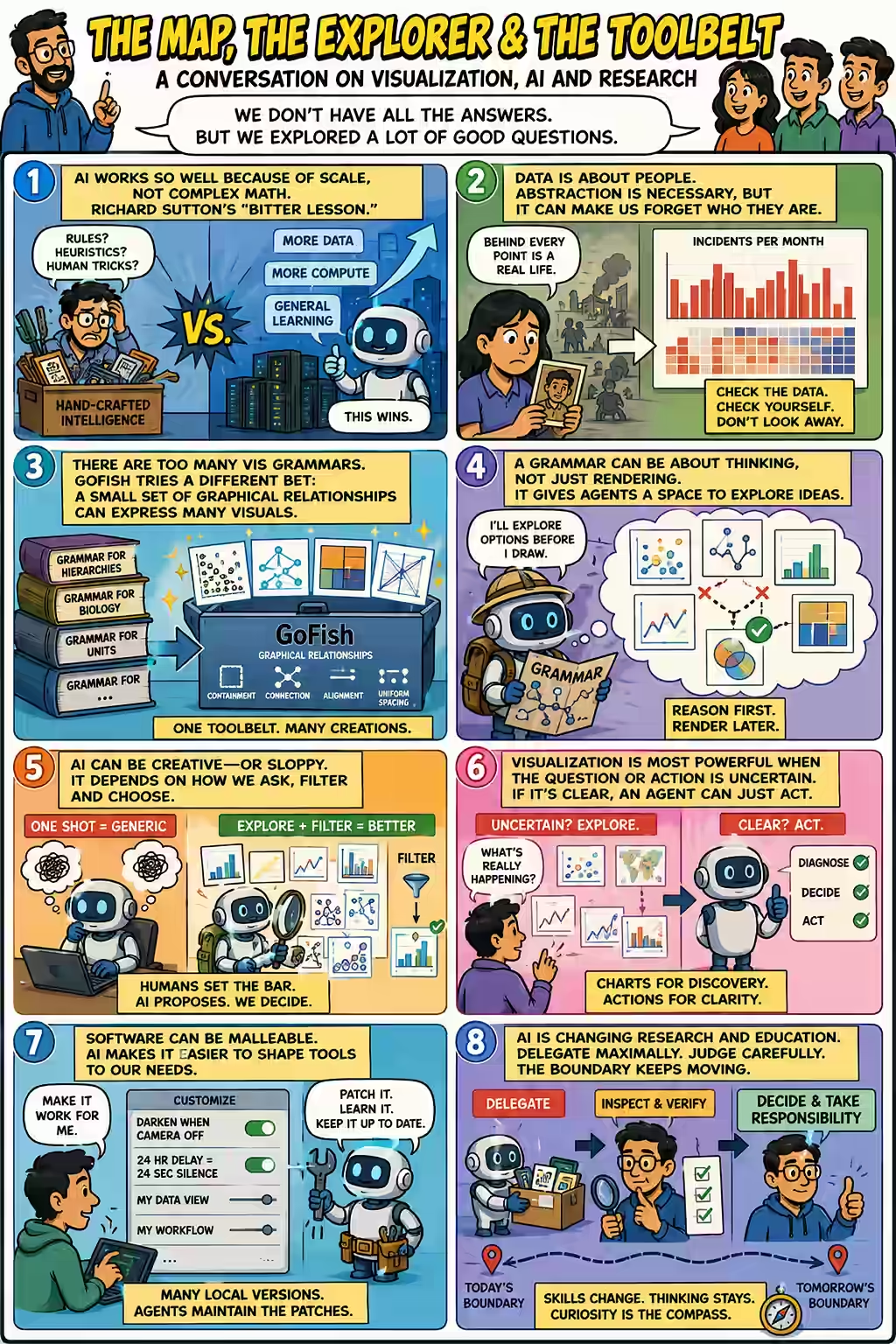
This week, I learned:
⭐ How to teach so people learn better. Make them do > Show > Tell. Workshop > Demo > Slides. Let them ask, try, struggle, and commit first; explain next; help last. But only when they know enough to get part-way. Make problems CONCEPTUALLY hard (not in language, visual, or procedure). But make sure instructions are clear. Test their learning with a NEW case, immediately. Measure learning. Can they recall it LATER, apply it ELSEWHERE, explain WHY, and know when they may be WRONG? Vogue runs an “In the bag” series where people pull stuff out of their bag, and audiences watching feel they KNOW the person. Depending on the setting, we might be able to help people “know” each other by curating several items. Here are a few ideas. Physical: Bag, Wallet, Fridge, Drawer, Keychain, Remembered phone numbers Mobile: Battery usage by app, Recent emojis, Text prediction for “Honestly, I just want to…”, Autocorrect dictionary, Alarm labels / reminders, Saved Wi-Fi, Blocked/muted contacts, Contact favorites, Contact names, e.g. “Mom ❤️” vs “DO NOT PICK UP”, Device / Wi-Fi names Laptop: Open tabs (count, age), Recurring calendar events, /Downloads, Photos, Email drafts, Subscriptions, Kindle highlights Ownership and connections come from attachment, which can be created. If you name something, touch something, contribute to something in any way, it becomes yours. When people contribute to someone else’s work and discuss it, they build a connection. According to both Claude and ChatGPT, if you had to pick one model for ideation / brainstorming, it might be GPT 5.5. It’s better for divergent generation: the broadest, most exhaustive pool of usable ideas. Fable 5 is better for deep creative judgment: reframing, finding structural flaws, recombining ideas. Claude Code supports rules which are exactly like a CLAUDE.md but support a paths: YAML metadata - so they’ll be read only when Claude Code is reading those paths. If you have a SKILL.md that explains how to do something and you only need its outcome, then move it to a sub-agent (e.g. fake data generation, tool failure logging). Use SKILL.md for instructions that need to be woven into a task, e.g. memorable explanations. The key bottlenecks in running an agent /loop are (a) imagining higher order problems and (b) defining a measure of success / progress. Long tail -> sell options. Black swan -> Buy options. That’s a roughly accurate summary. The trouble is, we don’t always know which tail we’re in. So, sell only if you can afford one hit. ArchiveBox lets you view pages / RSS feeds offline. uvx --from git+https://github.com/ArchiveBox/ArchiveBox.git@dev archivebox works, and config / tools are stored in ~/.config/abx/. The installation didn’t go very smoothly and the whole thing felt bloated, so I abandoned it. I use monolith -I -e $URL to download a page as an offline single-page HTML. Combined with uvx feed2exec I can archive RSS feeds for offline reading. That’s easier than having to open Feedly - I just mark read files with a x at the front and keep reading. The downloads are slow (~3 min/feed) and large (5 GB for 15 feeds, 5MB median feed size) because they embed videos and all images/files, but I can safely delete what I’ve read or will ignore. ChatGPT Project Injection as Role Confusion is a very well written paper (blog-post style) that says the key to tricking LLMs is to confuse them about WHO wrote a line. Just adding a “User: " in front of a line makes it more likely that LLMs think it’s a user. Even when test is written in the style of their system instructions, they fall for it - irrespective of where the content came from. This makes GEO more effective, too. Also, the last section “8. Open Ideas for Roles Research” is a fantastic read on LLM psychology (or rather, neurology). On The AI Compass I am The Podcast Bro. Patron saint: Lex Fridman. “You listened to a three-hour interview with an AI researcher and now you have opinions. Strong ones. You’re long on compute and short on regulation, and you’ve said ’exponential’ more times this month than a calculus teacher. Love is the answer, and also AGI.” Impact: +5.9. Valence: +4.1. Since Nano Banana 2 Lite isn’t as good as Nano Banana 2 and about half the price, I wouldn’t switch yet. Claude Sonnet 5 is out. Fable 5 will be released soon. GPT 5.6 is still on probation. Codex has a Record and Replay feature for Mac that lets you do something, records it, and learns from it. Very useful for non-developers. It’s like recording Excel macros, which unleashed a lot of power for me when I didn’t know Visual Basic. Claude Code Artifacts lets Claude Code live-publish a web page and share it securely. The “live-publish” part is the interesting thing. Claude in a /loop can now become the app that updates a “dashboard”, a live feed/story, a self-evolving app, … and so much more. (This feature is only available for Team/Enterprise but the idea is universal.) Tau, like Pi, is a minimal coding agent. τ = 2*π. It shows what it does very transparently, making it easy to learn how agents work. uvx --from tau-ai tau works seamlessly. Configs, logs, and sessions are stored in ~/.tau and you can log in via your Codex/ChatGPT subscription. Skills for Design Engineers has a useful animation vocabulary skill that converts vague animation prompts to precise animation terminology. X has an MCP Server but it’s meant for development/coding than general users. Setting it up for ChatGPT / Claude requires creating tunnels. OpenAI supports Secure MCP Tunnels that let ChatGPT connect to your machine securely. A very powerful feature. Unfortunately, this seems to need an organization - and even though personal accounts can still access it, it’s proven a bit more messy than I’d like to use. notebooklm-py is a CLI for NotebookLM. Unofficial and potentially unsupported, but it’s amazing how AI makes reverse-engineering APIs so easy. If you start a temporary ChatGPT chat and close it, it still runs in the background - but you have no way of going back to it (not even the back button) or seeing what it said/did. I know this because it was accessing my MCP server even after I navigated away from the chat accidentally. The code refactoring industry can go full swing now. “As an example of what AI can accomplish, Claude Opus 4.7 substantially reimplemented gotree—a bioinformatics toolkit with about 16,000 lines of Go and 40+ commands. We believe this same task would take a human engineer without AI assistance 2–17 weeks. Opus 4.7 solved it in 14 hours, passing 2,000/2,001 tests (99.95%), at a cost of $251.” MirrorCode A useful rule of thumb: Cloudflare tunnels are for links to share with others. Taiscale is for services (even non-HTTP) only your devices should see. ChatGPT date -d (date +-%wday) +%F is the most compact way to round down to the nearest Sunday. Avoid date -d "last sunday" +%F which, on a Sunday, returns the previous Sunday, not today. ChatGPT A useful way of controlling AI verbosity is word count. To do that, I need an intuitive sense of how much to ask for. Here’s my rule of thumb: one page of paragraph text on ChatGPT is 200-300 words. 150-200 if it’s mostly bullets. I can typically read 1-2 pages of output. So, 300-600 words is my limit. Google Labs launched a DESIGN.md spec to guide agents on a consistent design. The good part is that it aligns with the proposed W3C design tokens spec. But beyond that, I’m not convinced of the benefit. Atlassian’s DESIGN.md had mixed results. Claude feels it could go either way. I’ll give this a miss for now. Questions I was asked Week ending 05 Jul 2026
...