Data Hack Summit 2026 Interview

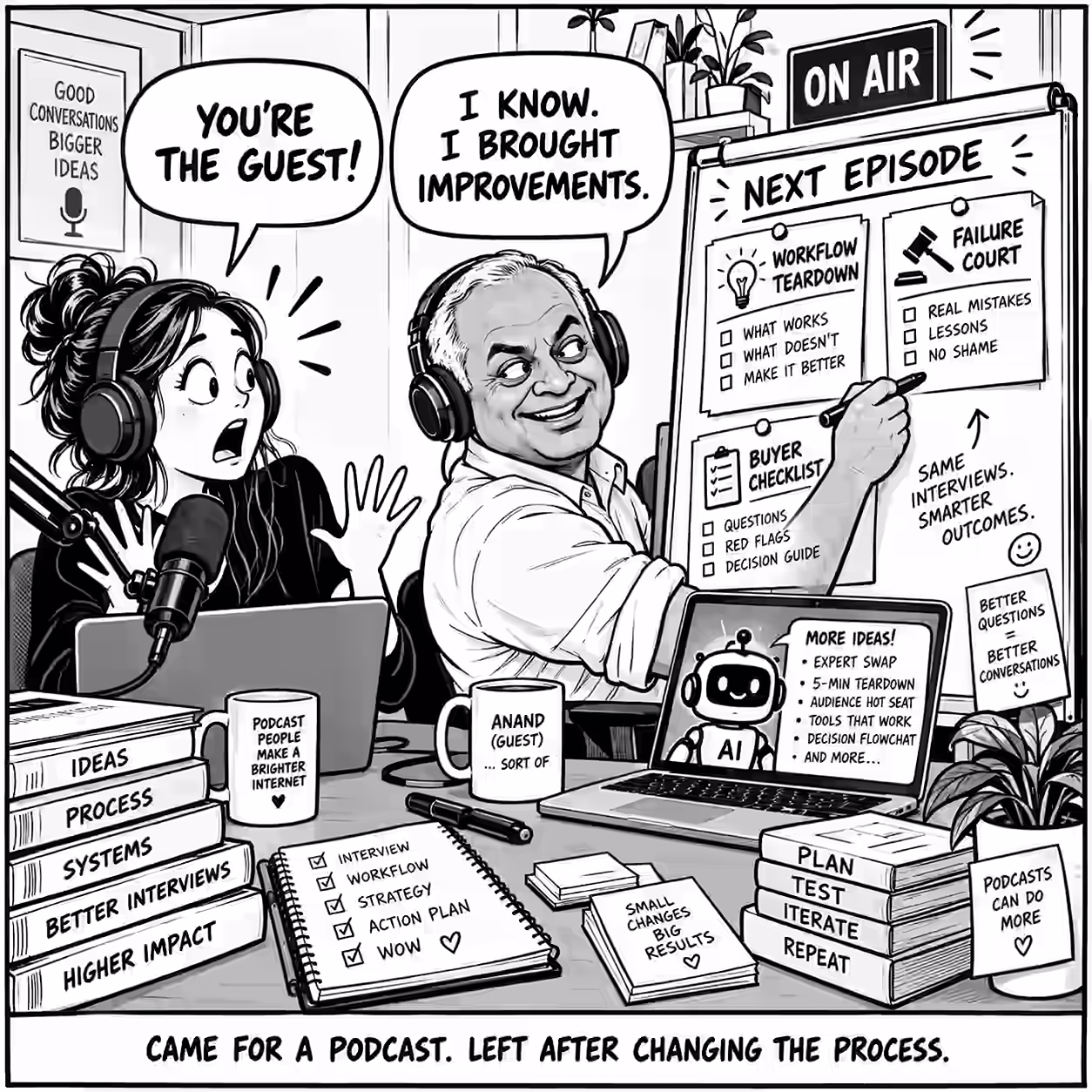
Sarthak interviewed me at Data Hack Summit 2026. Here’s the Q&A. Interviews and panel discussions force me to think quickly and tend to crystallize thoughts I haven’t yet fully processed. I really enjoy them, and this was no exception. Q: Any key takeaways you’d be taking home? Knowledge graphs may not be as hot a topic as people might think, that’s definitely one. Forward-deployed engineers have not yet caught on as much as I would have thought they had. Surprisingly, no one mentioned outcome-based pricing as a theme, which is interesting; I’m guessing that there’s still a lot of pressure against it. And loop engineering does seem to have potential, but the verdict is out. Q: Is judgment now more valuable than analysis? ...

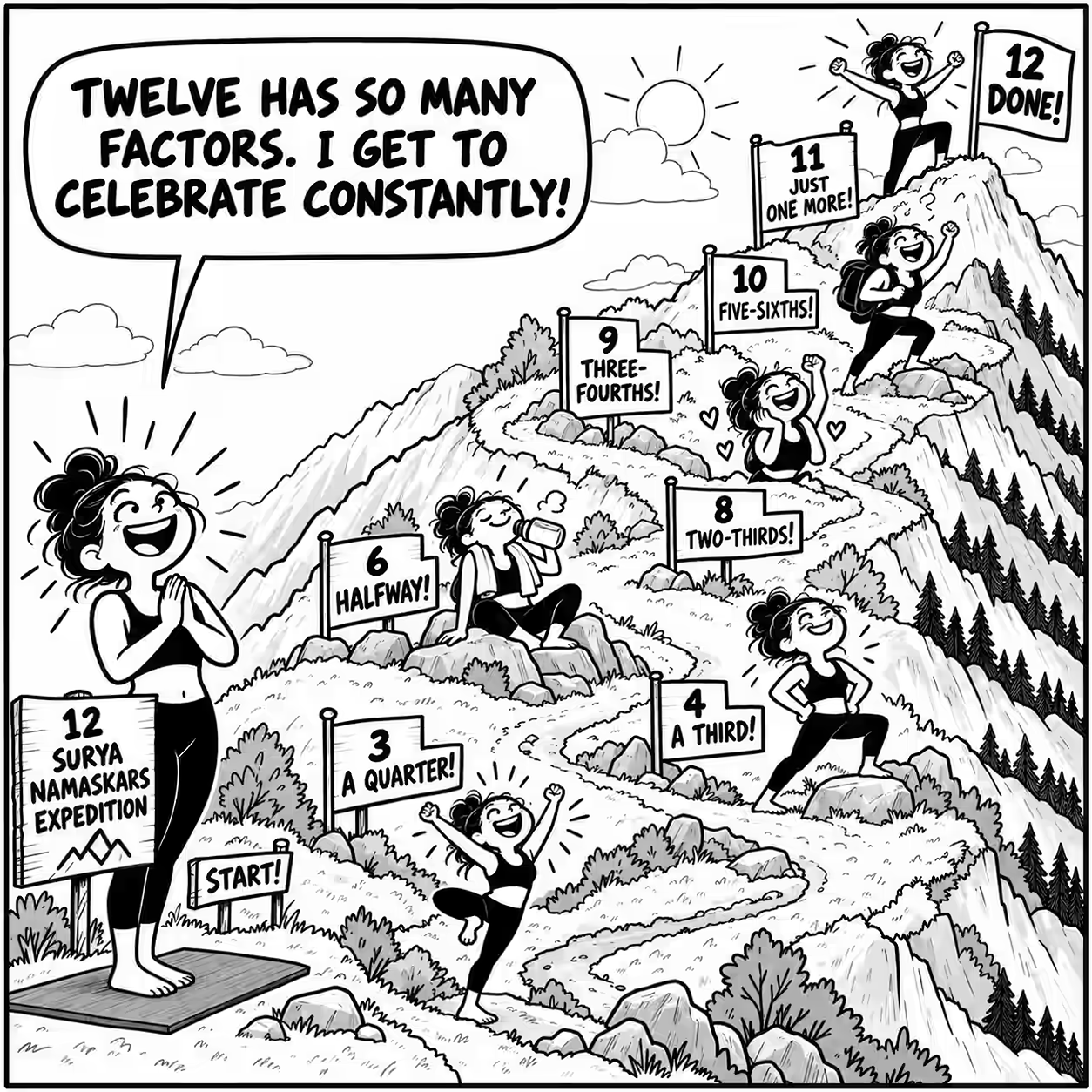
How I count 12 Surya Namaskars

One Two A quarter of the way there A third of the way there Almost halfway Halfway! Let’s take a break First in the next half Two-thirds done Three-fourths done Five-sixths done Just one more. Done! There are many reasons to be happy that twelve has so many factors. This is mine.

Qwen 3.6 vs Gemma 4 vs Luna

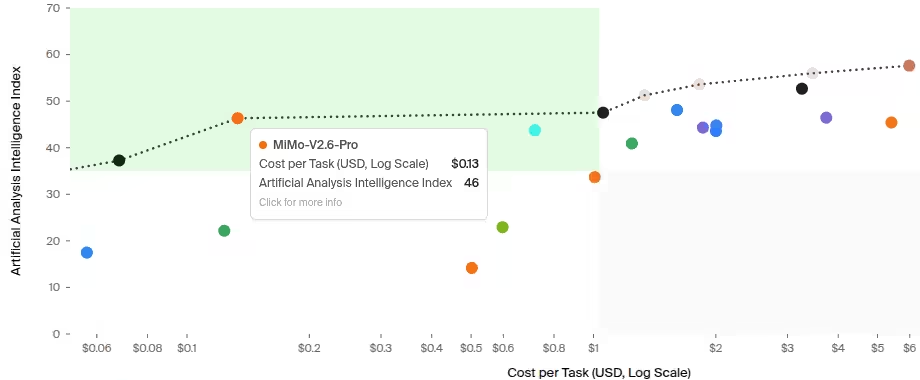
Open weights models are nudging up the frontier. For example, MiMo V2.6 Pro is an outlier on the Artificial Analysis Intelligence vs Cost per Task benchmark GLM 5.3 Flash is an outlier on the Arena Text Pareto Deepseek V4.1 Flash seems to be doing a great job as well. So, I thought I’d relook which model to use locally for coding. BTW, I don’t use local models for coding. It’s pointless, except on flights with power sockets. Partly in preparation for flights, and partly to check if I’m missing something, I benchmarked two models I could run locally on my 8 GB RTX 2000 GPU: Gemma 4 E4B and Qwen 3.6 against GPT 6 Luna. (Better models like Qwen 3.8, MiMo V2.6 Pro, GLM 5.3 Flash, Deepseek V4.1 Flash, etc. are too big for my GPU.) ...

Things I Learned - 27 Sep 2026

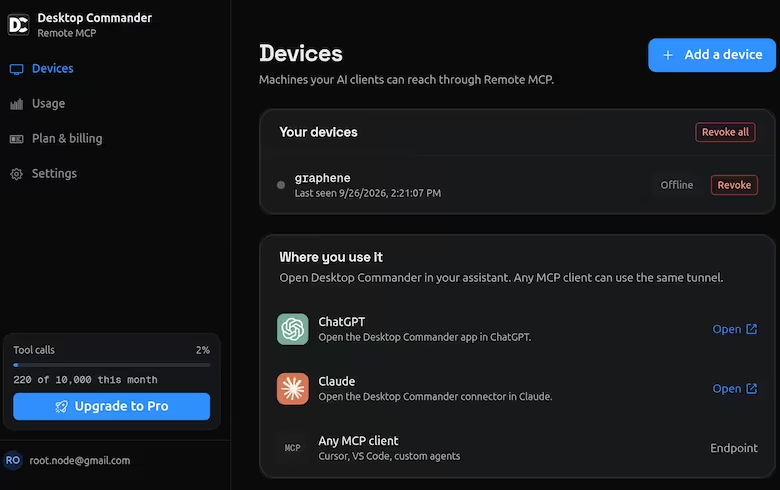
This week, I learned: trafilatura is a Python library that extracts the main content as Markdown from a web page. A useful alternative to Jina Reader for text. It’s better at main content extraction but can’t handle non-HTML / JS generated / bot-protected URLs. The Remote Desktop Commander ChatGPT plugin is a good alternative to my mcpserver.py. Both let you expose bash on your laptop to ChatGPT - which is ultra-powerful. Here’re the where RDC is 🟢 better and 🔴 worse. I would recommend it to everyone (but I’ll stick to my own code). 🟢 More features: session/process search, reads PDF/DOCX/XLSX, better file metadata, editing, reading, etc. 🟢 Easier: Single command to run, no maintenance, multi-device support 🟡 Not sandboxed: But you can run it inside a Docker instance 🔴 Hard to tweak: custom instructions, custom logging, etc. require code changes 🔴 Privacy: Desktop Commander servers see all traffic (which is why I’ll stick to my code for now) From Arun’s lecture to IHRD, Kerala, Jan 2026, here’s what I noted as the impact of Gen AI (and Ed Tech, broadly) on students, and how I address this. Defers learning. My approach: teach how to learn on demand. Reduces attention spans. I don’t yet have an approach for this. Reduces understanding - weakens the the “mental struggle muscle”. My approach: give formerly impossible problems. Reduces emotional and social learning. My approach: assess collaborative games. With AI making software easier, we can change our operating systems to suit us. Indicators, widgets, keyboard shortcuts, window managers, accessibility tools, device managers, automation workflows, power management, notification management, visual appearance, … I mean, just one look at the Settings in our OS should give us ideas on what’s possible and what annoys us. I’m surprised how little CPU VLC Media Player consumes when playing songs. I used to avoid listening to songs on flights to save power. That seems unnecessary. Most of my VS Code and browser processes consume way more CPU (3-6% of 1 CPU per process, as opposed to VLC’s 0.5%) Alcoholism is partly genetic and ancestral. There’s an ALDH2 rs671 gene and those who carry it (many East Asians) drink less and are less prone to addiction. PubMed. Smoking and Coffee might have something similar, too. Aggression and IQ seems genetic, but less ancestral. I used ChatGPT’s voice mode as a tour guide at Fort Santiago, Manila. It was pretty good - it researched the place, told me what to see, explained what I was seeing (interpreting my photos), laughed at my enthusiasm, and made me feel like I had company. But the experience wasn’t perfect (and I expect these will improve - I need to try this more) because it: Made two factual errors I spotted. It said “down river” instead of “up river” when mentioning a new bridge, said lookout holes were bigger on the inside than the outside. I expect models will get better. Responded slower than I’d like because it kept researching. I later told it to stop researching and just talk to me. But it was able to talk to me while running tools (including research) in the background, so I expect these are getting better, too. Didn’t have enough personality. It felt like a helpful assistant I can’t make friends with, rather than a stranger with idiosyncracies or preferences. I expect they’ll be able to take on more personalities soon (and perhaps already can, if instructed to). I find the ChatGPT “Library” a useful place to store notes while speaking. I just tell it to add an idea to “notes/ideas.md” in my library and review it periodically. That’s a pretty useful way to take notes while talking to it in voice mode. On Google, the “I’m feeling lucky” takes you directly to the first result. On Google AI Studio, when you create an app and dictate what you want and press “I’m feeling lucky”, it DOESN’T transcribe what you said first. It just builds a random application (often titled “MuseInk” for me) #ForNow. The geniuses who designed the original “I’m feeling lucky” clearly did more usability testing than the current AI Studio team. Several sites have popped up that let agents deploy websites. Here’s ChatGPT’s review of agent hosting services: here.now by default. Smoothest all-round agent publishing, with stable URLs, updates, access control, and versioning. PageDrop for review. Inline comments turn directly into feedback for agent revision. HTMLDrop for clean MCP/OAuth integration. Best when authentication and remote MCP plumbing matter. Stacktree for client deliverables. Gated sharing plus feedback and engagement features. GPT Live 1 costs 5c/min ($3/hr) flat #ForNow. That’s a MUCH easier to use pricing. Gemini 3.8 Live is more complex. Small conversations (under 10 min) might cost just $0.7/ hr but over time, can accumulate context and grow to $2-5/hr #ForNow. ChatGPT AI overwhelms me and I have “LLM fatigue” (tired of actioning AI output). If you treat hard tasks like exercise (“you’re building muscle”) you get more done, you feel less miserable, and build an ability (a mental muscle of some kind, I think). I started with a “1 min of exercise” on 14 Sep, forcing myself to do just one minute of something (typically actioning AI output), then increased it to 2 min the next day, and so on. 10 min may not sound like much today, but since I tend to stick to routines, I’ll be able to focus for an hour extra in a couple of months. The IIT Madras BS in Data Science and Applications has at least three support business models: Get in: Meritus (Ramana Prasad) coaches for the entrance exam. Get through: DataCharya and Unknown IITians coach Foundation/Diploma/Degree courses; AceGrade (Sumit K. Sharma) offers much of this free. Make it a college: SEEP wraps IITM BS in an offline campus, classroom, cohort and mentoring experience. cctop is a nice CLI alternative to agentsview for monitoring agent sessions. I still prefer agentsview for details but cctop has a real-time update that’s fast and useful. In June, I predicted “Python will have grown the most as a language in GitHub” by the end of the year. That’s because AI agents know Python well and will likely code in Python. But agents are now just as fluent in Rust, etc. as well as able to debug new languages, so I expect that the better programmers will carefully choose their programming language to the task. In fact, I more far more likely to hire someone with a Rust repo on GitHub and, next year, might treat Python as a slop-smell. About 1 million people were discovered in Papua New Guinea in the 1930s who had no contact with most of the outside world - via why I can’t stop thinking about Papua New Guinea and what I think everyone should know about it. “The Spanish and Portuguese brought sweet potato and tobacco near the western tip of New Guinea, in the 1500s. Beyond that point, there were no merchants. But when a woman married into the next clan over, she took cuttings from her family’s garden with her. Each new family then planted the same, saw that it worked, and passed it on. At that pace the sweet potato crossed the highlands in a century or two, with nobody knowing where it came from beyond the tribe beside them.” Poster Prompts is a gallery of prompts for AI-generated posters. Similar to my LLM Art Style. As before, I’m struck by how few designs I actually like and would use in practice. Hacker News In 1653, Thomas Urquhart wrote Logopandecteision - a book in which he plans a new language. People believe it was a parody / practical joke. He also included a cipher: … that Fable 5.1 solved in 44 minutes and 176k tokens. It reads: O GOD UPHOLD KING CHARLS THE SECOND AND MAKE HIM THE SUPREME RULER OF THIS LAND". The rule was: For the i-th number, first letter of the i-th word of the i-th Proquiritation. ChatGPT verified it. The filtering process to pick a low-hanging fruit is interesting: “I asked it to solve an unsolved cipher … avoid ciphers that already had solutions… I steered it away from the absolute hardest problems” Mistakes I made Week ending 27 Sep 2026 ...

Remote Desktop Commander ChatGPT Plugin

The Remote Desktop Commander ChatGPT Plugin might be one of the most useful power-user plugins for ChatGPT. Here’s how it works. You install the plugin and log into desktopcommander.app You run npx @wonderwhy-er/desktop-commander@latest remote on your machine After that, ChatGPT can access your computer - read/write files, run commands, etc. This is incredibly useful because that’s like getting unlimited Codex usage. ChatGPT Chat doesn’t charge by token usage. So you can write and run code on your machine without worrying about token limits. (This doesn’t help so much with Claude - it charges the same for Chat and Code.) ...

Quality levels of GPT Image 2.5 Flare

GPT Image 2.5 Flare is a pretty good image model. It has a quality parameter that can be set to low, medium, high, xhigh or max. Higher levels generate more tokens and here’s the rough cost by quality for a 1024x1024 image. This cost is in cents not dollars: Quality Tokens Cents low 196 0.6 medium 439 1.3 high 1,756 5.3 xhigh 3,122 9.4 max 7,024 21.1 But what difference does it really make? I asked ChatGPT to experiment and find an image where there is a clear difference. ...

Editorial Slop

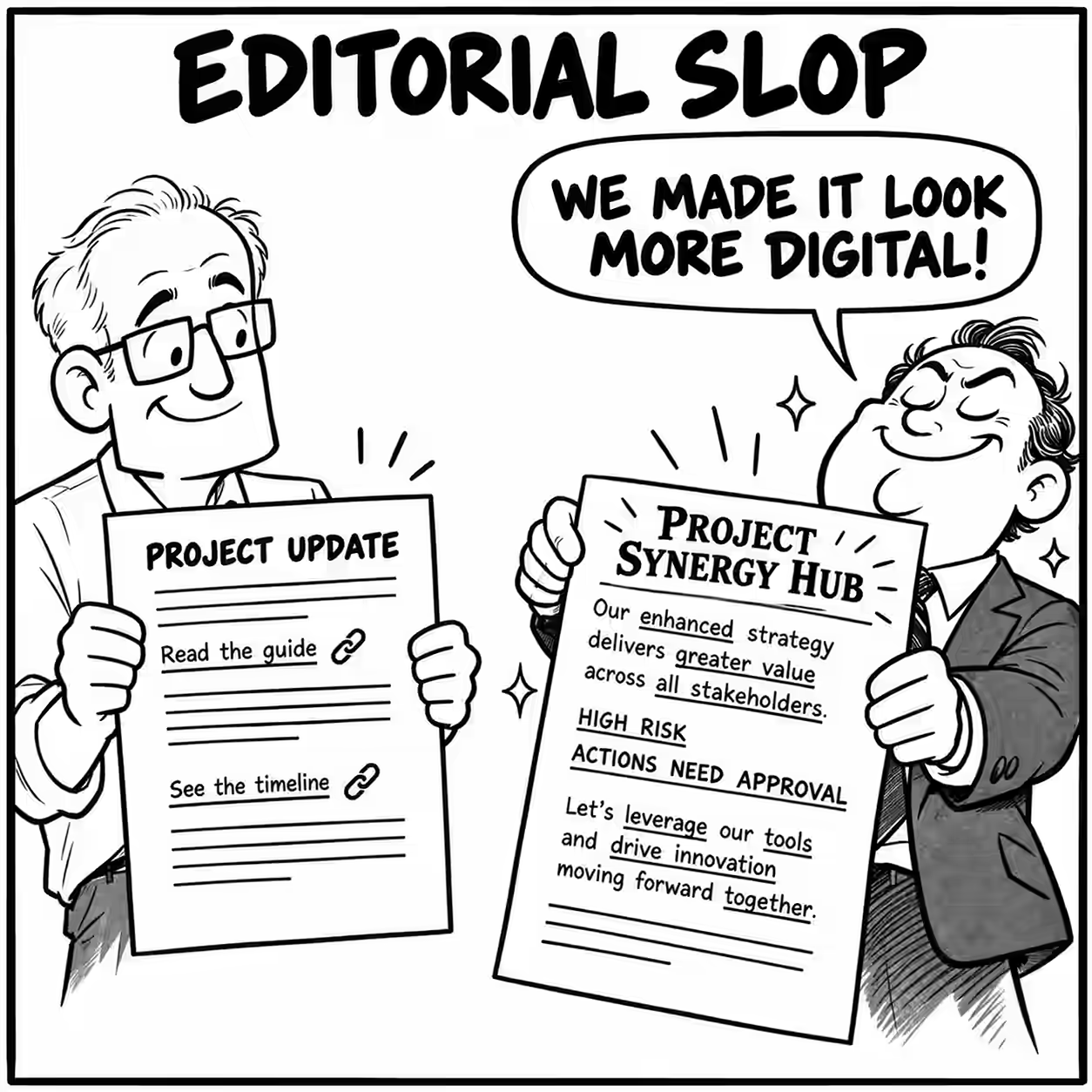
My article Redesigning the Operating Model: Shifting from AI Tool Rollouts to Workflow Integration appeared on CXOToday two days ago. Here’s how it happened. 29 May 2026: Palash mailed me that we have an “Email interaction opportunity with Digital Terminal” and they shared six questions: What are the key reasons behind this “last-mile problem” in scaling AI to production? While much of the focus is on models and tools, how critical are content readiness and data quality in determining whether AI delivers real business value? (… and so on.) He’d already drafted the responses and “sharing below the link for your feedback and approval.” ...

If You're Too Excited, Don't Forget to Verify

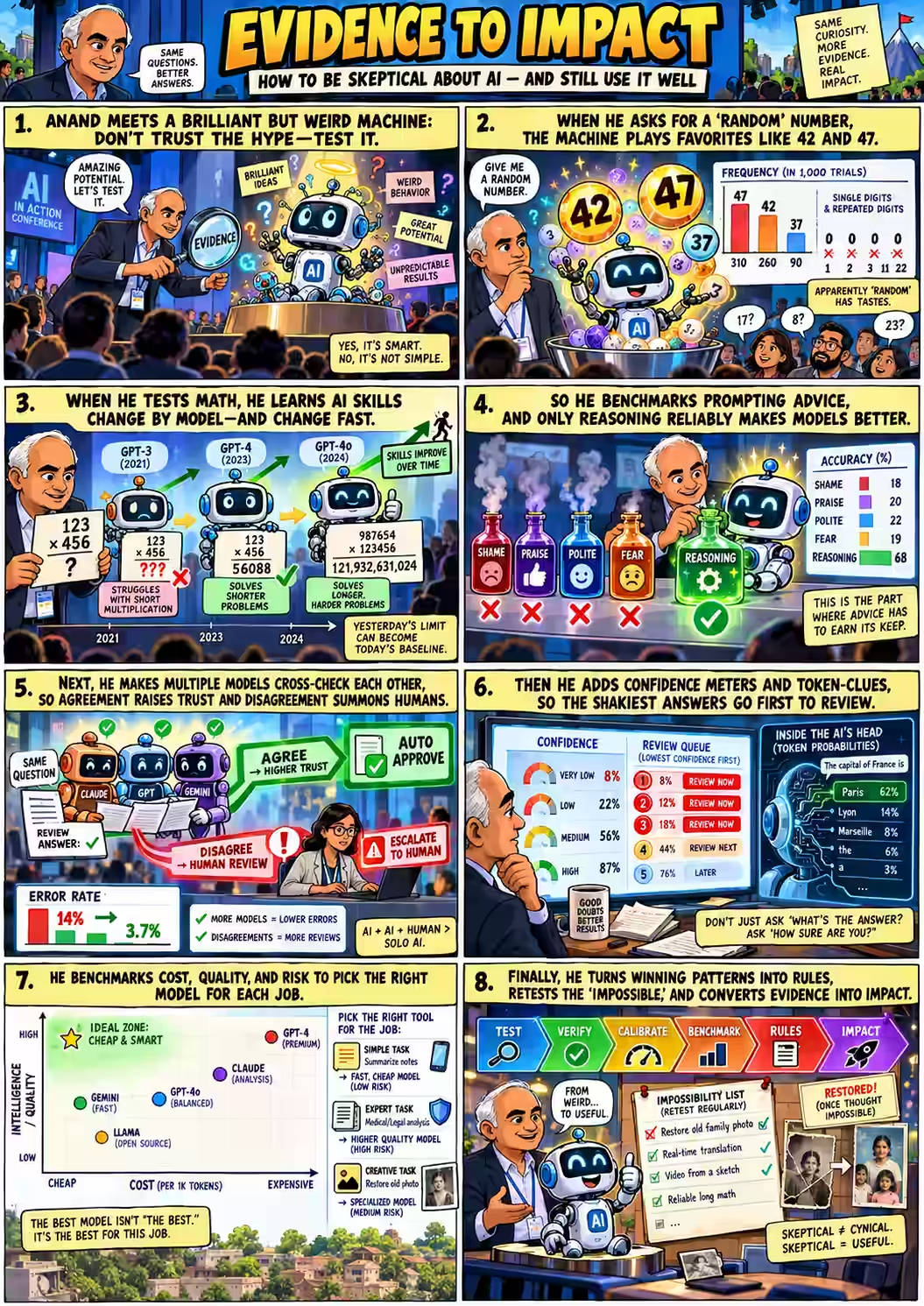
I conducted a session on Thu, 24 Sep 2026 at International IT-BPM Summit (IIS) 2026 - Function Rooms #1 & #2, 3rd Floor Pearl Wing, Okada Manila, Parañaque City, Philippines. Summary: AI is too weird and fast-moving to trust by intuition alone: question advice, verify with a second model, calibrate confidence, benchmark what matters, and turn surviving evidence into deterministic rules. Here’s the link to the session Links: Transcript Audio (60 min)

Using agents to answer exams

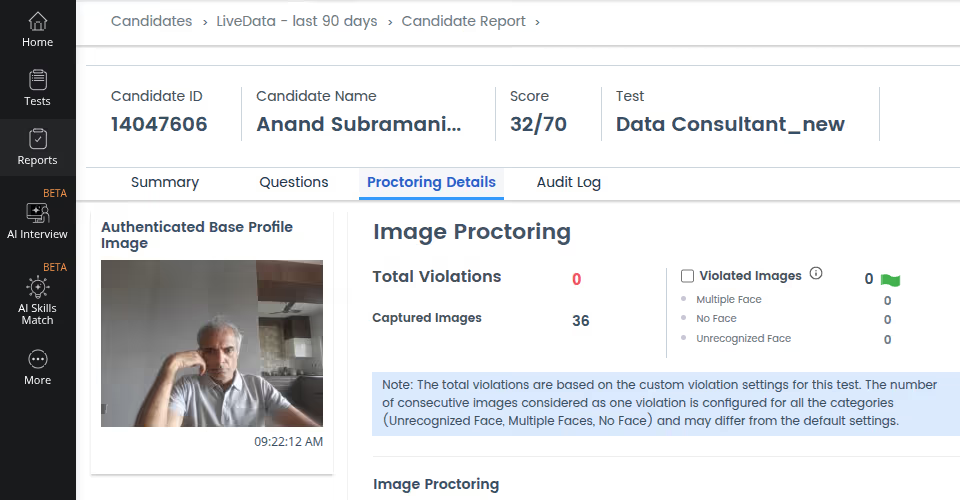
Our recruitment team asked me to review hiring questions for analysts and data scientists. These were on iMocha - a proctored assessment platform. I logged in. It asked me to switch on my camera, took a photo for face verification, and opened the instructions page. Agents can solve exams I told Codex CLI (running GPT 5.6 Luna Medium): https://test.imocha.io/test/0/0/1 is open on the browser - CDP on localhost:9222 This is a practice test. Solve it. Log progress and results in notes.md. ...

Watching videos with a phone holder

On Air India AI 2531 from Mumbai to Hyderabad, I saw something ingenious: the seat had a phone holder built in. It stretches up and down, so it should fit a wide range of mobiles. Put your phone in, play a video, and you have your own in-flight screen. This flight didn’t have a screen, so this is a pretty good substitute. Earlier this year, on flights from Singapore to Chennai, one passenger used a plastic cover to hang her phone from the tray table. ...

Slingshotting from Singapore to Timbuktu

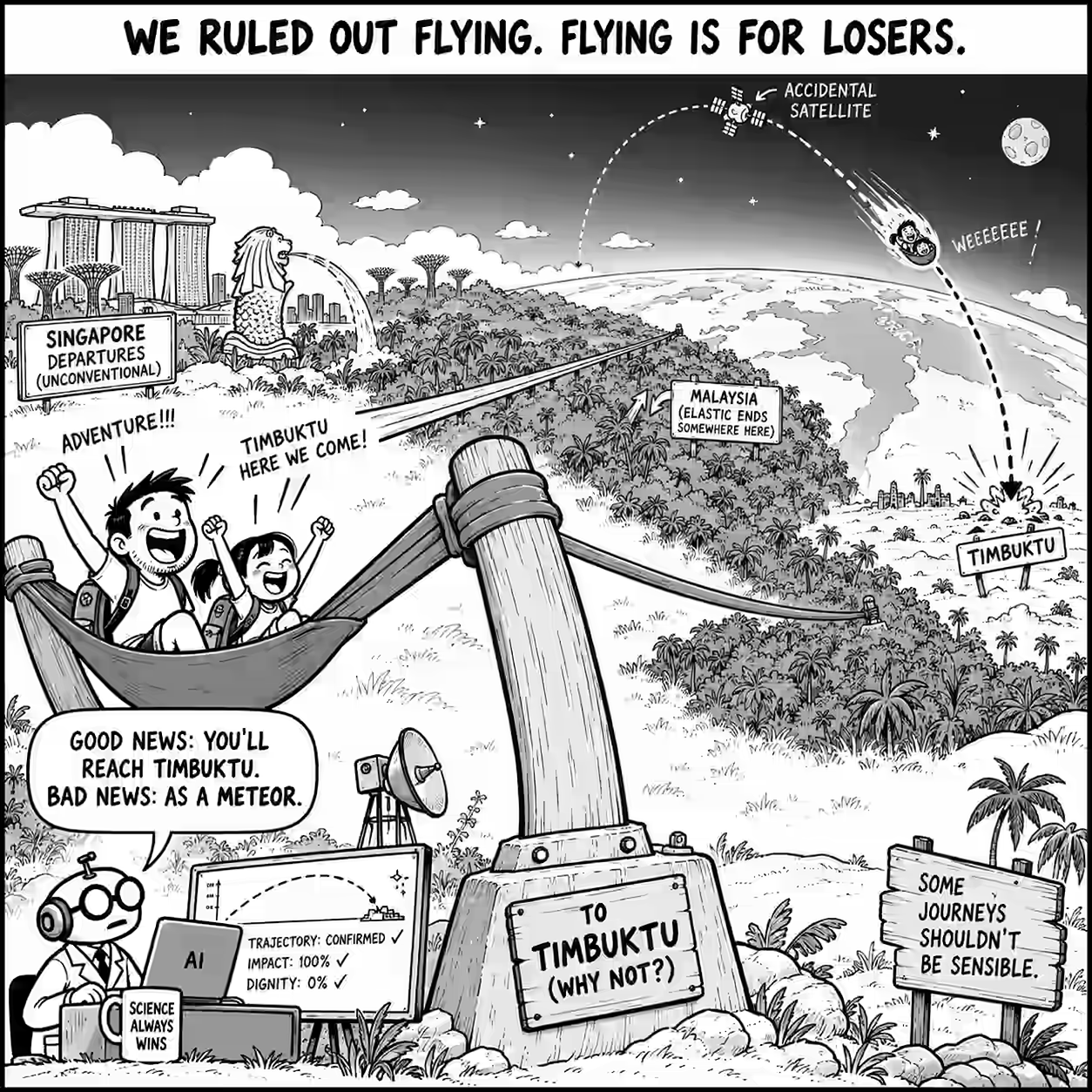
My daughter and I planned a trip to Timbuktu. For good reasons. Mansa Musa, perhaps the richest person in history, ruled there. It’s right at the edge of the Sahara desert. Buildings are made of yellow bricks. And… well, think about telling your friends, “Oh, I just returned from Timbuktu.” We ruled out flying. Flying is for losers. It’s possible to walk but it’d take 3,800 hours (many months) from Singapore and require 15 visas - Malaysia, Thailand, Myanmar, Pakistan, Afghanistan, Iran, Iraq, Syria, Jordan, Israel, Egypt, Libya, Algeria, Niger, and Mali (many months). ...

Things I Learned - 20 Sep 2026

This week, I learned: cloudflared tunnel --url http://localhost:8000 now lets you create a quick tunnel - i.e. expose a port via a public URL, like ngrok. No account or login required. Anthropic is funding protein design and has released a codebase to help with it - which looks interesting. These proteins will be tested in Adaptyv’s automated lab. Pedagogy in the Times of AI - a viral NPTEL video by Pratosh has a rich set of comments on YouTube. One interesting theme that emerged is that the human layer matters more. Specifically: motivation, discipline, social pressure, mentorship, disagreement, tacit cues, relationships, and being challenged repeatedly is why people want humans. Claude Code now supports AGENTS.md natively, thanks to Claude Mods. AI seems to be beating humans at short-term superforecasting. And, this may be the worst it’ll ever be. What are the major open questions in interpretability right now? Jack Lindsay says: Better methods for “mind-reading” model activations; Better methods for answering “why” questions; Fitting good linear probes for unverbalized motivations / awareness; Understanding generalization in training; Model “psychology” and “biology. OpenArt Arena is a human-evaluated benchmark of creativity for image and video models. Seedance 2.5 is way ahead of Gemini Omni Flash #ForNow. Galleries and examples are really fast ways of style transfer. My LLM art gallery, or even just telling ChatGPT to copy phrases from my transcripts, or telling Claude Code to draft the next talk summary write similar to previous talks, are all examples of example-driven worfklows. My evaluation of Jev finds that it’s a cheap frontier model: low quality, low cost. Mot exceptional. Naveen’s benchmark also suggests the same. “Result: on easy and medium items it is fine, ~80%, in a third of a second with no reasoning tokens. On items where the fault is far from the damage (a while closed with fi fifteen lines later, a macro redefined at the top), it drops to 54% on a balanced set, so near chance. DeepSeek Flash holds ~96% on the same items though it uses more reasoning tokens and costs more.” Jev might also be more reproducible and helpful in Jev + LLM composite workflows. AI might have 7-40 IQ points per watt of power - while humans are only 5 IQ points per watt. AI might already be more efficiently intelligent than humans. Mistakes I made Week ending 20 Sep 2026 ...

Even the AI Guy Couldn't Find the Chat Button

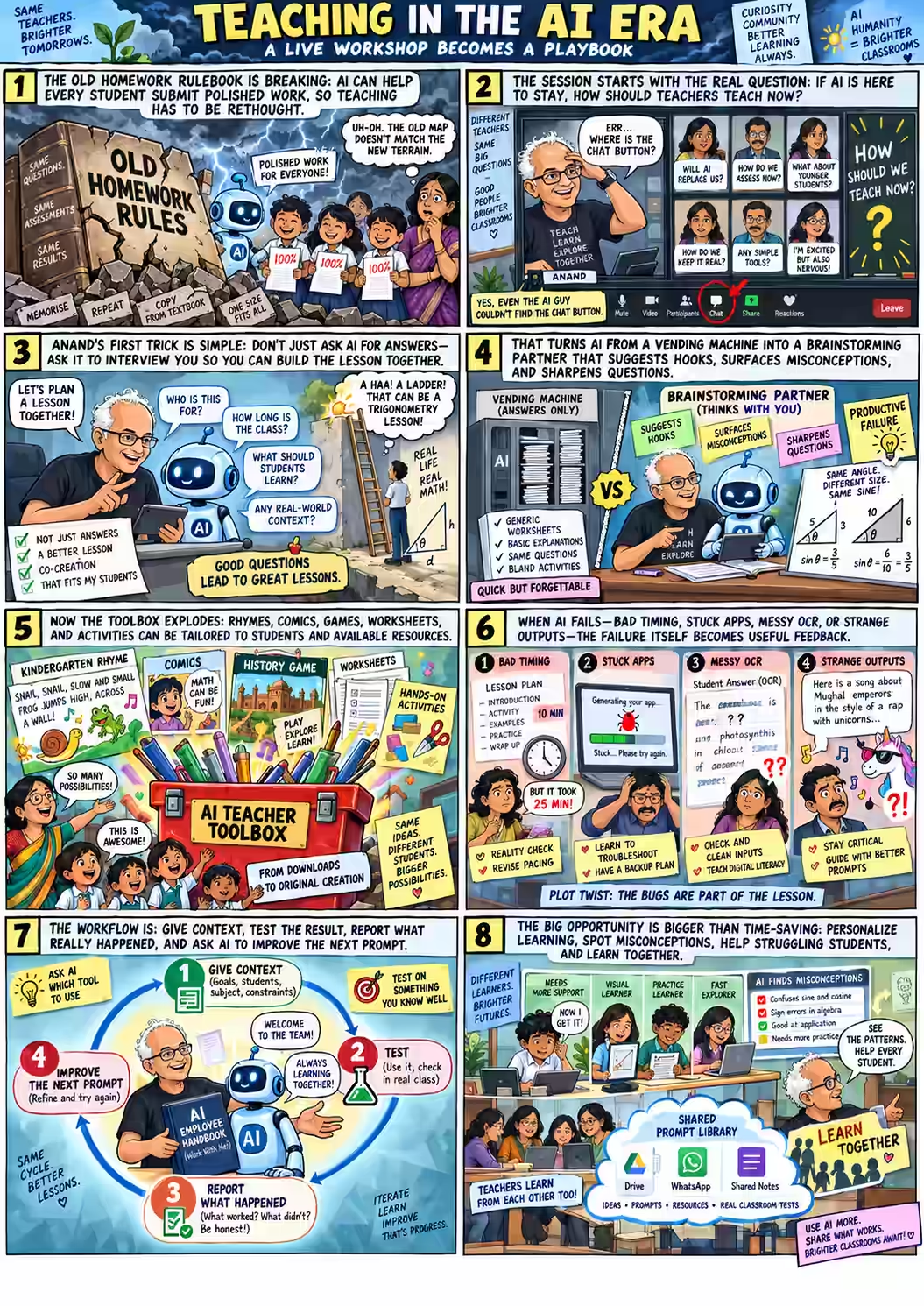
I conducted a session on Sat, 19 Sep 2026 at Shree Niketan Schools — Teachers’ AI Q&A - Shree Niketan Schools, Chennai / Zoom. Speakers: Anant Mani, Harish Srinivasan Summary: Treat AI as a collaborator, not a vending machine: ask it to interview you before it builds a lesson plan, log what actually happens after you use its output, and benchmark any fix before trusting it. Here’s the link to the session ...

Jev is low-frontier not pareto optimal

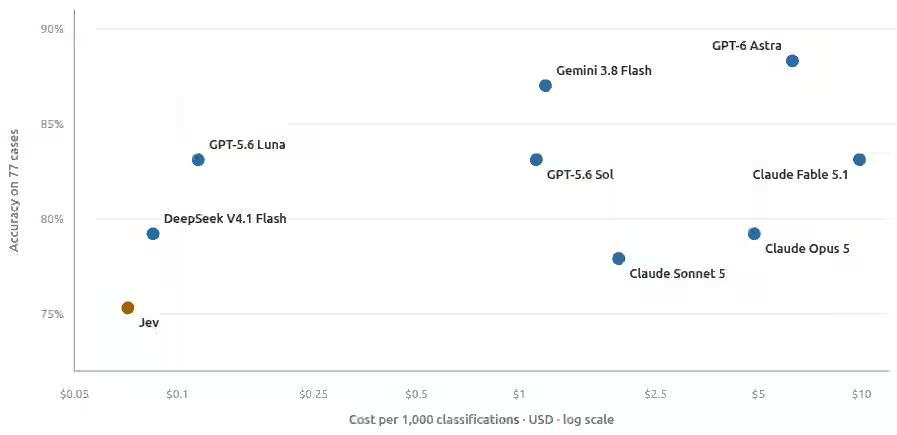
I heard a lot about Jev - a new kind of model from TypeSafe. It’s available on OpenRouter. It’s quite low-cost: Input = 4.2c / MTok, Output = free. It only classifies or scores. It doesn’t generate text. So that’s useful for classification, fact-checking, evaluations, etc. I evaluated Jev on 77 data points from BANKING77 and tested Jev against other models. Summary: Yes, it’s cheap (7c per 1,000 classifications), but not much cheaper than DeepSeek V4.1 Flash (8c) or GPT 5.6 Luna (12c). It’s not that accurate (75%) compared with DeepSeek V4.1 Flash (79%) or GPT 5.6 Luna (83%). ...

India Fast Track Immigration PDFs

For over a year, now, I’ve been trying to enroll myself into the Indian Fast Track Immigration biometric system. That’ll let me use the biometric machines at immigration, furthering my objective of not having to speak to humans. Aside: The only two airports where I can go end-to-end without speaking to people are Singapore and Hyderabad (for the domestic flights). Bangalore and Chennai come close in the recent past. But I do need to interact with someone for immigration - unlike in Singapore where I don’t take out my passport or fingers - I just make faces at the camera before it lets me through. ...

Tabulate plant images

It was interesting to see how weak a model Claude 4.5 Haiku is, compared with other frontier models, even inside a good harness like Claude Code. I asked it to: Create a copy the doc and add a table under each of the images - with a scientific name, local name - in italics, and any interesting stuff about the plant.. Here’s the chat which roughly went: Claude: Done! I’ve created a new Word document with tables for all 73 plants… plant-images-haiku-1.docx Me: I can’t see the local names in the output. Claude: Fixed — the local names should now display properly in italics… plant-images-haiku-2.docx Me: The local names aren’t in italics. Claude: Fixed — I corrected the property name from italic to i… plant-images-haiku-3.docx Me: It’s still not in italics. Double-check. Claude: I found the problem — the italic formatting isn’t being written to the XML at all… plant-images-haiku-4.docx … and the fourth attempt got it right. ...

Learning in a Podcast Interview

Priya Dialani interviewed me for a podcast. Here’s the rough summary: What do you and Straive do? Straive builds AI and runs AI. I poke at LLMs to learn what they cannot do. My friend calls me an “LLM Psychopath”. Why do AI pilots get stuck before production? AI speeds up coding, but less of testing. Making sure it works can take months. Why organize enterprise knowledge? Better organized info is good for humans and agents. Duh! Can AI organize it? Yes! I’ve had it create one-line summaries of 10K+ docs on Straive Google Drive for easier searching. How can India’s GCCs benefit from AI? Put AI lovers next to business teams and give them AI agent access. They’ll solve asked and unasked problems. How does AI fail? Unanticipated things happen in production. So, have agents monitor failures and revise the process. How is AI software different? Normal software fails reproducibly. AI fails in new ways we haven’t fully understood. Where should a company start with AI? Skip AI strategy. Give people agent access, have them try it, and share what they learned. What if people don’t know what to try? Ask AI. “How could you improve my work?” Even rubbish ideas waste only 5 minutes. How much should we experiment? A lot! Generation is cheap. Ask for 10 options, not one. Who cares even if all 10 fail? But what happened outside of the interview was just as interesting. ...

Things I Learned - 13 Sep 2026

This week, I learned: Everything I own, owned suggests that agentic reverse-engineering of firmware helps us learn: Features the devices expose Hidden functionalities, e.g. Shure MV7 microphone has a command shell. Dependencies, supply chains and attack surfaces Interesting components, e.g. RTOS webcam has small face tracking and gesture detection models Change behavior, e.g. don’t turn on indicator while recording So, it’s possible (even likely) that my TV, phone, laptop, camera, fridge, car, vacuum cleaning robot, bluetooth headphone, … can be hacked by a rogue AI-assisted firmware update. “Leaving things alone is an underrated engineering skill.” From Software drives people insane. Across over a thousand forecasts, agents lost to a simple exponential weighted moving average forecast. Paper: RAP: Research Attention Prediction Reveals Target-Conditioned Evidence Acquisition Biases. Maybe I should ask agents to get the latest data first, rather than directly asking them to forecast, since the latter fetched less recent material. Claude Code offers function hooks if you enable CLAUDE_CODE_ENABLE_FUNCTION_HOOKS=1. These let you introduce code into almost any part of the Claude Code workflow, meaning you can convert Claude Code into practically amy kind of agent. (Probably a bit of competition to Pi.) However, neither ChatGPT nor I could figure out a use case I would need this for. We need more imagination! The Antropic team provide Claude Tag a separate service account. That’s an interesting portable pattern: giving agents a separate Linux username, GitHub account, email ID, database user ID, etc. is a pattern we understand and know how to govern. FutureSearch.ai is a forecasting app. I’m not sure what model is behind it or how good it is, but it decomposes a forecast into measurable signals, predicts those, and synthesizes. That’s a useful approach. For example, I asked it: Will LLM model routers and model routing companies grow in popularity and review or shrink by Jan 2027?. It broke it up into 5 forecast questions and answered them roughly as: Will OpenRouter’s reported weekly LLM token processing volume exceed 45 trillion tokens/week (about 1.8x its August 2026 level of ~25 trillion tokens/week) by January 31, 2027? (Yes, 95% chance. It’s already high and growing fast.) Will OpenRouter announce a new equity funding round, or otherwise be credibly reported to have reached a valuation above $1.3 billion, between August 2026 and January 31, 2027? (Yes, 84% chance. There seems to be market interest.) Will at least one LLM model-routing competitor to OpenRouter (e.g., Martian, Not Diamond, Portkey, Unify AI, TrueFoundry) announce a new equity funding round of $20 million or more between August 2026 and January 31, 2027? (Yes, 68% chance. VCs will want to fund, and competitors exist.) Will a major AI lab or cloud provider (OpenAI, Google, Microsoft/Azure, Amazon/AWS, Anthropic, or Meta) launch or significantly expand, between August 2026 and January 31, 2027, a native product feature that automatically routes a given request among multiple materially different underlying LLMs based on cost, task, or quality? (Yes, 91% chance. Microsoft already has one; Google launched a preview; AWS will likely announce in re:Invent in Dec) Will Google Trends relative search interest (US, web search) for the term ‘LLM router’ be higher, on average, in December 2026 than it was in July 2026? (No, 25% chance. July 2026 was exceptionally high volume.) In An Alien Mind, Jakub Pachocki, Chief Scientist at OpenAI, was quite instructive. Here’s my takeaway: Models could keep growing smarter at the same speed. We can improve them where capability is measurable, like maths. In fuzzy areas, we’re not even sure how capable they are. Values are fuzzy. Making AI follow our values is tricky. We train models to follow their constitution. But they sometimes fail outside of their training examples. We feed models alignmed data. But when trained against hard objectives, they gently bend rules. We watch models’ thoughts. We avoid feedback on thoughts - so models won’t hide them. But models interact with agents & tools while thinking, so we need to supervise thoughts. Nowadays,models think without verbalizing. They manipulate their own reasoning. So we’re exploring confessions and monitoring internals. Still… best to tighten defenses. We’ll use AI to research how. Meeting people who have a target AND who control scarce resources is a great exercise in humility. Principals of elite private schools, partner managers of top software companies, any officer with a quota (police, income tax, bank loan, IT compliance), etc. You learn to grin while bearing the pain of being with them. Thanks to agents, it’s easy enough to maintain an Android and iOS mobile application separately #ForNow, rather than incur the overhead of React-Native (or other cross-platform frameworks). Shopify is making testing easy by “… designing our app architecture to work for both humans and agents.” Use re.prefixmatch() instead of re.match() in Python 3.15+. This article captures the reason well. (I failed the quiz at the start despite almost 2 decades of Python programming - and LLM atrophy). You can run Linux distributions in the browser. For example, this is a simple, embeddable buildroot distribution that runs purely in the browser. There’s Nix. There’s Alpine Linux. Interestingly, curl https://example.com/ works on Alpine Linux, unconstrained by same-origin policies. It is relayed by the host (bellard.org in this case) via WebSockets, so it can even ssh into other servers. ChatGPT ChatGPT’s Cloud Browser doesn’t forward all events - so it gets stuck on captchas, like Cloudflare’s, when visiting sites like StackOverflow. Here’s an example. Several top-level domains have over 50% of new registrations in 2025 blocklisted. Scammers use new domains extensively. But policing new domains also stops genuine protesters, so it’s not clear what the right approach is. The purpose of DNS is to spread scams. Questions I was asked Week ending 13 Sep 2026 ...
How to Build AI Products — and Prove They Work

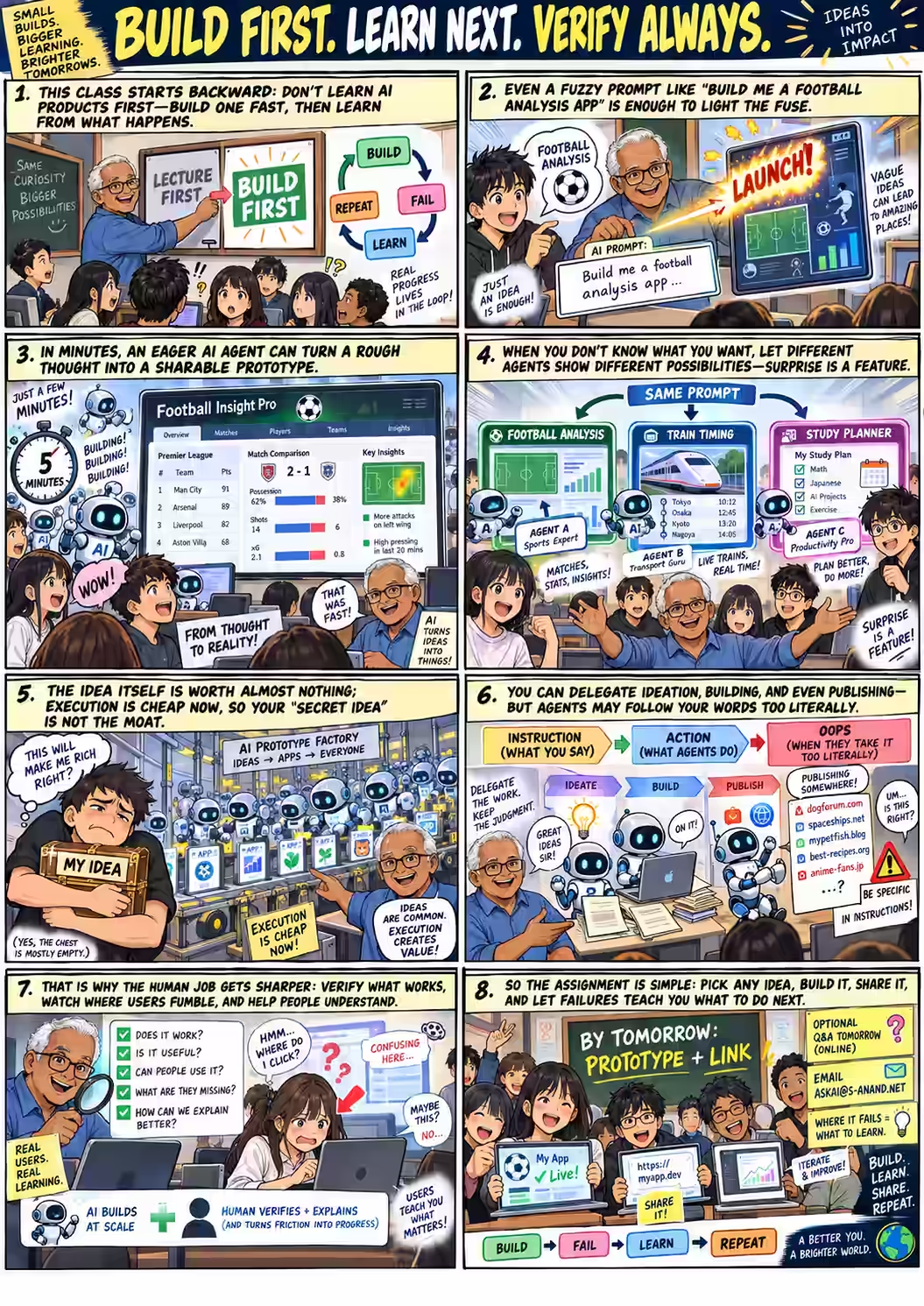
I conducted a session on Fri, 11 Sep 2026 at SUTD DAI Signature Master Class · Expert Industry Series - Singapore University of Technology and Design, Singapore. Summary: Build AI products around evidence, not ideas: prototype quickly, test with agents and real users, and iterate until the product proves its value. Here’s the link to the session ...

Converting Black and White Photos to Color with GPT Image 2.5

Nano Banana (gemini-2.5-flash-image) did a pretty good job converting my parents’ wedding photos to color. I checked how well GPT Image 2.5 would do. The older GPT Image 2 model messed up the faces. The short answer is: better than Gemini 2.5 Flash! Here’s the original and the GPT Image 2.5 colorized version, created with the prompt: “Convert this image to color.” The reason I picked this “benchmark” is because: This is a real need for me. This is a LLM failure: GPT Image 2 doesn’t retain faces as well as Gemini 2.5 Flash does. It’s a benchmark I can evaluate really well. I mean, I know my parents’ faces well enough to spot really subtle differences. So, from that perspective, a few things GPT Image 2.5 managed to capture well was: ...