The Innovation team has been experimenting with 3D interaction, audio, video and AI agents. Three things struck me:
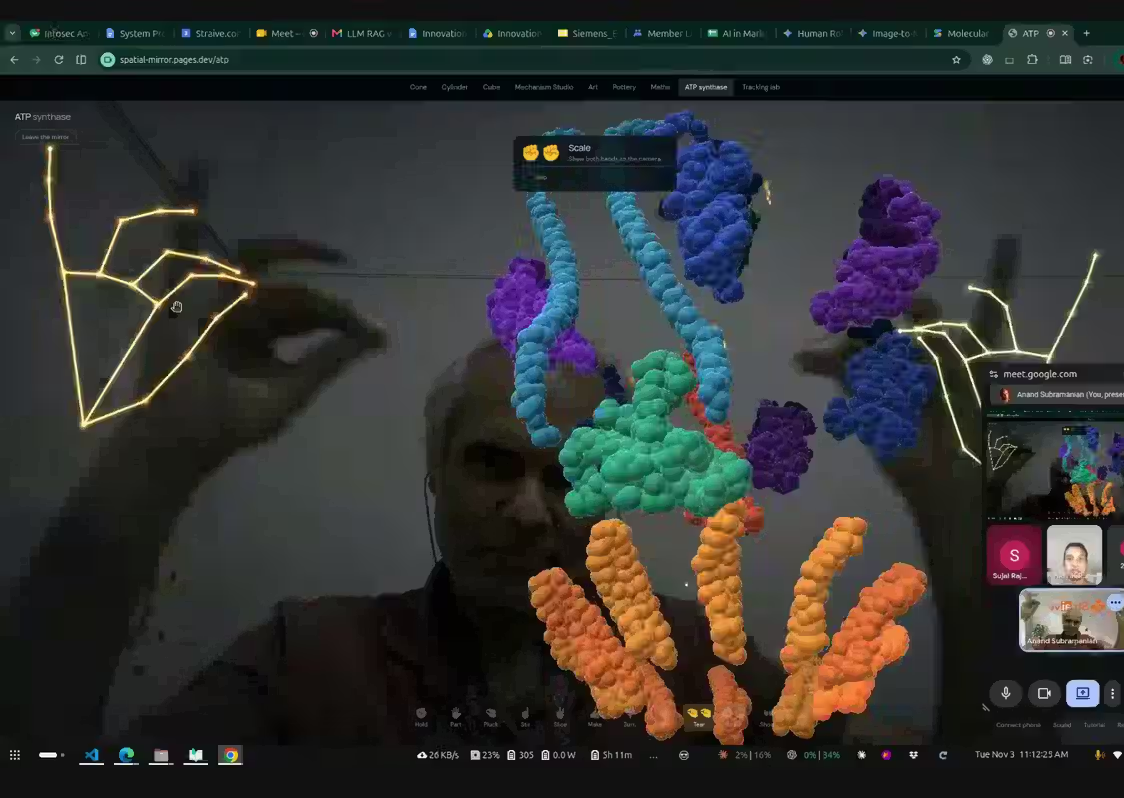
- We can manipulate a 3D molecule with our hands, or try different furniture in a virtual room, using a browser.
- Sound search can find things a transcript never records. And a small specialist model can diagnose a machine at a tiny fraction of an audio LLM’s cost.
- AI can help us improve videos and business decisions when its suggestions are checked against evidence, not just written convincingly.
New ways to interact and create
Hold a 3D molecule in your hands (Sujal). At our Innovation Team meeting, I used hand gestures in front of my camera to manipulate a colourful 3D ATP synthase molecule: pluck, slice, scale, rebuild and explore its parts. The browser recognizes the gestures; a paired phone can also control the scene. It is related to Sujal’s remote 3D pottery experiment.
- Uses: Science education, pharma/medtech training, virtual exhibits, remote product demonstrations.
- Ideas: Could a biology teacher pull apart a molecule while explaining it? Could a field engineer demonstrate how to assemble a part without shipping the equipment? The gestures take practice, and this is a visual learning interface, not a validated physical simulation.
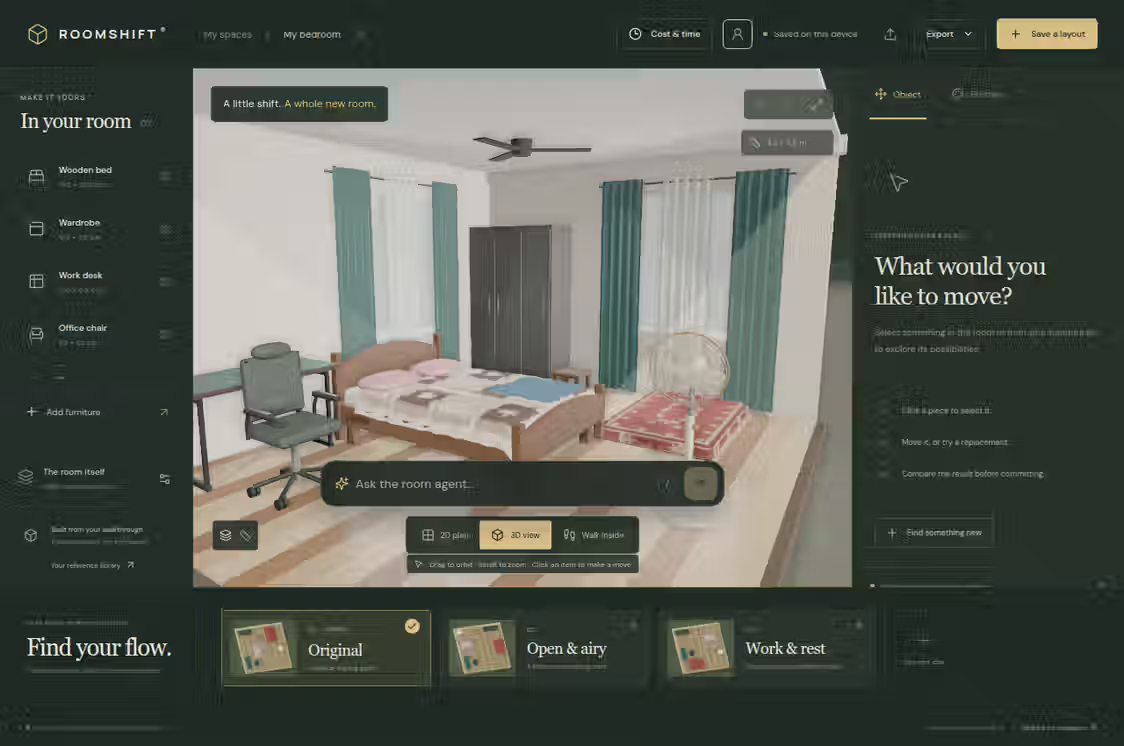
Rearrange a room, not just render it (Sujal). Roomshift lets you move furniture through a 3D room, swap pieces, compare layouts and walk inside. You can bring your own 3D model; the important difference from image generation is that the objects remain editable.
- Uses: Real estate, furniture retail, interior design, offices and facilities.
- Ideas: Could customers try a product in their own space before buying? Could we test hotel or hospital layouts with staff? Measurements are estimates until checked.
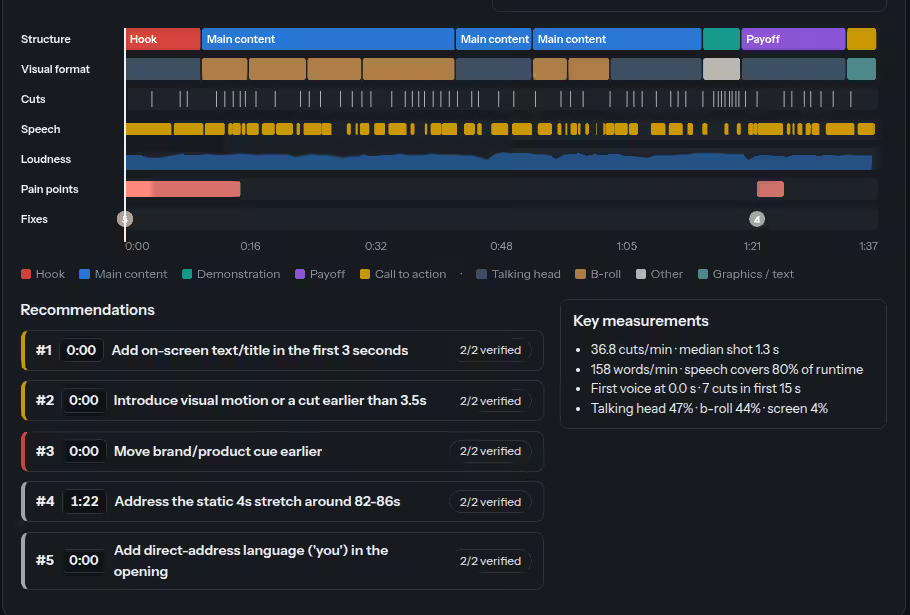
Find where a video might lose viewers (Sujal). Choose a demo video, click Analyze, and inspect a timeline showing cuts, speech, silence, visual formats and potential problems. In the Uber Eats Super Bowl ad, it suggests introducing the brand sooner and flags a static four-second stretch around 1:22. Every suggestion links to measured evidence, rather than being a free-form AI opinion.
- Uses: Marketing, video production, learning-content teams and media publishers.
- Ideas: What if every training video or campaign got an automatic editorial first pass? The tool flags possible attention problems; it does not measure actual audience retention or predict views.
Search and understand sound, not just speech
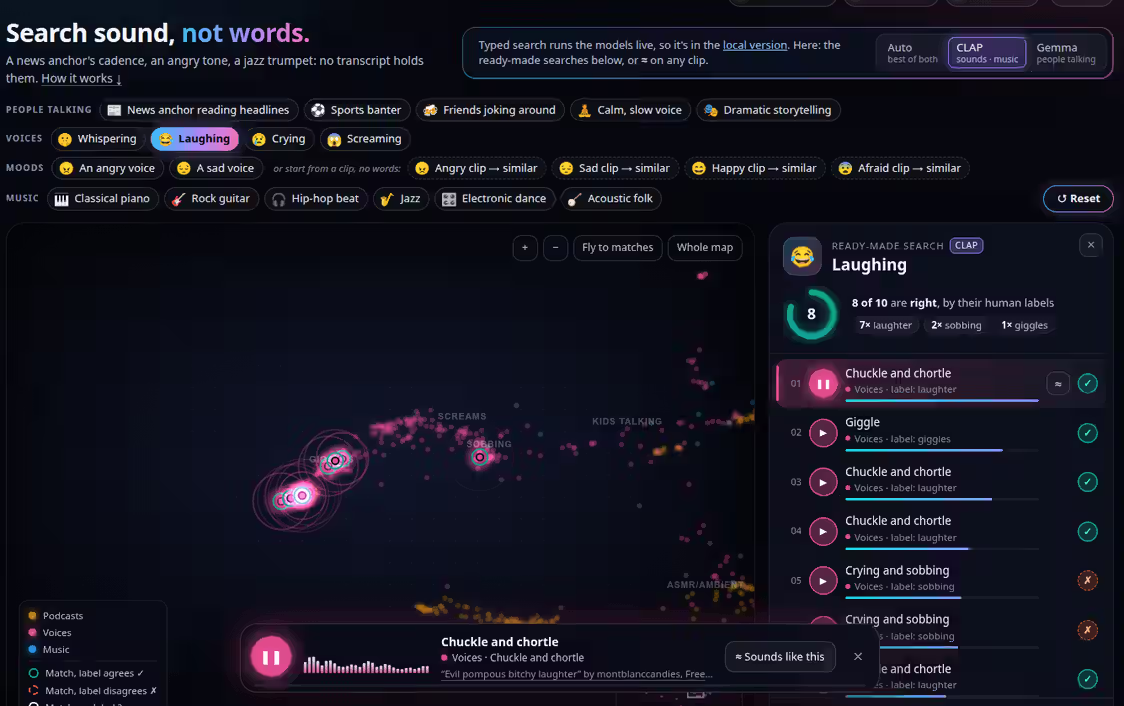
Find sounds that transcripts cannot search (Atharva). Search 7,221 clips for laughter, whispers, musical styles and conversations without using transcripts. In the live demo, CLAP found 8 of the top 10 human-labelled laughing clips. Atharva found CLAP stronger for recognizable sound events like coughing, sneezing and laughter, while Gemma is stronger for conversational scenes like friends joking about football. The demo can use both.
- Uses: Broadcast and podcast archives, contact-centre QA, accessibility, video tagging.
- Ideas: Search an archive for applause, sirens, background music or a change in tone. Could we enrich transcripts with a second index of everything audible that isn’t said? The hosted demo has preset searches; arbitrary new queries need its local backend.
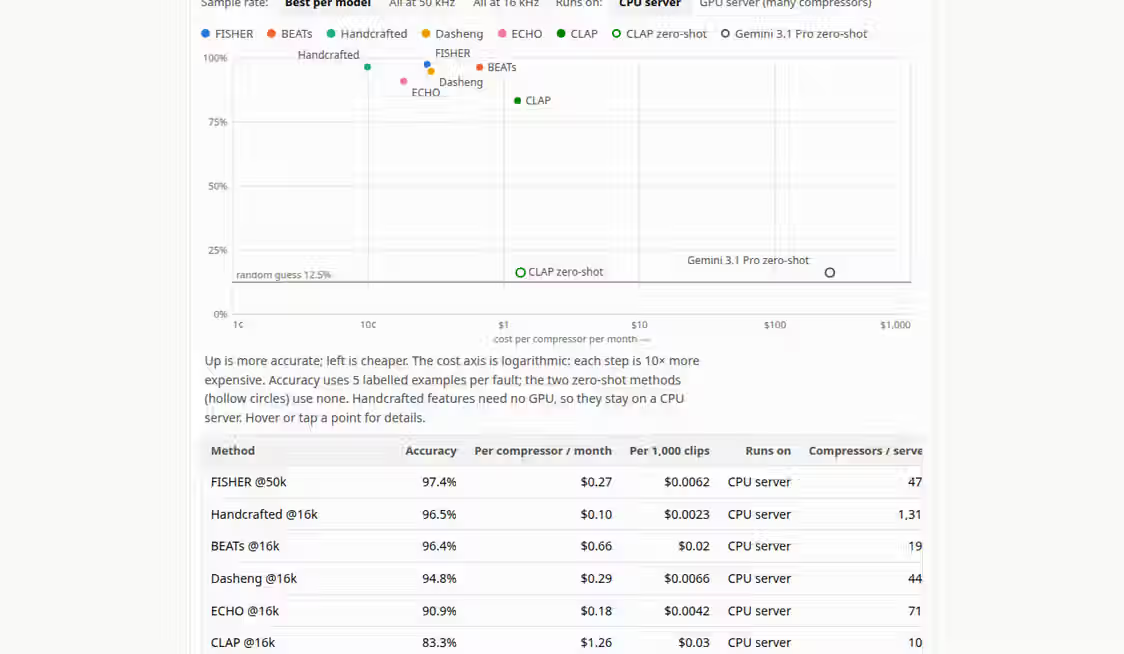
Diagnose a compressor from one second of sound (Jivraj). On recordings of one compressor in eight states, a specialist industrial-audio model, FISHER, identified the correct fault 97.4% of the time after seeing five examples of each state. Simple signal processing reached 96%; Gemini 3.1 Pro with no examples scored 16.3%. Estimated analysis cost: $0.10–$0.27 per compressor per month for the cheaper approaches, versus $254 for the zero-shot LLM.
- Uses: Manufacturing, predictive maintenance, industrial monitoring.
- Ideas: Before deploying an expensive general model, try a microphone and a few labelled fault recordings. These results are from one machine in one lab; transfer to a second machine remains untested.
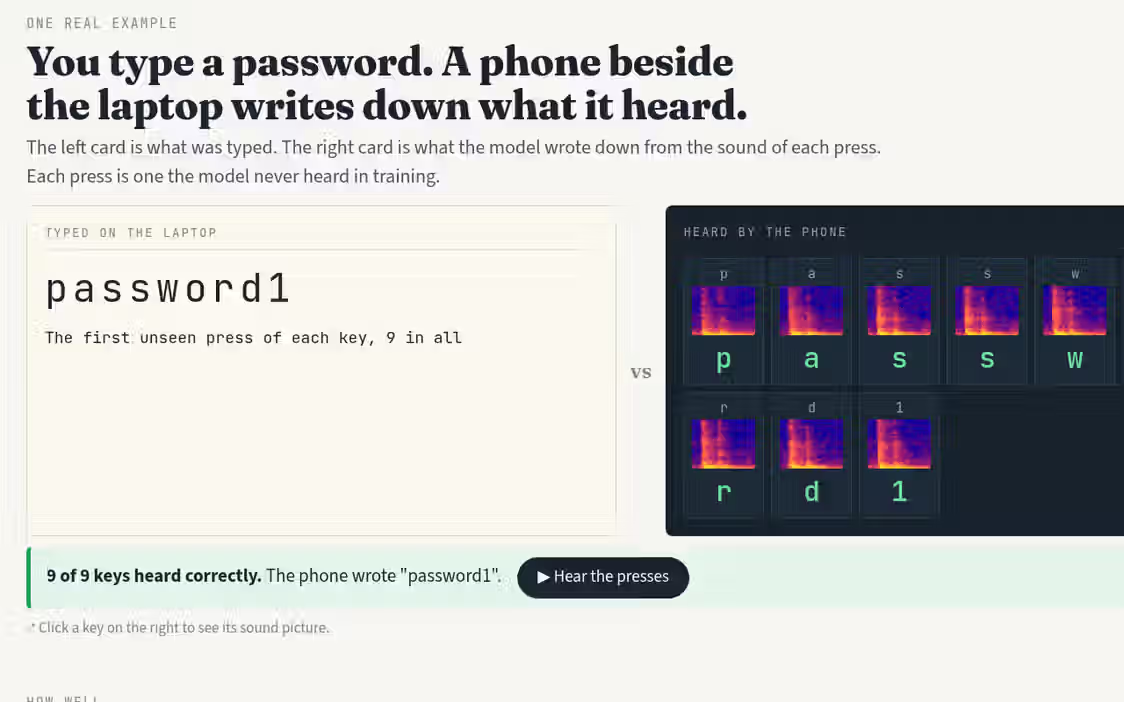
Can a phone hear your password? (Eswar). After training on the sounds of 25 presses per key, a small model identified 93% of unseen mixed keypresses from a nearby phone microphone. The page lets you listen to a word and see what the model inferred.
- Uses: Security awareness, endpoint and microphone risk assessments.
- Ideas: What can an innocent microphone reveal? It is device-specific: tested on different devices, accuracy fell close to chance.
Can we detect a cloned voice? (Eswar). A WavLM detector classified 94% of 604 held-out real/fake clips correctly, including simulated phone audio. But it caught only one of three newer voice clones when passed through a simulated phone line.
- Uses: Banking fraud, contact centres and identity checks.
- Ideas: A suspicious voice score could trigger callback verification, not automatic rejection. The newer-clone trial is tiny, and false alarms become costly when most callers are genuine.
The system around the model matters
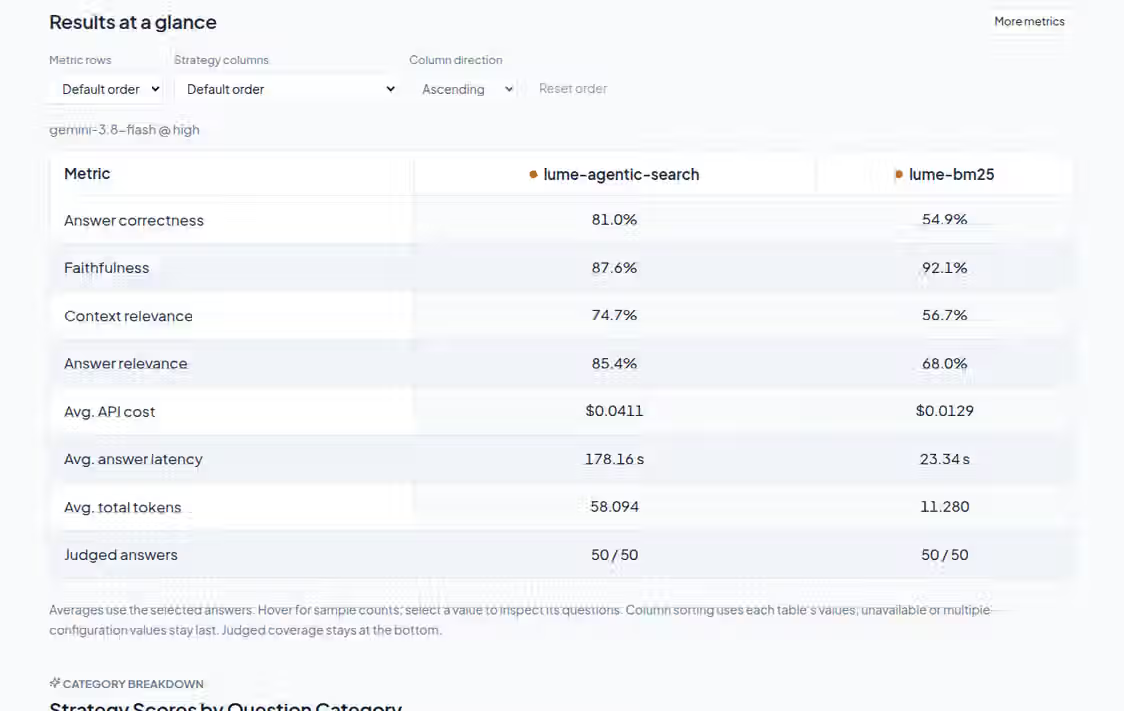
Search 10,469 financial filings: simple versus agentic (Hritik). On 50 questions with the same Gemini 3.8 Flash model, agentic search achieved 81% answer correctness against 54.9% for BM25. But it cost about 3.2× more, took 178 seconds rather than 23, and had slightly lower faithfulness (87.6% versus 92.1%).
- Uses: Asset managers, investment research, enterprise knowledge search.
- Ideas: Don’t choose a RAG architecture from a single accuracy score. Compare correctness, citations, latency and cost on the client’s questions.
Agents that cannot give themselves permission (Eswar). In a simulated bank, eight agents investigate a trader’s $2 million discrepancy. Every request goes through a code-enforced gate checking both agent permissions and the human’s entitlement. An auditor probes the rules; governance proposes changes; Compliance approves them.
- Uses: Banking, healthcare, agent security and compliance.
- Ideas: Let AI discover and propose fixes, but keep authorization and enforcement outside the model. The replay is synthetic, not a production security certification.
One experiment for education
Can an AI be wrong in exactly the way a student is? (Atharva). Across almost 68,000 questions to nine models, prompting a model to hold a specific maths misconception can make it choose the corresponding wrong answer. Reasoning often helps it make the intended mistake.
- Uses: Assessment publishers and adaptive-learning platforms.
- Ideas: Let simulated students test multiple-choice options for misconceptions they do or don’t catch, before giving them to real students. Their behaviour still needs checking against actual student choices.
Also worth exploring: Reproducible LLM-answer replay (Eswar)—it saves and replays the first answer, rather than controlling model randomness—and news grouped by headlines, patterns and underlying forces (Atharva), which could be adapted into a client-specific industry briefing.
These are experiments. If one sparks an idea or connects to a client problem, please let me know.