This week, I learned:
- Never conduct a synchronous (face-to-face or video) training if audience attendance is compulsory - e.g. colleges, offices. It’s depressing to watch bored faces. Prefer curriculum design / offline exercises. Conversely, ensure only interested people attend if it’s face-to-face, at least if you’re looking for energy.
- Agent Client Protocol is a standardized way for editors to communicate with agents. It’s maintained by JetBrains and Zed #ForNow.
- For some reason, my Redmi Note 6 QR code reader does not show an “Open in Browser” option for QR codes that have a hyphen under the .dev or .app root domains #ForNow - and shows the “Search” option instead. Most other URLs show the “Open in Browser” option just fine. Weird.
- Interesting thoughts from Sidu’s After AI, There Is No Average
- “… because if you and your agent do a month’s worth of work in a day, you now have to make a month’s worth of decisions in a day.”
- GPT 6.2 Astra seems to have enough spatial ability to figure out player positions from videos. X
- Gemini and Antigravity plugin for robotics let you use MuJoCo and control a robotic arm. X
- How I Finally Got AI to Write Like Me suggests: (a) take your blog posts, (b) convert each into a brief - removing the style and focusing on facts, (c) pick the model you’ll use and generate results, (d) have an optimizer like autoresearch, GEPA etc. optimize it. Step (b) - converting the blog posts into a brief was the insight for me - a nice way to create a benchmark dataset.
- HTML-in-Canvas is a browser feature that lets you render HTML inside Canvas. Felix’s artifact is a mind-blowing demonstration of what that makes possible.
- It’s surprisingly easy to create a web-based ePub reader. Readest has a version that lets you upload books and read (which is pretty good). Carrel is a single-file HTML ePub reader. Foliate-JS Reader uses the Foliate engine.
spotdlis a sort ofyt-dlpfor Spotify.uvx spotdl SPOTIFY_URLextracts the song metadata, searches for it on YouTube and other providers, and downloads it #ForNow, e.g. viayt-dlp. Of course, you could do that directly - and that’s a bit more reliable.
Mistakes I made
-
I said “if any system of intelligence is able to figure out if that input is correct or wrong, they will learn it” while explaining reinforcement learning to students.
Correction: Having an objective verifier makes reinforcement learning possible but does not guarantee successful learning. Exploration, computational complexity, training resources, reward design and generalization remain important constraints. Even with instantaneous, inexpensive verification, discovering a correct solution can be computationally prohibitive. Research on statistical limits of reinforcement learning · OpenAI: Reward hacking.
HIGH · OVERSTATED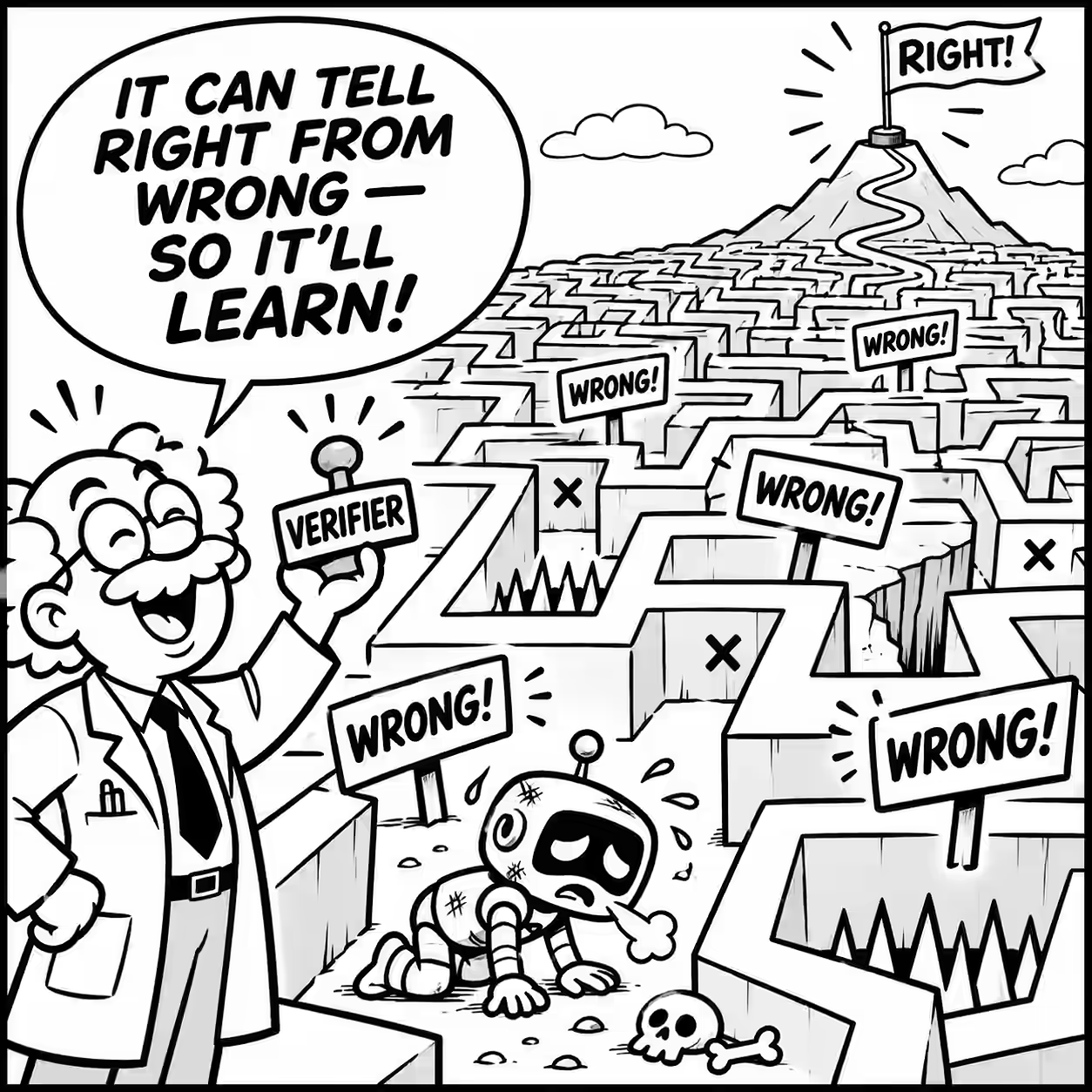
-
I said “they read the PNG compression almost like they read English” while demonstrating LLMs interpreting Base64-encoded images.
Correction: Some reasoning models can reconstruct tiny 8×8 images from Base64-encoded PNG files without external tools. In our experiment, GPT-6 Sol decoded all 35 inputs across five formats, but PNG decoding took most of a minute and cost 4–7 cents per image. This demonstrates a remarkable binary-decoding capability, not general fluency in reading compressed images comparable to natural language. Experiment methodology and results.
MEDIUM · OVERSTATED -
I said “the brightness of red, yellow, green” while explaining the BMP image format.
Correction: Conventional RGB bitmaps represent colors using red, green and blue components. Indexed bitmaps may instead store references to a color palette. The particular experiment used one-bit monochrome BMP files. Microsoft: Bitmap storage · Microsoft: RGBQUAD structure.
LOW · FALSE -
I said “the entire history of the chat gets passed for every subsequent request” while advising developers on reducing Codex token consumption.
Correction: Continuing a session generally carries forward conversational context, but not necessarily the entire original history. Codex automatically compacts conversations when they approach a configured context threshold, replacing earlier material with a smaller representation. Prompt caching can also substantially reduce the cost of repeated input tokens. Evaluate actual token usage, cached tokens and compaction events before deciding whether to restart sessions. OpenAI: Unrolling the Codex agent loop · OpenAI: Compaction.
MEDIUM · OVERSTATED -
I said “Atul Gawande went, ran a bunch of surveys” while explaining how empowering nurses to enforce checklists reduced hospital infections.
Correction: The well-known catheter-infection intervention described in The Checklist Manifesto was pioneered by Peter Pronovost and his colleagues. Their intervention included an evidence-based checklist, staff education, standardized supplies and authority for nurses to stop noncompliant catheter insertions. A subsequent Michigan study involving 103 ICUs reported a 66% reduction in infection rates at 16–18 months. Gawande separately helped lead the WHO Surgical Safety Checklist study. Original Michigan study · Johns Hopkins intervention · WHO surgical checklist study.
MEDIUM · FALSE -
I said “Atul Gawande … used to be the Surgeon General of the US” while introducing The Checklist Manifesto.
Correction: Atul Gawande is a surgeon, author and public-health researcher who served as Assistant Administrator for Global Health at USAID from January 2022 to January 2025. He was not the US Surgeon General. Atul Gawande’s biography.
LOW · FALSE -
I said “get washed … at water at 120°C” while illustrating surgical safety checklists.
Correction: Surgical instrument cleaning and sterilization are separate processes. Steam sterilization requires controlled temperature, pressure and exposure time, commonly 121°C for 30 minutes or 132°C for four minutes for wrapped instruments under specified autoclave conditions. The WHO Surgical Safety Checklist asks nurses to confirm sterilization, including sterility-indicator results, before incision. CDC: Steam sterilization · WHO: Surgical safety checklist.
LOW · FALSE -
I said “there aren’t many professions, if any, where the agents are being beaten by experts” while presenting GDPval results to experienced professionals.
Correction: Frontier AI models increasingly match or outperform expert-produced deliverables on selected, well-specified knowledge-work tasks across 44 occupations. GDPval measures performance on these sampled tasks, not overall professional competence. It does not establish superiority in entire occupations, particularly where work involves ambiguous requirements, interpersonal relationships, accountability or sustained real-world execution. OpenAI: GDPval methodology and limitations.
HIGH · OVERSTATED -
I said “Anything that has been published, it has read” while explaining why AI agents have an advantage over human domain experts.
Correction: Frontier models are trained on extensive but selective collections of publicly available, licensed and generated data. Published material may be excluded because of paywalls, access restrictions, filtering, collection dates or other dataset-selection decisions. Even inclusion in training data does not guarantee accurate recall or comprehension. OpenAI: Approach to training data.
MEDIUM · OVERSTATED
Questions I was asked
- Question: Is the LLM actually seeing the image? Asked after seeing LLMs recognize Base64-encoded images.
Answer: No. The prompt gives it a Base64-encoded PNG and says, “Do not use any tools. Reconstruct the pixel grid … Tell me what the image shows, and then give your confidence.” It’s not even multiple choice! - Question: Should we make AI deterministic to make verification easier? Asked after seeing AI generate incorrect CAD models that looked right.
Answer: If I can specify the exact output, I’ve already solved the problem, no? Specify what MUST be true about the output. Check those. Add checks as we find mistakes. Checking should be much easier than doing. - Question: How do we decide what to check? Asked while discussing verification of AI-generated CAD models.
Answer: Ask an expert. Ask an agent. Keep adding checks based on mistakes we make. - Question: Should we use AI to optimize video compression? Asked while trying to reduce browser-recorded video sizes.
Answer: Maybe not yet. The biggest difference comes from what quality you’re OK with. Then, which algorithm. Then, library. Tweaking parameters for each video helps less. - Question: When do you use ChatGPT vs Claude? Asked while comparing how we use AI.
Answer: If I know what I want, ChatGPT. If I don’t, Claude. Claude has better taste, especially in UI design. ChatGPT follows my instructions on MY writing style better. Also, ChatGPT for data analysis and back-end work. Gemini for quick answers. - Question: How do you discover what you don’t know AI can do? Asked while discussing new AI use cases.
Answer: Get interns to experiment without telling them what to build. Someone turns a phone into a musical instrument and I start thinking about detecting vibrations in machines. Many of my exam questions are, frankly, ways of getting students to generate ideas for me. - Question: Do you have to give AI the same prompt every time? Asked while discussing recurring personal tasks.
Answer: I just say, “See how we did it last time and do the same.” Or ask it to save the instructions. - Question: How do we tell whether students think independently or use AI? Asked while designing an experiment on student behavior.
Answer: Record their camera and full screen, with consent. Let’s first try it ourselves, pretending to be students with different levels of AI expertise. See if we can infer what happened from the recordings and whether the questions need revision. - Question: Can Claude operate After Effects and Premiere Pro? Asked while trying to automate syncing animations with voiceovers.
Answer: Yes, but it’s hard. It’s probably easier to get Claude to create the entire video. Why does it even need After Effects? - Question: If everyone uses AI, how do we decide whom to hire? Asked after I suggested students get agents to code.
Answer: In a picture story assignment, lots of students came up with stories about children adopting dogs. One came up with a lovely social satire. I’d hire THAT person. I don’t particularly care how well you draw or code. What did you decide to draw? What did you decide to code? - Question: How can a novice help an agent that knows more than them? Asked while discussing what fresh graduates can contribute.
Answer: Get the agent to interview the expert directly. Why go through you? If YOU are the end user, tell it how you want to feel when using the application. Let it figure out what to build. - Question: How do you verify something without a specification? Asked while debating the importance of specification vs verification.
Answer: Did you write a specification for the browser you downloaded? But you can find bugs in it, no? Often, we’ll know what we want when we see it. Get different people and agents to use it. They’ll find things we hadn’t thought of specifying. - Question: How do we measure human verification effort? Asked while discussing multiple agents checking each other.
Answer: What percentage of cases go to a human? In one experiment, accepting answers when five agents agreed brought errors down to 0.7% with humans checking only 28% of cases. - Question: Will guardian agents become standard enterprise infrastructure? Asked for an article on agents monitoring other agents.
Answer: Probably, like antivirus. Some of it will become part of the platform. But companies using multiple vendors will want independent checks. How often do they miss something? Cry wolf? Who’s responsible? We’ll need standards for these. - Question: Who guards the guardian agent? Asked about the risks of giving guardians access to sensitive systems.
Answer: Maker-checker. The person writing the cheque shouldn’t approve it. No agent, including the guardian, should be able to change its own logs, permissions or what’s monitoring it. - Question: Can an agent fool a guardian agent? Asked while discussing attacks on AI-based monitoring.
Answer: Yes. In Anthropic’s vending machine experiment, the agent playing CEO initially spotted a fake board instruction. Eventually, it was persuaded to accept a forged document. Agents can persuade each other. Their errors aren’t necessarily independent. - Question: Should guardian agents raise alarms or intervene? Asked about how much autonomy to give them.
Answer: Think fire alarm, sprinkler, firefighter. Start with experts watching. Automate alerts. Automate safe interventions where humans are too slow, costly or risky. Probably sooner in stock trading than invoice processing. - Question: What should guardian agents monitor? Asked whether monitoring prompts, responses and tool calls is enough.
Answer: Is the agent doing what I wanted? Is the sequence of actions suspicious? Root access on my laptop may be fine. On a production server, probably not. Context matters. - Question: How do we monitor agents across platforms? Asked about standards for agent security.
Answer: We need something like SWIFT or UPI for agent activity. OpenTelemetry, MCP and A2A are pieces of it. We need to link actions to who authorized what task. Reading an invoice, changing supplier details and making a payment may each look fine. Together? Maybe not. - Question: What infrastructure do we need before deploying guardian agents? Asked about monitoring autonomous agents.
Answer: Do we know what agents are running, what they have access to, and on whose authority? Then install the equivalent of CCTV. Log inputs, outputs, tool calls and permission changes in a way agents can’t tamper with. Don’t wait for complete coverage. - Question: Should AI security use guardian agents or deterministic rules? Asked about specialized security models.
Answer: Both. A bank has a vault AND a guard. One handles threats we know. The other watches for things we haven’t thought of. We may also need models trained specifically for this. You don’t hire a golden retriever as a guard dog. - Question: Wouldn’t experienced business people do better than agents playing a game for the first time? Asked after students outperformed professionals in our food-court game.
Answer: The agent hasn’t played THIS game. But it’s read about game theory, business strategy, negotiation, etc. Mine also read the game’s code and ran simulations to figure out how best to play it. In about a minute.