2026 1

Things I Learned - 21 Jun 2026

This week, I learned: It doesn’t always take time to learn or convey things. (Early trust can be built instantly, e.g. vulnerability.) At first, experts don’t know how to make skills explicit. But trainer effort could compress 10X via evals, practice loops, and feedback. Learner elapsed time would compress less. Everyone has something worth discovering, but not every conversation is worth my time right now. So, meet new people with trust, attention, and good questions. Continue if there’s emotional / intellectual stimulation (surprising, interesting, moving, connecting, energizing, challenging), else exit warmly with respect. To avoid getting overwhelmed in ultra-interesting conversations, mental closure helps. During the conversation, pause, name, reflect, and close. “Wait, you’re saying X. I should do Y. I’ll reflect/act tonight.” or “Wow, let’s sit with that for 5 seconds. You mean X. I feel Y. I’ll drop.” After the conversation, summarize: “What struck me were X1, X2. I’ll plan Y1, Y2 and drop Z1, Z2.” Then take a short break. Setting "markdown.editor.updateLinksOnPaste.enabled": false might fix the delay / freezing (infinite spinner) issue when pasting Markdown in VS Code. The bottleneck to quality of AI output has shifted from model quality to harness quality (and this is not obvious to many people). It is important, therefore, to optimize harness usage rather than prompts usage, i.e. harness engineering over context engineering. I use ug --smart-case --bool -Q --sort=rtime to interactively search for text in files. It’s like VS Code search-across-files. Here are the shortcuts I find useful: Alt-g: Glob (filter files to search in) Alt-[ or ]: Decrease or increase context (lines before / after) Alt-w: Word match toggle Alt-c: Count lines toggle Alt-u: Ungroup - show lines once even if multiple matches Using AI for health seems to have reached a tipping point. Three people have pitched an idea in this space to me in the last three days. One is a managed personal health provider who wants to tie-up with hospitals to gather data to improve AI health advice. Second is an enterpreneur who wants to enable the Indian Govt to use AI to improve public health - given the low proportion of trained doctors in public hospitals. The third is a colleague who is uploading personal health reports, fitness data, DNA data, wearable data, etc. and suggest daily habits such as fitness, nutrition, sleep, medication, etc. to optimize health. Changing the topic (e.g. asking a question) instead of answering a question is powerful. It lets you decline requests, avoid sensitive topics, ignore boring ones, learn rather than teach, and bring in your agenda - all at one shot. I need to un-practice my 40-year habit of answering questions. (This is selfish. I forgive myself.) bolt.diy seems like a browser-embeddable coding agent. That is, you can add bolt.diy to your web page and have it build apps. That might be a pretty powerful upgrade to generative UI - where pages build themselves based on the user input. Codex has a few new features in the last few months. Codex can generate images and have voice conversations. /goal sets an overall session goal to avoid getting side-tracked. /side is like Claude Code’s /btw - for a side task while the main task continues. /resume lets you switch to any previous session. /keymap debug lets you edit the keymap and inspect what keystrokes the terminal sends. @ lets you mention files, directories, skills, and plugins. Ctrl+R works, lets you pick a previous prompt. Ctrl+O copies the last answer as Markdown. Hooks are stable. PreToolUse lets you log every tool, SessionStart lets you inject repo-specific rules. MCPs with readOnlyHint can run in parallel. codex doctor diagnoses environment issues. codex remote-control lets you remotely control Codex, making it a server. Codex Python SDK is better and you can have Codex run as a back-end more smoothly. To change others’ behavior, embody (not preach) it visibly and consistently, make it easy to copy, and ask without forcing. It takes time, though. ChatGPT Governance is how groups keep promises when things (people, incentives, environment, pressure) change. A simple way to explain what governance is to someone who doesn’t understand why governance matters, and guide on when it does not matter. Forward Deployed Engineers are the next evolution of data scientists, IMHO. AI can do data science. Data scientists will likely act as the “Human As An Interface” (HaaI) to business, proactively identifying and solving problems - a space business analysts traditionally occupied. Of course, business analysts will likely do the same without needing data scientists to help. But since AI replaces data scientists more than business analysis, I expect that the % of data scientists who become FDEs will be higher than business analysts. The value of data exported from software is high. For example, your email, social posts, CRM / HRMS / ERP dumps, service tickets, purchases, notes etc. These let you create a personal / organizational digital brain. Hence proprietary solutions will make exports harder and open solutions will emerge. To live-preview any publicly accessible Excel file, you can embed or link to https://view.officeapps.live.com/op/embed.aspx?src=YOUR-URL The Codex app can now use the browser much better and faster since last week if you enable “Dev mode” OpenAI. THis uses CDP - which is more efficient than screenshots - and is something Codex CLI has been doing for many months. In Codex, Claude Code, etc. you can submit a prompt while the agent is working to steer it, i.e. after it completes a turn (e.g. a tool call) it will factor in the prompt. You can also queue it. Neither of these is available on ChatGPT or Claude.ai, though it’s such an important feature. On ChatGPT, submitting another prompt stops the previous run and the agent continues with the new prompt. By default, git uses ~/.config/git/ignore or %USERPROFILE%\git\ignore as the global .gitignore. You can override that with git config --global core.excludesFile PATH. StackOverflow

2025 3

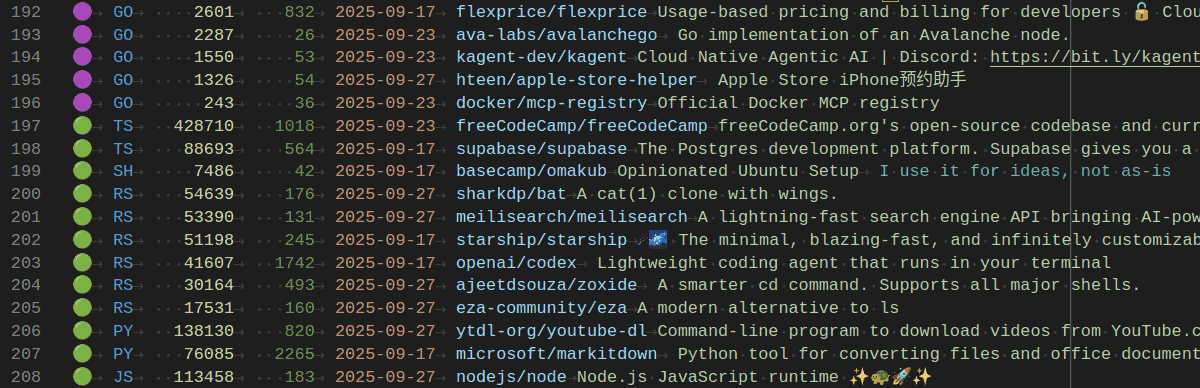
How to review trending GitHub repos on VS Code

Here’s how I track trending GitHub repos each week. I run a scheduled script that saves a clean TSV I can scan fast. It uses uvx gtrending to fetch weekly trending repos for: Rust: High-quality system tools. (Anything in Rust seems cool.) Go: Reliable CLI/infra tools. (Like Rust, most Go code seems good.) Python: Most AI/ML stuff TypeScript: Most modern JS codebases JavaScript: Most front-end utilities Shell: Productivity scripts I pipe results through jq to extract: ...

Things I Learned - 21 Sep 2025

This week, I learned: When editing an image, ChatGPT’s non-thinking mode does a much better job of preserving the original image features than the thinking mode. When editing my photo, I found that the thinking mode creates images that looks quite different than me. A surprising effect of overthinking. ⭐ When evaluating model accuracy, compare with human accuracy rather than perfect accuracy. SMEs rarely agree among themselves, so it’s unlikely that they will agree with an LLM. Instead, measure how often the LLM agrees with the majority of SMEs and how often it disagrees with all SMEs. This gives a more realistic measure of accuracy. LLMs instead of Human Judges? and Judging LLM-as-a-Judge. ChatGPT I understand at least one mechanism of how costs are inflated in large organizations. Even people who want to keep costs low find that the process of tracking expenses, submitting receipts, answering questions around approval, adds transaction cost. So, rather than going for a $10 plus top up mechanism, I would rather go for and ask people to take a $500 top up. Better ask for more and waste than have to ask again. YouTube downloaders: yt-dlp for the CLI, Stacher for Windows/Mac/Linux, Cobalt for a web-based app. Ref VS Code a bunch of features I discovered: It can run a terminal in its own new window for over a year (via Ctrl+P > Terminal: Move Terminal into New Window). Now, Ctrl + Alt + Shift + ` does this directly. Terminal Intellisense shows completion suggestions in the UI. Very helpful. Ctrl+Space triggers the menu completion. ⭐ “We find that the per-step error rate itself rises as the task progresses”, i.e. once a conversation goes the wrong way, it’s really hard to correct it. The Illusion of Diminishing Returns Japonaise Cake is the name of the pastry that I had as a child and grew up longing for. I have spent several weeks searching for it in the roadside bakeries at Bangalore and Chennai but only one bakery seems to have it. systemd is the modern way to run scheduled jobs, instead of cron. It’s far more complex. But it can catch up on missed runs via a Persistent option. Working with systemd timers ⭐ Vice-chancellors of universities resist AI in education because (a) their faculty does not know AI and (b) AI is unreliable. But they are interested in (a) large-scale AI-evaluation and (b) AI-enabling entire campus. tldr.sh offers concise man pages, e.g. uvx tldr jq. cheat.sh offers detailed examples, e.g. curl cheat.sh/jq or curl cheat.sh/:help. ugrep is a fast drop-in replacement for grep. It supports fuzzy search with a customizable Levenshtein distance. Also ug -Q shows an interactive TUI searches like VS Code’s “Search in Files” feature. Very intuitive. Dagger lets you write CI/CD workflows in Python. I tried running it but after 7m of pulling large Docker containers, I gave up. Too heavy. dotslash lets you write scripts that downloads GitHub releases, caches, and runs them. Requires writing scripts. I prefer mise. ChatGPT has a quota for searches. I saw this phrase in the reasoning traces: “I’ll avoid overloading on citations since we only have a few calls left.” It doesn’t seem to be in ChatGPT’s system prompt from last month, so it’s either part of the tool response or a new prompt. Depending on the underlying chips that a model uses, the floating point multiplications may differ and model quality can vary. So Claude 4 Opus running on Anthropic’s GPUs can produce different results from when running on Google’s GPUs or Amazon’s GPUs.

Things I Learned - 16 Feb 2025

This week, I learned: Connected Papers shows papers similar to each other based on co-citation and bibliographic coupling for ~50,000 papers. Notes from a fireside chat with Prashanth Chandrasekar, CEO, StackOverflow, and the StackOverflow team There’s a signal that software demand is growing in 2024. Many more students took the StackOverflow survey in 2024. So more students (or other professionals) are shifting into / starting to learn software development. The AI Index is a good resource for AI trends. Experts are better able to use AI for writing code. Less experienced developers are more likely to use AI for code reviews, project planning, etc. There’s a 5% decline in favorability for AI tools compared to 2023, maybe due to disappointing results. Pilot groups working on AI are 25-30% more productive. They’re the most enthusiastic. For the rest of the company, it drops off to 5-10% #LEARNING Benefit comes from NEW people becoming programmers, not existing ones getting more effective? StackOverflow wants to be where the developer is. The programmer workflow was: Google -> StackOverflow -> GitHub. Now it’s changing to ChatGPT / Cursor -> GitHub. StackOverflow has a partnership with OpenAI and working on a plugin. Same with Google’s Duet AI, GitHub Copilot, many others. They’ll link to StackOverflow. StackOverflow is driving integration actively through an enterprise Overflow API Q: What tech have you seen blaze through the ranks? Prashanth: Abstraction wins. Stuff that abstracts away things well and more wins. This includes Gen AI. Erin Yepis: Rust (from 3% to 12%). AWS has steady growth. Erin Yapis: I have a time series spreadsheet that I’ll publish. Q: What technologies are unusually tightly coupled? Prashanth: AWS & Google Cloud are tightly coupled. Q: We have an engagement problem. Might be India-specific. What are low-effort high-return mechanisms to increase engagement. Eric Woodring: Rather than a static web page, integrate it using the API. #TODO Ben Marconi: Use LLMs to write post mortems and push to StackOverflow. #TODO Eric Woodring: “Hydrating” the community helps. We take repeat questions on Teams / Slack and seed them using LLMs. We integrate with the API to auto-add Q&A. Transform documentation into Q&A. Potentially UPDATE existing Q&A if it’s wrong. Q: What unexpected lessons about developer behavior have you learned while running StackOverflow? Prashanth: We didn’t expect developers moving away from Google. Now it moved to the IDE. Q: What are you learning about developer learning behavior? Ben Marconi: Generating LLM-based onboarding documents. Using StackOverflow for Teams to identify who the experts are to contact for specific topics. Q: Are you thinking about leveraging Stack Overflow’s knowledge base for personalized or interactive learning experiences? How? Prashanth: Traditionally, people use StackOveflow for productivity, learning, and flexibility (i.e. to ask/answer questions asynchronously without breaking their flow). So yeah, learning is important for us. (Duh!) Q: Could Stack Overflow’s interactions help evaluate the accuracy and relevance of LLM-generated code? Or provide potential metrics on quality? Prashanth: LLM accuracy improves by ~30%. Upvotes / downvotes are reinforcement learning (RL) in steroids, so that helps. Q: What are your thoughts on reliance on LLMs potentially deskill-ing developers? Prashanth: A real issue for junior developers, not for senior ones. They’ll come across as knowledgeable. Make internal evaluations and interviews more rigorous. Anand’s requests for action: Could I get a copy of Erin’s spreadsheet? Vivek Narayanan will follow-up. Could you help me learn more about hydration? Nick Madison will set up a meeting with customer success group. I switched to fish shell mainly because: Autocomplete and tab completion works perfectly, out-of-box. Syntax highlighting is beautiful Great multi-line editing To format with VS Code Ruff, you need to point the ruff.interpreter setting to a Python interpreter. You can’t run the ruff server without Python, even though ruff itself doesn’t need Python. cd checks all paths specified in CDPATH for the directory name and changes to the first match. That’s pretty convenient! Flipper Zero is now on my list of “To Buy” tools. It has a variety of hardware devices including NFC, RFID, Bluetooth, Infrared, etc. and is great to reverse engineer or hack devices.
2024 2

Things I Learned - 14 Jul 2024

This week, I learned: Carlton’s TDS session Always create a new venv via VS Code when starting a training session. Helps reproduce issues (though I could use Colab instead) Create an empty .ipynb notebook and double-click it. That’s another way (though slower) to open a Jupyter notebook Share Parrish Knowledge Project podcast. Three generations of wealth There is a big difference between liking animals and being a vet. Between liking education and being a teacher. Even if no one reads your writing, you benefit from the writing. Emotional.crises like 9/11 or Covid are far easier for markets to recover from Hidden brain podcast. White trying to hard can back fire on you Sometimes conscious thinking makes our automated responses of sports music, dance are great examples Instead, SURRENDER to something outside of you. Like playing with kids. Exercise also sends blood away from brain. Drugs. ChatGPT. It’s called Ue in Chinese philosophy A quick check on the pricing of text to speech models OpenAI TTS: $15/1M chars Ref Deepgram Aura: $15/1M chars Ref Elevenlabs Scale: $165/1M chars Ref Google TTS Neural2: $16/1M chars Ref Azure AI Speech: $15/1M chars Ref AWS Polly Neural TTS: $16/1M chars Ref

Things I Learned - 14 Apr 2024

This week, I learned: Prashant Pandey: we need to prepare before every meeting. Something to teach VS Code Select any code and command Explain this to understand the code %something in command bar searches ACROSS files for a term. Exactly like Ctrl+Shift+F Copilot has an Inline Chat: Start in Terminal (that needed me to unbind Ctrl+I in bash to work) Ctrl+2 opens a second window on the side. Ctrl+1 goes back to the first window Terminal: Open Detected Link lets you scroll through detected (file) links in terminal Terminal sticky scroll is transparent. (But Terminal stick scroll isn’t working for me.) Copilot uses last 10 commit messages, Jupyter notebook kernel state (variables) as additional context 1.88: supports locked scrolling to sync scrolling of side-by-side windows fsspec is used by csvbase, Pandas, etc. to implement file system protocols like s3fs, gcfs, etc. SQLime is a SQLite client / playground on the browser! Do nothing. Then do less Humans have a bias against inaction. Hence a strategic advantage. What can you cancel today? Humans have a bias against subtraction or removal. That too is a strategic advantage. What can you remove today? Humans have a bias against constraints. That’s a strategic advantage. What constraint can you embrace? No Yay! When declining something, add it your calendar so that when the time comes you can say yeah I got this time back