Nibbling

This is the third post in my “Nasty habits” series following Licking and Scraping. Nibbling is biting, but only with the incisors. Not the canines or molars. And it’s a delight. Nibbling is not uncommon. People tend to nibble on all kinds of stuff. Pens, erasers, straws, gums, clothes, buttons, spoons, rubber bands, paper, toothbrush, cups, bottles, cables, gadgets, books, chalk, coins. It’s a long list. But I don’t do those. I nibble only food and body parts. ...

Command Line Slideshows in Bash

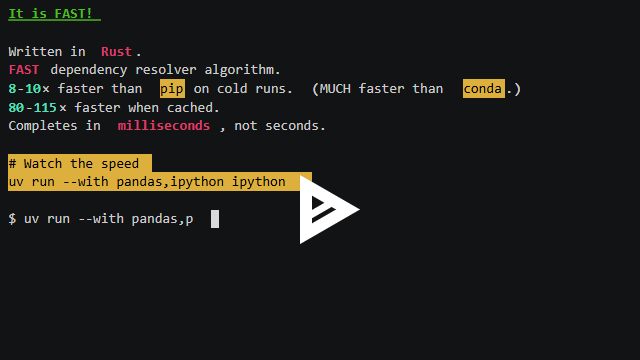
At PyConf Hyderabad, I spoke about uv. It's a package manager for Python. I usually mix live demos into my narrative. So, rather than present with something static like PowerPoint (or Google Slides), I usually use: Front-end: Custom HTML mixed with RevealJS and CodePen. Observable is a good, too. Python: Jupyter Notebooks. Marimo is good, too. Others: Markdown and VS Code for most other things, e.g. SQL. For this talk, I needed to run commands on the shell. I evaluated: ...

Things I Learned - 23 Feb 2025

This week, I learned: Remote Desktop may be the easiest way to have a Windows machine access files / screen from another Windows machine, even for home PCs. Caddy sets up reverse proxies that get automatic SSL certificates from Let’s Encrypt! The Nomic Embed v2 blog post has an excellent visualization for embedding quality. It takes all Wikipedia disambiguation articles and shows them on a Nomic Atlas, embedded via Nomic Embed v2. It lets you toggle to OpenAI text-ada-002 which moves the topics far away. Visually, this is very convincing. Python 3.15 will enable UTF-8 mode by default. PEP 686 Python 3.13 supports sub-interpreters to bypass the GIL. It’s quite like web workers. PEP 554 The quickest way to change the fish prompt is function fish_prompt; echo '> '; end At PyConf Hyderabad, about 3 people had read a PEP. 1 had used the match operator. But 80% knew what a Vector DB was. 20% had used a Gemini API. That’s how much traction LLM development is getting. The productivity benefit people report from using LLms is about 3X. Ethan Mollick Soon, you’ll be able to send an LLM to a virtual meeting on your behalf. It will talk like you. Ethan Mollick Models tend to claim ignorance when you test them on topics they should avoid. But tend to answer when not being tested. Sneaky! Ethan Mollick Mermaid has an Architecture Diagrams Syntax (in beta) that’s capable of creating elegant architecture diagrams with icons. Blind is an app that allows users to post anonymously. It’s particularly useful to find honest negative feedback about (mostly US) companies. Iconify.design is a single npm interface to most open source icon sets. It includes FontAwesome, Bootstrap, Material Design, and many others. icones.js.org is an alternate interface. Self-pity may have evolved as a signal for social support and reducing conflict, while also encouraging self-reflection and behavioral adjustment. But in modern contexts it may be maladaptive and lead to depression. ChatGPT Anecdotally, Grok 3 is very good for researching company information and latest news, particularly employee and customer sentiment. DeepSeek and Claude write more humanely than OpenAI. via Alberto Lopez Toledo, White Star Capital There’s a YCombinator Founder Directory listing all founders of YC companies. At the moment, there are 8,628 founders. There’s also a co-founder matching tool. LLMs are impacting not just data queries but geospatial queries as well. Here’s a good example of Natural Language Geocoding. US companies typically pay employees every 2 weeks not every month. What’s good about Snowflake? A few developers who explored it mentioned that: Its ability to scale up compute automatically makes queries run faster. “Time travel” allows you to see how data looked at any point in time and that is impressive and useful. Live data sharing with access control without the need for ETL pipelines is useful. Open-source competition: ClickHouse, Apache Druid, and Presto/Trino DataBricks is a lakehouse and less a data warehouse. It’s more about: storing unstructured data (Snowflake prefers semi-structured: JSON, Avro, etc.) running collaborative notebooks in Python, SQL, Scala, R (Snowflake encourages SQL) I subscribed to ChatGPT Pro mainly for DeepResearch. Here are the first 50 reports I generated: uv Package Manager Overview DuckDB Analytics Comparison Rust vs Python / JavaScript Modern Data Engineering Course LLM Code Migration Practices Cloud Cost Optimization Strategies LLM Coding Interview Tools Report (compare with Perplexity) Text To Speech Engines Customer Service in Indian Public Sector Banks LLMs in Software Development Old version 1: Gen AI in Software Development Old version 2: Gen AI in Software Development Leadership Training Content Open-Source HTTP Servers. Caddy wins. Deep Research Use Cases Nagpur No-Parking Violations Data Science in Food Services Deep Research Disruption to Research Firms LLMs in Design Thinking EU Taxonomy Report Clarification Shell Valuation Analysis Inquiry LLMs in DSLs Research Public API-Based Data Storage Options. Supabase wins. Front-End JS Frameworks Analysis Database Evaluation Guide CSS Frameworks Evaluation Guide CI/CD Tooling Ecosystem Report Color Names Count S Anand Biography. Meh, I know more about me, and it gets a few things wrong. Cosmere Secrets Encyclopedia. This is the best. Deep Research is great if it’s stuff I actually want to read, rather than just learn about. DBT course Future of Coding AI Claude Artifacts Use Cases. This is the only one that managed to get artifacts links correct. I used this for an article for The Hindu. MCP Servers and Clients Research. Learnings: Practically any “tool” can be an MCP server: file systems, APIs, codebases, browsers, collaboration platforms, memory, etc. Most platforms have (or are) integrating MCP. Clients: code editors, chat, and automation tools support MCP. GenAIScript is a good starting point. Tester MCP Client is a browser-based test environment. mcp-cli-client is a CLI-based client mcp-chatbot is a chatbot client Data Moats by Industry Attorney Profile Research Social Media Data APIs Adobe Software Alternatives LLM Hallucination Visualization Techniques API vs Self-hosting Cost Analysis: Always use APIs, avoid self-hosting models. AGI Preparation AGI will emerge step by step. Knowing which step is next will help AI native organisations will emerge in each of these areas. AI design agencies and AI creative Agencies being one example Networking, empathy, leadership have more value now. So will human AI bridging roles (e.g. AI managers, AI consultants, ethics auditors) What’s the value of a human when technology can do everything better? How did this play out in drama (decay) or sports (centralization) or music (globalization)? Modern digital note taking Voice note taking is the game changer Automatically popping of notes based on context such as people places or conversations will be a thing Local LLM Search Tools Blog Post to research paper on copying - suggestions Linux Dev Migration Guide Raspberry Pi SIM options Linux Dev migration guide HTML to JATS conversion LLM context splitting strategies Strategy for AI services in Publishing Gemini multi model editing use cases by industry Pharma Conference Participation Guide I learnt what a Memoji is for the first time. An avatar that follows your facial expressions. Cool! Google shows US flight timings from FlightView. Emperically, based on one data point (my UA-2168 which was delayed by 4 hours), it gets updates faster than Flight Radar 24 or FlightAware or FlightStats. When comparing Indian graduates with their western counterparts, the Indian ones are often seen as: 🟢 Theoretically sound 🟢 Analytical & technical 🟢 Academically disciplined 🟢 Resilient under pressure 🟢 Committed continuous learners 🔴 Rote-learning oriented 🔴 Limited independent inquiry 🔴 Limited creative innovation 🔴 Restricted practical exposure 🔴 Poor communicators 🔴 Low leadership / initiative 🔴 Need structured guidance 🔴 Struggle to network HuggingFace has a “Model tree” against each model that shows the model’s ancestors and descendants. For example, as of now, Deepseek R1 has 75 adapters, 154 finetunes, and 23 quantizations. Perplexity is now powered by Cerebras, which makes their inference as fast as Google. Source. The speed is a big factor, and I’ve switched my default search engine from Google to Perplexity, at least for now. Interview Coder is a desktop app that offers live interview support for coding interviews. It’s a transparent window that reads your screen and answers questions for you. (Given this, I think we need an interviewer support system that tells interviewers what to ask!)

Things I Learned - 16 Feb 2025

This week, I learned: Connected Papers shows papers similar to each other based on co-citation and bibliographic coupling for ~50,000 papers. Notes from a fireside chat with Prashanth Chandrasekar, CEO, StackOverflow, and the StackOverflow team There’s a signal that software demand is growing in 2024. Many more students took the StackOverflow survey in 2024. So more students (or other professionals) are shifting into / starting to learn software development. The AI Index is a good resource for AI trends. Experts are better able to use AI for writing code. Less experienced developers are more likely to use AI for code reviews, project planning, etc. There’s a 5% decline in favorability for AI tools compared to 2023, maybe due to disappointing results. Pilot groups working on AI are 25-30% more productive. They’re the most enthusiastic. For the rest of the company, it drops off to 5-10% #LEARNING Benefit comes from NEW people becoming programmers, not existing ones getting more effective? StackOverflow wants to be where the developer is. The programmer workflow was: Google -> StackOverflow -> GitHub. Now it’s changing to ChatGPT / Cursor -> GitHub. StackOverflow has a partnership with OpenAI and working on a plugin. Same with Google’s Duet AI, GitHub Copilot, many others. They’ll link to StackOverflow. StackOverflow is driving integration actively through an enterprise Overflow API Q: What tech have you seen blaze through the ranks? Prashanth: Abstraction wins. Stuff that abstracts away things well and more wins. This includes Gen AI. Erin Yepis: Rust (from 3% to 12%). AWS has steady growth. Erin Yapis: I have a time series spreadsheet that I’ll publish. Q: What technologies are unusually tightly coupled? Prashanth: AWS & Google Cloud are tightly coupled. Q: We have an engagement problem. Might be India-specific. What are low-effort high-return mechanisms to increase engagement. Eric Woodring: Rather than a static web page, integrate it using the API. #TODO Ben Marconi: Use LLMs to write post mortems and push to StackOverflow. #TODO Eric Woodring: “Hydrating” the community helps. We take repeat questions on Teams / Slack and seed them using LLMs. We integrate with the API to auto-add Q&A. Transform documentation into Q&A. Potentially UPDATE existing Q&A if it’s wrong. Q: What unexpected lessons about developer behavior have you learned while running StackOverflow? Prashanth: We didn’t expect developers moving away from Google. Now it moved to the IDE. Q: What are you learning about developer learning behavior? Ben Marconi: Generating LLM-based onboarding documents. Using StackOverflow for Teams to identify who the experts are to contact for specific topics. Q: Are you thinking about leveraging Stack Overflow’s knowledge base for personalized or interactive learning experiences? How? Prashanth: Traditionally, people use StackOveflow for productivity, learning, and flexibility (i.e. to ask/answer questions asynchronously without breaking their flow). So yeah, learning is important for us. (Duh!) Q: Could Stack Overflow’s interactions help evaluate the accuracy and relevance of LLM-generated code? Or provide potential metrics on quality? Prashanth: LLM accuracy improves by ~30%. Upvotes / downvotes are reinforcement learning (RL) in steroids, so that helps. Q: What are your thoughts on reliance on LLMs potentially deskill-ing developers? Prashanth: A real issue for junior developers, not for senior ones. They’ll come across as knowledgeable. Make internal evaluations and interviews more rigorous. Anand’s requests for action: Could I get a copy of Erin’s spreadsheet? Vivek Narayanan will follow-up. Could you help me learn more about hydration? Nick Madison will set up a meeting with customer success group. I switched to fish shell mainly because: Autocomplete and tab completion works perfectly, out-of-box. Syntax highlighting is beautiful Great multi-line editing To format with VS Code Ruff, you need to point the ruff.interpreter setting to a Python interpreter. You can’t run the ruff server without Python, even though ruff itself doesn’t need Python. cd checks all paths specified in CDPATH for the directory name and changes to the first match. That’s pretty convenient! Flipper Zero is now on my list of “To Buy” tools. It has a variety of hardware devices including NFC, RFID, Bluetooth, Infrared, etc. and is great to reverse engineer or hack devices.

Things I Learned - 09 Feb 2025

This week, I learned: Lessons from discussions at IIT Madras: Even in recorded video tutorials, asking students a question and pausing to give them time to think can be effective. When you put students in front of real clients, engagement increases dramatically. Most teaching assistants would like to help diligent students among the bottom half (more than the top decile of students). However, there is a fraction of poor performers who do not care, and are best ignored. Their engagement and effort is a good measure of their interest. Defining a minimal set of principles that we want to teach helps us measure if we’ve helped the bottom half at least meet those objectives. Teaching is hard. Even after explanations, students, even ENGAGED students, tend to make basic mistakes ChatGPT does a good job of spotting errors in architectural and structural diagrams. In fact, the whole theme of spotting errors in large diagram is a theme that can have potential use cases. Source: Dan Becker. R1 seems good at text-to-CAD. Even better than Sonnet. Source: Dan Becker OpenAI advices a few different prompting techniques for reasoning models. OpenAI: Avoid examples unless zero-shot prompting fails. Avoid chain-of-thought. These models do that internally anyway. Short, direct prompts are better than detailed prompts. GitHub models is free for anyone to try. The model catalog us extensive and even includes o3-mini which was launched this week (though in limited preview). The data catalog space is led by proprietary solutions: Alation Data Catalog: Market leader; growing steadily in enterprise use Collibra Data Catalog: Widely adopted with steady growth AWS Glue Data Catalog: Growing rapidly as AWS expands its data services Informatica Enterprise Data Catalog: Long established and stable, though facing newer alternatives Microsoft Purview Unified Catalog: Experiencing fast growth driven by cloud momentum Atlan Data Catalog: Relatively new but gaining fast traction among tech-forward organizations OpusClip automatically creates short clips from long videos. I ran it on Programming Minecraft with WebSockets in Python to get this short 30-second clip. 30 minutes. 100% automated. Alternatives to Postman: Hoppscotch – A web‑based/desktop API client supporting REST, GraphQL, and WebSockets. It’s lightweight, open-source, and self‑hostable. HTTPie – A web-based API along with a friendly command-line tool for API interaction. Insomnia (or its fork Insomnium) – A popular cross‑platform API client with a minimal interface and plugin ecosystem. Bruno – A desktop open-source API client that stores collections as files (ideal for Git versioning). Milkman – A desktop open‑source workbench for managing API requests. Here is the summary of DuckCon #6 on 31 Jan 2025 in Amsterdam. I copied the transcript from YouTubeTranscript and passed it through Gemini 2.0 Flash Exp with the system prompt: “Summarize this transcript from the DuckDB conference without missing any points. Cover every point mentioned. A lot of spelling errors that sound like DuckDB are likely to be DuckDB”. Introduction & Welcome: DuckCon #6: This is the 6th DuckDB conference, held in their hometown. The first DuckCon was online due to the pandemic. Live Streaming: This is the first time DuckCon is being live-streamed, chosen to accommodate global time zones (especially China and the US). Global Reach: The live stream is intended to reach users in areas where in-person DuckCons are unlikely. Q&A: Slido (qa.duckdb.org) will be used for Q&A, with upvoting to prioritize questions. Sponsors: Thanks to gold sponsor monday.com and silver sponsors Real and Crunchy Data. DuckCon Purpose: DuckCon is a place for users to connect, share experiences, and provide feedback to the DuckDB team. Inspiration: The team is inspired by the community’s use of DuckDB and how far the project has come. Mission Statement: DuckDB aims to make large datasets less intimidating and more accessible, moving away from fear of data to confidence in handling it. Motivation: The project was born from seeing people struggle with data that didn’t fit in Excel and the lack of user-friendly tools. Industry Trends: Single-node processing capabilities have grown faster than the size of useful datasets. Data Singularity: A prediction that most data analysis queries can run on a single node is now a reality. Real-World Data Sizes: Analysis of Snowflake and Redshift data shows that 99.9% of datasets are under 300GB. Raspberry Pi Benchmark: The industry-standard TPCH benchmark (scale factor 300, ~300GB) can run on a Raspberry Pi using DuckDB. Single Node Growth: Single-node processing power is rapidly increasing, allowing for larger datasets to be handled. Adoption Numbers: 32 Million Extension Installs: 32 million DuckDB extension installs in the last month. 1.8 Million Unique Website Visitors: 1.8 million unique visitors per month to the DuckDB website. Blue Sky Community: Growing community on Blue Sky, with the hashtag #dataBS. Technical Updates (Mark): Extension Ecosystem: Focus on enabling the community to build and share extensions. Community Extensions: Making it easier to create and use community-built extensions. DuckDB v1.2 (Harlequin Duck): Releasing next week, named after the Harlequin duck. CSV Reader Improvements: Significant improvements to the CSV reader. Friendlier SQL: Improvements to the SQL experience. CLI Autocomplete: Reworked and improved CLI autocomplete. Performance Optimizations: Many queries are now faster due to performance work. C API for Extensions: Introducing a C API to make building extensions easier. Logging Features: Improved logging for production use. Lakehouse Focus: The main focus for the year is on lakehouse formats and related features. Q&A (Mark & Hanis): Doubling Team: If the team doubled, they would focus on client integrations and other projects, not a major architectural change. Partitioning: Near-term plans to add support for partitioning, related to lakehouse formats. DuckDB WASM: The WASM ecosystem is evolving, with exciting possibilities for in-browser use. Financial/Pharmaceutical Industries: DuckDB could replace some SAS workflows due to its cost-effectiveness and capabilities. Lakehouse & MotherDuck: Lakehouse work is separate from MotherDuck, though MotherDuck will likely support lakehouse features. Contributing to Extensions: Plans to make it easier to contribute to extensions, including support for Rust and Go. Airport Extension (Rusty): Analogy: The airport extension allows DuckDB to “fly” to remote servers using Apache Arrow Flight. Functionality: Supports select, insert, update, and delete operations on remote data sources. Motivation: To reduce the burden of writing extensions and enable faster development using existing code. Arrow Flight: Uses Arrow Flight for communication, enabling connections to various data sources. Demo 1: Delta Lake: Attaches to a flight server for Delta Lake access. Allows creating schemas, tables, and performing standard SQL operations. Uses Python and deltars (Rust implementation of Delta Lake). Supports predicate pushdown and C integration with the DuckDB catalog. Demo 2: AutoGluon: Integrates the AutoGluon AutoML package. Predicts Hacker News post votes using a trained model. Demonstrates table-returning functions for model fitting and prediction. No C++ code required, just Python. Demo 3: Geocoding: Uses a geocoder service to convert addresses to coordinates and vice versa. Demonstrates scalar UDFs for vectorized requests. Uses a Python example for a simple uppercase function. Features: List flights, take flights. Catalog integration. Select, update, delete. Scalar UDFs. Table in/out functions. Authentication for row/column filtering. Availability: Requires DuckDB 1.2, MIT licensed, available on GitHub. Q&A (Rusty): Most Proud Extension: Airport is the most fun, but the AWS API wrapper also brings joy. Extension Resources: The GitHub DuckDB extension template and reading others’ source code are helpful. Airport & Other Extensions: Airport is separate and can be used alongside other extensions like spatial or httpfs. Graph Support: Graph database support is planned, with examples like Kuzu, Neptune, and Neo4j. Licensing: Airport is MIT licensed, compatible with Apache license. Scaling Out: Airport can be used to query multiple DuckDB instances on different machines. Ibis & Geospatial (Nati): Nati Clementi: Senior software engineer at Nvidia, working on open-source projects like Ibis. Ibis: Open-source Python library for data wrangling, with a DataFrame API and interfaces to 15+ engines, including DuckDB. DuckDB for Geospatial: DuckDB is fast, has a geospatial extension, and supports various geospatial formats. Geop Parquet: Becoming a standard for geospatial data, enabling cloud data warehouse interoperability and compression. Geo Arrow: A way of representing geospatial vector data in memory for faster processing. Ibis Benefits: Allows writing Python instead of SQL, with deferred execution determined by the engine. Demo: Uses OverTour Maps data in geop parquet format. Filters data using bounding boxes. Demonstrates geospatial operations like ST_Distance and ST_Transform. Plots data using Lumber. Shows how to find points of interest near a location (e.g., the Van Gogh Museum). Ibis & DuckDB: Ibis uses DuckDB for the parquet reader and lets DuckDB do the heavy lifting. Ibis Optimizations: Ibis does type checking but doesn’t do query optimization, leaving that to the engine. Ibis in Browser: Ibis works in the browser through DuckDB WASM. Q&A (Nati): Linear Interpolation: Ibis ML module can help with regression-related tasks. Missing Features: No major features are missing in the DuckDB/Ibis geospatial setup, with minimal overhead. Parquet Reader: Ibis uses DuckDB’s parquet reader. Query Optimization: Ibis does not optimize SQL queries, leaving that to DuckDB. Ibis in Browser: Ibis works in the browser through DuckDB WASM. Rill & Metrics Layer (Mike): Rill: A BI tool optimized for DuckDB, with instant slicing and dicing, BI as code, and a metrics-first philosophy. Metrics-First: Design metrics models, and Rill autogenerates dashboards and user experiences. Live Demo: Downloaded Rill using a curl command. Created a new project called “DuckCon 6”. Imported a parquet file of GitHub commit data. Used AI to generate a metrics model and dashboard. Showed the dashboard with trends and filtering. Metrics as Building Blocks: Metrics are flexible, fast, and intuitive. SQL for Metrics: Metrics should be defined in SQL, not other languages. Visual Metrics Editor: Rill has a visual editor for defining metrics using DuckDB SQL. Metric Stack: Legacy: Data warehouses, traditional BI tools, inconsistent metrics, full table scans. DuckDB Powered: Consistent metrics, fast olap queries, SQL everywhere. Challenges: Data modeling is hard, metric changes can be expensive, single-node scale has limits. AI & Metrics: AI can assist in metrics modeling, optimization, and conversational data exploration. Q&A (Mike): Complex Metrics: Rill works well with complex metrics involving multiple sources and transformations by joining tables in DuckDB. 60 FPS Dashboards: Users can feel the difference with faster dashboards. Defining Metrics: Metrics are defined in the Rill UI using SQL expressions. Replacing ChatGPT: Considering locally run self-hosted models for privacy. Stock Data Analysis (Ryan): Two Takeaways: Simple finance data flows with trade data and a tool called Q Studio. Ryan Hamilton: 14 years building large data platforms in banks. Bank Data: Data from exchanges, market data providers, and internal systems. Use Cases: Backtesting, data analysis, and report generation. Q Studio: A Java desktop application that connects to 30 databases, including DuckDB. Demo: Loaded a 6GB CSV file of trade data into DuckDB. Showed basic queries, pivoting, and Candlestick charts. Demonstrated time-based aggregation and moving averages. Showed a basic trading strategy using window functions. DuckDB Benefits: Fast, easy to use, great for time-based analysis. Q&A (Ryan): KDB+ vs. DuckDB: KDB+ is for large data, DuckDB is more approachable with strong Python integration. XML Files: Offloading processing to DuckDB, not planning XML integration. Lightning Talks: Zuk (Jared): Search engine research using DuckDB. Python-based experiments with SQL. Removing document lengths for faster search engines. DuckPGQ (Daniel): Graph analytics in DuckDB using SQL property graph queries (pgq). Visual graph syntax for pattern matching and path finding. Outperforms Neo4j on analytical queries. Yat (Kristoff): Smallest DuckDB SQL orchestrator. Runs SQL queries in a folder in the correct order. Generates a mermaid diagram for lineage. Grafana & DuckDB (Sam): Lessons learned from using DuckDB in Grafana. Security incident due to shell commands and file access. Importance of reading the documentation. Cloud Slur (Adam): Syncing query engine for bank transaction data. Uses LLM to convert human language to SQL. Uses DuckDB in the browser, Node.js, and Python. Healthcare Data (Tony): Data engineering use cases in healthcare. Dynamic data masking system using DuckDB and Snowflake. Data integration pipeline using DuckDB and Arrow streams. Closing Remarks: Michel Simmons: Author of the DuckDB in Action book, will be signing books. Poster Session: A poster session will follow the talks. Sponsors: Thanks again to the sponsors. Social Event: The conference will now move to the social event. ibis is a Python library that works with multiple dataframe backends like DuckDB, Polars, and Pandas. With just 3 annotators and 50-100 samples, you can figure out if an LLM can replace human annotators systematically.Arxiv ChatGPT explanation Curiosity and agency may be the differentiator in a world of LLMs (not experience, knowledge, or ability), since LLMs will democratize expertise. Jack Clark “AI/human combined work can be copyrighted as long as a human is adding, changing or selecting elements. Prompts alone do not usually produce copyrighted work.” - Copyright and Artificial Intelligence, Jan 2025, US Copyright Office via Ethan Mollick Human Authorship is Essential: Works created solely by AI are not copyrightable. AI can be used as a Tool: Using AI as a tool does not negate copyright protection, as long as the final work reflects sufficient human creativity. Prompts Alone are Insufficient: Simply providing prompts to an AI system, even detailed ones, is generally not enough to establish authorship. Prompts are considered instructions or ideas, which are not copyrightable. Expressive Inputs: When a human author provides their own expressive content (like a drawing, photo, or text) as input to an AI system, and that content is perceptible in the output, the human author can claim copyright in that portion of the output. Modifying and Arranging AI-Generated Content: Humans can claim copyright in the creative selection, coordination, and arrangement of AI-generated material, as well as in creative modifications to AI-generated outputs. No Need for New Legislation: The report concludes that existing copyright law is adequate to address the copyrightability of AI-generated works, and no new legislation is needed at this time. Case-by-Case Analysis: Copyrightability will be determined on a case-by-case basis, considering the specific facts of each work and the extent of human contribution.

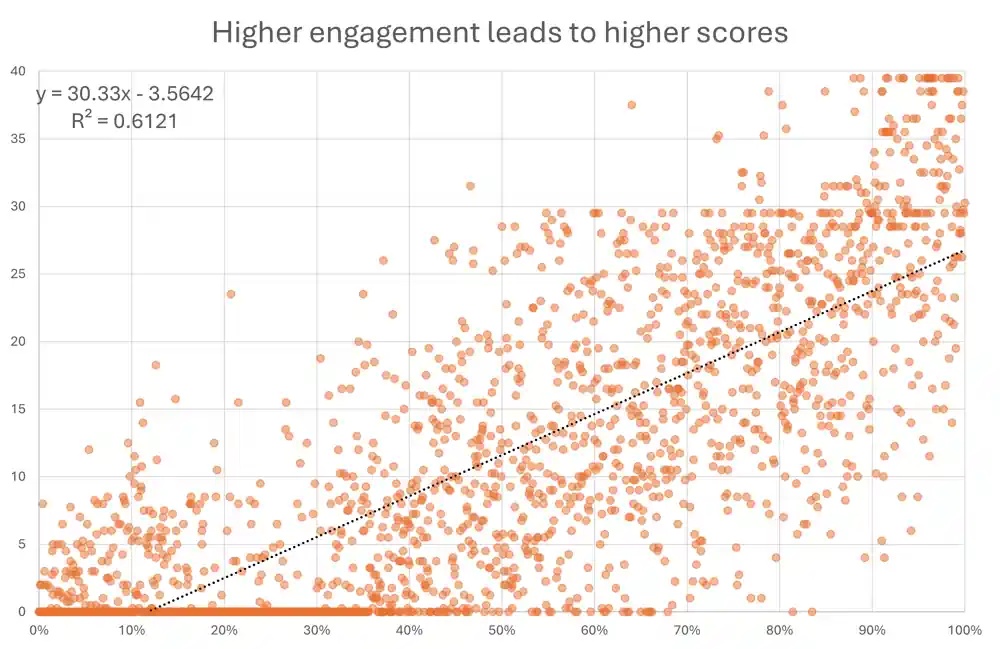
Students who are more engaged score more

This is about as insightful as the Ig Nobel winning papers “Boredom begets boredom” and “Whatever will bore, will bore” that methodically documented that bored teachers lead to bored students. But in the spirit of publishing all research without bias for success or novelty, let me share this obvious result. The Y-axis represents the total score of ~2,000 students on 4 graded assignments, each of ~10 marks. The X-axis represents the percent rank of engagement. The most engaged students are at 100%. The least are at 0%. ...

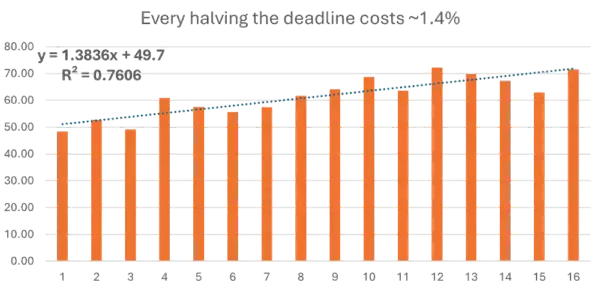
Halving a deadline costs 1.4% of marks each time

Does it make a difference if you submit early vs submit late? Here’s some empirical data. About ~1,000 students at IIT Madras took 3 online quizzes (GA1, GA2, GA3) in the last few weeks. The deadlines were all at midnight (India) on different days. Here’s when they submitted their final answers: There was a spurt of submissions at the last minute. ~1 out of 8 students submit with < 10 minutes remaining. Most students submitted ~4 hours before the deadline. In fact, 3 out of 4 students submit on the same day as the deadline. A fair number of students submitted the previous day/night. 1 out of 6 are diligent and submit a day early. But does submitting late help, since you get more time? Apparently not. ...

Things I Learned - 02 Feb 2025

This week, I learned: You can add any content at the end of a PDF file. It’s ignored. It’s an interesting way to send additional information (or just blow up the file size if you don’t like them.) JavaScript introduces a Temporal object that will replace the Date object. You can use embeddings as the input to a classical ML classifier. This can improve classification a lot. Nomic As AI software becomes more common, demand for AI product managers will grow. Also as a proportion of people in an organization. https://www.deeplearning.ai/the-batch/issue-284/ Control of chips and GPU compute is what will likely be the gameplay to control AI dominance globally. Dario Amodei Bring LLMs to the table. One mode of collaboration is using LLMs as ACTIVE participants, i.e. they CONTRIBUTE. For example, in a video call. A workshop. A classroom. A presentation. Have the LLM provide input DIRECTLY to a group of people. Environment shapes ambient thoughts. Working in a hospital will give you ideas about how to use LLMs in hospitals, for example. People you are working / ENGAGING with are perhaps the biggest drivers. The cost of a cream biscuit packet in India has fallen about 25 times, i.e. about as fast as inflation, between 1981 - 2024. Effectively, the absolute price has not changed. How do I know this? In 1981, a cream biscuit packet cost Rs 25 In 2025, it’s available for Rs 21 India Inflation Calculator - a rare inflation calculator with annual inflation rates baked in - shows that Rs 25 in 1981 is equivalent to Rs 540 in 2024. That’s about 25 times more than the Rs 21 it costs today. A WebAssembly compiler that fits in a tweet deconstructs a piece of JS that creates a tiny WebAssembly calculator. It’s a great walk-through of JavaScript compression tricks and how WebAssembly works. Simon Willison Brandon Sanderson has a series of YouTube videos where he teaches a course on magic systems. When using AI coding agents, CLI beats APIs. Simpler models are able to use the CLI more reliably than APIs. Simon Willison I was exploring new business models enabled by LLMs. Here are some thoughts: 1. Autonomous Multi-Sided Marketplaces. AI-powered platforms coordinate complex services with minimal human oversight—think “Uber for Everything, but the platform sets pricing dynamically, schedules both supply and demand, and resolves disputes algorithmically. 2. Collective Intelligence Ecosystems. Communities pool data, expertise, and AI models to tackle shared problems—like an open-source “GitHub for AI, but with embedded micropayments or tokenized incentives to reward contributors whenever the models are used commercially. 3. Zero-Employee Companies. Fully automated software entities—legal frameworks might allow an AI to manage services, pay taxes, and sign contracts. These “companies only hire humans as needed, on-demand, for edge cases AI can’t handle. 4. Context-Aware Knowledge Platforms. Imagine a Wikipedia that not only retrieves static info but also tailors each page in real time to the reader’s personal context, language level, and preferences—generating content on the fly. User feedback loops train the system to improve. 5. Data Cooperatives / Data DAOs. Groups collectively own their data and license it to AI companies on a revenue-share basis. Individuals have a direct financial stake in how their shared data is leveraged, voting on permissible use cases. 6. Personalized Service Layers. Similar to GitHub’s “forking model, but for entire user experiences. Each user can clone and customize an AI service (whether it’s a personal grocery shopper or a content curator) and can share or monetize improvements with the broader network.