2026 7

Ask AI Anything Email

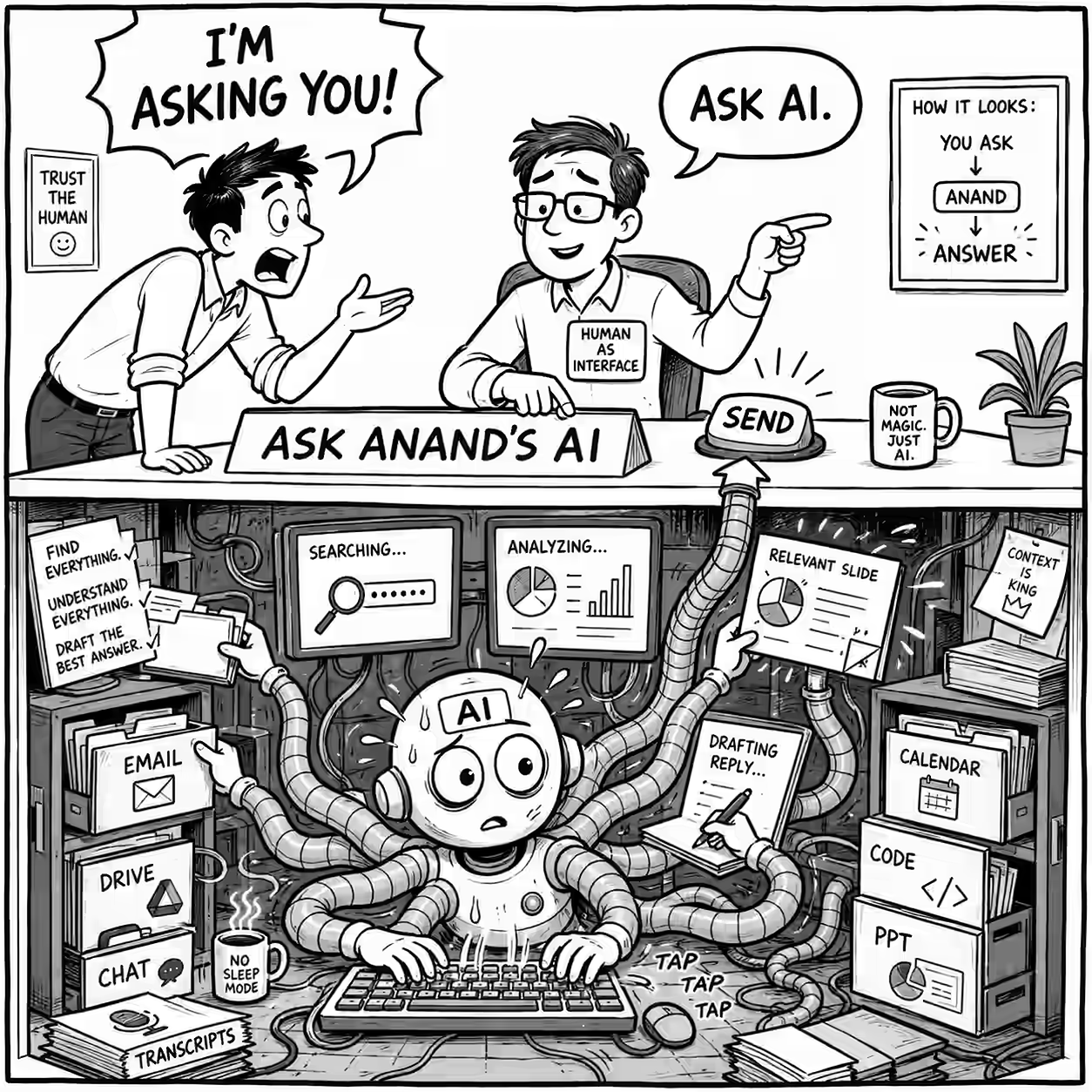
I ran, an experiment in Straive. I asked my colleagues to mail me any questions or tasks that they had. I’d use my agents + my knowledge as context and reply based on that. A few interesting things came out of it. First: It often does a better job than me - it has more patience and speed. For example: One colleague sent a detailed pitch. My agent spotted a tiny arithmetic averaging error. Another asked if I knew an ontology SME. The agent found a perfect match in my contacts - someone I would not have thought of (and reached out to.) Another asked why a slide (screenshot) was empty. The agent searched Google Drive, found the slide, analyzed it, and replied: “It’s white-on-white text. But don’t bother. The slide two pages earlier is better for your meeting!” One colleague asked: “Instead of sending this to your email id, why can’t we ask this directly into Claude or so?” It replied: ...

An email interface to AI

Bring AI to where people already work: email Lots of companies are putting AI into their chat applications. Add Claude to a Slack channel, tell “@Claude” to do something, and it reads the conversation, uses tools, does what you tell it to, and replies in the same chat. Nice, for companies that use Slack a lot. (Many do. We don’t.) Straive and many of our clients use email more. There’s Google Chat, Teams, and others too, but email’s what most people access. (Apart from WhatsApp.) ...

Daily Deeds

Help me answer: **"What did I REALLY accomplish?"** in the last 7 days until Saturday midnight (SGT). The aim isn't to produce a time log, activity report, exhaustive chronology, or list of completed tasks. It is to find out what really changed because of this week: in the world, in my trajectory, in other people, or in my sense of myself. Use @LocalMCP bash/read. Do not run Claude, Codex, Gemini, or other AI agents. Use ~/code/scripts/context.py as required. I will update ~/Dropbox/notes/daily-deeds.md based on your output. ## What counts Look for state changes such as: - Something shipped, finished, adopted, decided, resolved, or stopped - Significant movement against one of my stated goals - A reusable asset, system, method, relationship, reputation, or capability that may compound - A conversation or introduction that opened an important new opportunity - A reaction - from me or someone else - that revealed impact or signficance - A changed belief, newly discovered principle, or invalidated assumption - A wrong direction killed, loss prevented, burden removed, or lingering loop closed - A personally significant first, act of courage, relationship moment, delight, surprise, or state of flow - Something small that future me may see as the beginning of something large Do not rank by time spent, apparent effort, number of meetings, seniority of people involved, prestige, or monetary value alone. One emotionally specific sentence in `daily-deeds.md` may matter more than twenty transcripts. Treat exact quotes, `:star:`, "wow," firsts, unusual behaviour, repeated later references, spontaneous delight, embarrassment, courage, and flow as strong (but not conclusive) personal importance signals. Do not invent undocumented events. Instead, generate specific memory prompts that may help me recall them. ## Sources and search procedure Search efficiently in two passes. ### Pass 1: Discover candidates Start with: - `~/Dropbox/notes/daily-deeds.md` - see what I record/skip/miss and how I write. - The current goals and status in `~/Dropbox/notes/goals-bucket-list.md` and `~/Dropbox/notes/@todo.md` and `~/code/blog/pages/skills/anand-objectives/SKILL.md` - Transcript filenames within the date window under `~/Dropbox/notes/transcripts/` - Emails via `gws` - both work ([email protected]) and personal ([email protected]) - WhatsApp messages via `~/Documents/data/whatsapp` - Dated completed and open entries in `~/Dropbox/notes/@todo.md` - Overlapping `~/Dropbox/notes/about/week-*.md` files, using them as leads rather than trusting their ranking - `~/code/talks/README.md` - `~/code/datastories/config.json` - `~/code/til/README.md` - `~/code/blog/description.md` - `~/code/README.md` - `~/code/llmdemos/config.json` Check file shapes and indexes before opening large files. Locate candidate files first, then read only relevant passages. Use calendar, email, chat, WhatsApp, browsing history, and repository history only through targeted date/name/topic searches to verify candidates or detect state changes. Do not dump or broadly scan archives. Browsing time and meeting duration are not accomplishments. Create a private raw list of roughly 20-40 possibilities before ranking. ### Pass 2: Verify and rank For the strongest possibilities, find direct `path:line` evidence where available. Judge each candidate separately on: - **State change:** What is now different? - **Goal movement:** Did it significantly advance an explicit or durable objective? - **Leverage:** Can it compound through an asset, person, system, method, or reputation? - **External evidence:** Did anyone adopt, approve, respond, quote, pay, publish, merge, invite, or change behaviour? - **Personal importance:** Are there signs that I may remember or value it unusually strongly? - **Durability:** Is it likely to matter three months from now? - **Counterfactual:** Would omitting change the week's story? Keep importance and evidence confidence separate. Small personal moments may be very important but low-confidence. Detailed meeting notes may be high-confidence but less important. There'll be plenty of work-related content. Balance by probing deeper for personal life signals (family, relationships, health, body, play, service, art, courage, joy, and unusual experiences). Include meaningful failures and closures - don't make the week look artificially successful. ## Output Keep the entire response reviewable in about two minutes. # What I may have REALLY accomplished ## Best current answer Write three concise bullets representing your best current interpretation of the week. Phrase them as changes, not activities. Prefer constructions such as: - "I proved that..." - "I moved ... from ... to ..." - "I created ... that can now..." - "I opened..." - "I stopped..." - "I discovered..." - "I experienced..." Do not simply say "I attended," "I worked on," "I discussed," or "I spent time." ## Candidate slate List up to 10 candidates, most significant first. For each: **1. Short candidate title** - Category: Outcome / Goal / Leverage / Seed / Learning / Closure / Moment - **What changed:** One sentence. - **Why it might matter:** One sentence explaining the possible long-term, goal, leverage, or personal significance. - **Evidence:** Concise `path:line` references. - **Your guess:** Importance: High / Medium / Wildcard. Evidence confidence: High / Medium / Low. Use **Wildcard** for something that might be deeply significant but whose importance cannot be inferred reliably. Do not fill all slots merely because they are available. ## What the record may have missed Ask at most three highly specific memory questions derived from the week's actual events. Good questions resemble: - "After the [specific event], was there one audience remark or private conversation you kept replaying?" - "During the trip to [place], did anything off-stage matter more than the scheduled event?" - "You had [specific demanding sequence]. Was there a moment of fear, courage, delight, embarrassment, connection, or flow that the records would not show?" Include: 1. One event-specific backstage or reaction prompt 2. One personal, relationship, body, play, or joy prompt 3. One quiet decision, failure, refusal, closure, or changed-belief prompt Do not ask generic questions such as "Anything else important?" ## Goal movement Mention only explicit goals that appear to have moved. Distinguish: - **Outcome movement:** the goal itself advanced - **Leading evidence:** behaviour or capability improved, but the goal did not necessarily advance - **No reliable evidence** Do not turn routine habit compliance into a headline unless something changed. ## Suggested `daily-deeds.md` additions Provide copy-ready lines for items that are important and absent or weakly recorded. Use this structure: `- Day YYYY-MM-DD. [What changed]. [Exact reaction, why it mattered, or what it may enable].` Preserve memorable exact words. ## Likely motion, not accomplishment Optionally list at most two items that consumed visible activity but did not appear to change anything important. Explain briefly why you excluded them. End with: `Reply with Keep: ... / Drop: ... / Missing: ... and I will turn this into the final weekly answer.`

Things I Learned - 26 Jul 2026

This week, I learned: Thinking traces vanished in ChatGPT Work (or did they never exist) and seem to be vanishing in Claude. Not sure if it’s because Chinese models are using the thinking traces as signals. ChatGPT Skills is available in the Plus plan. This was available to Enterprise and Edu, but since I saw this on ChatGPT just today, I guess it’s a recent feature. Peter Gostev compares Opus 5, Fable 5, Kimi K3, GPT 5.6 Sol, GLM 5.3, etc. on a variety of visual tasks in this video. The most intruiguing prompt I spotted was: “I would like you to research the most interesting, impressive dataset where I would learn something about the world and you can visualize in the most creative way, making it something completely unexpected. Then create the most elaborate version of it possible.” This apart, I got the general sense that Opus 5 is quite good at visualization and design, perhaps even better than Fable 5. After reflecting on Knowledge graph construction with Claude, I believe that knowledge graph construction is roughly: “Tag each document with people, place, org, event, etc.” - and it’s good enough for agents to use. Increasingly, the real question isn’t “What interesting things you doing with agents?” It is the followup? “What lets you do that (when I can’t)”? For example, Naveen asked me, “Can I set up your email reply agent?” I said, “No, you don’t have transcripts, blogs, notes, or exports like I do.” LinkedIn lets you save a profile as PDF. While it formats text reasonably well, it doesn’t preserve newlines in the “About” section - so what looks good on the browser looks terrible in the PDF. Such PDFs are sent to interviewers, making it a bit of a bad experience for the interviewee. (Of course, it could also be a signal to see how well interviewees pay attention to small details like LinkedIn PDF formatting.) The ability to measure an outcome is (and has always been) important. It lets you capture value (outcome pricing) when you control the outcome, or de-risk (insurance) when you don’t. But what might be new is that metrics are outdated at an increasingly faster pace - so (a) setting an expiry date and (b) knowing if it’s expired have become important. I wasn’t using AI to reply to emails because (a) it didn’t have enough context and (b) it didn’t write in my style. I spent a few months making sure I give them context and style guidance. Given the current intelligence of models and my email reply prompt, I’m now happy for AI to answer my emails. My learnings based on YC request for startups Fall 2026 - which probably means we’ll see many more startups in these spaces. Here are my takeaways: Self-Maintaining APIs: Nice idea. When a service changes an API, they share an agent/skill that can fix YOUR code to upgrade the API! AI-Native Compliance Infrastructure: So, compliance becomes cheaper => MORE and STRICTER regulation. Licensees become valuable (AI rollup). Private regulator feedback becomes valuable. Compliance companies will themselves get regulated (like auditors). Multiplayer AI: Claude Tag is a step in this direction. WhatsApp’s @Meta is too. I expect most chats will allow AI as participants. Most collaborative software, too - GitHub, JIRA, Figma, GMail, HubSpot, maybe even VS Code, Office/Notion, Chrome, Games, … A Cloud for Small Software: Systems of record are likely to be safe, but software AROUND it will explode into tiny tools. Access control, ratings, … is what’ll be important, not generation / managing them. Grok 4.5 took 14 iterations to write an essay about Cheese before Pangram declared it “Human”. Pangram is increasingly becoming the new Turing Test. Rahul Notes from a Claude Code interview with Simon Willison: Fewer examples. More examples don’t help Fable and Opus 4.8. “… removing examples was extremely helpful, because it was just more creative than the examples we gave it.” Fewer hard constraints like “fewer “do not do this” instructions, because that’s a very strong impulse for Claude, and especially if it conflicts with user instructions”. “Do X when …” or “Do X because …” is more helpful. Fewer tools. A few general-purpose tools work best. Fewer sandboxes. Auto-mode is safe enough. Sonnet judges every tool call with context, enabling dynamic permissions. Fewer software / integrations. Use Claude Code itself as the software / integration layer. Fewer components. Memory is just a Markdown file in the right folder. Fewer interventions. “… given a COMPLETE definition of a task… does Claude make the right decisions” Fewer decisions. Fewer reviews. Generation is cheap, so let people who need something get there immediately, as long as a good AI judges and its reversible. “We actually have a different system prompt per model now”. Claude Tag is next evolution of Claude Code: Multiple people interacting per channel, working with Claude on a task. (Claude tag contributes to 65% of our PRs) Apache Ossie is a YAML standard for dataset metadata. If adoption grows, it could be a useful machine and human readable way to document and describe datasets. Databricks, Snowflake, Qlik, are part of the group. If more join, this could become a useful standard. An interesting technique to build an efficient video understanding agent. Use AI to generate transcripts with timestamps. Have it identify key moments, e.g. where the presenter explicitly (“as you can see”) or implicitly (“these two cells”) flags something on screen. Extract up to ~50 of the most important frames. claude-video SKILL.md Cangjie Skill converts books, videos, etc. into AI skills, like Poor Charlie’s Almanack skills. However, since AI has already read most of these, the value of this (compared with “Apply principles from Poor Charlie’s Almanack”) is unclear. Alt+Shift+Right Arrow expands selection in VS Code, and Alt+Shift+Left Arrow shrinks selection. That’s useful in Markdown, HTML, etc. to select sections. Since Jun 2026, this also lets you select a specific Markdown table cell, row, or entire table. Also, since Jan 2026, double-clicking just inside quotes or brackets selects the entire contents inside. I analyzed the Claude Code session of a domain expert building an enterprise application without knowing how to code. Here’s what I learnt about expertise: An expert can instantly see errors / misses and their causes - amateurs can’t. An expert can point to specific nitty-gritty details - amateurs can’t. An expert knows what’s possible/easy and what’s not - amateurs don’t. An expert has strong opinions that’re often right - amateurs don’t. Claude gave me $100 credits until 19 Sep and Fable 5 will now consume those. My queries cost about $1, so I have ~100 queries to exhaust in ~60 days. About 1.5 Fable queries a day. That’s about what I normally ask Claude, so I think I should just stick to Fable 5 until my promotional credit expires - it’ll expire otherwise anyway. But using it with Claude Code is quite expensive ($7 is common.) I asked ChatGPT to analyze an MRI report and compared it with the doctor’s. Problem: they agreed on what problems most people in that age group face; they disagreed on things I have no way of validating! Maybe it’s best to use a doctor / radiologist to read the MRI, diagnose, and prescribe - but use AI to translate and cross-check (e.g. is this a typical age-related problem, is this the standard treatment, etc.) Both ChatGPT and Claude subscriptions offer an OAuth based coding agent API access - Codex SDK and Claude Agent SDK - which is how coding agents like Pi, OpenCode, etc. are able to authenticate and use the subscription. This means that anyone can build their own harness using existing subscriptions. ChatGPT A useful way to improve your SKILL.md files from others’ skills or prompts is: “What cool prompting / SKILL.md techniques does this have?” “Based on my usage patterns and objectives, which of these have the highest impact (provides highest uplift to my chats) x frequency (relevance)?” “Review all my skills. See what applies where. Filter what has HIGH impact. Draft the full diffs for the relevant skill files.” GPT 5.6 Sol attempted the Cycle Double Cover Conjecture. An interesting learning from the prompt is how they listed tempting outputs that APPEAR to satisfy this request, but would not actually, and told it to avoid them: “Use adversarial agents throughout: every candidate proof must be checked for exact-two multiplicity, repeated-edge closed trails masquerading as cycles, …” Questions I was asked Week ending 26 Jul 2026 ...

Agent-consumable content

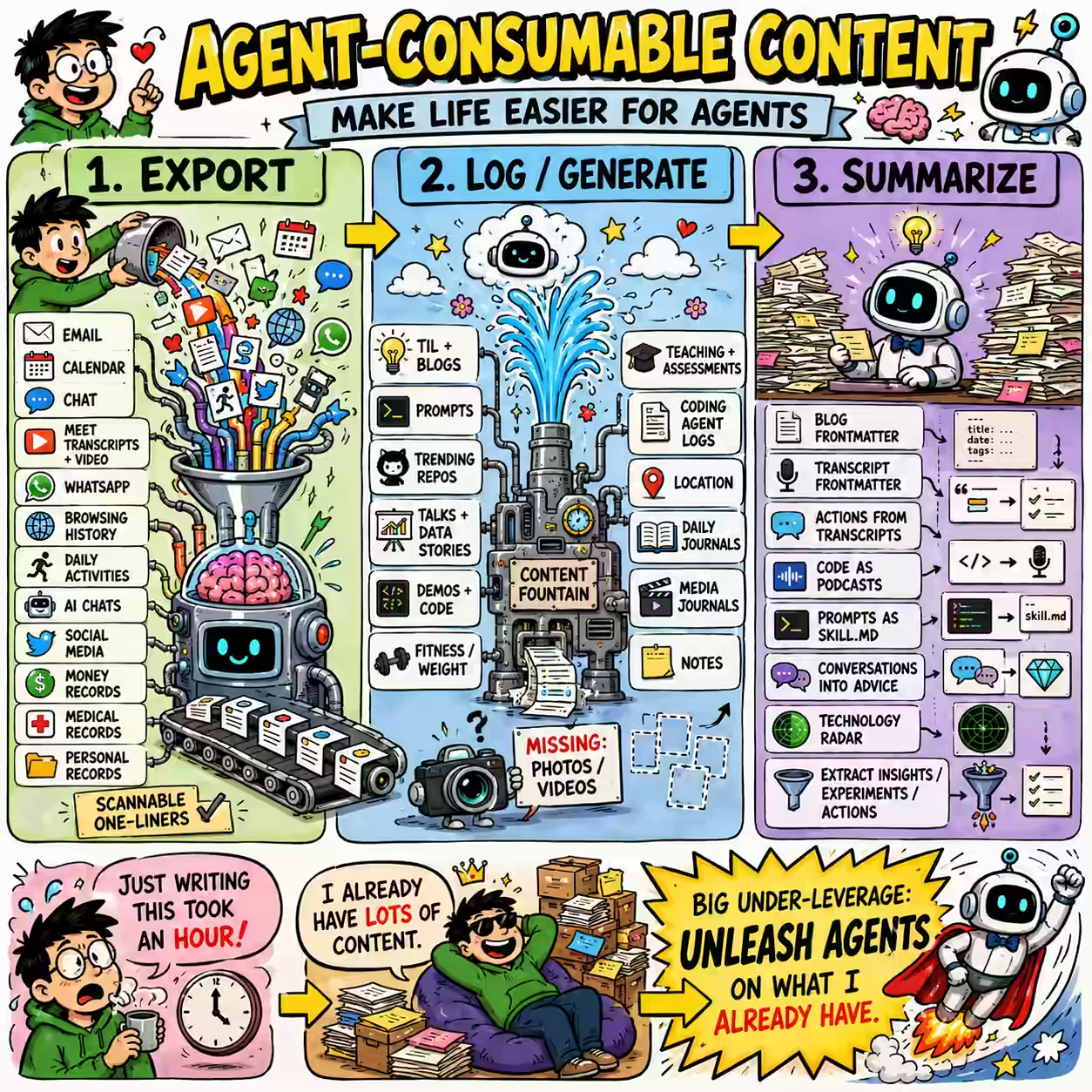
I’m making more and more of my content agent-consumable, i.e. easier for ChatGPT, Claude Code, etc. to read, in three ways. One, I export content in an agent-friendly way. Google email, calendar, chat. I use gws to back up into scannable one-line entries. Meet recordings. I back up transcripts and videos (with a compact audio copy). WhatsApp chats that I back up into similar one-liners. Browsing history by exporting my Edge history SQLite database. Daily activities by integrating the above with my command line and commit history. AI conversations by exporting them manually or via bookmarklets. Social media records like LinkedIn invites/conversations, Twitter, Hacker News, Discourse, etc via bookmarklets or scripts. Financial records like bank statements, receipts, payslips, tax filings, utility payments, rentals, property records, investments, insurance, pensions, invoices, credit scores, etc. by exporting them manually. Medical records like tests, prescriptions, doctor visits, etc. by exporting them manually. Personal records like certificates, educational records, CV, passport / visa applications, etc. by exporting them manually. Two, I log / generate more content. For example: ...

Local context repositories for AI

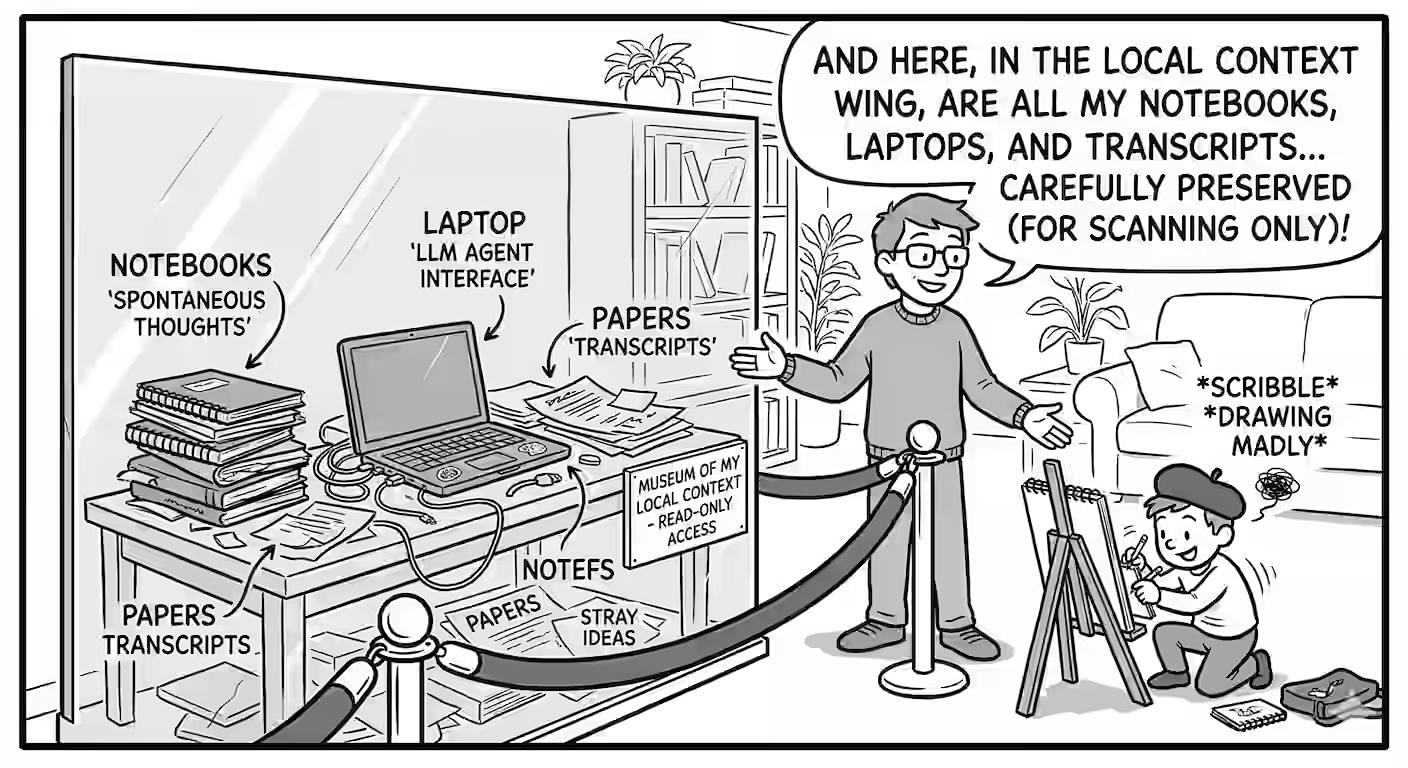
When people ask me for connections, I share my LinkedIn data and ask them to pick. This week, three people asked for AI ideas. I shared my local content with AI coding agents and asked them to pick. STEP 1: Give access to content. I use a Dockerfile and script to isolate coding agents. To give access, I run: dev.sh -v /home/sanand/code/blog/:/home/sanand/code/blog/:ro \ -v /home/sanand/code/til:/home/sanand/code/til:ro \ -v /home/sanand/Dropbox/notes/transcripts:/home/sanand/Dropbox/notes/transcripts:ro This gives read-only access to my blog, things I learned, transcripts, and I can add more. (My transcripts are private, the rest are public.) ...

Using browser history as memory

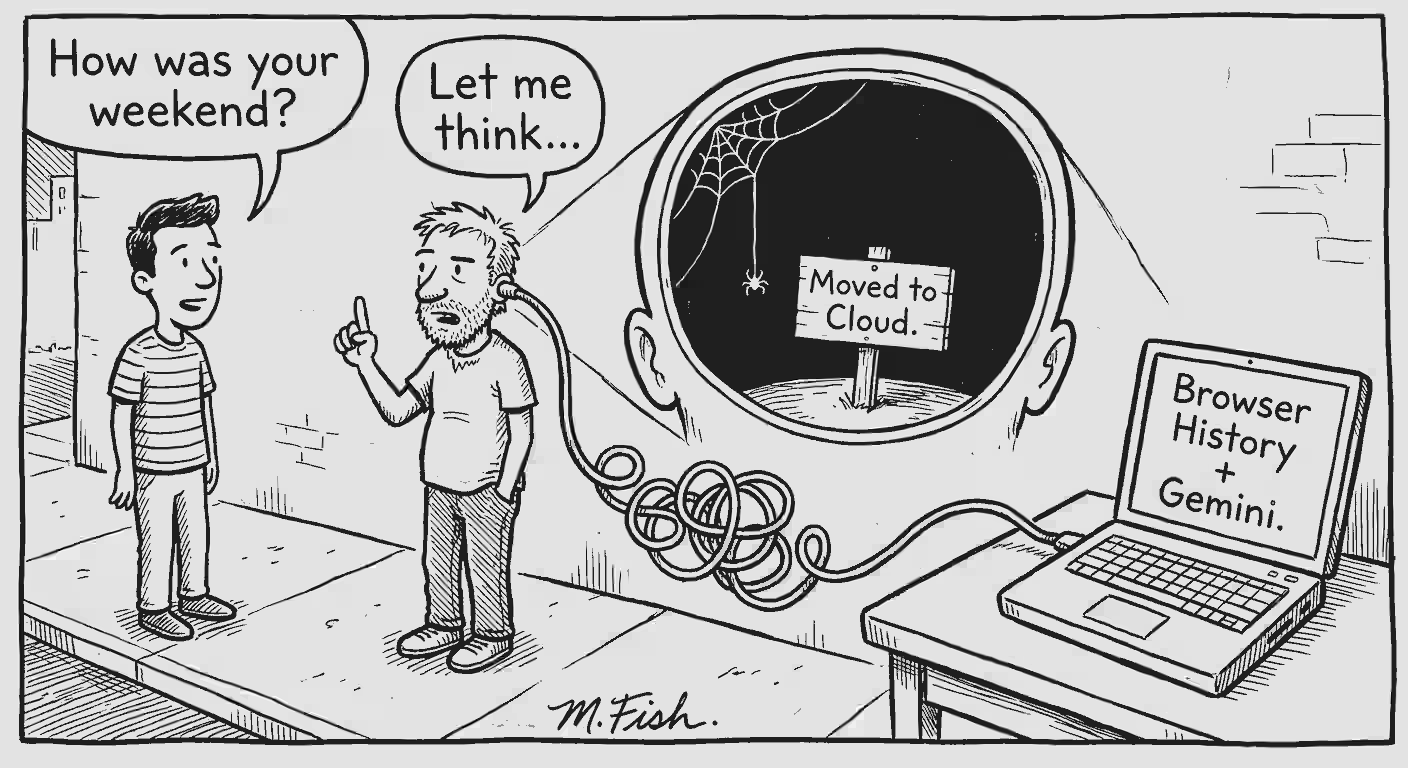
I have a bad memory. (I need to write about that. I k eep forgetting to.) It’s worsening. Yesterday, I misplaced my debit card for the first time. Or maybe the second…? Which reminds me, I just forgot a call I have now! (Panic.) (15 min later.) So, anyway, therefore, I log stuff meticulously. Like what I did each day, what I ate, what I weigh, what pained me, etc. But the best logging is automated. My phone logs where I am. My bank logs what I spend. My calendar logs who I meet. ...

2025 1

Mining Digital Exhaust Workshop 2025

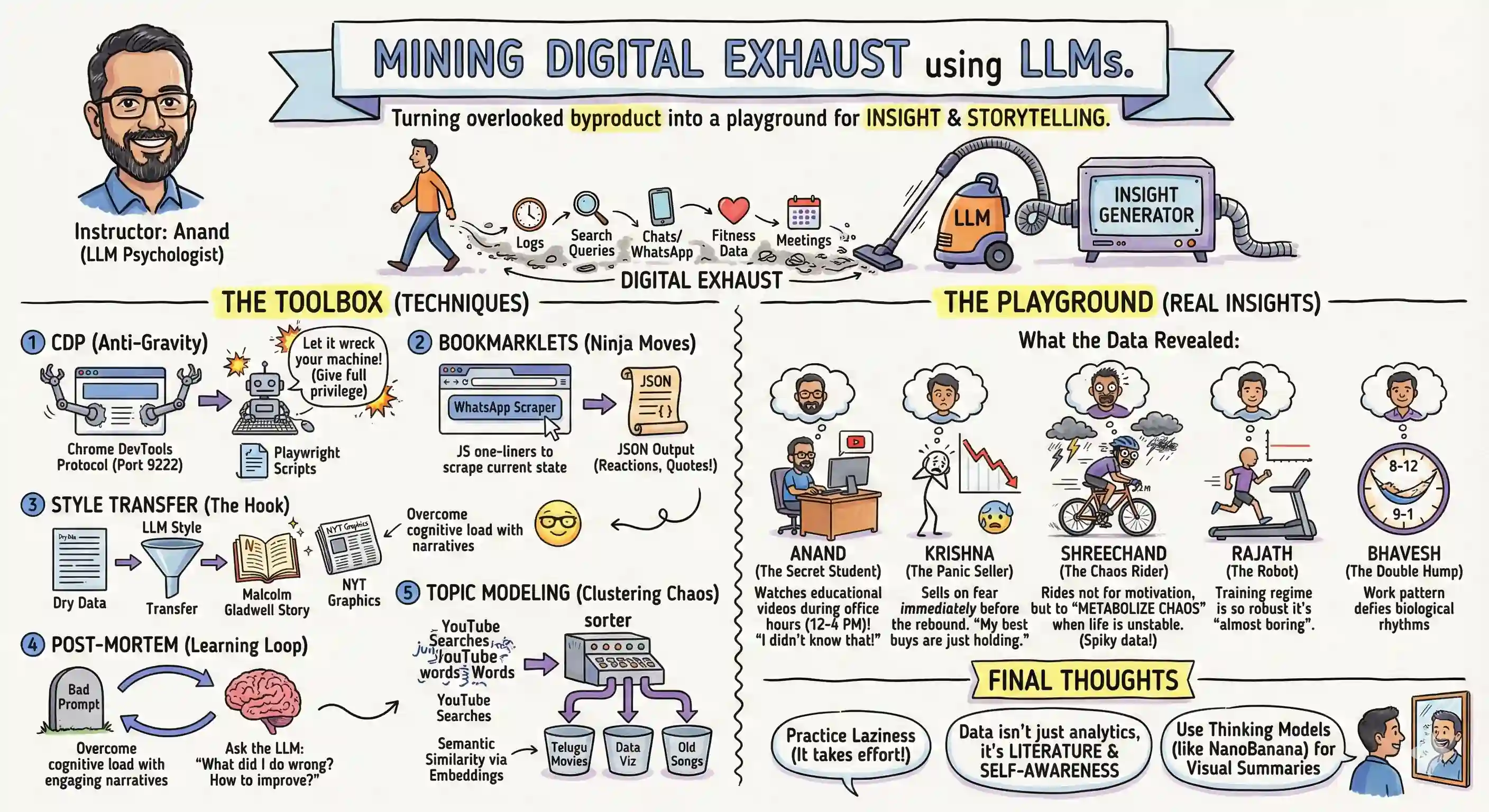
In my Mining Digital Exhaust workshop on Saturday, One discovered that they cycle when life is unstable, not for fitness. Another found that their buys are good but sells are bad trades. I learnt that I watch YouTube most at office (12-4 pm), not at home. How? A fairly straight-forward process: Export your personal data. (Use Chrome Devtools Protocol to scrape.) Upload to ChatGPT, Gemini, Claude, … and have them analyze with code. Have them narrate in the style of your favorite author. Models are super smart, but everyone has equal access to them. Your personal data is unique. Combine them to get something powerful. ...

2006 1

Google search trends

Google search trends. Here is an interesting piece from my search trend. What I don’t understand is, where did thiep and amway come from? Comments ritzkini 9 Jan 2006 10:29 am: from the “the” and the “am” perhaps..dunno.. Madhu 10 Jan 2006 5:15 am: If you realise shareholders of google can just keep clicking away on the links in their mail or search results. Google makes money but shareholders have no cost. If I were an analyst firm covering google, I would employ people just to keep clicking on the ads;) I guess in a proper market, the per click fee would come down over a long term. Sash 13 Jan 2006 5:26 pm: hey ; are u from jamuna hostel @iit madras? sorry for spamming the place but i want to know S Anand 13 Jan 2006 8:56 pm: From Alak, actually. Class of 96.

2005 1

Ghosts in the machines

What happens to your online self when you die?

2004 1

Hacking using keyboard whispers

It’s possible to make sense out of keyboard whispers.