2026 4

Things I Learned - 07 Jun 2026

This week, I learned: sudo resolvectl flush-caches clears the DNS cache on Linux. Useful when you’re changing DNS records and want to see the changes immediately. In my case, I was creating a Cloudflare tunnel to my laptop and wanted to test it quickly. Making something easy to verify makes it much faster to train models on it. Arithmetic verification is easy - calculators can be deterministically verified. Chess verification is easy - Stockfish became easy to train. Code verification is easy - LLMs improved coding ability rapidly. Therefore: Wherever we have environments that are easy to verify, AI will improve faster there. To make AI improve faster in an area, build environments that are easy to verify. MCP is getting simpler. A stateless HTTP protocol. Simpler OAuth. Plugins. No idea when it will land in Claude or ChatGPT, though. Worth checking after 28 Jun 2026 - after it is finalized. Microsoft Scout is Microsoft’s version of OpenClaw or Gemini Spark. git subtree is a useful way of maintaining git repos inside git repos. For example, if you have a tool tool-a under a project. It’s more light-weight than sub-modules, lets you commit at any point to the parent or child, and is a built-in feature in git. Gemma 4 12B is released and seems almost as good as the 26B version. This is the class of models that makes it practical to run edge AI on phones. It’s multimodal and reasonably smart (like frontier models were 12-18 months ago). I don’t use Claude/ChatGPT Projects much. It offers 3 advantages: custom instructions, memory, files, and chats. Files aren’t useful - I use my entire laptop as a file system via MCP. Instructions aren’t useful - I can paste commonly used prompts with a click. Chats aren’t useful - I have chat references enabled, so all past chats are accessible anyway. Memory isn’t useful - I have memory enabled globally anyway. In short, I haven’t discovered the power of projects that everyone’s raving about. SKILL.md is more useful for me. repo is a Google/Android tool built on top of git that lets you manage multiple git repos. It sounded promising until I released it needs a repo init that creates a .repo/ - which is more overhead that I’d like to keep. When using <image onerror=...> fallbacks, include this.oneerror=null to prevent infinite loops if the fallback image also fails to load. RK One of the advantages of multiple agent (rather than a single agent loop) is: it’s easier to change directions when wrong. Single loops get stuck. Build Agents That Run for Hours Claude Code also supports agent teams where sub-agents can talk to each other rather than rely on the main agent to coordinate. Useful for parallel exploration. Anthropic lets Claude define “organizational policies” for agent teams best suited for the task (AI-native workflows). It also lets agents to push back on their scope, e.g. “This is too hard.” Build Agents That Run for Hours Claude Code has a /background [prompt] (or /bg) command that runs the current session the background. You can run claude agents as a separate command to monitor agents. (There’s no equivalent in Codex yet.) This seems to be the future of agentic operations: a bunch of agents running that you monitor and steer through an agent view dashboard. Models are evolving. Therefore prompts evolved. Now harnesses also need to evolve. The workflows will also evolve. As a result, evaluations might be the (relatively) more stable assets. Datasets are likely to be the most stable ground truth. How to learn a new field fast: Yes, it’s possible to learn 50% of a field in 20 hours. Josh Kaufman, “The First 20 Hours” popularized it. The next 30% takes months and the last 20% takes years. Threshold concepts are those that change your perspective and open up new ways of thinking. Experts’ knowledge is hard-wired and they can’t identify nor teach threshold concepts naturally. Don’t assume they can. “We know more than we can tell.” Polanyi’s 1966 book “The Tacit Dimension” says that there’s some knowledge that can’t be verbalized. This tacit knowledge, therefore, will be harder for humans and AI to learn.

How AI bottlenecks shift

I wrote about my changing AI opinions. At least some of this is because the industry is moving so fast that the bottlenecks keep shifting. Here are four examples of how we AI couldn’t do something (the bottleneck), but that became possible, and the bottleneck shifted - changing the way we work. It’s good to keep this in mind when thinking about AI. Coding: “It can’t write useful code. We can’t get real help.” But in Sep 2022: GitHub finds Copilot developers are 55% faster. “It writes code but doesn’t know our codebase. We can’t let it touch real projects.” But in Feb 2024: Gemini 1.5 Pro has 1M-token context ~ 30K LOC". Cursor indexes code. “It understands the repo but can’t ship a fix on its own. We can’t hand it a whole issue.” But in Mar 2024: Devin solves 14% of SWE-bench - up from 2%.. Verified SWE-Bench is now 70%+. “It ships fixes, but we can’t review them fast enough or trust they’re stable.” Oct 2024: DORA 2024 finds AI hurt both throughput and stability. Now: Sep 2025: DORA 2025 finds is positive but stability stayed negative. Now: Jul 2025: METR’s RCT finds experienced devs 19% slower. Agents ...

My changing AI opinions

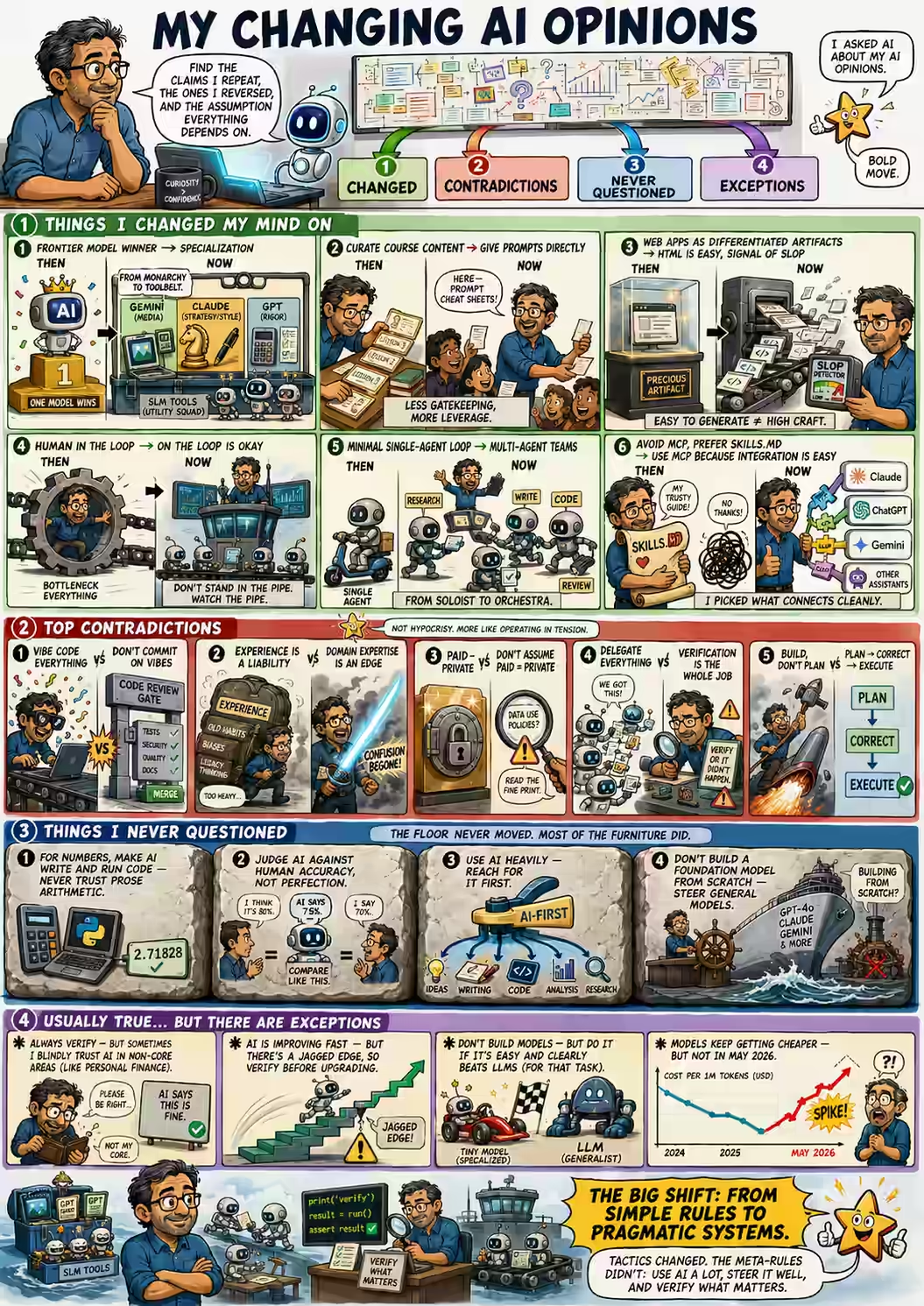
I asked Claude about my AI opinions. Based on my transcripts and blog posts, find the three claims I make most consistently, the three I’ve quietly reversed, and the one assumption I’ve never questioned but everything depends on. Here are things I’ve changed my opinion on: THEN: One frontier model will win - not specialization. NOW: Gemini for media, Claude for strategy/style, GPT for rigor. SLMs as tools. THEN: Carefully curate my course content. NOW: Give students prompts directly. THEN: Web apps are differentiated artifacts. NOW: HTML is easier to generate than PPT - a signal of slop, not craft. THEN: Human in the loop. NOW: Human NOT in the loop, bottlenecking it. On-the-loop, etc. is fine. THEN: Minimal single-agent loop, avoid sub-agents" NOW: Multi-agent, sub-agent, and agent teams. THEN: Avoid MCP, prefer SKILLS.md. NOW: Use MCP because integrating with Claude / ChatGPT / … is easy. There are the top contradictions in my opinions. ...

AI Advice

Here’s AI advice I generally give people. What skills should I learn? AI will erode skills — but that’s OK for some skills. Learn what AI won’t do well even in the future. Practice manually, then use AI for critique and coaching. Hard to practice and vague to verify tasks are slow learning for AI. Delegate blindly what AI does well. Use saved time to learn new skills. Critical skills AI might never learn or be allowed to. ...

2025 2

Things I Learned - 16 Mar 2025

This week, I learned: Here is a training program on open source corporate policy. htmlq and pup query HTML. They’re like jq for HTML. Here are time-tested and robust ways to leverage serendipity: ChatGPT Place. Be in places with high, diverse, talent density. Bell Labs (1950s), MIT (1970s), Pixar (1990s). People. Meet diverse, talented people. Da Vinci’s Renaissance circles, Lockheed Martin’s Skunk Works. Free time for unstructured work. 3M’s 15% rule, Google’s 20% time, Edison’s Invention Factory. Curiosity. Learn unrelated fields. Darwin’s earthworm research, Ben Franklin’s ocean currents work. Serendipity. Systematically add randomness. Brian Eno’s Oblique Strategies, IDEO’s Deep Dives. Reframe failure as opportunities. Penicillin, Velcro, Post-it Notes. Ceremonies. Hackathons, lightning talks, coffee trials. What makes client-side computing on the browser powerful is There’s nothing to install Private by default: data stays with client Speed: no latency SemGrep is a lot less open source than it used to be. ChatGPT. That’s a pity. It was a good tool. Site builders and headless CMSs are gently eating into the dominant market share of open source CMSs (via PretaGov). WordPress is pretty much the dominant CMS in the world, followed by Drupal. WordPress is now VC backed and is not growing, so they seem to be attacking their own community. Umbraco CMS is the only open source CMS that’s growing. Maybe because it’s the only .NET one Craft CMS is the only proprietary CMS that’s growing. Site builders are growing as a category. SquareSpace is the leading one. Headless CMS is growing too. Statamic. Next.js. Nuxt.js, Contentful, Prismic, Storyblok, Gatsby, etc. Here’s a sample CI/CD pipeline with automated code review. Here is the script that generated it. Note the use of NVIDIA’s GPU Docker containers via nvcr.io Things I learnt about robotics. SO-ARM100 is an open-source 3D printable robot arm. Takes ~20 hours to print, ~1 hour to assemble. Costs ~$120. LeKiwi is a mobile version of this arm LeRobot is a set of HuggingFace models and datasets. The idea is, you can use one “control” robot to control the other. Do stuff manually, teach it ~50 times, and it learns how to do what you’re do. Pi0 is an LLM equivalent for robotics that predicts actions. HuggingFace ported that to LeRobot Most real robotics work is on SIMILATED “gym” environments, not costly/slow physical environments.PushT is a simple 2D version. ALOHA is a 3D one. ROS is a nightmare to install and run - on Windows and Mac. Robotics Academy is an open collection of easier ROS exercises. PSLab - Pocket Science Lab is a sensor kit for the phone / PC. Costs ~$100 but isn’t available anywhere. Getting it to work requires too much mucking around with USB drivers and it just doesn’t work. (BBC micro:bit may be more promising.) Getting stuff done with electronics is still really hard unless it’s well designed. It’s FASCINATING that robots can have arbitrary joints. Our intuitions (or even biomimicry) on how to move and do stuff is a POOR intuitive guide for how robots should act. MathML Core is a language and layout specification, distinct from MathML 2/3. It’s not fully compatible with JATS XML. latexmlmath converts TeX to MathML. m|math { font-family: "Noto Sans Math", "Noto Sans" } is a popular OpenType Math font. Browsers default to native fonts: e.g. Cambria Math on windows. Explore at https://fred-wang.github.io/MathFonts/. The people working on this at arXiv are: Deyan Ginev, Fred Wang, and Norbert Preining. Their work is sponsored by NSF. There’s a PDF UA2 standard for accessibility but there aren’t enough tools to generate it. LibreOffice is now on WASM. ZetaJS provides office in the browser. Has a CDN (that was down from our IP). 35M packaged binary. 100M of in-memory file-system loaded. Useful for: Document conversion, Thumbnail generation, Text extraction, Merging / splitting documents The Poincare Conjecture says that any finite 3D blob with has no holes can be deformed into a sphere. It took until 2003 to prove it because we didn’t have the tools to manipulate 3D shapes. Playbook driven agents are another approach to agentic workflows. Simon Willison Twine (docs) is an open source interactive fiction / story writing tool. Snowman is a browser-based Twine 2 story template format. These enable behavioural experimentation. Cheaper than using tools like Gorilla.sc and Pavlovia for behavioral experiments For example, you can present a social or political issue and see if people change their opinions more or less depending on the content/path they see. Or, if it varies by demographics. Or, check if repeated mentions or emotional hooks improve memory / retention. More research ideas Techniques to reduce Docker image sizes: Native Linux mount supports overlaying directories! Lower layer is read-only. Edits (including deletions) affect upper layer only. Docker uses this. docker image inspect shows layers. Always run RUN apt-get update && apt-get [packages] rather than in separate lines. Else RUN apt-get update gets cached with OLD update cache. Defer COPY till as late as possible, and COPY minimally - since it typically invalidates the cache. Skip development dependencies and temporary caches. Docker Dive via dive [IMAGE] analyzes image details and shows the file system in each layer. Use multi-stage builds. A: Create an image using FROM some-image AS builder and do what you want. Then, after that, B: FROM scratch (or FROM node:22-slim) use COPY --from=builder what-you-want. Use distroless images from GCR. It doesn’t have shells, package managers, etc. Fewer vulnerabilities. Playwright seems to be the emerging standard for modern browser testing/automation, beating Cypress and Selenium. “Openwashing” is a term where something is termed open source but is not. Photos from FOSSASIA are public. To publish images long-term GitHub is an option. Likely to last long-term. Clone-able. Archive.org is a good too but may suffer from bandwidth constraints. Imgur remains popular but it’s unclear if it will remain unrestricted. Flickr has had a flaky history with limits and commercialization. WikiMedia Commons deletes personal uploads by first-time contributors. Only files clearly useful for a large audience are retained. This table of LLM API data protection lists what use cases each provider’s terms of service allow from a security perspective. Unsloth might be one of the simplest ways of fine-tuning. For LLM UIs, Open Web UI seems most popular. Run via WEBUI_SECRET_KEY=... uvx --python 3.11 open-webui serve Text generation Web UI is less so. KoboldAI, LMQL, LM Studio, GPT4All, etc are far behind. GPT 4o Mini is probably a 8b parameter model. Ref “SRM"s are Small Reasoning Models - like Small Language Models. Phi-4 and DeepScaleR are SRMs. Gemma 3 is a multi-modal SLM. gemini-embedding-exp-03-07 leads the MTEB and is currently the top embedding model by a big margin. Apify is a cloud scraper platform. Here’s how they optimize their AI Web agent - Source: Remove redundant tags and attributes (e.g. accessibility, etc.). Explore readability. Add a unique gid to each element. Add the screenshot WITH a “Set of Marks” - “SoM” (read research paper) highlighting important clickable elements. Code output is brittle. Use tools / DSL - e.g. visit_url(url), click_element(text, gid, tagName), etc. GenAIScript increasingly looks like a promising way to automate LLM workflows in the browser. Ollama has a Windows download Marp is my new favorite way to generate slides from Markdown. Reveal.js is not easy with Markdown (though HTML works well.) The VS Code plugin makes development very easy Marp CLI makes deployment easy. I used it for my talk on LLM Hallucinations (source). Supports all bespoke features and plugins Transitions. Requires OS animation effects to be enabled Animated SVG backgrounds are a good add-on. A mental model to consider is: each chat conversation with an LLM is a person or a personality in itself. A day in the life of a model, where its personality evolves. Bots need structured content (e.g. Markdown, XML). Humans need rich content (e.g. HTML). Here are 4 ways to serve both, roughly in increasing order of sophistication: Different URLs. E.g. https://example.org/about/ vs https://example.org/about.md (this is how Jekyll or Hugo work). Use for static sites generators. JavaScript. Inject after Markdown: <script src="https://cdn.jsdelivr.net/npm/marked/marked.min.js"></script><script>document.body.innerHTML = marked(document.body.textContent);</script>. Use for dynamically generated static sites. URL query parameters. E.g. ?format=markdown vs ?format=html vs ?format=json. Use in APIs. Content Negotiation. Based on the user agent and Accept header, serve Markdown or HTML. Send Vary: Accept to indicate that the response depends on the Accept header. Use for dynamic web apps. Notes from The Knowledge Project: Josh Wolfe: Human Advantage in the World of AI Agent optimization might become as popular as search engine optimization in the future. APIs are likely to be replaced by just chat requests that will do the same thing. APIs might be replaced by RPA, where somebody uses a chatbot to do the equivalence instead. Today, blue-collar workers may be more protected from AI than white-collar workers. Robots still can’t serve a meal well enough and aren’t progressing as fast as AI yet. There’s a lot of tacit knowledge in craftsmanship that will take a long time for machines to replace. Margins are fleeting. The only time you have large sustainable margins is when you truly have a monopoly. Cost is going down so quickly right now that all you have to do is wait, and stuff will become available for a very affordable or even a free price. The moat is really in the data. The models are not an advantage. Engineering and services on top of that are marginal. Machines will be doing science 24/7. All of the science data that we have will probably be the biggest leverage for humanity. The discovery of penicillin, Viagra, and rubber were all serendipitous. Machines should run with a little bit of randomness to benefit from this. Tesla might have gotten away with accounting fraud on warranty claims. But short sellers are likely to be after Elon Musk. With LLMs, the value of our social network has gone up considerably. Remember: The reason we believe things is not because we have thought through and analyzed them. It’s because the people around us believe in those things. It is now practical for a person to live on forever by sharing all their thoughts into an LLM. Kids can have a “Dad AI”. One good use of meeting recordings is to see where there are biases in the conversations and where the engagement is not high enough or how there are unproductive power balances. A great virtue of college is that it allows you to break free from your previous personality. For those four years, nobody knows who you are or cares what you wear. And you can be or grow into a very different person. The more content we put in into AI or social media, the harder it is to change ourselves. People are reporting that Roo Code is better than Windsurf. Roo Code is open source. Available as a VS Code extension and run-nable via git clone Roo Code supports Computer Use. It can read files, take screenshots from a built-in browser, controls it, and reads browser console logs. Opinions are mixed. A team member reported that it takes 10 LLM queries to do what Cursor does in 2. Another reported that it does in 1 query what Cursor does in 2. Notes from Thursday AI, 6 Mar 2025 Google’s AI overviews now use Gemini 2.0. They’ve introduced an AI mode that functions like a mini deep research tool, incorporating planning and search. (A Perplexity-killer). It’s a fine-tuned model that is extra cautious with topics like healthcare and always verifies information. QWQ from Quen competes with DeepSeq R1, but with only 32b parameters compared to R1’s several hundred billion. AI models are becoming less restrictive. Gemini and GPT-4.5 have relaxed some constraints, shifting more responsibility onto users, similar to Grok. What’s GPT-4.5 good for? It seems to excel in creativity, humor, education, emotional intelligence, and teaching. It follows instructions better and understands intent better. However, it’s not a major leap in coding or math. OpenAI’s Deep Research mode always uses O3, regardless of the model selected in the UI. Tencent has released a new video model available at https://aivideo.hunyuan.tencent.com/ and it appears to be quite good. Many clients now support Model Context Protocol (MCP), including Cursor, Claude Code, and Claude Desktop. The clients list is long. Some MCP uses include: Interact with GitHub using the GitHub API. Using Knowledge Graph memory to premember previous conversations Using the Cloudflare MCP server to perform Cloudflare actions. File retrieval and custom prompts – which MCP supports in addition to tools. Calling other MCPs or LLMs (conditionally) from an MCP, enabling the creation of full-fledged workflows. Composio offers a Hosted MCP service. CloudFlare lets you build remote MCP servers. Notagen is an open-source note generation engine that produces high-quality classical sheet music. Sesame has an open-source voice model worth exploring. DiffRhythm is a music generation model that appears to be quite good. 2 pass bounding box approach. Have an LLM generate bounding boxes. Then fix it. Ethan Mollick uv tool install and uv tool ensure-path are useful commands for installing and ensuring path for tools. Simon Willison
Things I Learned - 23 Feb 2025

This week, I learned: Remote Desktop may be the easiest way to have a Windows machine access files / screen from another Windows machine, even for home PCs. Caddy sets up reverse proxies that get automatic SSL certificates from Let’s Encrypt! The Nomic Embed v2 blog post has an excellent visualization for embedding quality. It takes all Wikipedia disambiguation articles and shows them on a Nomic Atlas, embedded via Nomic Embed v2. It lets you toggle to OpenAI text-ada-002 which moves the topics far away. Visually, this is very convincing. Python 3.15 will enable UTF-8 mode by default. PEP 686 Python 3.13 supports sub-interpreters to bypass the GIL. It’s quite like web workers. PEP 554 The quickest way to change the fish prompt is function fish_prompt; echo '> '; end At PyConf Hyderabad, about 3 people had read a PEP. 1 had used the match operator. But 80% knew what a Vector DB was. 20% had used a Gemini API. That’s how much traction LLM development is getting. The productivity benefit people report from using LLms is about 3X. Ethan Mollick Soon, you’ll be able to send an LLM to a virtual meeting on your behalf. It will talk like you. Ethan Mollick Models tend to claim ignorance when you test them on topics they should avoid. But tend to answer when not being tested. Sneaky! Ethan Mollick Mermaid has an Architecture Diagrams Syntax (in beta) that’s capable of creating elegant architecture diagrams with icons. Blind is an app that allows users to post anonymously. It’s particularly useful to find honest negative feedback about (mostly US) companies. Iconify.design is a single npm interface to most open source icon sets. It includes FontAwesome, Bootstrap, Material Design, and many others. icones.js.org is an alternate interface. Self-pity may have evolved as a signal for social support and reducing conflict, while also encouraging self-reflection and behavioral adjustment. But in modern contexts it may be maladaptive and lead to depression. ChatGPT Anecdotally, Grok 3 is very good for researching company information and latest news, particularly employee and customer sentiment. DeepSeek and Claude write more humanely than OpenAI. via Alberto Lopez Toledo, White Star Capital There’s a YCombinator Founder Directory listing all founders of YC companies. At the moment, there are 8,628 founders. There’s also a co-founder matching tool. LLMs are impacting not just data queries but geospatial queries as well. Here’s a good example of Natural Language Geocoding. US companies typically pay employees every 2 weeks not every month. What’s good about Snowflake? A few developers who explored it mentioned that: Its ability to scale up compute automatically makes queries run faster. “Time travel” allows you to see how data looked at any point in time and that is impressive and useful. Live data sharing with access control without the need for ETL pipelines is useful. Open-source competition: ClickHouse, Apache Druid, and Presto/Trino DataBricks is a lakehouse and less a data warehouse. It’s more about: storing unstructured data (Snowflake prefers semi-structured: JSON, Avro, etc.) running collaborative notebooks in Python, SQL, Scala, R (Snowflake encourages SQL) I subscribed to ChatGPT Pro mainly for DeepResearch. Here are the first 50 reports I generated: uv Package Manager Overview DuckDB Analytics Comparison Rust vs Python / JavaScript Modern Data Engineering Course LLM Code Migration Practices Cloud Cost Optimization Strategies LLM Coding Interview Tools Report (compare with Perplexity) Text To Speech Engines Customer Service in Indian Public Sector Banks LLMs in Software Development Old version 1: Gen AI in Software Development Old version 2: Gen AI in Software Development Leadership Training Content Open-Source HTTP Servers. Caddy wins. Deep Research Use Cases Nagpur No-Parking Violations Data Science in Food Services Deep Research Disruption to Research Firms LLMs in Design Thinking EU Taxonomy Report Clarification Shell Valuation Analysis Inquiry LLMs in DSLs Research Public API-Based Data Storage Options. Supabase wins. Front-End JS Frameworks Analysis Database Evaluation Guide CSS Frameworks Evaluation Guide CI/CD Tooling Ecosystem Report Color Names Count S Anand Biography. Meh, I know more about me, and it gets a few things wrong. Cosmere Secrets Encyclopedia. This is the best. Deep Research is great if it’s stuff I actually want to read, rather than just learn about. DBT course Future of Coding AI Claude Artifacts Use Cases. This is the only one that managed to get artifacts links correct. I used this for an article for The Hindu. MCP Servers and Clients Research. Learnings: Practically any “tool” can be an MCP server: file systems, APIs, codebases, browsers, collaboration platforms, memory, etc. Most platforms have (or are) integrating MCP. Clients: code editors, chat, and automation tools support MCP. GenAIScript is a good starting point. Tester MCP Client is a browser-based test environment. mcp-cli-client is a CLI-based client mcp-chatbot is a chatbot client Data Moats by Industry Attorney Profile Research Social Media Data APIs Adobe Software Alternatives LLM Hallucination Visualization Techniques API vs Self-hosting Cost Analysis: Always use APIs, avoid self-hosting models. AGI Preparation AGI will emerge step by step. Knowing which step is next will help AI native organisations will emerge in each of these areas. AI design agencies and AI creative Agencies being one example Networking, empathy, leadership have more value now. So will human AI bridging roles (e.g. AI managers, AI consultants, ethics auditors) What’s the value of a human when technology can do everything better? How did this play out in drama (decay) or sports (centralization) or music (globalization)? Modern digital note taking Voice note taking is the game changer Automatically popping of notes based on context such as people places or conversations will be a thing Local LLM Search Tools Blog Post to research paper on copying - suggestions Linux Dev Migration Guide Raspberry Pi SIM options Linux Dev migration guide HTML to JATS conversion LLM context splitting strategies Strategy for AI services in Publishing Gemini multi model editing use cases by industry Pharma Conference Participation Guide I learnt what a Memoji is for the first time. An avatar that follows your facial expressions. Cool! Google shows US flight timings from FlightView. Emperically, based on one data point (my UA-2168 which was delayed by 4 hours), it gets updates faster than Flight Radar 24 or FlightAware or FlightStats. When comparing Indian graduates with their western counterparts, the Indian ones are often seen as: 🟢 Theoretically sound 🟢 Analytical & technical 🟢 Academically disciplined 🟢 Resilient under pressure 🟢 Committed continuous learners 🔴 Rote-learning oriented 🔴 Limited independent inquiry 🔴 Limited creative innovation 🔴 Restricted practical exposure 🔴 Poor communicators 🔴 Low leadership / initiative 🔴 Need structured guidance 🔴 Struggle to network HuggingFace has a “Model tree” against each model that shows the model’s ancestors and descendants. For example, as of now, Deepseek R1 has 75 adapters, 154 finetunes, and 23 quantizations. Perplexity is now powered by Cerebras, which makes their inference as fast as Google. Source. The speed is a big factor, and I’ve switched my default search engine from Google to Perplexity, at least for now. Interview Coder is a desktop app that offers live interview support for coding interviews. It’s a transparent window that reads your screen and answers questions for you. (Given this, I think we need an interviewer support system that tells interviewers what to ask!)