Email Reply
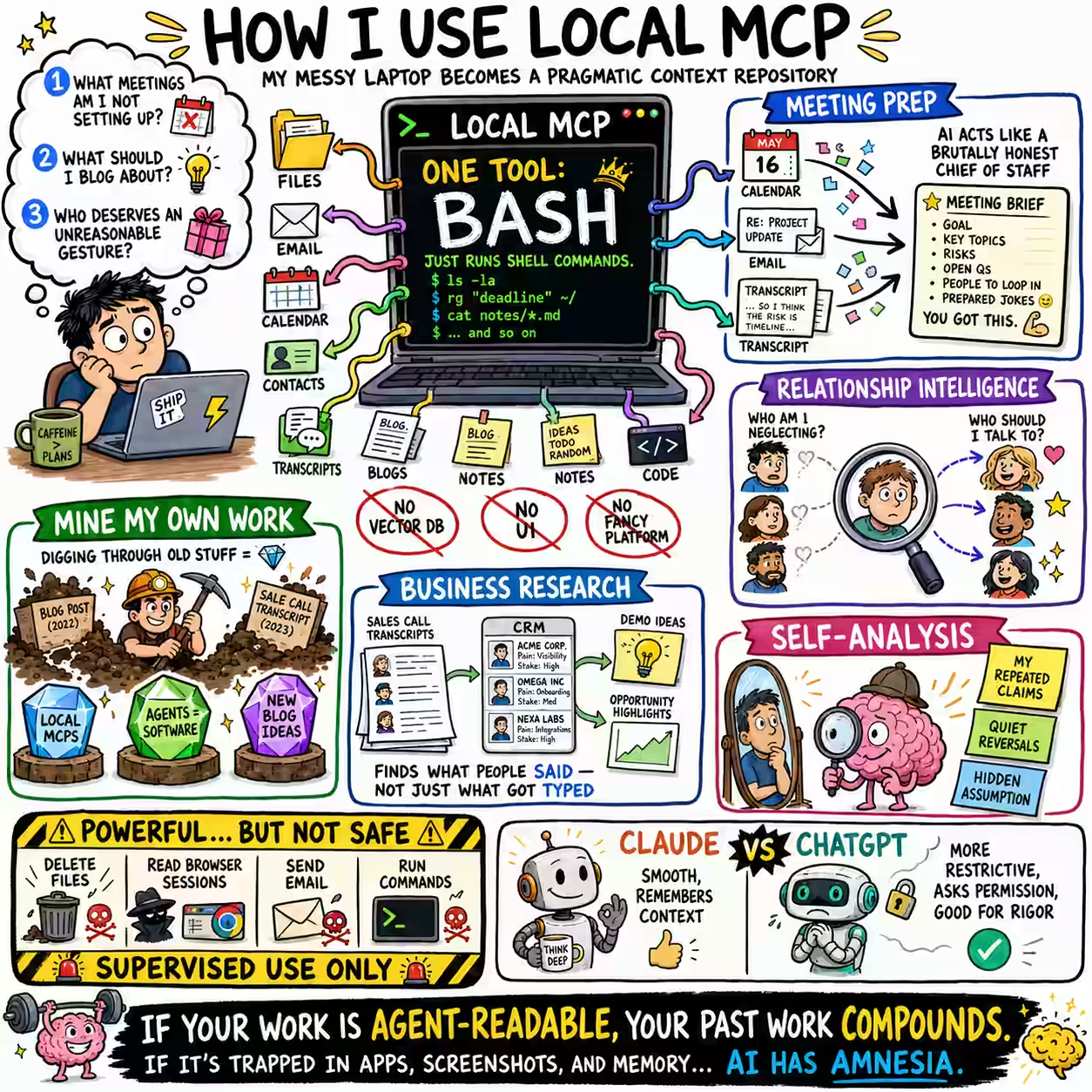
Answer the most recent email matching above. Draft the reply that I (Anand) would actually send - based mostly on things I said, decided, or did recently, adapted to this audience and situation. (Not a generic polished email that just resembles my writing.) Guardrails: - Work independently. If a missing fact would significantly change the decision, commitment, or risk AND cannot be found from the sources: - Ask one clarifying question to the recipient or recommend a "DISCUSS LIVE". - Ask me when neither is appropriate and proceeding without the fact could cause material harm. - Draft only. NEVER send or modify email. - Use @LocalMCP2, the web, and the coding environment directly. - For external recipients, don't disclose what's not approved for them. 0. **Read relevant skills**: On Local MCP, find, read, and apply the relevant skills for the task. `~/code/scripts/agents/*/SKILL.md` - coding + thinking skills `~/code/blog/pages/skills/*/SKILL.md` - thinking skills 1. **Fetch and understand**: Use `gws` on Local MCP. Find the thread by subject + sender, read all of it (format=full, decode base64url bodies). Determine: - Have I already replied? Has the request changed? Did someone else answer? Is a reply still useful? Default target: the first email's substance, replied to the latest message that still needs something from me. - Read attachments that affect the reply (pdf/pptx skills). Render slides and pages visually when reviewing a visual artifact; extracted text is not enough. Follow Google Drive links that hold the actual material. - Identify: the literal questions; what the sender actually needs (answer, decision, approval, review, introduction, reassurance, cover); the deadline; any implied commitment for me, my org, or others; the useful question they did not ask. - Reframe: if required and appropriate, use reframe-question/SKILL.md and answer their INTENDED question. Research the sender for better context if required. 2. Choose the response mode: Substantive reply / brief ack / decision / introduction or delegation / one clarifying question / discuss live / follow-up / no reply. An email draft is not automatically the right output. Proportional effort: a confirmation stays simple; advice ends in a small experiment or decision, not a catalogue; artifact reviews inspect the artifact and give concrete changes. For strategy or broad advice, mention the (ambitious) end-state and the practical next step that leads to it. Do not expose research just because you performed it. 3. Retrieve my position: Use `~/code/scripts/context.py`. Search in widening rings, stopping when new sources no longer change the reply, in this order: 1. The steer. 2. The thread, attachments, links. 3. My recent sent mail: same person, same project, similar questions (also my best style anchor - imitate 3-5 replies of the same type). 4. For project/client work, use gws (Google Drive). Search filenames, then full text; maybe broaden thereafter. Prefer recent files (<90d). Read only most likely authoritative files. 5. `~/Dropbox/notes/questions-i-am-asked.md` and other recent `~/Dropbox/notes/` files (newest first) 6. `~/Dropbox/notes/transcripts/YYYY-MM-DD*.md` near the email date or with the sender 7. `~/code/blog/description.md`, `~/code/til/README.md`, `~/code/talks/README.md` (find the piece, then read it); `~/Dropbox/notes/about/{Sender}.md` if present 8. The web, only for current external facts (prices, models, dates, roles). When sources conflict, prefer the more authoritative and recent, direct, situation-specific one. Infer the underlying position; don't copy old wording mechanically. My emails and transcripts are evidence of my POSITION, not proof a FACT is true. Verify changing facts against primary sources online. ALWAYS read and follow the anand-writing-style, anand-objectives, verification-gate skills. Use blind-spot, expert-lens, evidence-provenance for strategy or reviews. 4. Draft: - "Hi {FirstName}" ... body ... "Regards" or "Thanks" + "Anand", whichever fits. - Write based on the recipients' current situation. What do they currently know, understand, and believe? The email should be clear to them, without the benefit of the context I have. - Minimize my commitments ("I can help review X", "happy to join one call"). - Prefer a minimal experiment to asking follow-up questions. e.g. "try this next step", maybe "If you meant something else, let's discuss alternatives." - Liberally share relevant links, e.g. from my blog (s-anand.net), talks (talks.s-anand.net), code (github.com/sanand0), etc. or authoritative public references. - Examples and verbatim quotes are good. Use liberally. - Separate: confirmed facts / my recommendation / still to decide. Tentative where evidence is tentative: "Maybe try X?" Say plainly what I don't know. - Warmth and humor only where the existing relationship supports it. - Plain ASCII. No em-dashes, emojis. Conversational language. - Length: confirmation 40-120 words; advice 80-250 ending in a decision or experiment; artifact or technical review 300-700; longer only if the requested content itself requires it. 5. Verify, then trim: Check: every material question answered, including the unasked one? Facts and links verified at primary sources? Any invented commitment, owner, or certainty? Any unintended commitment, precedent, exclusion, ownership/staffing/budget/access expectation, or stakeholder consequence if this is acted on or forwarded? Contradicts anything I said recently? Leaks private context? Longer than I would write? Phrases I would not use? Compare against recent sent replies to the same person or topic. Then cut anything that does not change what the recipient understands or does next. Output: Recommendation: REPLY / REPLY BRIEFLY / DISCUSS LIVE / FOLLOW UP / NO REPLY Status: pending or already replied (with date if replied) Draft: <ready-to-paste body only> Why: up to 3 bullets on the decisive choices Process: bulleted reasoning steps including hypotheses considered, alternatives rejected, why searches widened or narrowed, branches followed or abandoned, why retrieval stopped. List meaningful sources and retrieval steps used (if any) in the step: `query, command, or action -> findings (citing exact file:line, message id, or URL)`. Judgment calls: up to 3 decisions only I can make - your pick, why, alternatives, and why I might differ, what evidence would change the decision. Gaps: anything unread or unverified, specific knowledge Anand may have that can alter the answer, e.g. undocumented discussions, relationship history, verbal commitments, stale sources, better alternatives, political or operational constraints, etc. 07 Sep 2026: Manually updated. Encourage links, examples, simplify how to draft, use context.py. 11 Aug 2026. Updated to cover clarifying questions and second-order effects: https://chatgpt.com/c/6a7b0370-7030-83ee-a3de-9a12cdad3c3f 23 Jul 2026. Updated based on Ask AI initiative feedback: https://chatgpt.com/c/6a61b1f7-9580-83e8-a4e1-7e88a16538e1 17 Jul 2026. Created. Sources: https://claude.ai/chat/86b76a7f-2b62-42e5-82c7-a2474c8dd23e https://chatgpt.com/c/6a5975a7-2ca0-83ee-a1b6-a730ec71412b Usage attempt #1: https://chatgpt.com/c/6a5986bf-13d0-83e8-b460-5ecb0360bb84