I teach Tools in Data Science (TDS) at IIT Madras. At our October 2026 orientation, JK began: “A simple five-minute saying ‘TDS is hard’ will be the orientation.”
We ended up discussing the philosophy of the course for over an hour. Here are some questions students asked.
Q: What is TDS trying to teach?
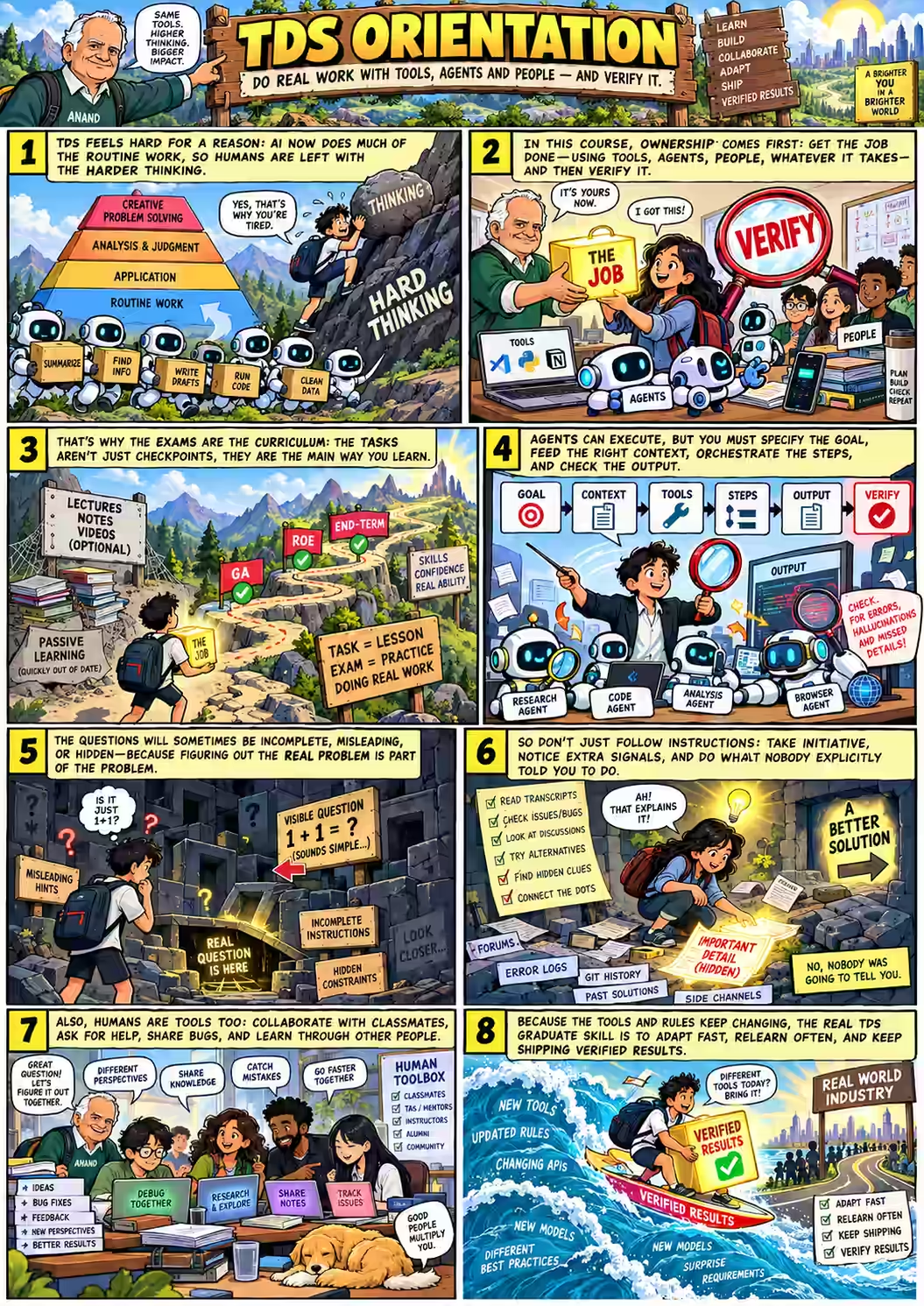
A: “Get the job done.” Use agents, tools, people, your ingenuity, whatever. “I’m giving you the job - get it done.” The problems are inspired by real work. The important part is getting it done correctly, and verifying it.
Q: But using ChatGPT, copying answers, isn’t that cheating?
A: In real life, no one rewards you for reinventing the wheel. “If you feel copying is bad, think of it as group work.” Ask colleagues. Use agents. We’re designing questions where simply copying won’t help. So, what’s usually called “cheating” is actually part of the job.
Q: What’s the syllabus? Should we watch the course videos?
A: “Exams are the curriculum.” My advice: “Ignore all the videos. Solve the problems.” If you’re stuck, use the course content, YouTube, AI, friends, whatever helps. “Why should your learning be only limited to half a dozen things that I’m providing when the entire world is there?”
Q: I scored 34.5 after many failed attempts using LLMs. What did I learn?
A: Sushmitha asked this. I picked on “many failed attempts.” You couldn’t solve it earlier. Now you can. “Maybe you will say, ‘Oh, but I just learned how to use LLMs.’ Fair. That is a useful skill.” You may have learned orchestration, debugging, or context engineering. We don’t even have good names for some of these skills yet.
Q: If agents do the work, what’s left for us?
A: Give them the right information. Connect tools. Orchestrate. Notice what’s missing. Verify. “When I tried it, it worked” isn’t enough. Can you make it work “99 times out of 100”? The agent executes. You’re responsible for the result.
Q: Shouldn’t we understand how AI solved the problem? Do we need programming?
A: “If you have time, learn and understand.” Understanding helps when things break, as Carlton pointed out. But we’re deliberately overloading students. “You’re supposed to delegate everything to agents.” Knowing programming concepts helps, but “the specifics of programming languages may not be” as important. “I’m training muscle memory.”
Q: Why is TDS so hard? Why are questions sometimes misleading?
A: Real-world requirements can be incomplete, confusing, even wrong. A client might ask you to optimize their supply chain when they really want to convince their boss they’ve already optimized it. “Being able to read between the lines is a skill.” We want students to be skeptical, notice what’s missing, and figure things out.
Q: Isn’t it unfair that some students can afford better AI models?
A: Yes. Students also have different amounts of time, experience, and support. “Where do I spend the scarce resources that I have?” Can you use free models, optimize your budget, or work with friends? JK reminded students that they had over a thousand classmates to collaborate with. We want to reward resourcefulness, though we still need to distinguish that from purchasing power.
Q: What if the exam portal itself is difficult to use?
A: Improve it! Reproduce bugs, collect logs, report them. Or “create a bookmarklet” to change the interface yourself. I joked that maybe we should worsen the portal so students would improve it. We won’t. But “What have people done that they have not been told to?” That’s something I look for when hiring.
Q: How will the end-term test us if we’ve used AI for everything?
A: Without AI or internet access. Can you specify a problem? Spot a wrong answer? Verify a solution? Don’t expect questions repeated from assignments or videos. “Your preparation for the end-term is not studying before the end-term; it is practicing all of the examinations.”
Q: Won’t everything we learn become obsolete as AI improves?
A: Some of it will. “This course is constantly changing.” Earlier, we focused on software tools. Now agents can operate many of them. Even Carlton and I are struggling to keep up. “The process of relearning is what you may need to learn more than the content of what you learn.”
JK summed it up at the end:
“At the end of the course, if you get a better idea of how you learn with AI, that would be the key takeaway that we would want you to have from the course.”
That’s what we’re trying to teach. Let’s see how well we manage it.
Explore the public course | Watch the orientation and read the transcript
Links:
- Video (77 min)
- Transcript
- Audio (77 min)