One of my goals this year is to publish 2 books. One got published. Sort of.
Data Science for Sustainable Development Goals: India Case Studies is an open-access anthology and I’m the designated author of Chapter 10: Using Data Analytics to Improve Students’ Performance is about how Gramener worked with NCERT to analyze the National Achievement Survey data, discovering stuff like TV hurts maths but not reading scores, playing helps maths but not reading scores, fathers of West Bengal (not mothers) and mothers of Punjab (not fathers) influence their children’s scores the strongest, and so on.
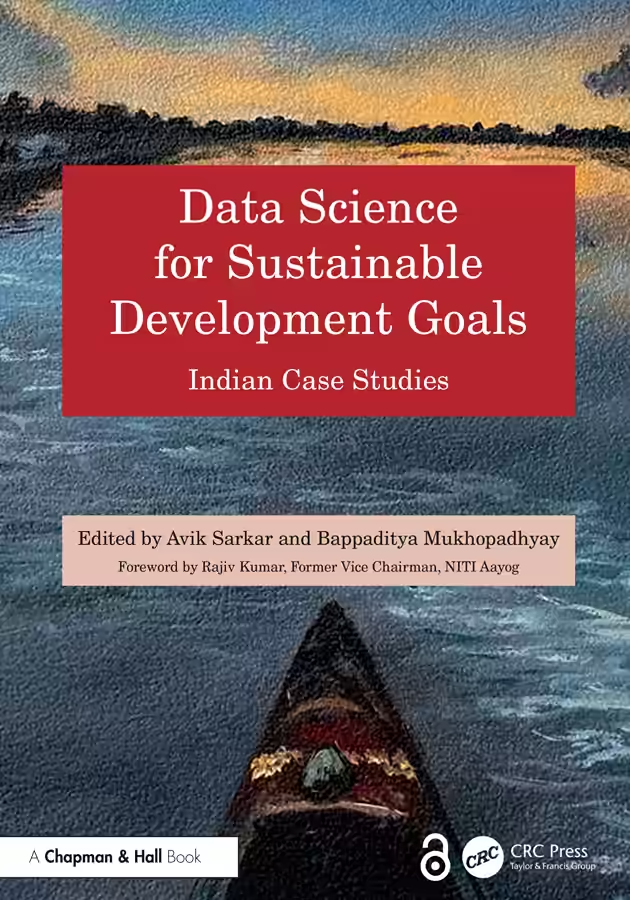
(BTW, Chapter 5: Enhancing Reader Engagement and Creating Interaction through Data Analysis by Sugata is about how Gramener visualized the 2013 elections with Vijay Karnataka, sharing how rich the candidates where, where the money was concentrated, which MLAs performed well, how younger MLAs differed in their questions from older ones, and so on - and that’s something Nikhil, Sharon and I worked on, too.)
In Jan 2019, Avik Sarkar - who was an Expert on UN Big Data & Data Science Committee from India - reached out suggesting that Gramener write chapters for a book on applications of data science in government. We discussed internally and picked up four streams:
- Ministry of Trade & Commerce work. I requested Shankesh who was busy, then Vijayam, who agreed, but we didn’t proceed.
- UP Health Ministry: Anand Madhav wrote this along with Dr Vasanthakumar
- NCERT: I wrote a draft in Feb 2019, expanded it a bit in Jul 2019, and this was ready too.
- Karnataka Elections: Sugata wrote this chapter in Oct 2019.
By then, COVID struck. Avik approached Sage as the publishers initially, but COVID stopped all new books, and Sage’s India operation later ceased. Then he approached Wiley but Wiley’s India publishing operations had also stopped. Besides, the case study format made it difficult to position it as an academic book.
Eventually, CRC Press / Taylor & Francis eventually accepted it. Great Lakes Institute agreed to pay the processing charges so that it could be open access.
So, by Dec 2023, we had 3 chapters ready for publication.
But by Mar 2024, Dr Vasanthakumar had moved to Ladakh and the current UPTSE officials denied permission. So we dropped this chapter.
Finally, in Jun 2026, the book was published - with Sugata’s and my chapter.
But note my use of the words “sort of” and “designated author”? That’s partly because it’s an anthology, not a solo book (but no complaints). But also because I wasn’t sure I wrote that chapter.
My chapter opens with these words:
Anand’s neighbour’s son, Adhvait, is a precocious 10-year old. He is into gaming and gadgets. He’s glued to Chotta Bheem on TV and Doraemon on YouTube…
My reaction was: “Adhvait? Who’s that? Oh, wait, I didn’t write this. Sunil must have ghost-written this. This is not my style. Besides, I wouldn’t mention Chotta Bheem or Doremon.”
This is exactly how I feel when AI ghost-writes for me. “This is not my style.” or “This is not what I would have written.”
Clearly, AI ghost-writing is not a new problem. People have been ghost-writing for decades. The feeling it evokes in me is the same.
To be fair, the style wasn’t bad. Not AI style, certainly not mine, but not bad.
Then I asked ChatGPT to go through my emails and find out when exactly I asked Sunil to write it.
It turns out I never did. On 18 Feb 2019, I wrote the first draft of the chapter. It begins with exactly the same sentences - including Adhvait, Chota Bheem, and Doremon.
Here’s when went through my head:
What!? I wrote this? Who is this Advaith …
Oh, it says “…he skulks near Anand’s door to use our WiFi on his phone.” I remember Adhvait! We spoke to his parents. I was really impressed…
Wait a sec.. Some of this is clearly written by me. In fact, I wrote this whole thing!
It’s amazing. I don’t like AI’s style. I don’t like ghost writers’ styles. I don’t like my own style! Reminds me of …
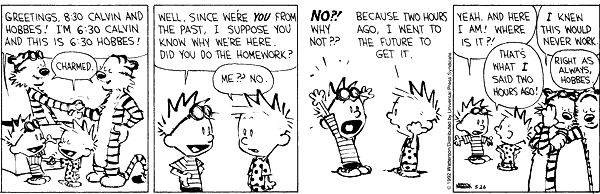
So the next time I critique AI or a ghost-writer for not writing in my style, I should remember that even I don’t write in my own style. Whatever that is.
There’s another story here: I remembered none of this. Not the original request, nor the chapters, nor who wrote what, nothing!
All of this was excavated by ChatGPT with GPT 5.6 Sol on High, over 90 minutes, going through several gigabytes of my email archives. It found the entire story. Not just stuff I forgot, but stuff I never knew. (I don’t read all my emails, certainly not fully.)
This “email archeology” is powerful. Storing everything enables it (and that’s going to become more common) but re-constructing history is amazing.
Reminds me of The Dead Past by Isaac Asimov. A historian is able to reconstruct history from the past using a chronoscope.
ChatGPT is my chronoscope.
The Dead Past also ends with a warning on how creepy it can be. True. It feels creepy. But, like videos, gramophones, portraits, and writing, I guess we’ll get used to it.