On 28 Feb 1990, Calvin and Hobbes played Scrabble.
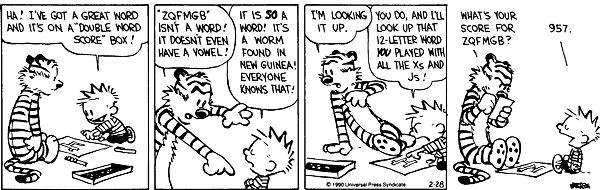
Calvin: Ha! I’ve got a great word and it’s on a “double word score” box!
Hobbes: “ZQFMGB” isn’t a word! It doesn’t even have a vowel!
Calvin: It is SO a word! It’s worm found in new guinea! Everyone knows that!
Hobbes: I’m looking it up.
Calvin: You do, and I’ll look up that 12-letter word YOU played with all the Xs and Js!
Hobbes: What’s your score for ZQFMGB?
Calvin: 957.
Question is, how do you score 957 on a double-word score? It isn’t even even!
But, it turns out, it’s possible - even in a realistic game of Scrabble, with standard rules, a standard board, but lots of tiles, and an increasingly creative dictionary.
Claude recreated the game these two would have played, descending from a perfectly legitimate game into a mess of Calvinball, reproducing the “12-letter word YOU played with all the Xs and Js” and ending with exactly 957 points for “ZQFMGB”. Here it is!
Source:
- Interactive step-by-step replay - with dialogues.
- Claude Chat
- Code repo
While Claude did have a great sense of humor and style, it overdid the “honest” bit. There were twenty-four occurrances of “honest” in the output. Some snippets:
Tracing column continuity rules for honest low-cost placements.
Continue building the honest opening
Search interlocking placements for honest words
Expanding usable grid space for extra honest word placements.
Show several candidate honest boards
Verify honest acts in story order
Sequencing honest plays within the block to avoid invalid crosses.
Costing honest heavy words to fill the block’s early rows.
Planning Act II’s bridge from the honest cluster into the block.
Deciding which rows can supply Act IV words honestly.