2026 1

Things I Learned - 08 Feb 2026

This week, I learned: The Disconnected Git Workflow explains how to use the git send-email workflow. That’s like using email instead of GitHub as the collaboration mechanism - decentralizing and reducing dependencies. Grok throws a HTTP 431 when you pass it a query over 6,890 characters in the URL. Here’s an example with 6,900 characters. As of now, there’s no way to tell uv to use the cache and install only missing repos (#15454). But this is Deno’s default behavior, making Deno a slightly better choice in this regard. Shelling Out Sucks shares common pitfalls when calling the shell from programs. Suggestion: Shell-escape ALL inputs. Use set -o pipefail to detect failures in the middle of a pipe chain. Explicitly check the error code, not just stderr. dax, which is based on zx, is a simpler Deno-based alternative to shell scripts. See examples. ChatGPT. However, scripting language matters more when humans maintain shell scripts. Since I’m using AI, it’s easier to use bash scripts and let it handle any complexities. git push --force-with-lease is like git push --force but won’t overwrite if others have pushed in the meantime. Default to this instead of --force – it’s safer. Microsoft’s docfind generates a WASM search index for documents, building a dependency free browser based compact and fast search. diffs seems a promising library for rendering diffs in the browser. Genie 3 seems pretty good. We should expect to see World Models becoming usable in a few months.

2025 1

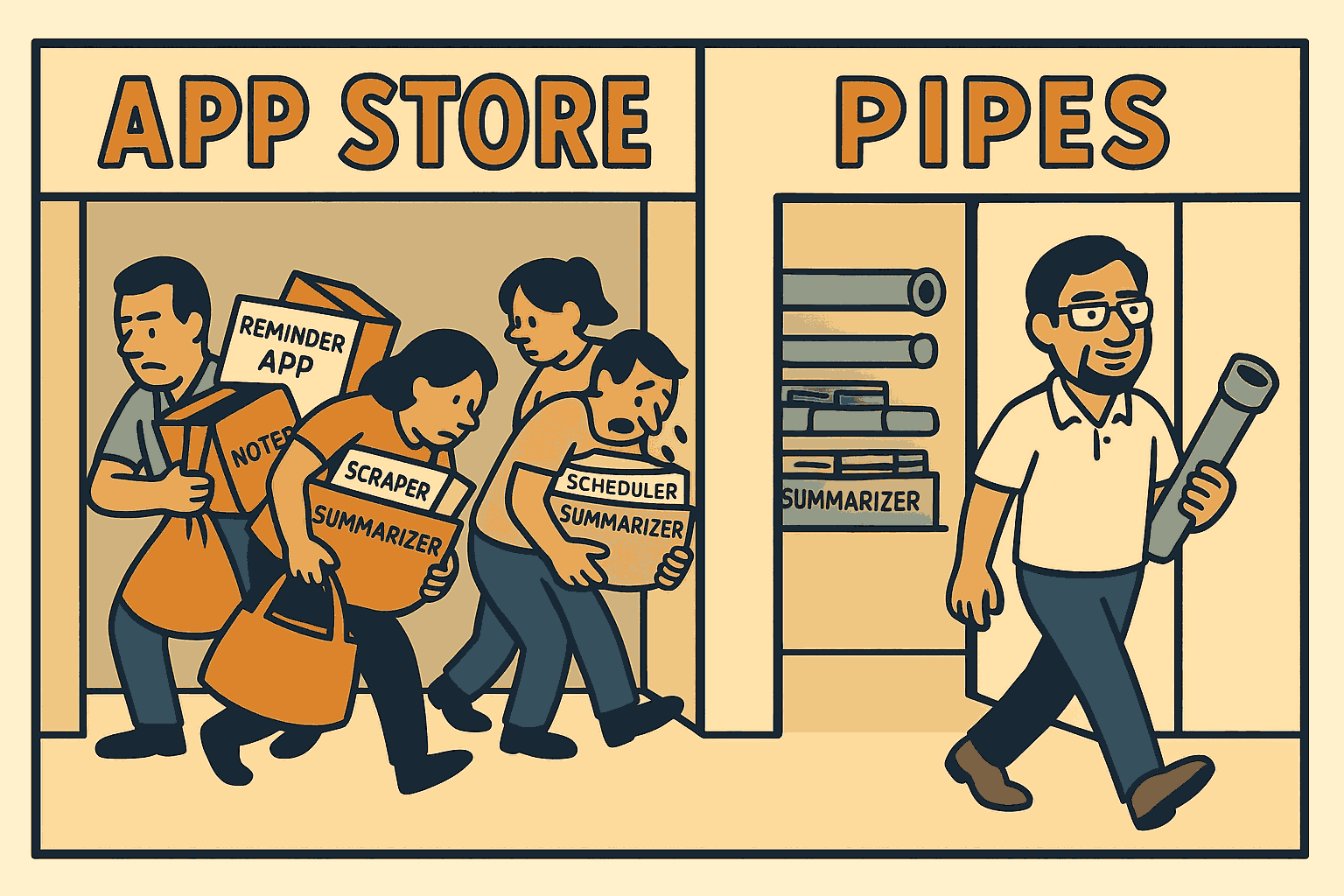
Pipes May Be All You Need

Switching to a Linux machine has advantages. My thinking’s moving from apps to pipes. I wanted a spaced repetition app to remind me quotes from my notes. I began by writing a prompt for Claude Code: Write a program that I can run like uv run recall.py --files 10 --lines 200 --model gpt-4.1-mini [PATHS...] that suggests points from my notes to recall. It should --files 10: Pick the 10 latest files from the PATHs (defaulting to ~/Dropbox/notes) --lines 200: Take the top 200 lines (which usually have the latest information) --model gpt-4.1-mini: Pass it to this model and ask it to summarize points to recall ...

2013 1

Hosting options

I've been trying out a number of options for hosting recently, and have settled on Amazon spot instances. Here were my options: Application hosting, like Google AppEngine. I used this a lot until 2 years ago. Then they changed their pricing, and I realised what “lock-in” means. I can’t just take that code and move it to another server. Besides, I’m a bit wary of Google pulling the plug. Heroku? Same problem. I just want to take the code elsewhere and run it. Shared hosting, like Hostgator. This blog is run on Hostgator and I’m extremely happy with them. But the trouble is, with shared hosting, I don’t get to run long-running processes on any ports I like. Run you own servers. The problem here is quite simple: power cuts in India. Dedicated hosting, like Amazon EC2, Azure, GCE, etc. This remains as pretty much the main hosting option I’m a price optimisation freak. So I ran the numbers for a year’s worth of usage. I was looking at the CPU cost of a large machine with 7-8GB RAM. Bandwidth and storage are negligible. The cost per hour worked out to: ...