2026 1

Things I Learned - 11 Jan 2026

This week, I learned: Software Heritage is a non-profit that archives software. You can submit any Git repo for archival. Over 400 million projects have been archived so far. Everything Bad Is Good For You by Steven Johnson (2005) argues that pop culture isn’t all bad. But it isn’t all good either, unlike the book’s claims. Claude Popular culture formats (e.g. video games, manga, soap operas, game shows) are steadily more cognitively demanding, complex. They provide a dopamine kick from problem-solving. These may have led to the Flynn Effect (rising IQs in 1990s-2000s). Or it may be due to nutrition, smaller families, education, etc. Action games correlate with visual-spatial skills. Strategy games correlate with memory, planning. But is it causation? It doesn’t always translate to real-world skills. Also, side effects are real and bad: screen-time, addiction, misinformation, etc. The purpose of a featured image in a blog post is to help readers decide whether to read it. Share the article’s output/focus (e.g. for data stories, products). Else a visual summary (e.g. sketchnote, comic capturing the essence). Else skip. Avoid stock photos. # NFLSavant.com has play-by-play data for NFL games. Ten of the least well known psychology / sociology research findings. ChatGPT Learning styles are a myth. People might prefer visual / audio / … learning but it doesn’t help learning. Mix learning modes. NotebookLM can help. Casual acquaintances help find new information or jobs much more than close friends, since they’re in different social circles. Nurture weak ties. Use a relationship architect. Tell a lie often enough and people mistake familiarity for truth. Fact-check habitually. The more you see / hear something the more you like it. (Exposure effect.) Expose to good things. When others mess up, we blame them. When we mess up, we blame the situation. (Attribution error.) Pause before judging. Sometimes, rewarding people makes them like doing it less. (Overjustification effect.) People who know less over-estimate their knowledge. (Dunning-Kruger effect.) Habitualize calibration via feedback and tests. People do worse when they’re afraid their failure will reflect on their stereotype. (Stereotype threat.) Practice emotional resets. Higher expectations lead to better performance. (Pygmalion effect.) Engineer positive expectations. Benevolent sexism (e.g. protective paternalism) can be harmful too. Scan for well-meaning bias. Liberalism => economic growth, peace and expanding rights. Also colonial violence, exclusions (women, slavery, …), and eroding community. It is vulnerable to authoritarianism (e.g. emergency powers, recessions). Since 2006, democracy has consecutively declined, reversing half the progress since WW2. But alternatives are unclear. Claude Notes from The Periodic Table by Primo Levi. Pure Zinc does not dissolve easily in sulphuric acid. An impurity like Copper Sulphate pulls electrons from Zinc and offers them to Hydrogen ions, speeding up the reaction. Impurities, foreign bodies, etc. have a purpose, too. Discomfort = Information. Overcoming discomfort = Capability. Capability = Freedom. Therefore: Seeking discomfort (carefully, purposefully) = Building freedom. Simple != Easy. Simple = Clear. Clear = Actionable. Indifference often feels like malice. ⭐ Analogies have limits. (The Map is not the Territory.) When using analogies, always explore where, when and why they will break. Pay close attention near where they break. ⭐ Knowledge vanishes with people unless written down. Write “Do X. Because of Y. Unless Z changes.” The last two are critical. I could NOT have read the book without a Randall Munroe re-styling. I cried anyway. “There’s about 300-400 that were corporate assets. One watched them all the time. These are people who in 15 years could be CEO. There’s something about them that caught your fancy when you were in a meeting… brilliant ideas that challenged your thinking… We called them “Corporate Assets” and tracked them, to make sure we game-planned them, give them the right assignments.” Indra Nooyi, The Knowledge Project The accesskey attribute works a bit like magic. Adding an accesskey="h" on a home page link, or an accesskey="t" on a theme toggle button automatically enables keyboard shortcuts Alt+H or Alt+T to activate them. (Varies by browser and OS, but hovering shows the shortcut!) Familiarity and recency feel like learning but they’re not. Instead: Take tests. Review (spaced repetition). Interleave learning. That’s what helps. Claude Make It Stick (Peter C. Brown, 2014) A Mind for Numbers (Barbara Oakley, 2014) Ultralearning (Scott Young, 2019) How to Take Smart Notes (Sönke Ahrens, 2017)

2025 1

How To Double-Check Personality Flaws With AI

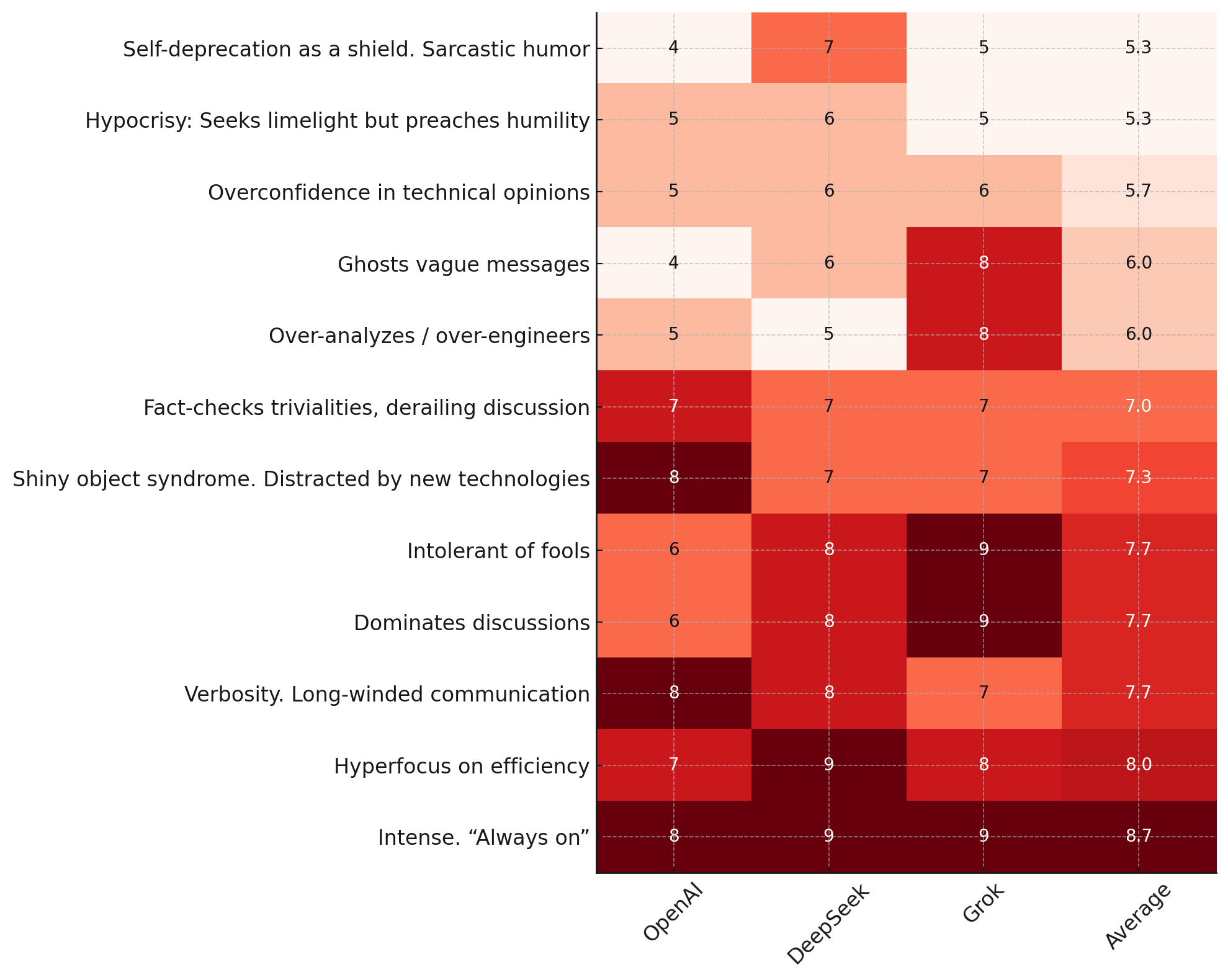
After ChatGPT's discussion of my personality flaws, I asked it to listing specific conversations as evidence for flaws. Then I asked 3 LLMs to rate the evidence. Personality FlawChatGPTDeepSeekGrokAverageSelf-deprecation as a shield. Sarcastic humor4755.3Hypocrisy: Seeks limelight but preaches humility5655.3Overconfidence in technical opinions5665.7Ghosts vague messages4686.0Over-analyzes / over-engineers5586.0Fact-checks trivialities, derailing discussion7777.0Shiny object syndrome. Distracted by new technologies8777.3Intolerant of fools6897.7Dominates discussions6897.7Verbosity. Long-winded communication8877.7Hyperfocus on efficiency7988.0Intense. “Always on”8998.7 🟢 LOW: Self-deprecation / sarcastic humour as shield ChatGPT: 4/10. Bio and a few quips reveal dry self-mockery, yet direct chat evidence of humour as defence is sparse; it surfaces only occasionally. | DeepSeek: 7/10. Explicit self-awareness goals and dry humor noted, but little evidence of defensive/sarcastic use. Grok: 5/10. Some self-deprecating humor exists, but its use as a shield is not strongly supported. 🟢 LOW: Hypocrisy: seeks limelight yet preaches humility ChatGPT: 6/10. You aspire to humility but routinely headline conferences and TEDx talks; the coexistence of public speaking and stated modesty gives the charge a middling footing. | DeepSeek: 6/10. TEDx/PyCon prominence contrasts with stated humility goals, though self-improvement efforts are genuine. Grok: 5/10. Public speaking contrasts with humility goals, though this may indicate self-awareness, not hypocrisy. 🟢 LOW: Over-confidence in technical opinions ChatGPT: 7/10. You assert strong views (e.g., Node vs FastAPI) but also invite verification and accept corrections, yielding only moderate evidence of over-confidence. | DeepSeek: 6/10. States strong preferences upfront but routinely invites validation and course-corrects. Grok: 6/10. Strong opinions are expressed, but openness to correction moderates the perception of overconfidence. 🟢 LOW: Ghosts vague messages ChatGPT: 5/10. You’ve stated you ignore low-context e-mails, but chat logs show you usually follow-up or clarify rather than disappear. | DeepSeek: 6/10. Documented tendency to ignore low-context questions, though chat logs show active clarification habits. Grok: 8/10. Multiple instances show the user ignoring or not responding to unclear or low-context messages. 🟢 LOW: Over-analyzes / over-engineers ChatGPT: 5/10. Designing auto-re-flow SVG chevrons and exhaustive RAG specs hint at depth beyond the simple solution, yet you also champion “smallest libraries” and lightweight rate-limiters. | DeepSeek: 5/10. Some prototype/structuring tendencies, but strong preference for minimal solutions counterbalances this. Grok: 8/10. The user often dives deeply into tasks, sometimes creating complex solutions for simple problems. 🟡 MEDIUM: Fact-checks trivialities, derailing discussion ChatGPT: 8/10. Many requests revolve around “double-check,” “fact-check,” or recalculating tiny details, which lengthens threads even when stakes are small. | DeepSeek: 7/10. Frequent accuracy demands and citation hunts elongate discussions, but stays focused when content is solid. Grok: 7/10. Evidence of prioritizing precision, like fact-checking minor details, can disrupt conversation flow. 🟡 MEDIUM: Shiny-object syndrome ChatGPT: 6/10. Parallel explorations of Godot, Matrix, Cloudflare Workers, SVG SmartArt, esp32-eye, etc. reveal a persistent pull toward new tech before finishing earlier threads. | DeepSeek: 7/10. Broad simultaneous explorations (Godot/WASM/DuckDB), though sustains core projects long-term. Grok: 7/10. Exploration of new technologies is frequent, but focus on core projects suggests a balanced curiosity. 🟡 MEDIUM: Intolerant of fools / low clarity ChatGPT: 7/10. Frequent demands for precise formats, citations, and “be specific” instructions show a low tolerance for ambiguity, though you still help patiently on non-technical questions. | DeepSeek: 8/10. Strong pattern of rejecting ambiguity/fluff, though softened by humor and non-technical engagements. Grok: 9/10. The user consistently demands clarity and efficiency, showing little patience for ambiguity or fluff. 🟡 MEDIUM: Dominates discussions ChatGPT: 4/10. Long, multi-part prompts and the need for TL;DRs suggest you can overshadow lighter voices, but you periodically insist on brevity and delegate tasks, tempering the effect. | DeepSeek: 8/10. Long technical messages (avg ~3k chars) and intense Q&A patterns create conversational dominance. Grok: 9/10. Detailed, technical responses consistently steer and dominate conversations. 🟡 MEDIUM: Verbosity / long-winded communication ChatGPT: 5/10. Average messages run several thousand characters, and you often request exhaustive, multi-section outputs—though you sometimes tell the assistant “Shorter please,” verbosity remains a clear pattern. | DeepSeek: 8/10. Multi-step technical requests dominate interactions, though periodic “shorter please” self-corrections exist. Grok: 7/10. Messages are often lengthy and detailed, though the user also requests concise responses from others. 🔴 HIGH: Hyper-focus on efficiency ChatGPT: 8/10. Recurrent themes—cost monitoring, smallest-lib preference, GPU-utilization alerts—show you relentlessly optimise workflows and expect others to keep pace. | DeepSeek: 9/10. Unambiguous prioritization of concise formats, minimal libraries, and metric-driven optimization. Grok: 8/10. Repeated emphasis on concise, efficient communication and minimal tools is evident. 🔴 HIGH: Intense – “always on” ChatGPT: 8/10. Around-the-clock, multi-topic requests (weekend cron jobs, 2 a.m. prototypes) portray sustained high energy, with only a few calmer “travel nerves” moments as counter-weight. | DeepSeek: 9/10. High-volume technical queries across domains, 6am research routines, and rapid prototyping habits. Grok: 9/10. High energy and engagement are consistently shown through task initiation and scheduling. My actions: Learn from fools and focus on the big-picture. Specifically: ...

2023 1

Things I Learned - 31 Dec 2023

This week, I learned: Quantum computing is slow, has low transfer bandwidths, and only prime factorization has an exponentially faster algorithm. via The hidden brain podcast. What would Socrates do? Also Philosophy Bites Podcast: why do philosophers use example. And: the happiness lab: happiness lessons of the ancients How many of our beliefs are truly our own? How many are a product of our environment? Contrast these and identify your true beliefs For every thought and action you have, even tiny ones, ask “Why am I doing that?” Dig deeper because it may not be intrinsic One way to become memorable is to.write stuff others will reproduce for a long time. Plato and Aristotle did that everyone has multiple personality. This is partly because different parts of the brain evolved independently for different functions. System one and system two thinking are just such one broad classification. e.g. We think our train is moving when the nearby train moves because our visual brain is faster than our somatic brain. Good lessons and pitches cater to the rational AND the subconscious. Reason AND story. To activate different parts of the brain. That’s why philosophers use examples Philosophy brings change through reason. Revelations: through sudden insight. Rhetoric: through insight. Act as if you already are what you want to become. Aristotle Align your environment (including habits) to your beliefs. It will become easier to act your beliefs then. All virtues are moderation. It’s possible to take every virtue to the wrong extreme Some Christians have wristband that reads WWJD. What would Jesus do? Explore yourself a reminder of what would X do. Maybe Benjamin Franklin, Socrates, Feynman, etc People mistake their environment for their feelings. 1970s Experiment: People on a shaky bridge think they love each other. Experiment: people rationalize things irrespective of reality. “The Unexamined Life” is about questioning theories or stories or maps constantly. It’s also about questioning our thoughts and emotions constantly. Mindfulness is the VERBAL way of doing this. Meditation is the NON-VERBAL way of paying attention. Both are Processes to remove distraction and increase authenticity. Learning about people is a good way to learn about ourselves. And vice versa. Lica has a fascinating demo of how a document can be converted into a video story. Spillnot doesn’t spill drinks even when you swing! Things super-intelligences could do that humans can’t: Solving complex mathematical problems Advanced scientific discovery (quantum computing, nanotechnology, biotechnology) Ultra-precise predictive modeling in complex systems (climate, economics, social dynamics) Optimizing global systems at high precision (logistics, traffic, energy distribution, resource allocation) Universal translation (unknown languages, animal communication, extraterrestrial signals) Deep medical personalization: individualized medical treatments from genetics, environment, and lifestyle Create new materials: Designing materials or chemicals with specific properties Complex system integration: combining AI, bio tech, nano tech in new ways Philosophical insights: new perspectives or solutions to age-old philosophical dilemmas Space exploration and colonization Predicting natural disasters Customized education at scale Ways of working with them Collaborative problem solving Creative collaboration Decision support Personalized education Establishing ethical and safety protocols Recreational and leisure activities Mini-GPTs is an interesting approach to shrink LLMs and make them domain specific. It takes existing LLMs and removes neurons not used in a specific domain (e.g. law, medicine, etc.) Book to read (again) about how to take a team beyond their abilities even if you’re not the expert “Measure What Matters” by John Doerr “High Output Management” by Andy Grove “The Checklist Manifesto” by Atul Gawande “The Lean Startup” by Eric Ries “Creativity, Inc” by Ed Catmull “The Hard Thing About Hard Things” by Ben Horowitz “The Four Disciplines of Execution” by Chris McChesney, Sean Covey, and Jim Huling

2007 1

Knowing less is better

Malcolm Gladwell argues that knowing less can be an advantage. This is based on a study in which kids in the US were asked which was a bigger city: San Antonio or San Diego. Many didn’t know. Kids in Germany were asked the same. Most knew: San Diego was bigger. Why? Because they’d heard of San Diego, but not of San Antonio. P.S: A comment mentions that the actual difference in population between these cities is only 2%. So maybe the US kids were right to be unsure… ...

2006 4

The myth of prodigy

The myth of prodigy. Precociousness as a child is no indicator of future success.

You will regret virtue more than vice

In the long run, people tend to regret having missed out on opportunities for pleasure – and they wish they hadn’t been so diligent about working. Based on research at Columbia University. Clive has a nice article about it titled In the long run, we regret virtue more than vice. Comments joe bosco 3 Jul 2006 1:12 am: finally - some math that buttress my arguments. enjoy maaadi :) - indulge in sinful pleasures

Beautiful people are paid more

Beautiful people are paid more because of a positive feedback mechanism. Employers expect them to perform better. They expect themselves to perform better. And these come across. Comments Madhu 10 Apr 2006 7:12 am: he he.. my research deals with whether board of directors have any impact on CG et al. I should probably consider the looks of the board as an important parameter S Anand 12 Apr 2006 7:10 pm: It’s supposed to be a stronger effect with women. You could factor that in :-) Madhu 14 Apr 2006 7:28 am: and probably suggestion reservation for women in the board;)

Seven plus or minus two

The seven plus or minus two rule. That’s all your brain can remember.

2005 4

Herbert Simon on Information

Quote by Herbert Simon on Information: What information consumes is rather obvious: it consumes the attention of its recipients. Hence a wealth of information creates a poverty of attention, and a need to allocate that attention efficiently among the overabundance of information sources that might consume it. It sounds quite like the Scientific American article The Tyranny of Choice which says that after a point, more choice causes unhappiness. The satisfaction of picking the best choice is less, because the second best is almost as good. And you’re more likely to not pick the best – because there are so many choices – and will regret it more often. ...

Imitation is tougher than we thought

Research suggests that chimps learn differently from humans. When they showed the chimpanzees how to retrieve the food, the researchers added some unnecessary steps. Those chimps could see that the scientists were wasting their time sliding the bolt and tapping the top. None followed suit. They all went straight for the door. The children could see just as easily as the chimps that it was pointless to slide open the bolt or tap on top of the box. Yet 80 percent did so anyway. ...

Cognitive daily

Cognitive daily. Are rich kids more troubled than poor kids? How do we decide what we’re seeing? What else are we doing when we watch a movie? What are we doing when we watch a movie? etc.

Acts of commission rather than omission

Thinking, a book by Hardman and Macchi, says people would much rather let bad things happen, than take a risk to stop them: Decisions with identical outcomes are judged as worse when they result from acts of commission than acts of omission. For example, most people are reluctant to vaccinate children against a potentially lethal flu when side effects of the vaccine can cause death. Faced with a flu epidemic that is expected to kill 10 out of 10,000 children, most people are not willing to accept a 9 out of 10,000 risk of death from vaccination, and the median acceptable maximum risk is 5 in 10,000. Apparantly, killing a child with a vaccination (that is, an act of commission) is perceived as worse than causing its death by failing to vaccinate (that is, an act of omission). ...

2002 5

People who are trusting adopt the Internet

IBM’s research shows that people who are trusting adopt the Internet more than those who are suspicious by nature.

Do not look at the needle

I always knew it. If you’re taking an injection, don’t look at the needle.

Things Mil and his girlfriend have argued about

Things Mil and his girlfriend have argued about. I dread to think of my future.

My sleeping posture

My sleeping posture “suggests” that I’m narrow-minded, self-centered, etc. Not true. (?)

Psychology of weblogs

The psychology of weblogs. After reading this, I realised I ran out of things to say almost a year ago.

2001 2

Worlds funniest joke

The world’s funniest joke.

Dream research

Dream Research and Dream Bank. Lots about the analysis of dreams.

1999 1

Keirsey temperament sorter

The Keirsey temperament sorter is an online Myers-Briggs test. My type is ENTP, which I share with Walt Disney, Richard Feynman, Steve Jobs and Calvin (of Calvin and Hobbes.) Comments Thejesh GN 14 May 2009 8:13 am: Good good. This is almost 10 year old. You started blogging long back! The Calvin and Hobbes search Takedown | s-anand.net 21 May 2010 11:53 am (pingback): […] when I started reading Calvin & Hobbes. The earliest reference I can find in my blogs is in July 1999. I remember it didn’t take me long to become a fan. I’d read every strip on the newspaper; hunt […]