In 2025, I made a number of predictions on this blog. (Not intentionally. I just said stuff.)
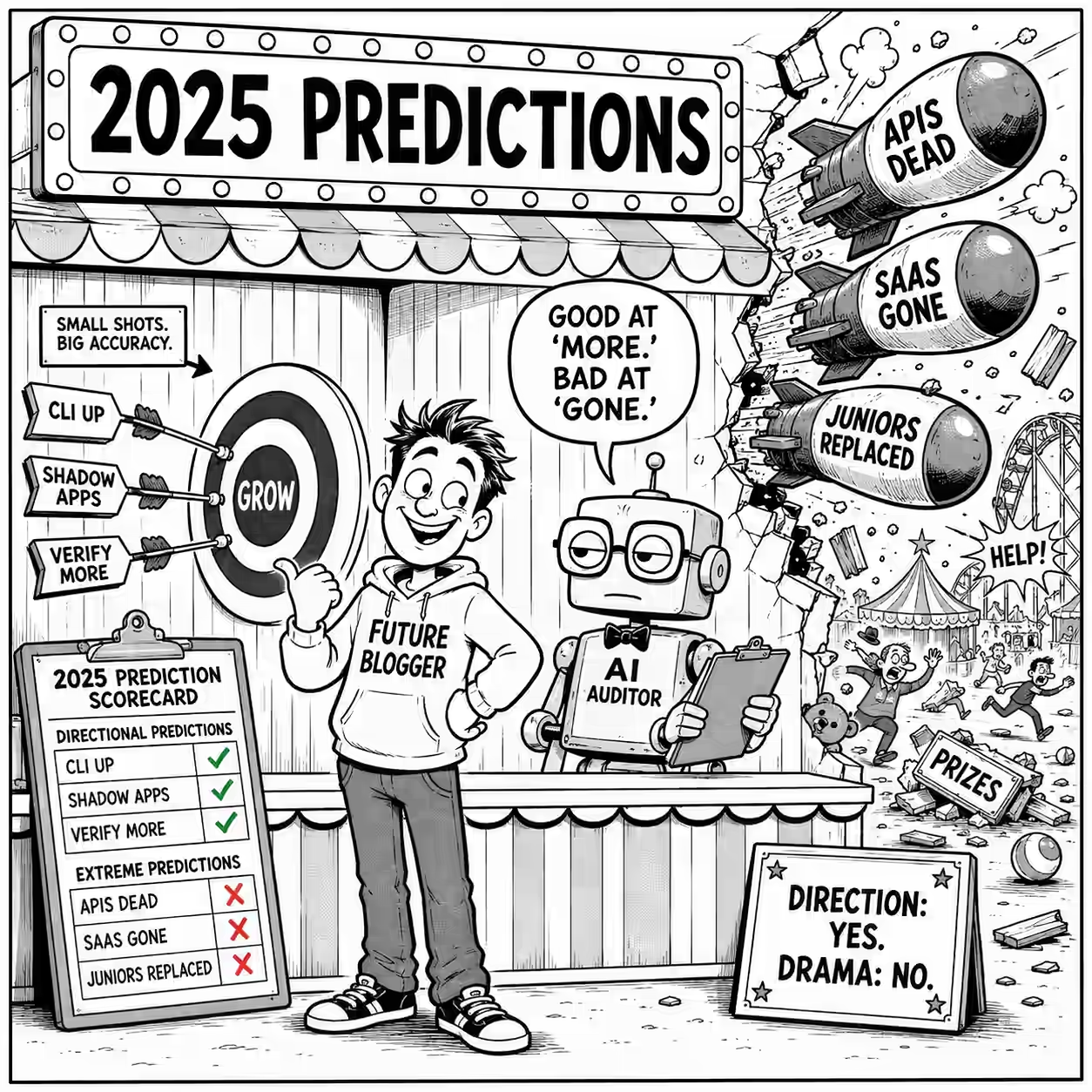
I asked ChatGPT to audit them. It selected 440 claims, filtered out vague or pending ones, and verified the rest. Here’s what I got right and wrong.
🟢 “My chat will overtake search in 12-18 months. When ChatGPT becomes my primary lens on knowledge…” (chatgpt-vs-google-usage.md:L27). Audit: This actually happened in your own browsing data: search led through April 2026; in May, chat jumped to 2,211 visits vs 1,319 search visits, and stayed comfortably ahead thereafter. 🟢 “Typed languages are better suited for vibe coding. This will likely lead to the growth of typed languages (TypeScript, Rust, Go) but also of typing in untyped languages (e.g. Python).” (things-i-learned-10-aug-2025.md:L33). Audit: TypeScript became GitHub’s #1 language in August 2025 and grew 66% YoY; GitHub itself explicitly connects the rise of typed languages to more reliable AI-assisted coding. This is unusually strong because you got both the direction and mechanism. (The GitHub Blog) 🟢 “Code Mode … is a smart way to use MCPs and a very likely future direction. Using LLMs to write code to call MCPs rather than directly.” (things-i-learned-05-oct-2025.md:L49). Audit: OpenAI’s current Responses API has essentially this as a named capability: Programmatic Tool Calling lets a model write and execute programs that coordinate multiple tools and intermediate results. (OpenAI) 🟢 “CLI optimization for LLMs will likely emerge. More CLIs (and wrappers / hooks in the shell) will improve output and error contexts for LLMs…” (things-i-learned-27-jul-2025.md:L86). Audit: By May 2026 you were yourself testing rtk, a CLI proxy explicitly producing compact agent-friendly command output; across 216 commands you measured about 50% token reduction. That is almost exactly the wrapper you predicted. 🟢 “In the future, AI that works directly with file systems, Model Context Protocols, and local APIs are likely to become more important.” (features-actually-used-in-an-llm-playground.md:L76). Audit: File-system-native coding agents became mainstream, while MCP expanded into both hosted and local integrations; Anthropic now packages local MCP servers as easy-to-install desktop extensions. (Claude Help Center) 🟢 “Agents are slow. Parallelizable tools … will grow. Tool speed … will become more important.” (things-i-learned-22-jun-2025.md:L106). Audit: Parallelism has become a central agent UX: OpenAI’s Codex app is explicitly built around managing multiple agents simultaneously; at the extreme, internal users now accumulate more than 60 hours of agent turns per day by parallel execution. (OpenAI) 🟢 “Companies-of-one will grow. Sole founder can handle support functions.” (things-i-learned-24-aug-2025.md:L14). Audit: Nasdaq’s Economic Institute finds one-person US business applications up more than 20% since early 2025, with essentially all recent application growth coming from solo businesses. Stripe separately reports solo founders reaching 63% of Atlas C-corps in Q2 2026. (Nasdaq) 🟢 “We will move towards an organization structure where developers are embedded with business teams rather than working as a separate group. Sort of like embedded executive assistance instead of a central typing pool.” (things-i-learned-08-jun-2025.md:L49). Audit: Forward-deployed engineer demand reportedly increased 42-fold from 2023-25, with roughly 9,000 roles globally by early 2026. The role is almost precisely “technical people embedded with the business to make AI work in its real environment.” (Reuters) 🟢 “Shadow apps will grow. Anyone can code. Users build apps with prompts, sheets, agents, outside of IT SDLC. Like Excel sheets.” (things-i-learned-24-aug-2025.md:L18). Audit: Microsoft now explicitly describes a “new wave of shadow AI”: users installing coding/desktop/SaaS agents outside traditional IT governance, and has built discovery products specifically for unmanaged AI applications and agents. (Microsoft) 🟡 “Agents generate diffs/PRs. Tools to edit and comment on these online will emerge.” (things-i-learned-22-jun-2025.md:L107). Audit: GitHub now measures PRs created and merged by Copilot coding agent, while review comments can be handed directly to the agent with “Fix with Copilot,” including batches of review feedback. That’s almost verbatim fulfillment. (The GitHub Blog) 🟡 “Models’ ability to orchestrate longer workflows will improve. Factor that into your application design.” (things-i-learned-10-aug-2025.md:L44). Audit: By mid-2026, OpenAI reports large increases in requests corresponding to >30-minute, >1-hour and even >8-hour human tasks, while Codex explicitly targets long-running tasks spanning hours or longer. (OpenAI) 🟡 “Code review process will be re-invented.” (things-i-learned-22-jun-2025.md:L109). Audit: GitHub has rebuilt Copilot review around an agentic architecture that gathers broader repository context, uses tools, produces findings, and can hand fixes to another coding agent. This is substantially more than autocomplete added to old review. (The GitHub Blog) 🟡 “Domain expertise will therefore become even more valuable in the near future.” (things-i-learned-20-apr-2025.md:L39). Audit: 2026 hiring evidence points toward domain/product expertise becoming more important rather than pure coding alone, particularly as AI handles more implementation and firms need people who can connect it to actual business functions. (Reuters) 🟡 “Validation is the New Bottleneck: Since coding is now much faster, the critical, time-consuming task has shifted to reviewing, testing, and validating the LLM’s output.” (things-i-learned-17-aug-2025.md:L90); you also predicted “The Quality Control (QC) function will become larger and more critical” (L95). Audit: GitHub has now productized exactly that bottleneck in Code Quality; more than 10,000 enterprises used its preview, and GitHub explicitly frames AI-accelerated code output as creating the need for trustworthy pre-merge quality validation. (The GitHub Blog) 🟡 “Agents generate technical debt faster than humans. Solving this will become a major problem/opportunity.” (things-i-learned-22-jun-2025.md:L114). Audit: GitHub’s 2026 Code Quality launch is close to a commercial instantiation of this forecast: AI increases code output, so automated quality/debt detection and remediation moves earlier into the development cycle. (The GitHub Blog) 🟡 “Governance will grow. Non-experts are acting like experts. Validation is more important.” (things-i-learned-24-aug-2025.md:L19). Audit: The companion to shadow AI has indeed been governance: Microsoft now ships specific discovery, monitoring and governance for unmanaged AI agents, while NIST has continued expanding formal GenAI evaluation tooling. (Microsoft Learn) 🟡 “Soon, we won’t just follow a lesson plan – we’ll have lessons built just for us. AI will track how we learn and adapt in real time. It’ll feel like having a personal coach in your back pocket.” (o3-is-now-my-personalized-learning-coach.md:L91). Audit: ChatGPT Study Mode now asks what the learner knows, adapts explanations, checks understanding, works from uploaded course material, and uses memory to personalize support; OpenAI explicitly describes the objective as personalized learning support available to any student. (OpenAI Help Center) 🟡 “Cost is going down so quickly right now that all you have to do is wait, and stuff will become available for a very affordable or even a free price.” (things-i-learned-16-mar-2025.md:L116). Audit: The broad direction held. OpenAI cut GPT-5.6 Luna API prices by 80% in July 2026 while simultaneously improving capability-per-dollar. The “all you have to do” part is hyperbole, but the price-curve forecast was right. (OpenAI) 🟡 relayed: “Control of chips and GPU compute is what will likely be the gameplay to control AI dominance globally.” (things-i-learned-02-feb-2025.md:L16, attributed there to Dario Amodei). Audit: Advanced-AI-chip export licensing remains an explicit geopolitical control mechanism in 2026, including restrictions and license review for H200/MI325X-class accelerators going to China. 🔴 “AI closes the gap between junior & senior devs – even when both use AI. Quality doesn’t suffer much. So onboarding can be faster, compensation ladder may shorten.” (things-i-learned-03-aug-2025.md:L52). Audit: The emerging evidence says AI changes the work but does not erase the expertise gap: experienced developers are better at steering/delegation, while low-experience AI-heavy contributions incur substantially more review and lower acceptance. (arXiv) 🔴 “LLMs already deliver hours of analyst work in minutes. Entry-level roles WILL vanish.” (goodbye-mba-hello-ai.md:L17). Audit: The labor-market warning was directionally good, but “vanish” is a major magnitude error. Stanford finds a meaningful relative decline among 22-25-year-olds in highly AI-exposed jobs, while employment remains substantial and overall exposure groups still show employment growth. “Entry-level hiring contracts sharply” would have scored much better. (Stanford Digital Economy Lab) 🔴 “Coders micro-manage LLMs. I think a novice will be more efficient and get better results than me.” (how-to-visualize-data-stories-with-ai-lessons.md:L285). Audit: Current empirical work points the other way in real software work. In a 22,953-PR study, lower-experience AI-heavy developers received 4.5* more review comments, had 31% lower acceptance, and took over 5* longer to resolve issues; qualitative work likewise finds experienced developers better at delegation and control. (arXiv) 🔴 relayed: “API access from model providers will shrink. Selling tokens is not a viable business model given lowering costs.” (things-i-learned-23-mar-2025.md:L19, from the Alexander Doria notes immediately above it). Audit: Almost exactly backwards. Model providers expanded their APIs into richer agent platforms, and token-metered API access remains a core commercial model - including premium pay-as-you-go modes. (OpenAI) 🔴 “APIs are likely to be replaced by just chat requests that will do the same thing. APIs might be replaced by RPA, where somebody uses a chatbot to do the equivalence instead.” (things-i-learned-16-mar-2025.md:L111-L112). Audit: Chat did become a front end, but the implementation moved toward more APIs underneath, not fewer: tool APIs, Responses, MCP, computer-use interfaces and programmatic tool calling are now the substrate agents use. (OpenAI) 🔴 “Software companies build ‘SaaS’-like apps today. Agents will replace apps. Instead of UI, workflows, and app logic, they’ll engineer prompts, APIs, and evals.” (agents-will-replace-saas-apps.md:L12). Audit: The interface-shift was right; “replace” was not. Gartner now forecasts agentic AI may expose roughly 20% of SaaS application spending by 2030 - meaning substantial disruption, not app extinction. Agents are often a new interaction layer over systems of record and APIs. (Gartner) 🔴 relayed: Models will “internalis[e] workflows … to wipe out the apps and workflow space.” (things-i-learned-23-mar-2025.md:L17, from Alexander Doria notes). Audit: “Internalize capabilities” was insightful; “wipe out” was the failed extrapolation. Enterprise applications remain a very large substrate even in Gartner’s fairly aggressive agentic-AI forecast. (Gartner) 🔴 “Demand for SaaS (one-size-fits-all) will shrink.” (things-i-learned-06-apr-2025.md:L89). Audit: Not yet. For example, Gartner forecasts Indian SaaS spending growing 18.9% in 2026, from $3.9B to $4.6B. AI is changing SaaS economics and seat licensing, but current demand is still growing rather than shrinking. (Gartner) 🔴 “The early majority have come in… Soon the late majority will come in asking for existing solutions that have already solved their problem for many others.” (things-i-learned-03-aug-2025.md:L44). Audit: This mapped your client/audience experience onto population adoption much too quickly. In 2026, US Census data put business AI usage around 17-20%, nowhere near a conventional late-majority phase. (Census.gov) 🔴- baseline error: “Given the cost and accessibility of drones, I guess drone terrorist attacks will soon emerge.” (things-i-learned-16-nov-2025.md:L43). Audit: They had already emerged. The UK government documented Daesh using small armed remotely piloted aircraft carrying grenades in Iraq in 2017; the UN had already been studying weaponized UAS use by non-state armed groups for terrorism-related purposes before this 2025 post. This is therefore a clean failure to establish the baseline, not a future hit. (GOV.UK) 🔴 relayed: “Personal writing with connection won’t go away. AI can’t give you heartbreak. But the rest of non fiction writing will vanish.” (things-i-learned-30-mar-2025.md:L69, under “Notes from Writing with AI”). Audit: Nonfiction is under real pressure, but “vanish” is nowhere close. UK nonfiction publishing still generated about GBP1.0B in 2025, down only 3%; the wider publishing industry reached record revenue. (Publishers Association) Legend:
...