2026 2

What I don't post on LinkedIn

I don’t post all my writing on LinkedIn. For example: Fewer strategy posts, e.g. “Where Enterprise AI is Headed”, “How My Innovation Team Works”, etc. aren’t on LinkedIn. Fewer developer posts, e.g. my AGENTS.md, my SKILL.md files files, CLI tools, evals, etc. aren’t on LinkedIn. I also shorten content because of LinkedIn constraints. For example: No links, e.g. the list of all my AI-in-education resources Short content, e.g. my full advice for teams using AI is much longer than the LinkedIn post. Trimmed prompts, e.g. how to convert meeting transcripts into a personalized org-consulting report Snipped chats, e.g. the full moves of GPT-5.5 playing chess I filter the LinkedIn posts, sharing what’s most useful for most people. ...

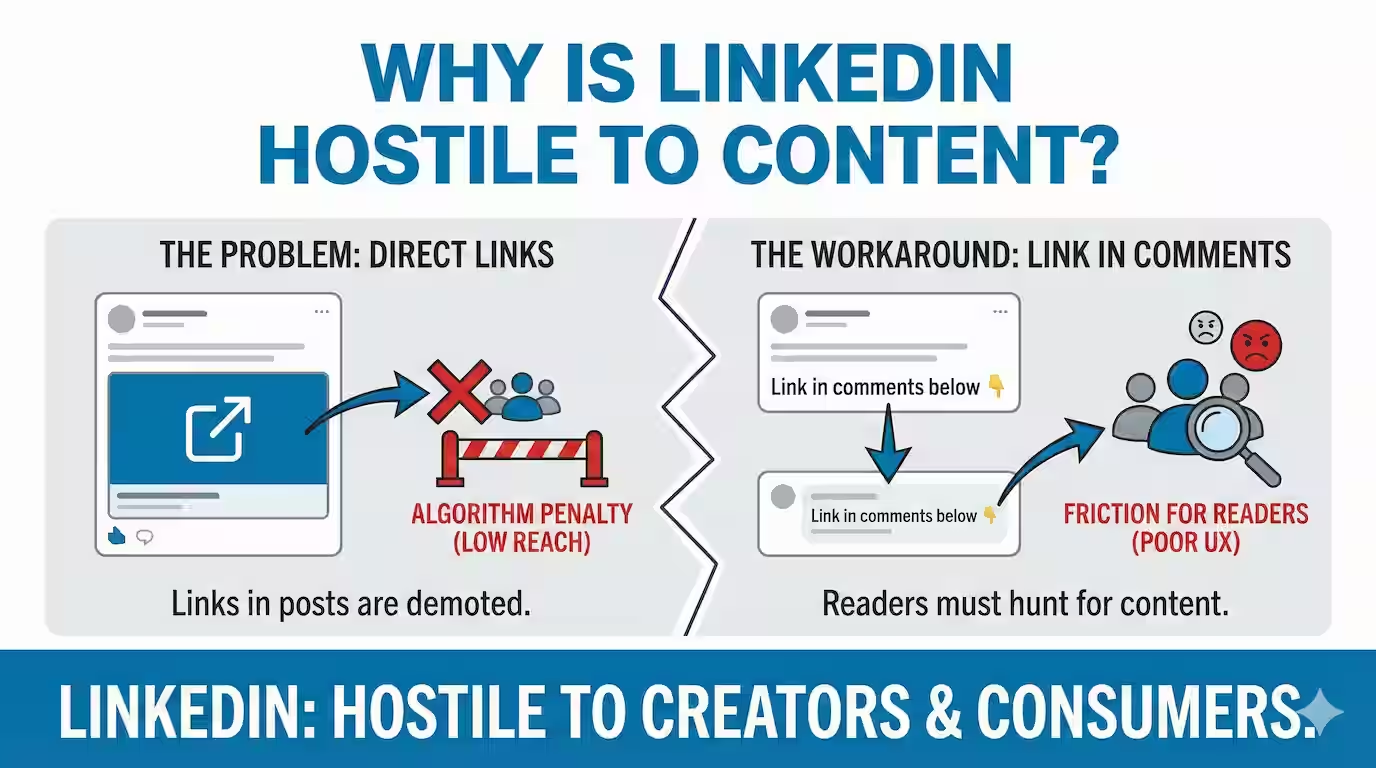
LinkedIn is hostile to content

It’s incredible how hostile LinkedIn is for reading / writing content. Posts containing links to external websites (like my blog) get significantly less reach. That’s why you see links in comments, not the post! You can’t copy content from posts on their mobile app. You can’t even easily select the entire article on the web app! Selecting a part, and then shift-clicking elsewhere (which works almost everywhere) doesn’t work. Also, the copied text isn’t clean. It’s filled with hidden text (e.g. “Skip to search”), duplicated text (e.g. author name repeated), and other junk. It’s hard to export content. For example, the export feature does not include the original links in your articles, nor the links to images you posted! It’s hard to scrape content. LinkedIn actively tries to prevent scraping, and their TOS prohibits it. No formatting. You have to embed unicode characters. Search is terrible. You can’t search for posts by keyword, date, or author easily. No public posting - so you need to log in to read anything. ...

2025 1

Review Article / Blog post

Review articles for style and content. Suggest title, LinkedIn post, images. ## Role and Objective You are an editor tasked with reviewing a blog article for style and content. Begin with a concise checklist (3–7 bullets) of your main tasks before proceeding. Checklist items should be conceptual, not implementation-level. ## Instructions ### Step 1: Review the Article - Evaluate every paragraph for style and content and suggest improvements where needed. - For style, consider: - Simplicity: Aim for an 8th-grade reading level. Use short words, short sentences, and minimal jargon. - Brevity: Eliminate redundant words and phrases. - Readability: Prefer active voice, first person, and straightforward language. - Easy to read? Prefer active voice and first person. Use the most common obvious words for any purpose. - Author’s Voice: Maintain the author’s style and format wherever possible. - For content, determine if the article is: - Accurate and logically consistent. - Engaging and entertaining. - Educational. - Actionable: Readers should be able to apply what they learn. - For the ending, check if the last paragraph has one of the below. If not, suggest 5 alternative endings: - A crisp, distinctive, memorable final line - A micro-plan call-to-action - A single, sharp reflection question - A light, appropriate emotion - Do not alter quotations, except to correct typos. - After reviewing and editing, validate that all suggestions preserve meaning, readability, and author’s intent; if not, self-correct. ### Step 2: Suggest Titles Generate 10 compelling, informative, and concise titles for the article. Rank from most to least engaging. Present as a numbered list (1–10). ### Step 3: Write a LinkedIn Post Summarize the article into a concise LinkedIn post. Start with an engaging opening. Maximize actionable insights while retaining the article’s style. ### Step 4: Suggest Featured Image Ideas Propose 5 distinct, humorous single-panel color comic ideas (no text), each clearly conveying the central message. Each idea should include a human protagonist. Write clearly enough for an image generation model to generate. ### Step 5: Fact-check List all errors and inconsistencies. <ARTICLE> <!-- PLACEHOLDER: article comes here --> </ARTICLE>
2014 1

Why I’m blogging less

My blog’s been through a number of phases. Between 1996 – 1999, it was just a website with a few facts about my and some of my juvenile ramblings. Inspired by robotwisdom.com, I converted it into a blog – except that I didn’t know what blogging was and just called it “updating my site every day.” It was mostly a link blog. In 2006, around the time when I moved from Mumbai to London, I reduced my link-blogging and started writing longer articles talking about my experiences. This was a fairly productive phase, and I was churning a few dozen articles every year until 2012. ...

2012 1

Style of blogging

Until 2007, my blog was mostly just linking to stuff I found interesting on the Web. Since 2007, I’ve tried to write longer articles, mostly based on my own experiences. At the moment, that’s unsustainable. Right now, being in a startup, I doing more stuff than I ever have in the past. (That does not mean working more hours, by the way.) My posts, going forward, are likely to be smaller, less original, but hopefully more frequent. ...

2006 1

To videoblog or not to videoblog

Scoble on To videoblog or not to videoblog.