2026 1

Career Advice

My answers to career advice people have asked me. Should I go deep or broad in my career? Early in your career, sample actively, i.e. go broad. Commit to depth when process (not just outcomes) energizes you. Read Range (David Epstein, 2019). ...

2010 1

A sense of proportion

A quote from David Heinemeier Hansson: So the problem is, a lot of business managers and especially business owners, they have no sense of probability. They can’t fathom that concept. So They treat the probability of 1 to 10 trillion as the same as a 1 to a 100. And like, “We’ve got to deal with this 1 to a trillion probability, because, what if it happens?” No! Doesn’t matter! I mean, don’t care. ...

2008 1

Resolving the Prisoners Dilemma

If you’re ever taken a course in Economics, and it discussed Game Theory, you may be familiar with The Prisoner’s Dilemma. Roughly, this is the problem. Assume you possess copious quantities of some item (money, for example), and wish to obtain some amount of another item (perhaps stamps, groceries, diamonds). You arrange a mutually agreeable trade with the only dealer of that item known to you. You are both satisfied with the amounts you will be giving and getting. For some reason, though, your trade must take place in secret. Each of you agrees to leave a bag at a designated place in the forest, and to pick up the other’s bag at the other’s designated place. Suppose it is clear to both of you that the two of you will never meet or have further dealings with each other again. ...

2006 4

Multicriteria decision making

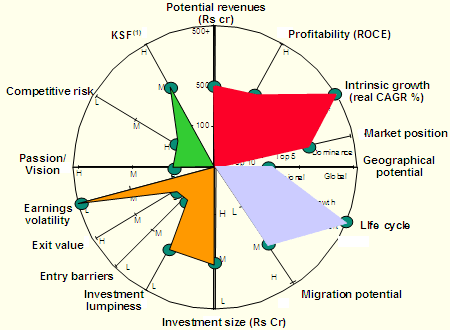
Decisions are usually based on multiple criteria. You have to trade off between criteria. I’ve been involved many such decisions over the last 5 years. Example 1: A conglomerate wanted to identify industries for growth. We shortlisted 19 industries, identified 12 criteria for the attractiveness of an industry, researched each one and plotted them on spidergraphs like below. The intention was that, to identify the most favourable industries, you’d just pick the ones with the largest filled area. ...

Demand draft fees

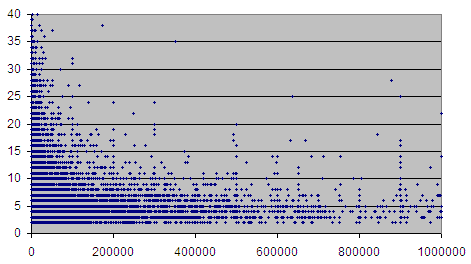
Once, we were looking at whether banks made money on demand drafts (DDs). DDs are costly. 90% of a bank’s costs are people-related, and it takes a fair bit of time (hence people) to process DDs. If you pay for DDs in cash, it costs even more because the teller has to count the notes. To recover this cost, banks charge a fee. The fee increases with the size of the DD. A DD for Rs 10,000 may cost Rs 50, while one for Rs 100,000 may cost Rs 200. ...

Math will rock your world

It’s a good time to be a mathematician.

Market emergence - fan bartering

Over my last few years as a consultant, I’ve seen many interesting ways in which markets have emerged where they shouldn’t have, creating havoc in pricing and scarcity. Fixed prices fluctuate, free goods acquire a value, and non-tradeable goods are traded. I’ll share a few of these examples over the next few weeks. Once, a fan manufacturer asked us, We did an analysis and found that our wholesalers’ margins fluctuate. How could that happen, when we are fixing their buying and selling prices? ...

2005 1

Business continuity planning

The Economist on Business Continuity Planning. The effect on Ericsson, a Swedish mobile-phone company, of a fire in a New Mexico chipmaking plant belonging to the Dutch firm Philips, has become a legend. The fire, in March 2000, started by a bolt of lightning, lasted less than 10 minutes, but it caused havoc to the super-clean environment that chipmaking requires. Ericsson, unable to find an alternative source of supply, went on to report a loss of over $2 billion in its mobile-phone division that year, a loss that left it as an also-ran in an industry where it had once been a leader. ...

2003 1

i2 to delist

i2 may have to delist. And delisting may be good for them.

2002 3

Microsoft vs IBM

Microsoft (2002) vs IBM (1982). An article on whether Microsoft will go the IBM Way. Microsoft’s ability to adapt and prosper hinges on meeting a third main challenge: creating trust.

What Microsoft is up to

Good summary of what Microsoft is up to at the Economist.

The 7-column blueprint

I was traveling from VT to Ullas Nagar to buy furniture. Since it’s an hour-and-half, I had taken a printout of an article on Scenario Planning to read. Being the gripping reading that it was, I’d fallen asleep on page 4, when I feel a gentle tap on my shoulder. “Excuse me, are you reading this?” Since I was asleep, I clearly wasn’t. But I looked at him, just to make sure he hadn’t mistaken it for a newspaper or something. He had a moustache, was wearing a blue shirt, and didn’t looked like the type who could mistake Scenario Planning with the latest political gossip. ...

2001 4

Digitally certified video conferences

This is something I hadn’t thought of when we wrote our business plan. Digitally certified video-conferences. But we did think of insuring ourselves.

GartnerG2

The Gartner Group, which focused on IT strategy, has launched GartnerG2, which will talk about business strategy.

Unhappy workers are better than happy ones

Here’s a new one. A study shows that unhappy workers are better than happy ones. Throw the Hawthorne effect out of the window.

Investors are smart

Investors are smart. Disney kills Go.com. Stock rises. Sega kills Dreamcast. Stock rises. Lesson: kill it if it won’t work.

2000 2

Krislyn strictly business sites

Krislyn’s Strictly Business sites is a portal for business sites. It’s appeal is in its flat structure and small list of good sites.

Strategy and Business

I found some interesting articles on Strategy & Business magazine. How Novell manages their reseller channel, how brick-and-mortar companies can brand on the Internet and corporate culture on the Internet.