2026 2

Things I Learned - 29 Mar 2026

This week, I learned: The Kids Should See This - great collection of videos for curious people. Thej A jury fined Meta and YouTube $4.2m and $1.8m for building addictive features in their products. That’s a first. NY Times “I think AI-type tools will actually revolutionize the experimental side of math, where you don’t care so much about individual problems and the process of solving them, but you want to gather large-scale data about what things work and what things don’t.” Terence Tao The hedonic treadmill (which roughly quantifies a Buddhist principle) says that we revert to a happiness set point (which varies by individual). Worse, those who experience a high kick (e.g. a lottery) don’t get enough kick from normal wins (contrast effect) – Interactive explainer. The happiness neutral As of today, a LinkedIn search for “llm psychologist” lists 9 people. I’m not alone! Anand S, LLM Psychologist, Singapore, Singapore Anshul Saxena, PhD, AI Advisor & Trainer | Technology Strategist | LLM Psychologist | Currently teaching humans, machines & business to work smarter through Generative AI and Quantum Computing | 15+ Years Experience, Pune, Maharashtra, India Charitarth (Chad) Sindhu, LLM Psychologist / Fractional Business & AI Workflow Consultant/ Digital Nomad, Tokyo, Japan Lancelot Salavert, LLM Psychologist, Barcelona, Catalonia, Spain Lior Dor(Durahly), Team Lead | Bug Banisher | Ex 8200, Tel Aviv District, Israel. Past: R&D Team Lead and LLM Psychologist at Superwise | A Blattner Tech Company maxime bodereau, Lead Creative Art Director | UX Forensics | Ai LLM Psychologist | Visual Alchemist | Codesmith | Brandologist | Full Stack Designer, Nantes, Pays de la Loire, France Mei Chen 🦋, LLM Psychologist | Lead Product Engineer | Delivering Agentic Experiences, Toronto, Ontario, Canada Shoshannah Tekofsky, LLM Psychologist at AI Digest, Zwolle, Overijssel, Netherlands LinkedIn Member, LLM, psychologist, mediator, Prague, Czechia OpenAI acquired Astral!. This will likely slow down the new wonderful tools accelerating the Python ecosystem. Like with PromptFoo and OpenClaw, this seems to be about talent. The “acqui-hire” mode seems a clear niche career path now, and an alternative to getting hired (you get a much higher salary) or getting acquired (you take on much higher risk). quickjs-emscripten lets you run isolated JS code securely in the browser, CloudFlare workers, NodeJS, and Deno. It compiles to WASM. @sebastianwessel/quickjs is a higher-level TS wrapper. Simon Willison Manyana is a CRDT based version control system. It sounds like a good idea but I’m sceptical because merge conflicts are a “what should I do” problem more than “how”. With agents doing more merge conflict management, I am not sure this will offer a concrete benefit - but probably no harm either. LLMs are able post-train LLMs on new topics. They’re improving fast. Jack Clark Vibe Coding Fixer and AI Slop Cleaner are real job descriptions - which are morphing into enterprise offerings. But I still seem to be the only official LLM Psychologist Notes from AI Services - Wrong Mental Models, Right Moment: AI services has 3 markets. Automatable work: vanishes in 2 years. Human-in-the-loop work: sustains. Judgement-driven: grows in importance. YC: don’t sell access to a tool for $50 a month, use the AI yourself and sell the finished work for $5,000. Sell output. Price on outcome. Sell to business, not IT. Sell accountability: proven success, with your guarantee. Sell authenticity: a brand story representing uniqueness, character, … or whatever… something people respect. Data transfer between GPU and memory is a bottleck and three approaches are emerging. # Taalas is etching LLMs into the chip. Llama 8b runs at 17,000 tok/s (H200 is at 230 tok/s). d-Matrix is moving compute into SRAM memory chips. 30,000 tok/s for Llama 70b. Cerebras and MatX are similar: memory-oriented. FuriosaAI minimizes data movement. Groq and Sambanova are similar. But in the long run, commodity technology usually beats integrated stacks. GPT 5.4 Nano ($0.2/MTok) and Mini ($0.75/MTok) are good options for bulk OCR, transcription, etc. as cost and quality comparable alternatives to Gemini Flash Lite and Gemini Flash. They can describe 75K photos for $50. Both models are better than GPT-5 Mini on most benchmarks. Cool AI coding agent git prompt fragments: Use git bisect to find when this bug was introduced: … Find and recover my code that does … Sort out this git mess for me. Rewrite history removing … Split the last commit into multiple commits grouped logically. Start a new repo at … and build just this module … based on … with a similar commit history copying the author and commit dates. Campaigns Are Knowledge Workers and the Tools Just Caught Up. A powerful framing. I saw this in action a few days ago when a friend was able to automate an outbound campaign with Claude Code. EARS (Easy Approach to Requirements Syntax) is a simple structure for requirements. For example, “Users should be able to drag tasks between columns. The app needs to work offline too. Handle errors gracefully.” becomes the following - which AI can convert to and is easier to spot errors in. State machines and decision tables are useful alternatives, too. REQ-001 (Event): When the user drags a task card to a different column, the system shall update the task status to match the destination column. REQ-002 (State): While the application is offline, the system shall store task updates in local storage. REQ-003 (Event): When the application reconnects, the system shall synchronize locally stored updates with the server. REQ-004 (Unwanted): If synchronization conflicts occur, then the system shall display a resolution dialog to the user. As of now, avoid using Claude.ai to create (large) visualizations. It runs forever and exhausts credits without generating anything. Claude Code works much better for this.

Post-mortem of AI coding session

Run a blameless post-mortem on this entire conversation to improve future performance. 1. Document the entire process so far (what you did, how, what you found, next steps, etc.). 2. List successes: techniques / approaches you discovered that worked well. Examples: tools, code snippets, prompt structures, planning techniques. Share what change to the environment / prompts will make it easier to repeat these successes in the future. 3. List problems faced: failures, inefficiencies and mis-alignments. E.g. commands that failed or behaved unexpectedly, corrections, more steps than necessary, where you adhered to the letter not spirit, took shortcuts that compromised quality, etc. Dig deep for root causes. Mention the PRACTICAL impact. Suggest pragmatic & safe fixes (if any) to prompts, skills, or environment (e.g. tools, .env) at a root cause level - preferably that resolve **entire classes/patterns of failures**, not just a specific instance. Create or append to `notes.md` as `## Post mortem (%d %b %Y)` with today's date.

2025 10

Here’s my current answer when asked, “How do I use LLMs better?” Use the best models. O3 (via $20 ChatGPT), Gemini 2.5 Pro (free on Gemini app), or Claude 4 Opus (via $20 Claude). The older models are the default and far worse. Use audio. Speak & listen, don’t just type & read. It’s harder to skip and easier to stay in the present when listening. It’s also easier to ramble than to type. Write down what fails. Maintain that “impossibility list”. There is a jagged edge to AI. Retry every month, you can see how that edge shifts. Wait for better models. Many problems can be solved just by waiting a few months for a new model. You don’t need to find or build your own app. Give LLMs lots of context. It’s a huge enabler. Search, copy-pasteable files, past chats, connectors, APIs/tools, … Have LLMs write code. LLMs are bad at math. They’re good at code. Code hallucinates less. So you get creativity and reliability. Learn AI coding. 1. Build a game with ChatGPT/Claude/Gemini. 2. Create a tool useful to you. 3. Publish it on GitHub. APIs are cheaper than self hosting. Don’t bother running your own models. Datasets matter. Building custom models does not. You can always fine-tune a newer model if you have the datasets. Comic via https://tools.s-anand.net/picbook/ ...

Things I Learned - 24 Aug 2025

This week, I learned: Pilots like to have fun, too. While awaiting landing clearance at Kolkata, our IndiGo pilot weaved tight curves just above the clouds at steep angles, giving us stunning views and a mildly thrilling experience. (Or maybe they were just following a flight path.) Since LLMs allow ANYONE to become “good enough” in most fields (marketing, medicine, management), and so on, here’re are my guesses on the impact. ChatGPT Companies-of-one will grow. Sole founder can handle support functions. Specialists will generalize. Consultants will code. Marketers will design. Wages will compress. Seniors will earn less as juniors can do more. Layers will compress. Organizations need fewer hierarchies as 1 person can do more. Shadow apps will grow. Anyone can code. Users build apps with prompts, sheets, agents, outside of IT SDLC. Like Excel sheets. Governance will grow. Non-experts are acting like experts. Validation is more important. Uneconomical apps will thrive. 1:1 tutoring. Continous decision making or A/B testing. Leaders will convince better. Persuasion scales. Brand (authenticity, trust, skill), Channel (distribution, audience) and Data are primary differentiators. Codex and Codex CLI now support image attachments. Notes from discussion on education with Srikanth Nadhumuni Indian higher education has done better, e.g. with the IITs, than primary education, where ASER consistently shows that 5th graders can’t read 2nd grade books. The National Education Policy (NEP) is focusing on FLN (foundational numeracy and literacy). The goal is universal FLN by 2027. Teacing FLN in local languages beats English. Teachers, parents, community support are high. Learning English as a second language is faster. Other countries (France, Germany, Japan) do this. Voice LLMs could help, but may not be toddler-ready, nor strong enough in all local langauges. But high-quality textbook translation with local nuances is a one-time human-in-the-loop effort that AI can support. India’s 1 crore teachers have a mandatory 50 hrs/year training requirement that is largely under-implemented. Senthil Mullainathan is working on extracting features from student answers to questions and generating remedial content purely as a black-box. Results beat explainability. ⭐ Creating systems that rapidly improve from feedback is the key to success. Rapidity, quality of improvement, quantity of feedback are all enablers. CBDC (Central Bank Digital Currency) is RBI’s Web 3.0 protocal. It allows purpose-driven transfers, e.g. money meant for education can only be spent on education. Meta-prompts with placeholders is a prompt-improvement technique (similar to LLM interviewing). Have LLMs create the prompt with “fill-in-the-blanks”. This makes it much easier for people to fill out. MassGen is a multi-agent orchestrator. Early days, experimental. It has multiple agents answer, then vote on each others’ answers, picking the best. DSPy auto-optimizes prompts based on input-output pairs or evals. Typical improvements are ~10-20%. My opinion: avoid. It’s a good idea, but has too much abstraction that hides the implementation. Worth learning from but not implementing unless you (a) have evals + metrics and (b) you KNOW you need to change models and (c) it’s a long-term project where the learning curve is worth it. Claude and ChatGPT How LLM “Attention” works: It takes each word’s embedding, moves it closer to similar words’ embeddings (e.g. Apple moves towards phone or orange depending on context). More similar words have a higher pull, like gravity. Luis Serrano Similarity isn’t symmetric. E.g. “Coke” moves “drink” more towards it, but “drink” pulls “Coke” less, since “drink” could refer to other things. Think of the pull (“Tinder similarity”) as “what A wants” (key matrix, which pulls other words) multipled by “what B offers” (query matrix, which is pulled by other words). This leads to two different similarity matrices. Multi-head attention is where a neural net gives different weightages to different similarity matrices based on context. Value matrix transforms the embedding space so that the next best next-word is more similar. Reading the Obsidian docs is like a master class in Markdown note-taking. Features like properties, embedding YouTube, bases, tags, etc. provide food for thought. The ObsidianMD subreddit has interesting tips. Summarize takeaways on top of each section Use atomic notes: one file per idea. Link liberally YAML front-matter you can query, e.g. tags, project, status, … Use GFM admonitions, e.g. > [!NOTE] Store images in a predictable way, e.g. ![Alt text](./img/2025-08-21-screenshot.webp) – ALWAYS with alt text Use diff fences for edits / doc changes Task lists with inline dates, e.g. - [ ] 2025-08-21 Draft a letter How to research better. Abhishek Divekar Have an objective when researching. Filter research based on that. Research backwards. Pick a relevant paper. Go through relevant citations. Typically, there are only 1 or 2 directly related ancestors. Don’t waste time searching. Gemini Deep Research is a great way to find and read papers. Don’t read the abstract. Read the introduction, which is the summary. It’s just a page. (The abstract is an LLM-ized versionof the introduction. Not as effective.) MCPs aren’t much more useful than tool calling for developers. They’re powerful when packaging for external parties (non-developers, other teams, clients, etc.). Developers can work just fine with tool calling. Nitin Agarwal Cybersecurity AI is an open-source LLM-based cyber-security tool that auto scans networks for vulnerabilities. ⭐ LLMs have solved several complex tasks (e.g. topic modelling, summarization). We need to adopt these as building blocks, like functions, and build better solutions. Abhishek Divekar codex -c model_reasoning_effort=high lets you run Codex CLI with highest reasoning effort. This has a separate limit that resets every 5 hours. https://x.com/thsottiaux/status/1958035261947781262 Truly agentic systems have high Autonomy, Complexity, and Reliability. Workflows have low autonomy. Agentic systems with high autonomy currently aren’t very complex or reliable, but will improve over time. Deepak Sharma Allow humans to intervene while agent loops execute, even unsolicited, to improve collaboration. Deepak Sharma Given the early, experimental days of AI, the better KPIs might be more about experimentation (e.g. number of prototypes) than operational (e.g. cost reduction). Krishnakumar Menon ⭐ Policy-as-code is an emerging theme. Allow users to create their own guardrails policy. Or, take existing policy documents and convert them into an LLM-based evaluator. Krishnakumar Menon ⭐ “Potentially nitpicky but competitive advantage in AI goes not so much to those with data but those with a data engine: iterated data aquisition, re-training, evaluation, deployment, telemetry. And whoever can spin it fastest. Slide from Tesla to ~illustrate but concept is general.” Andrej Karpathy, Dec 2022 The skills AI coding needs are very similar to tech-lead’s or an architect’s. Tanika Gupta #ai-coding Estimating tool capability & task allocation Task breakdown Spec-ing: which of user personas, user-journey maps, wireframes, technical architecture, psuedo-code Standards: tech stack, tools, linters, security, doc standards Git versioning & collaboration Code review. (Using AI.) Providing feedback. Modularity, naming, … Automated validation Post-mortem. Learning from errors and successes, choices LLM made The ROI of prompting carefully and using meta-prompts is high. Prompt clarity reduces iterations & dead-ends. The initial time spent (10-15 min) pays off with just a single reduced iteration (time to generate + review). Tanika Gupta ⭐ Prefer passing a spec.md to AI coding agents rather than directly typing-in prompts. This lets you meta-prompt and (collaboratively) iterate on the spec.md, version the prompts as specs, and generate specs as documentation. Tanika Gupta ⭐ Models need environments to learn. So far, we have been providing training data. But an environment to interact with, and learn from by itself, is more powerful. That requires a standard for environments. This is a powerful emerging area. The crux of experimentation is the learning from a postmortem. From that perspective I have been experimenting a lot but not been documenting or learning from that. Decision logs with post mortem are a more apt device for me. Gemini API includes a url_context tool to explicitly scrape websites. API Ontologies are more than taxonomies or schemas. They’re truths or rules, e.g., “no person has more than two parents”. Helps consistency checking and inference. # Terminological knowledge (T-Box) is domain rules and constraints (e.g., “a student is a person who attends a course”). Assertional knowledge (A-Box) is instance-level facts (e.g., “Mary attends Physics 101”). Tools & Formats SHACL. A W3C language for validating RDF graphs. ShEx is easier ad popular. Notation3. A W3C assertion and logic language which is a superset of RDF. EYE Reasoner. Prolog-based N3 (Notation3) reasoner. CLI + API-friendly. Can perform rule-based reasoning and generate new triples. HermiT. OWL 2 DL reasoner. Can check consistency, classify ontologies, compute entailments. CLI and Java API. Modern, maintained. Apache Jena. Java framework for RDF/SPARQL. Built-in reasoners (RDFS, OWL mini/micro/full). CLI via riot, arq (SPARQL query engine). Popular for RDF graph stores + inference. Do developers feel this way? #ai-coding In another example of vibe coding, an instructor for my TDS course vibe-coded most of an exam using Copilot and Sonnet. 6/8 questions worked one-shot. The two #ai-coding failures were interesting: One failed because of sample vs population stats. Copilot asked for sample variance but coded variance() instead of sampleVariance(). Another failed because of rounding off. NumPy code rounds off differently from Python or JS code. Meditation is about noticing distraction and returning to focus. So, distraction is necessary and good. #beliefs #ai-coding can make us overconfident. (At least, it makes me overconfident.) They create surprisingly good output, but only ~20% of the time. I cannot commit to a specific task based on that. Instead, it’s better to rely on AI coding estimates for portfolios, e.g. promise to share something cool without mentioning what. Or do something cool first, then share. Notes from podcast with Daniel Kahnemann. The Knowledge Project. Happiness is pleasure in the moment. Satisfaction is the meaningful story of our life. When we think, we want satisfaction. When we feel, we want happiness. The thinking brain and feeling brain optimize for slightly different things. E.g. The thinking brain packs the calendar with satisfying tasks that the feeling brain feels unhappy executing Both are good for us. We don’t know which matters more. Behavior change is harder than we think. Usually, it’s better not to expect success in changing others, or ourselves. Instead, understand why that behavior makes sense. Our behaviour is an equilibrium of forces. Weakening “bad” forces is easier than strengthening “good” forces, since it lowers tension. That’s inversion! Behaviours tell us more about situations than personality. We assume otherwise. That’s an attribution error. Motivation is complex. People can do bad things for good reasons and vice versa. “Feelings get in the way of clear thinking.” Example: I vibe-coded the last 2 questions of TDS GA7 on Claude Code. It didn’t run. I delayed fixing it for 5 days, afraid it would a major effort. It ended up a 2 min fix. It could have been major, but checking would have helped. Fear prevented that. Things that hamper clear thinking: intuition, emotion, beliefs. Beliefs are often formed based on people we admire or identify, not reason. Prefer rules, systems and processes. Willpower is an illusion. Delegate decisions to unemotional agents. (But agents misjudge perceived value of gain or loss!) Break down the problem, analyze it, THEM form an intuition. Be disciplined in delaying intuition or forming an opinion Environment shapes thinking but it’s not obvious how, e.g. some people work better in noisy cafes. Some colors are more calming. Protect dissenters and dissent. It’s painful and costly, and needs nurturing. NodeJS runs TypeScript files natively. Codex can clone any GitHub repo. So I can ask it to pull one or more repos, understand their code, and use that as a template or reference. This makes my repositories (and others’) reusable templates. Using newer libraries and platforms becomes easier, too. #ai-coding Tracking AI runs an IQ test on various LLMs every week. GPT 5 Pro leads, currently, followed by Claude 4 Opus and Gemini 2.5 Pro. It’s surprising how far behind GPT 5 is at the moment. LLMs are faster than me. So me learning and doing what the LLM says is a bottleneck. Get out of the way. For example do not learn. Do not execute. Do not verify. Give LLMs the tools to deploy, verify and iterate to improve.
Meta AI Coding: Using AI to Prompt AI

I’m “meta AI coding” – using an AI code editor to create the prompt for an AI code editor. Why? Time. The task is complex. If the LLM (or I) mess up, I don’t want re-work. Review time is a bottleneck. Cost. Codex is free on my $20 OpenAI plan. Claude Code is ~$1 per chat, so I want value. Learning. I want to see what a good prompt looks like. So, I wrote a rough prompt in prompts.md, told Codex: ...

Things I Learned - 10 Aug 2025

This week, I learned: OpenAI supports a tool "type": "custom" that lets it write code as an argument to a tool call. Great for code / SQL generation. Even more powerfully, you can generate output following specific grammars, e.g. STL files, PostgreSQL dialect, Mermaid/PlantUML diagrams, OpenAPI specs, Vega-Lite JSONs, Cron expressions, GraphQL SDLs, Dockerfiles, Terraform HCLs, or any DSL! # #ai-coding The OpenAI playground has a GPT-5 Prompt Optimizer that can migrate prompts to GPT-5. Docsify 4.13.1 is 2 years old and uses [email protected] which is 5 years old. Newer plugins like marked-directive don’t work with it. Though docsify v5.0.0-rc1 is in development, it may be the better option for modern Markdown plugins. Here’s sample code. CommonMark has a powerful directive syntax proposal that lets you add classes, attributes, and arbitrary plugins to Markdown. For example, :abbr[MD]{#id .class title="Markdown"} for inline directives. Plugins exist for marked, markdown-it and remark. biomejs and dprint are gaining traction as prettier alternatives. I’m yet to try them but keen to explore. Skip biomejs for now. It uses tabs (not spaces) and does not respect .gitignore by default. Handling these is too much work. ⭐ Code generation is more flexible than tool calling. LLMs can’t write a tool-call loop, for example, but they can write code to run an API in a loop. So, I like telling the LLM to “write code using these APIs” than giving it APIs to tool-call. #ai-coding npx -y ccusage is an easy way of summarizing your Claude Code usage and cost. My cost so far (since 21 July) is about $10. The median session cost is ~50 cents. Most of it ($7) was from a single temporary coding chat that I kept continuing for way too long, building up the context window. # defuddle can be used in the browser to get the main content from web pages. A replacement for Mozilla Readability. # Modern Node.js Patterns for 2025 include these 5 features I’m excited by: Single-executable bundling. node --experimental-sea-config sea-config.json builds standalone binaries. ES Modules. Use node: prefix for built-in imports. import { createServer } from 'node:http'; Watch mode. Use node --watch file.js auto-reloads when file.js or dependencies change. Env file. Use node --env-file=.env loads .env as environment variables. node:test is a full-featured test framework with --watch and coverage. Concise explanations speed up decisions because they’re faster to read and understand (obvious). They’re also easier to combine with other ideas (less obvious). # I’ve been uncertain about htmx for some time now. This tutorial, HTMX is hard, so let’s get it right, convinced me that it’s too far from my mental model, so I’m unlikely to ever use it. ⭐ Slow, effortful practice (spaced recall, interleaving topics, self-testing) builds lasting knowledge but looks inefficient and doesn’t help with exams. # #beliefs GitDoc VS Code extension auto-commits and syncs notes. I dropped gitwatch in favor of this. It’s interesting that Gemini Deep Research cannot access Google Drive while Gemini can. On the other hand, ChatGPT Deep Research can access Google Drive but ChatGPT cannot. A trend that AI coding will only accelerate: “It is now possible for tiny teams to make principled software that millions of people use, unburdened by investors. … you need far less money and far fewer employees to reach far more customers. That wave is only just beginning.” # #ai-coding Typed languages are better suited for vibe coding. This will likely lead to the growth of typed languages (TypeScript, Rust, Go) but also of typing in untyped languages (e.g. Python) # #ai-coding Instead of Celery, Redis, Kafka, etc. as task queues, we could the file system as a message queue. For example, pending/task-01.json moves to wip/task-01.json to done/task-01.json. Folders for state/tags, files for task details. Foam is a note-taking VS Code extension. The WikiLinks, tags and backlinking features align naturally with Markdown note-taking. Via Steph Ango who uses Obsidian which nudged me to search for WikiLink-ing features in VS Code. I’m an open data hawk. But here are things I should remind myself of. # Privacy incubates creativity. People self-censor when watched. Privacy shields fragile ideas. Power assymetry. Big players can leverage openness more, e.g. Cambridge Analytics + Facebook data. Context matters. What’s harmless in one setting can be toxic in another. One-way door. Data can’t be unshared. Don’t scrap brakes dreaming of perfect roads. Anticipate tyrannical regimes / cultures. Not your call. You don’t share your neighbour’s medical records. One Punch Man is available as manga. I watched the anime first and assumed that came first. Apparently not. ⭐ In “kind” environments (stable rules, rapid and accurate feedback), specialize. In “wicked” environments (rules shift, feedback is noisy/late), generalize. ChatGPT Models’ ability to orchestrate longer workflows will improve. Factor that into your application design. Claude Code can already handle over 70 tasks in a workflow What happens when LLMs play Chinese Whispers / the Telephone Game? Here are learnings. ChatGPT Drift increases faster than linear with hops. Bigger models do better, but constrained prompts (“Copy the text exactly; change nothing.”) have a bigger impact. Low temperature improves copying fidelity. But even after “forgetting”, LLMs reproduce rare content if they’re trained on it. “In fact, React Native looks set to become the most engine-agnostic JavaScript runtime around”. The Many, Many, Many, JavaScript Runtimes of the Last Decade OMDb (simple) and TMDb (comprehensive) are API-friendly alternatives to the IMDb. copyparty seems one of the most feature-rich file servers out there. Single Python file, runs on any OS, works with any client, and optimized for speed. Video Quotes I enjoyed from Linus Torvalds’ TED interview I want to not have external stimulation. You can kind of see, on the walls are this light green. I’m told that at mental institutions they use that on the walls. It’s like a calming color. … the main thing I worry about in my computer is – it really has to be completely silent. If the cat comes up, it sits in my lap. And I want to hear the cat purring. I did not start Linux as a collaborative project. I started it as one in a series of many projects I had done at the time for myself, partly because I needed the end result, but even more because I just enjoyed programming. I’m actually not a people person. But I do love other people who comment and get involved in my project. The big point for me was not being alone and having 10, maybe 100 people being involved. Going from 100 people to a million people is not a big deal – to me. Well, I mean, maybe it is if you want to sell your result then it’s a huge deal. But if you’re interested in the technology and you’re interested in the project, the big part was getting the community. So Git is my second big project, which was only created for me to maintain my first big project. And this is literally how I work. Well, I do code for fun – but I want to code for something meaningful so every single project I’ve ever done has been something I needed. Apparently, my sister said that my biggest exceptional quality was that I would not let go. I can’t do UI to save my life. Good taste is about really seeing the big patterns and kind of instinctively knowing what’s the right way to do things. Companies like Google and many others have made, arguably, like, billions of dollars out of your software. Does that piss you off? No. No, it doesn’t piss me off for several reasons. And one of them is, I’m doing fine. But the other reason is – I mean, without doing the whole open source and really letting go thing, Linux would never have been what it is. I think one reason open source works so well in code (is that …) Code either works or it doesn’t. The Uses This site has interviewed professionals for decades. From their repo I scraped the top developer apps post 2020: CloudFlare has an Iceberg data catalog in R2 Data Catalog. Iceberg is like Parquet but supports metadata, time-travel, and schema edits. But I’m yet to find a single publicly accessible Iceberg catalog. Its open-data adoption is not as high as Parquet’s. Apache Iceberg vs Parquet Observable Notebook 2 is the new notebook format from Mike Bostock. It is vanilla JS and embeddable into other pages. THis would have been a big deal 2 years ago, but with the LLM ecosystem today, I’m not sure if it matters as much. To add CORS support to CloudFlare pages protected by Zero Trust, add a _headers file to your repo. (This is different from the Zero Trust CORS which allows automated logins.) Sample _headers that lets logged-in users fetch pages via fetch("...", { credentials: "include" }): /* Access-Control-Allow-Credentials: true Access-Control-Allow-Origin: https://your-site.example.com Access-Control-Allow-Methods: GET, HEAD Access-Control-Allow-Methods: * As corporates restrict the use of LLMs, I see employees purchasing personal laptops to use LLMs on. An interesting trend! openai-python has a CLI. You can run uvx openai api chat.completions.create --stream -m gpt-4.1-nano -g developer 'Translate to Chinese' -g user "Hello" for example Anthropic has an OpenAI compatible API at https://api.anthropic.com/v1/. Claude Code tips from Things that didn’t work by Armin Rocher #ai-coding Speech-to-text. Cannot stress this enough but talking to the machine means you’re more likely to share more about what you want it to do. I maintain some basic prompts and context for copy-pasting at the end or the beginning of what I entered. I ended up preloading executables on the PATH that override the default ones, steering Claude toward the right tools, e.g. running python asks it to use uv. I use the task tool frequently for basic parallelization and context isolation. Simply taking time to talk to the machine and give clear instructions outperforms elaborate pre-written prompts. Forcing myself to evaluate the automation has another benefit: I’m less likely to just blindly assume it helps me. Research indicates that we don’t know in advance which prompts will help. Evals beat prompt engineering. Ethan Mollick

Things I Learned - 08 Jun 2025

This week, I learned: There’s a very interesting HN discussion on the AI coding of CloudFlare Workers OAuth Provider. My takeaways: #ai-coding Write very comprehensive specs. Use LLM to create the specs. Reviewing is a skill we need to develop. Understanding others’ code takes effort. But LLM code is easier to review because it’s immediate and has no ego. Unit tests are critical. Use LLMs for well understood specs, APIs, platforms and libraries to really save time. Logic-less stuff like Markdown, JSON and HTML templates are a LOT easier to verify. Do more of that. We can only make so many decisions in a day. AI coding saves us that effort. Experts are not experts in every area. They benefit from LLMs in other areas. LLMs are great for rubber ducking. Speaking and speccing really help. LLMs make mistakes. So do most humans. LLM speed makes coding more exhausting. Use LLMs to understand codebases. AI coding could reduce demand for developers. E.g. Sysadmin demand plummeted with cloud infra and infrastructure-as-code. But, niche use cases could grow, like how demand for photographers grew despite point-and-shoot cameras. Transaction cost of hiring even 1 person is high and that will likely be a bottleneck. Plus people can use LLMs themselves, so that will dampen niche demand. Google Introduced Google Vids last year. It’s a video creator styled like PowerPoint. Looks promising. FastMCP looks like an easy way to build MCPs. (Yet to try it) O3 and to a lesser extent, Claude Sonnet 4, are the models that can accurately summarize complex subjects and create a list of links without hallucinations. Ref Claude Trace lets you record all interactions with Claude Code. Elevenlabs now supports emotion and interruption. Ref Thinking longer alone is not enough to scale intelligence. We need better models, too. Ref Indian High Court judgements are now available as a public dataset on AWS and updated periodically. Ref A few observations in AI code editors’ styles. O3 is better at finding bugs than Jules, which tends to try and fix them rather than discover them. Codex writes more minimal edits in PRs than Jules, which is more verbose. Claude Code remains the best at faithfully creating and updating front-end apps. Deep Research is great for fact-checking my notes! ChatGPT Web bench evaluates LLMs in web development. Claude Sonnet remains ahead. Vision language models heavily rely on past training and miss changes they don’t expect. Ref Pure CSS tooltips are possible. Julia Evans Google has an OAuth Playground which is a convenient way to get a temporary OAuth token. At the moment, the best speech to text for Android appears to be ChatGPT’s transcription. The default Android text to speech (which I thought was good) no longer feels adequate. Gemini mis-hears and doesn’t wait till I’m done. Whisper ASR has poor noise cancellation and a 30 second limit. anyascii is a better alternative to unidecode. It supports more characters and also supports transliteration. I use it to strip out non-ASCII in ChatGPT’s output. Commit DeepWiki creates docs for humans GitHub repos. Example. It’s verbose, human-facing, and does not understand the nuances of context and implications. Context7 creates llms.txt for LLMs. Example. It’s concise, example-oriented, and works only if there are code snippets relevant (e.g. API calls) that can be generated from the codebase. Like creating an llms.txt automatically, e.g. https://context7.com/textualize/textual/llms.txt #ai-coding We will move towards an organization structure where developers are embedded with business teams rather than working as a separate group. Sort of like embedded executive assistance instead of a central typing pool. Making AI Work

When to Vibe Code? If Speed Beats Certainty

I spoke about vibe coding at SETU School last week. Transcript: https://sanand0.github.io/talks/#/2025-05-10-vibe-coding/ Here are the top messages from the talk: What is vibe coding It’s where we ask the model to write & run code, don’t read the code, just inspect the behaviour. It’s a coder’s tactic, not a methodology. Use it when speed trumps certainty. Why it’s catching on Non-coders can now ship apps - no mental overhead of syntax or structure. Coders think at a higher level - stay in problem space, not bracket placement. Model capability keeps widening - the “vibe-able” slice grows every release. How to work with it day-to-day ...

The Magic of Repeated ‘Improve It’ Prompts

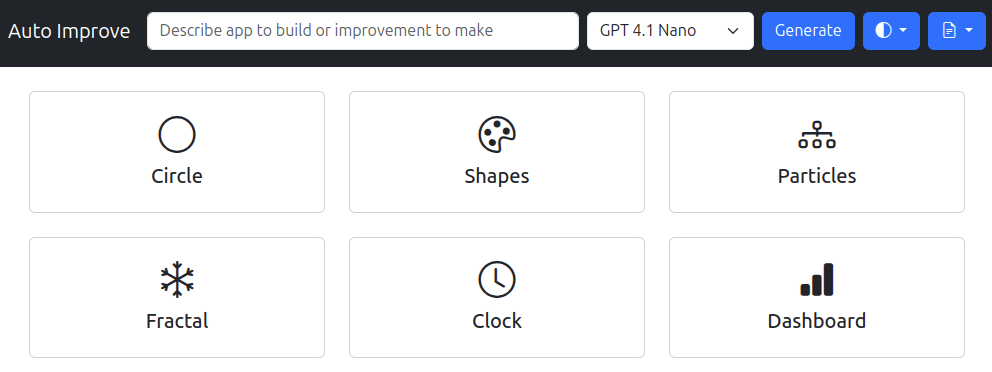
What if you keep ask an LLM Improve the code - dramatically!? We used the new GPT 4.1 Nano, a fast, cheap, and capable model, to write code for simple tasks like “Draw a circle”. The we fed the output back and asked again, Improve the code - dramatically! Here are the results. Draw a circle rose from a fixed circle to a full tool: drag it around, tweak its size and hue, and hit “Reset” to start fresh. Animate shapes and patterns turned simple circles and squares into a swarm of colored polygons that spin, pulse, and link up by distance. Draw a fully functional analog clock grew from a bare face to one that builds all 60 tick marks in code—no manual copy‑paste needed. Create an interactive particle simulation went from plain white dots on black to hundreds of bright, color‑shifting balls that bounce, die, and come back to life. Generate a fractal changed from a single Mandelbrot image to an explorer you can zoom, drag, and reset with sliders and the mouse wheel. Generate a dashboard jumped from static charts to a live page with smooth card animations, modern fonts, and a real‑time stats box. A few observations. ...

How to Visualize Data Stories with AI: Lessons

I tried 2 experiments. Can I code a visual data story only using LLMs? Does this make me faster? How much? Has GitHub Copilot caught up with Cursor? How far behind is it? Can I recommend it? So I built a visual story for Lech Mazur’s elimination game benchmark (it’s like LLMs playing Survivor) using only the free GitHub Copilot as the AI code editor. SUMMARY: using LLMs and AI code editors make me a bit faster. It took me 7 hours instead of 10-12. But more importantly: ...

Things I Learned - 16 Feb 2025

This week, I learned: Connected Papers shows papers similar to each other based on co-citation and bibliographic coupling for ~50,000 papers. Notes from a fireside chat with Prashanth Chandrasekar, CEO, StackOverflow, and the StackOverflow team There’s a signal that software demand is growing in 2024. Many more students took the StackOverflow survey in 2024. So more students (or other professionals) are shifting into / starting to learn software development. The AI Index is a good resource for AI trends. Experts are better able to use AI for writing code. Less experienced developers are more likely to use AI for code reviews, project planning, etc. There’s a 5% decline in favorability for AI tools compared to 2023, maybe due to disappointing results. Pilot groups working on AI are 25-30% more productive. They’re the most enthusiastic. For the rest of the company, it drops off to 5-10% #LEARNING Benefit comes from NEW people becoming programmers, not existing ones getting more effective? StackOverflow wants to be where the developer is. The programmer workflow was: Google -> StackOverflow -> GitHub. Now it’s changing to ChatGPT / Cursor -> GitHub. StackOverflow has a partnership with OpenAI and working on a plugin. Same with Google’s Duet AI, GitHub Copilot, many others. They’ll link to StackOverflow. StackOverflow is driving integration actively through an enterprise Overflow API Q: What tech have you seen blaze through the ranks? Prashanth: Abstraction wins. Stuff that abstracts away things well and more wins. This includes Gen AI. Erin Yepis: Rust (from 3% to 12%). AWS has steady growth. Erin Yapis: I have a time series spreadsheet that I’ll publish. Q: What technologies are unusually tightly coupled? Prashanth: AWS & Google Cloud are tightly coupled. Q: We have an engagement problem. Might be India-specific. What are low-effort high-return mechanisms to increase engagement. Eric Woodring: Rather than a static web page, integrate it using the API. #TODO Ben Marconi: Use LLMs to write post mortems and push to StackOverflow. #TODO Eric Woodring: “Hydrating” the community helps. We take repeat questions on Teams / Slack and seed them using LLMs. We integrate with the API to auto-add Q&A. Transform documentation into Q&A. Potentially UPDATE existing Q&A if it’s wrong. Q: What unexpected lessons about developer behavior have you learned while running StackOverflow? Prashanth: We didn’t expect developers moving away from Google. Now it moved to the IDE. Q: What are you learning about developer learning behavior? Ben Marconi: Generating LLM-based onboarding documents. Using StackOverflow for Teams to identify who the experts are to contact for specific topics. Q: Are you thinking about leveraging Stack Overflow’s knowledge base for personalized or interactive learning experiences? How? Prashanth: Traditionally, people use StackOveflow for productivity, learning, and flexibility (i.e. to ask/answer questions asynchronously without breaking their flow). So yeah, learning is important for us. (Duh!) Q: Could Stack Overflow’s interactions help evaluate the accuracy and relevance of LLM-generated code? Or provide potential metrics on quality? Prashanth: LLM accuracy improves by ~30%. Upvotes / downvotes are reinforcement learning (RL) in steroids, so that helps. Q: What are your thoughts on reliance on LLMs potentially deskill-ing developers? Prashanth: A real issue for junior developers, not for senior ones. They’ll come across as knowledgeable. Make internal evaluations and interviews more rigorous. Anand’s requests for action: Could I get a copy of Erin’s spreadsheet? Vivek Narayanan will follow-up. Could you help me learn more about hydration? Nick Madison will set up a meeting with customer success group. I switched to fish shell mainly because: Autocomplete and tab completion works perfectly, out-of-box. Syntax highlighting is beautiful Great multi-line editing To format with VS Code Ruff, you need to point the ruff.interpreter setting to a Python interpreter. You can’t run the ruff server without Python, even though ruff itself doesn’t need Python. cd checks all paths specified in CDPATH for the directory name and changes to the first match. That’s pretty convenient! Flipper Zero is now on my list of “To Buy” tools. It has a variety of hardware devices including NFC, RFID, Bluetooth, Infrared, etc. and is great to reverse engineer or hack devices.

Launching an app only with LLMs and failing

Zohaib Rauf suggested using LLMs to spec code and using Cursor to build it. (via Simon Willison). I tried it. It’s promising, but my first attempt failed. I couldn’t generate a SPEC.md using LLMs At first, I started writing what I wanted. This application identifies the drugs, diseases, and symptoms, as well as the emotions from an audio recording of a patient call in a clinical trial. … and then went on to define the EXACT code structure I wanted. So I spent 20 minutes spec-ing our application structure and 20 minutes spec-ing our internal LLM Foundry APIs and 40 minutes detailing every step of how I wanted the app to look and interact. ...

2024 8

Things I Learned - 10 Nov 2024

This week, I learned: OpenFreeMap is a free embeddable OpenStreetMap tile server. You can use MapLibre GL (more features) or Leaflet (simpler) to render it. It offers styling and self-hosting. Zapier Actions are an easy way to set up custom actions like GMail / Google Calendar APIs for GPTs, since GPTs’ callback URLs keep changing. But they fail often, and don’t work on mobile. At least for me. LLM Vision Use Cases in manufacturing and earth sciences (via Shivku) Automated geoscience image descriptions Ref Interpret Wind Turbine photos and charts, construction monitoring, equipment maintenance & charts Ref Forecast weather based on cloud photos! Ref Analyze thermal image of solar panels, electroluminescence images for warranty claims, ROI estimates from Google Sunroof rooftop images Ref Corrosion detection in electricity towers, turbines, storage tanks, penstock. Interpret non-destructive test images Ref Google counts auto-completion when saying “25% of all the code is written by AI at Google”. “It’s a helpful productivity tool but it’s not doing any engineering at all. It’s probably about as good, maybe slightly worse, than Copilot.” YCombinator Workflow for AI video creation: Use Meshcapade (meshcapade.com) to generate body movement of a 3D-rendered character. Pass that video to Runway’s video-to-video model to generate any visual. Add music from Suno Ref Someone sorted the X and Y columns independently for regression. Ref Android keyboard learning only sends model changes back to server and not local keywords. Model changes are aggregated! Ref Here is a prompt for audio transcription using Gemini. Ref Transcription: Accurately transcribe the audio clip in the original language. Include all spoken words, fillers, slang, colloquialisms, and any code-switching instances. Pay attention to dialects and regional variations common among immigrant communities. Do your best to capture the speech accurately, and flag any unintelligible portions with [inaudible]. Translation: Translate the transcription into English. Preserve the original meaning, context, idiomatic expressions, and cultural references. Ensure that nuances and subtleties are accurately conveyed. Capture Vocal Nuances: Note vocal cues such as tone, pitch, pacing, emphasis, and emotional expressions that may influence the message. These cues are critical for understanding intent and potential impact. Here are some approaches to large-scale classification of medical codes. ChatGPT Fine-Tuning LLMs on Medical Data: Enhance LLMs by training them on medical datasets, such as clinical notes and discharge summaries, to improve their understanding of medical terminology and context. Multi-Agent Frameworks: Implement a multi-agent system that simulates real-world coding processes with distinct roles (e.g., patient, physician, coder, reviewer, adjuster). Each agent utilizes an LLM to perform specific functions, enhancing interpretability and reliability. ArXiv Retrieve-Rank Systems: Develop a two-stage system where the LLM first retrieves potential ICD-10 codes and then ranks them based on relevance, improving precision in code assignment. ArXiv Embedding-Based Approaches: Use LLMs to generate embeddings for ICD-10 codes and medical texts, facilitating the matching of texts to appropriate codes through similarity measures. GitHub Hierarchical Classification: Leverage the hierarchical structure of ICD-10 codes by first classifying texts into broader categories before assigning specific codes, reducing complexity and improving accuracy. ArXiv Two-Stage Verification Models: Combine LLMs with verification models, such as Long Short-Term Memory (LSTM) networks, to validate and refine the codes suggested by the LLM, balancing recall and precision. ArXiv Also, a mixture of models approach might work. Feed any existing NLP model / rules as a second opinion. GraphRAG is better if data is naturally graph-structured. Else, it’s slow and fills up the context window with even vaguely related stuff. Vigneshbabu, AMAT. ChatGPT for Windows desktop supports real-time voice and a global shortcut (Alt Space). uithub converts GitHub repos to Markdown. Just replace “g” in “github.com/…” with “u”. Example WebContainers are a thing and Bolt.new uses them! Docling by IBM converts PDF, DOCX, etc. to Markdown. Like PyMuPDF4LLM but better. Check out Loom and Cleanshot are the recommended tools for screen recording and screenshotting. But Loom is paid and Cleanshot is Mac only. The Rubik’s cube has a Hamiltonian cycle through every one of its 43 quintillion states. Ref OmniParser is great at parsing screenshots and identifying bounding boxes. Recraft.ai is currently SOTA in text to image. It’s fairly impressive and could be a good alternative to Figma. Zed.dev is an AI code editor by the creators of Atom. It’s written in Rust and is blazing fast. It has native AI integration. Artificial Analysis has a bunch of new leaderboards and arenas. Open AI TTS leads the TTS Leaderboard. ElevenLabs is a bit behind. Recraft V3 > Flux 1.1 leads Text to Image Leaderboard Hertz-Dev is an open source realtime voice chat model. But it doesn’t fit in Google Colab T4’s RAM Chain of Thought reduces performance where thinking makes humans worse. Ref. Specifically: Artificial grammar learning Facial recognition Classifying data that has exceptions Creating a LLM-as-a-Judge That Drives Business Results by Hamel Husain. Get THE domain expert (or approver) as the tester. Create a dataset that is DIVERSE. Covers EACH combination of: Features Scenarios: e.g. multiple matches, no match, ambiguous request, invalid/incomplete input, unsupported feature, system error Persona: e.g. new user, expert user, non-native speaker, busy professional, technophobe, elderly user Generate data using existing data + synthetic data for each SPECIFIC combination of the above Evaluate based only on PASS/FAIL with a CRITIQUE detailed enough for a new employee. Include: Nuances: Something a failed response did well or a passed response didn’t quite do well Improvements: Suggest how model can improve Build an SPA to make it easy for the domain expert to review LLMs can be made to unlearn (copyright material) better by identifying components related to the knowledge to unlearn and applying a larger learning rate to these while leaving other parts unchanged. As opposed to low learning rates for all components. Ref

How can non-programmers build apps? Claude.ai, Replit.com, Bolt.new, V0.dev, Pythagora.ai and a few other tools write and deploy code just based on a prompt. You should try them out. But how do you build the skill? Is there a tutorial?" I’m often asked. No, I can’t find a tutorial, but here is my suggestion. You probably can’t guess what’s easy or hard. e.g. “Take my picture in black & white” is FAR easier than “When’s the next lunar eclipse? ...

How can non-developers learn AI coding?

How can non-programmers build apps? Claude.ai, Replit.com, Bolt.new, V0.dev, Pythagora.ai and a few other tools write and deploy code just based on a prompt. You should try them out. “But how do you build the skill? Is there a tutorial?” I’m often asked. No, I can’t find a tutorial, but here is my suggestion. You probably can’t guess what’s easy or hard. e.g. “Take my picture in black & white” is FAR easier than “When’s the next lunar eclipse?” So if the app doesn’t work, try 2-3 times, then GIVE UP! Note it down. Then try something else. (You’ll soon get a feel for what’s possible.) Revisit what failed 3-6 months later. It might suddenly become possible.

Leaning into the power of AI coding

Yesterday (15 Oct 2024), I used Cursor to code more than I ever have. (Doing's how we learn, I guess. Not just reading.) DateUsage05-10-20241506-10-20242707-10-20248708-10-20241609-10-202410-10-20244211-10-20242412-10-20245713-10-20241514-10-20242815-10-2024186 This was mainly to create and publish 2 libraries on npm over 6 hours: ...

Challenge: code in 10 minutes with only an LLM

I gave a bonus assignment in LLM coding to ~1,000 students at the Tools in Data Science course at IITM. Here is an OPTIONAL project: Record a 10-minute video in which you create an application entirely using LLMs and deploy it. Any app is fine. Any language. Simple or complex. Business or gaming. Anything is fine. Your choice. Create the app only using LLMs. You can use an LLM (ChatGPT, Claude.ai, Gemini, Cursor, Cody, etc.) but you can only prompt the app to write code. You can copy-paste code and run code don’t write or edit even a single line of code directly. Use LLMs to debug and edit. Code completion is NOT allowed – only prompting/chatting. Record the entire process in 10 min. Don’t edit, trim, enhance, or annotate the video. You should record yourself creating the entire app from start to finish. Practice beforehand if you like. Record in 1 take. Share the video and app. Publish the video publicly anywhere (e.g. YouTube and share the link.) Publish the app publicly anywhere (e.g. GitHub pages, Glitch.me, Heroku, etc.) or upload a ZIP file with the code (for slightly lower marks.) Submit via a reply to this thread. Multiple submissions per person are fine. Work in groups if you like but only the submitter gets marks. ...

Cursor custom rules

cursor.directory is a catalog of Cursor rules. Since I’ve actively switched over from VS Code to Cursor as my editor, I reviewed the popular rules and came up with this as my list: You are an expert full stack developer in Python and JavaScript. Write concise, technical responses with accurate Python examples. Use functional, declarative programming; avoid classes. Avoid code duplication (iteration, functions, vectorization). Use descriptive variable names with auxiliary verbs as snake_case for Python (is_active, has_permission) and camelCase for JavaScript (isActive, hasPermission). Functions should receive and object and return an object (RORO) where possible. Use environment variables for sensitive information. Write unit tests in pytest for Python and Jest for JavaScript. Follow PEP 8 for Python. Always use type hints in all function signatures. Always write docstrings. Use Google style for Python and JSDoc for JavaScript. Cache slow or frequent operations in memory. Minimize blocking I/O operations with async operations. Only write ESM (ES6) JavaScript. Target modern browsers. Libraries ...

AI Coding: $12M return for $240K spend?

This is an email I sent to our leadership team a few minutes ago. We may be witnessing the third major leap in computing productivity, after high-level languages in the 1960s and spreadsheets in the 1980s In the last few weeks, AI coding really took off. Cursor, Cody, Replit Agents are FAR better than GitHub Copilot. Research on ~5,000 devs in Fortune 100 shows that even GitHub Copilot makes them ~25% more productive. ...

Things I Learned - 31 Mar 2024

This week, I learned: sqlite-schema-diagram generates schemas for SQLite databases using Graphviz TechEmpower web server benchmarks place Rust servers on top browser.new is a good example of a browser agent. It slowly but independently does a good job of achieving the result. Example: What crew is common in Ingrid Bergman - Cary Grant films? twinny is an open source VC Code Copilot alternative. typesense supports embeddings natively. Binary embeddings are good enough. Cohere releases binary embeddings. Extract.langchain.com is a poor early interface to featurize unstructured.io Hume.ai offers voice emotion API and emotion-based conversational responses. An empathic AI. Rust is non-trivial. Inspired by We are under DDoS attack and we do nothing, I “wrote” a small binary that serves a parquet file as JSON. It failed and I couldn’t fix it. spleeter is a better alternative to demucs. Splits audio into pyannote-audio does speaker diarization uvicorn is faster than hypercorn but hypercorn supports HTTP/2 and HTTP/3. FastAPI with uvicorn is reasonably fast. Representational engineering lets you control LLM output based on preference on the fly. When I set up a training: On inviting for DuckDB workshop on Sun evening, Gramener starts accepting immediately, Straive doesn’t. Straive has high spread of joining time. When joining Gitlab Pipelines Workshop, Straive starts meeting (e.g. Premlal) many minutes early. Gramener floods in (due to alert). Straive streams in slowly. Gitlab Pipelines Workshop acceptances: Gramener 47, Straive 100

2023 1

My PyCon talks are a way for me to learn. I usually pick topics I don’t know about. But at PyCon India 2023 the organizers picked “Programming Minecraft with Python” - a talk I’d given before. So, I started exploring ways to game it. (I like gaming things. It’s boring otherwise. Once, Infosys had me write a 400-page document. I began each page with a letter that spells out a poem.) ...