Recruiting smart people

Recently, I have ended up giving bits of advice to people recruiting at start-ups, and a few patterns have emerged that are worth sharing. Before I go ahead, I should warn you that I have no qualifications whatsoever. (All consulting advice should come with this caveat, perhaps!) You might be better off reading Joel Spolsky’s Smart and Get Things Done (read). I haven’t read it myself, but from what little I see of it, the thoughts seem similar. ...
Open source in corporates

Last month, my first application went live. I’ve been writing code for 20 years. Not one line of my code has been officially deployed in a corporate. (Loser…) It’s a happy feeling. Someone defined happiness as the intersection of pleasure and meaning. Writing code is pleasurable. Others using it is meaningful. But this post isn’t quite about that. It’s about the hoops I’ve had to jump through to make this happen. ...

Organisational amnesia

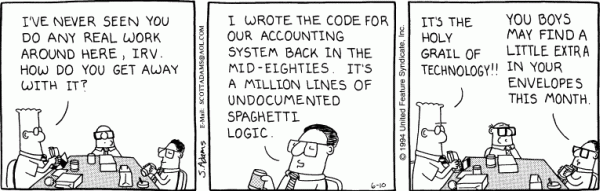
It’s amazing how much of a dependency there is on individuals writing IT systems. Reminds me of that Dilbert strip: A few weeks ago, I was trying to figure out in what happens when there are multiple promotions. (Our client is a retailer.) I mean, if there’s a phone that costs £100 and there are 2 promotions: 10% off on phones and £10 off on phones. Do you apply the 10% off first and pay £80 or the £10 off and pay £81? ...

The courage to be honest

Some months ago, I was working with a client who wanted to set up a website with social commerce elements. (That’s Web 2.0 in fancy words.) They only seemed to have a very rough idea of what they wanted, so asked them right at the start of the meeting: “Why do you want social commerce?” Their answer was interesting, and one that I had not expected. They said, “We want to project the image of an honest an open organisation.” ...

Resolving the Prisoners Dilemma

If you’re ever taken a course in Economics, and it discussed Game Theory, you may be familiar with The Prisoner’s Dilemma. Roughly, this is the problem. Assume you possess copious quantities of some item (money, for example), and wish to obtain some amount of another item (perhaps stamps, groceries, diamonds). You arrange a mutually agreeable trade with the only dealer of that item known to you. You are both satisfied with the amounts you will be giving and getting. For some reason, though, your trade must take place in secret. Each of you agrees to leave a bag at a designated place in the forest, and to pick up the other’s bag at the other’s designated place. Suppose it is clear to both of you that the two of you will never meet or have further dealings with each other again. ...

Less is more

The hours in consulting are pretty long. 65 hours a week used to be my norm, and that’s ignoring the travel time to and from work. So there wasn’t too much life outside of work. (I’ve come to realise, though, that what you do outside of work doesn’t change that much with more free time. What does change is that you just enjoy it more – both in and out of work.) ...

Return on effort

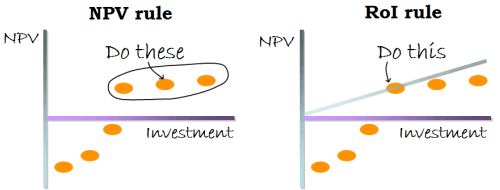
If you have a bunch of projects you could do, and want to decide which ones to take up, I was taught a rule: if a project has positive net present value, do it. That is, find out how much money you have to put in (& when), and how much you’ll get out (& when). Adjust for money today being worth more than money tomorrow. If it makes a profit, just do it. ...

Filtering vs weighting

I am selecting a CRM package for a bank. I asked my colleagues how they’d gone about it, and got 8 responses. Every single one of them had the same weighting approach: Take a huge list of criteria, assign weights, score each package, calculate a weighted-average score, pick the highest one. As I mentioned earlier, I think weighting is a lousy method. (See Errors in multicriteria decision making.) You can’t say “I picked this package because it has X, Y and Z features, which the others don’t.” You can only say, “Oh, overall, it has the highest score…” ...

Errors in multicriteria decision making

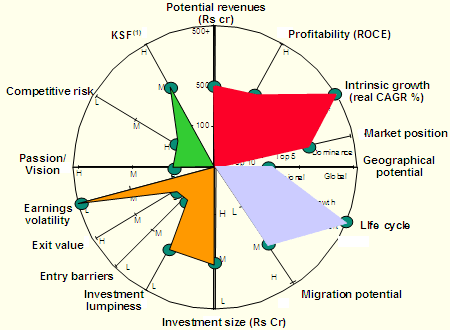
I talked about my approach for multicriteria decision-making, and mentioned that it was fundamentally flawed. Here’s why. The charts above compared two industries. The bigger the area, the more favourable the industry. The underlying assumptions being: The criteria are comparable. (Points at the same level are of comparable importance. Twice as large is twice as important.) All (and only) relevant criteria have been included. In this particular example, I know for a fact that both these assumptions are invalid. And in every case I used this methodology, the assumptions fail. ...

Multicriteria decision making

Decisions are usually based on multiple criteria. You have to trade off between criteria. I’ve been involved many such decisions over the last 5 years. Example 1: A conglomerate wanted to identify industries for growth. We shortlisted 19 industries, identified 12 criteria for the attractiveness of an industry, researched each one and plotted them on spidergraphs like below. The intention was that, to identify the most favourable industries, you’d just pick the ones with the largest filled area. ...

Normalising non-normal distributions is bad

I was working with the treasury of a bank. They were trying to estimate how much money could flow out of their savings account in a day, worst case. I took their total savings account balance at the end of each day and found the standard deviation. I took thrice the standard deviation, and said, “You can be 99.7% sure that your daily loss won’t be more than 1.5% of the balance.” ...

Normalising non-random samples is bad

I rate movies on a scale of 1 (bad) to 5 (good). This is an absolute scale. Initially, I assumed that I would watch as many good movies as bad ones. So I'd have about as many 1s as 5s, and 2s as 4s. But, when I looked at my ratings for movies over the last year, I had far more 4s than 2s. My movie ratings were not normal. ...

Not all distributions are normal

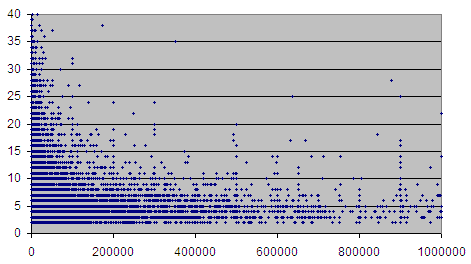
14 years ago, I was introduced to the process of normalising grades. Professors “fit” students’ marks into a normal distribution and assign grades based on that. (I still don’t know how they do it). Since then, I’ve encountered normalising a lot. My performance at work is normalised. I normalise my song ratings and movie ratings. I’ve normalised all kinds of things at work: lead-time of delivery of fans, movements in savings account balances, calls to a call centre, demand for a resource… you name it. ...

Change management

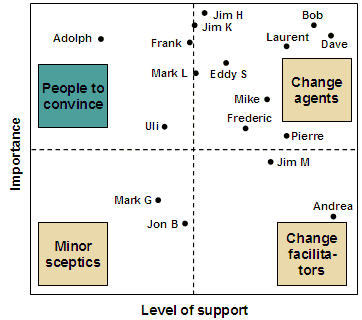
Change management can be analytic, as opposed to touchy-feely. Our client’s operating margin was falling. The bosses wanted to offshore their back office. Others weren’t convinced. To manage this change, we needed three questions answered: Who’s not convinced? Why aren’t they convinced? What’ll convince them? Who’s not convinced? We plotted the level of support and importance of key people on the stakeholder support matrix. This split people into 4 groups (below). Then we showed it around to people and had them move people around on the matrix. ...

Packaging

Packaging can make a huge difference to products. It really hit me when I saw this bottle of Heinz’s ketchup. My two big problems with normal ketchup bottles are: (a) the sauce spills to the side of the bottle and sticks to the cap, and (b) it’s tough to pour the last bits of sauce – you have to hit the bottle a lot. Now, I didn’t know I had these problems. But when I saw this bottle, it hit me. You keep the bottle upside down – so it’s easy to pour the last bits of sauce. And they way the nozzle valve is designed, the sauce doesn’t stick to the cap. Perfect! Since then, I don’t buy any other ketchup bottle. Even if I WANT ketchup, I don’t buy it unless I get this bottle. Packaging made be brand loyal. (Caveat: I’m not REALLY brand loyal. I’d buy any ketchup with this packaging. But only Heinz has it right now.) ...

Conflicting policies

A software services firm once asked us, “How come we are not able to staff projects quickly, even though we have a lot of people on the bench?” There were a bunch of reasons, but among those, we found something interesting. They were implementing two policies that were logical on their own, but disastrous together. (The bench is where programmers sit when they are not on a project.) Here’s how they work. When a project starts, the project manager requests resources (people) for the project. HR passes on matching CVs to the project manager, who approves or rejects them, in consultation with the client. ...

Demand draft fees

Once, we were looking at whether banks made money on demand drafts (DDs). DDs are costly. 90% of a bank’s costs are people-related, and it takes a fair bit of time (hence people) to process DDs. If you pay for DDs in cash, it costs even more because the teller has to count the notes. To recover this cost, banks charge a fee. The fee increases with the size of the DD. A DD for Rs 10,000 may cost Rs 50, while one for Rs 100,000 may cost Rs 200. ...

Channel economics

We were working with the financing subsidiary of a conglomerate. They had two divisions that gave loans for buying vehicles (mostly trucks, but also cars). One division used the direct channel. They had direct marketing agents (DMAs) who were paid a commission for getting the contract, and the division collected the monthly installments. The other used the dealer channel. The dealers would get the contract as well as collect the installments. ...

ATM breakeven

Banks install ATMs to lower their branch costs, and to attract new customers. When working out the economics of ATMs, we found that lowering branch costs alone could not be a viable reason to install an ATM. The bank argued as follows: “Every time someone withdraws money from an ATM, they avoid going to the branch. With enough people going to the ATM, I can afford not to increase my branch size, and that saves me money. Since it costs me Rs 20 every time a person withdraws cash (in terms of salary, rent, etc.) and an ATM costs about Rs 2,200 a day, I’ll break even if there are 110 cash withdrawals from the ATM.” ...

Market emergence - prepaid phones

Reliance Infocomm, after launching their prepaid business in India, introduced an new scheme. Pay Rs 4,300, and get a mobile phone PLUS prepaid vouchers worth Rs 4,300. Effectively, you’re getting a mobile phone for free. The scheme made good financial sense for Reliance. With a million subscribers to this scheme, they could recover Rs 430 cr of their upfront capital investment and retire their debt. Besides, the Rs 4,300 would have normally been bought over a period of around three years by prepaid subscribers, making its present value around Rs 3,600, at an interest rate of 12%. Add to that the reduction in distribution cost due to bulk selling, and possibility of non-usage, etc… the economics might work out. ...