2026 8

My predictions in 2025

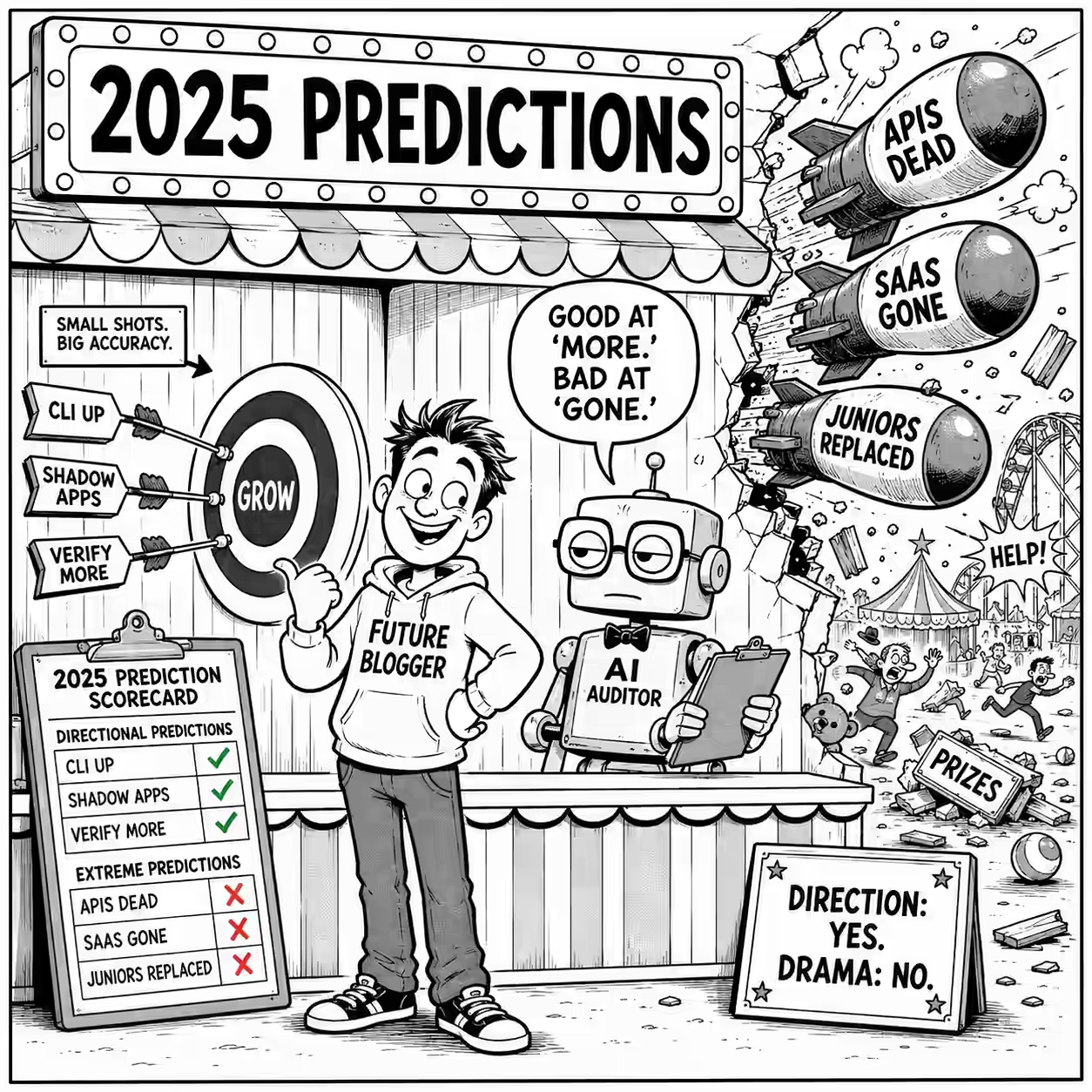
In 2025, I made a number of predictions on this blog. (Not intentionally. I just said stuff.) I asked ChatGPT to audit them. It selected 440 claims, filtered out vague or pending ones, and verified the rest. Here’s what I got right and wrong. 🟢 “My chat will overtake search in 12-18 months. When ChatGPT becomes my primary lens on knowledge…” (chatgpt-vs-google-usage.md:L27). Audit: This actually happened in your own browsing data: search led through April 2026; in May, chat jumped to 2,211 visits vs 1,319 search visits, and stayed comfortably ahead thereafter. 🟢 “Typed languages are better suited for vibe coding. This will likely lead to the growth of typed languages (TypeScript, Rust, Go) but also of typing in untyped languages (e.g. Python).” (things-i-learned-10-aug-2025.md:L33). Audit: TypeScript became GitHub’s #1 language in August 2025 and grew 66% YoY; GitHub itself explicitly connects the rise of typed languages to more reliable AI-assisted coding. This is unusually strong because you got both the direction and mechanism. (The GitHub Blog) 🟢 “Code Mode … is a smart way to use MCPs and a very likely future direction. Using LLMs to write code to call MCPs rather than directly.” (things-i-learned-05-oct-2025.md:L49). Audit: OpenAI’s current Responses API has essentially this as a named capability: Programmatic Tool Calling lets a model write and execute programs that coordinate multiple tools and intermediate results. (OpenAI) 🟢 “CLI optimization for LLMs will likely emerge. More CLIs (and wrappers / hooks in the shell) will improve output and error contexts for LLMs…” (things-i-learned-27-jul-2025.md:L86). Audit: By May 2026 you were yourself testing rtk, a CLI proxy explicitly producing compact agent-friendly command output; across 216 commands you measured about 50% token reduction. That is almost exactly the wrapper you predicted. 🟢 “In the future, AI that works directly with file systems, Model Context Protocols, and local APIs are likely to become more important.” (features-actually-used-in-an-llm-playground.md:L76). Audit: File-system-native coding agents became mainstream, while MCP expanded into both hosted and local integrations; Anthropic now packages local MCP servers as easy-to-install desktop extensions. (Claude Help Center) 🟢 “Agents are slow. Parallelizable tools … will grow. Tool speed … will become more important.” (things-i-learned-22-jun-2025.md:L106). Audit: Parallelism has become a central agent UX: OpenAI’s Codex app is explicitly built around managing multiple agents simultaneously; at the extreme, internal users now accumulate more than 60 hours of agent turns per day by parallel execution. (OpenAI) 🟢 “Companies-of-one will grow. Sole founder can handle support functions.” (things-i-learned-24-aug-2025.md:L14). Audit: Nasdaq’s Economic Institute finds one-person US business applications up more than 20% since early 2025, with essentially all recent application growth coming from solo businesses. Stripe separately reports solo founders reaching 63% of Atlas C-corps in Q2 2026. (Nasdaq) 🟢 “We will move towards an organization structure where developers are embedded with business teams rather than working as a separate group. Sort of like embedded executive assistance instead of a central typing pool.” (things-i-learned-08-jun-2025.md:L49). Audit: Forward-deployed engineer demand reportedly increased 42-fold from 2023-25, with roughly 9,000 roles globally by early 2026. The role is almost precisely “technical people embedded with the business to make AI work in its real environment.” (Reuters) 🟢 “Shadow apps will grow. Anyone can code. Users build apps with prompts, sheets, agents, outside of IT SDLC. Like Excel sheets.” (things-i-learned-24-aug-2025.md:L18). Audit: Microsoft now explicitly describes a “new wave of shadow AI”: users installing coding/desktop/SaaS agents outside traditional IT governance, and has built discovery products specifically for unmanaged AI applications and agents. (Microsoft) 🟡 “Agents generate diffs/PRs. Tools to edit and comment on these online will emerge.” (things-i-learned-22-jun-2025.md:L107). Audit: GitHub now measures PRs created and merged by Copilot coding agent, while review comments can be handed directly to the agent with “Fix with Copilot,” including batches of review feedback. That’s almost verbatim fulfillment. (The GitHub Blog) 🟡 “Models’ ability to orchestrate longer workflows will improve. Factor that into your application design.” (things-i-learned-10-aug-2025.md:L44). Audit: By mid-2026, OpenAI reports large increases in requests corresponding to >30-minute, >1-hour and even >8-hour human tasks, while Codex explicitly targets long-running tasks spanning hours or longer. (OpenAI) 🟡 “Code review process will be re-invented.” (things-i-learned-22-jun-2025.md:L109). Audit: GitHub has rebuilt Copilot review around an agentic architecture that gathers broader repository context, uses tools, produces findings, and can hand fixes to another coding agent. This is substantially more than autocomplete added to old review. (The GitHub Blog) 🟡 “Domain expertise will therefore become even more valuable in the near future.” (things-i-learned-20-apr-2025.md:L39). Audit: 2026 hiring evidence points toward domain/product expertise becoming more important rather than pure coding alone, particularly as AI handles more implementation and firms need people who can connect it to actual business functions. (Reuters) 🟡 “Validation is the New Bottleneck: Since coding is now much faster, the critical, time-consuming task has shifted to reviewing, testing, and validating the LLM’s output.” (things-i-learned-17-aug-2025.md:L90); you also predicted “The Quality Control (QC) function will become larger and more critical” (L95). Audit: GitHub has now productized exactly that bottleneck in Code Quality; more than 10,000 enterprises used its preview, and GitHub explicitly frames AI-accelerated code output as creating the need for trustworthy pre-merge quality validation. (The GitHub Blog) 🟡 “Agents generate technical debt faster than humans. Solving this will become a major problem/opportunity.” (things-i-learned-22-jun-2025.md:L114). Audit: GitHub’s 2026 Code Quality launch is close to a commercial instantiation of this forecast: AI increases code output, so automated quality/debt detection and remediation moves earlier into the development cycle. (The GitHub Blog) 🟡 “Governance will grow. Non-experts are acting like experts. Validation is more important.” (things-i-learned-24-aug-2025.md:L19). Audit: The companion to shadow AI has indeed been governance: Microsoft now ships specific discovery, monitoring and governance for unmanaged AI agents, while NIST has continued expanding formal GenAI evaluation tooling. (Microsoft Learn) 🟡 “Soon, we won’t just follow a lesson plan – we’ll have lessons built just for us. AI will track how we learn and adapt in real time. It’ll feel like having a personal coach in your back pocket.” (o3-is-now-my-personalized-learning-coach.md:L91). Audit: ChatGPT Study Mode now asks what the learner knows, adapts explanations, checks understanding, works from uploaded course material, and uses memory to personalize support; OpenAI explicitly describes the objective as personalized learning support available to any student. (OpenAI Help Center) 🟡 “Cost is going down so quickly right now that all you have to do is wait, and stuff will become available for a very affordable or even a free price.” (things-i-learned-16-mar-2025.md:L116). Audit: The broad direction held. OpenAI cut GPT-5.6 Luna API prices by 80% in July 2026 while simultaneously improving capability-per-dollar. The “all you have to do” part is hyperbole, but the price-curve forecast was right. (OpenAI) 🟡 relayed: “Control of chips and GPU compute is what will likely be the gameplay to control AI dominance globally.” (things-i-learned-02-feb-2025.md:L16, attributed there to Dario Amodei). Audit: Advanced-AI-chip export licensing remains an explicit geopolitical control mechanism in 2026, including restrictions and license review for H200/MI325X-class accelerators going to China. 🔴 “AI closes the gap between junior & senior devs – even when both use AI. Quality doesn’t suffer much. So onboarding can be faster, compensation ladder may shorten.” (things-i-learned-03-aug-2025.md:L52). Audit: The emerging evidence says AI changes the work but does not erase the expertise gap: experienced developers are better at steering/delegation, while low-experience AI-heavy contributions incur substantially more review and lower acceptance. (arXiv) 🔴 “LLMs already deliver hours of analyst work in minutes. Entry-level roles WILL vanish.” (goodbye-mba-hello-ai.md:L17). Audit: The labor-market warning was directionally good, but “vanish” is a major magnitude error. Stanford finds a meaningful relative decline among 22-25-year-olds in highly AI-exposed jobs, while employment remains substantial and overall exposure groups still show employment growth. “Entry-level hiring contracts sharply” would have scored much better. (Stanford Digital Economy Lab) 🔴 “Coders micro-manage LLMs. I think a novice will be more efficient and get better results than me.” (how-to-visualize-data-stories-with-ai-lessons.md:L285). Audit: Current empirical work points the other way in real software work. In a 22,953-PR study, lower-experience AI-heavy developers received 4.5* more review comments, had 31% lower acceptance, and took over 5* longer to resolve issues; qualitative work likewise finds experienced developers better at delegation and control. (arXiv) 🔴 relayed: “API access from model providers will shrink. Selling tokens is not a viable business model given lowering costs.” (things-i-learned-23-mar-2025.md:L19, from the Alexander Doria notes immediately above it). Audit: Almost exactly backwards. Model providers expanded their APIs into richer agent platforms, and token-metered API access remains a core commercial model - including premium pay-as-you-go modes. (OpenAI) 🔴 “APIs are likely to be replaced by just chat requests that will do the same thing. APIs might be replaced by RPA, where somebody uses a chatbot to do the equivalence instead.” (things-i-learned-16-mar-2025.md:L111-L112). Audit: Chat did become a front end, but the implementation moved toward more APIs underneath, not fewer: tool APIs, Responses, MCP, computer-use interfaces and programmatic tool calling are now the substrate agents use. (OpenAI) 🔴 “Software companies build ‘SaaS’-like apps today. Agents will replace apps. Instead of UI, workflows, and app logic, they’ll engineer prompts, APIs, and evals.” (agents-will-replace-saas-apps.md:L12). Audit: The interface-shift was right; “replace” was not. Gartner now forecasts agentic AI may expose roughly 20% of SaaS application spending by 2030 - meaning substantial disruption, not app extinction. Agents are often a new interaction layer over systems of record and APIs. (Gartner) 🔴 relayed: Models will “internalis[e] workflows … to wipe out the apps and workflow space.” (things-i-learned-23-mar-2025.md:L17, from Alexander Doria notes). Audit: “Internalize capabilities” was insightful; “wipe out” was the failed extrapolation. Enterprise applications remain a very large substrate even in Gartner’s fairly aggressive agentic-AI forecast. (Gartner) 🔴 “Demand for SaaS (one-size-fits-all) will shrink.” (things-i-learned-06-apr-2025.md:L89). Audit: Not yet. For example, Gartner forecasts Indian SaaS spending growing 18.9% in 2026, from $3.9B to $4.6B. AI is changing SaaS economics and seat licensing, but current demand is still growing rather than shrinking. (Gartner) 🔴 “The early majority have come in… Soon the late majority will come in asking for existing solutions that have already solved their problem for many others.” (things-i-learned-03-aug-2025.md:L44). Audit: This mapped your client/audience experience onto population adoption much too quickly. In 2026, US Census data put business AI usage around 17-20%, nowhere near a conventional late-majority phase. (Census.gov) 🔴- baseline error: “Given the cost and accessibility of drones, I guess drone terrorist attacks will soon emerge.” (things-i-learned-16-nov-2025.md:L43). Audit: They had already emerged. The UK government documented Daesh using small armed remotely piloted aircraft carrying grenades in Iraq in 2017; the UN had already been studying weaponized UAS use by non-state armed groups for terrorism-related purposes before this 2025 post. This is therefore a clean failure to establish the baseline, not a future hit. (GOV.UK) 🔴 relayed: “Personal writing with connection won’t go away. AI can’t give you heartbreak. But the rest of non fiction writing will vanish.” (things-i-learned-30-mar-2025.md:L69, under “Notes from Writing with AI”). Audit: Nonfiction is under real pressure, but “vanish” is nowhere close. UK nonfiction publishing still generated about GBP1.0B in 2025, down only 3%; the wider publishing industry reached record revenue. (Publishers Association) Legend: ...

How IMF mis-forecasts GDP growth

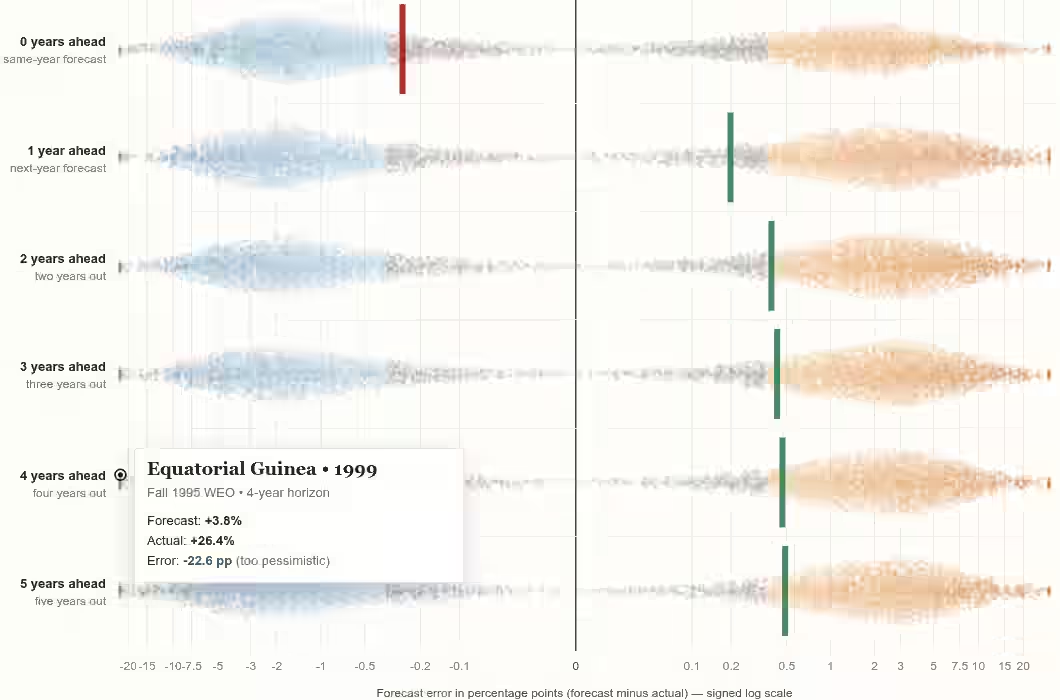
The IMF forecasts GDP growth every year. Their forecasts for the current year are slightly low. Their forecasts for the next year are slightly high. After that, it remains high. Some forecasts, like China, Singapore, UAE, Equatorial Guinea are consistently low. Other forecasts, like Japan, Congo, Mexico, Pakistan are consistently high. The interesting meta-pattern is how this sort of past-forecast analysis can be done for any topic. This emerged from an Ethan Mollick post and then I asked: ...

Add a Verify Button

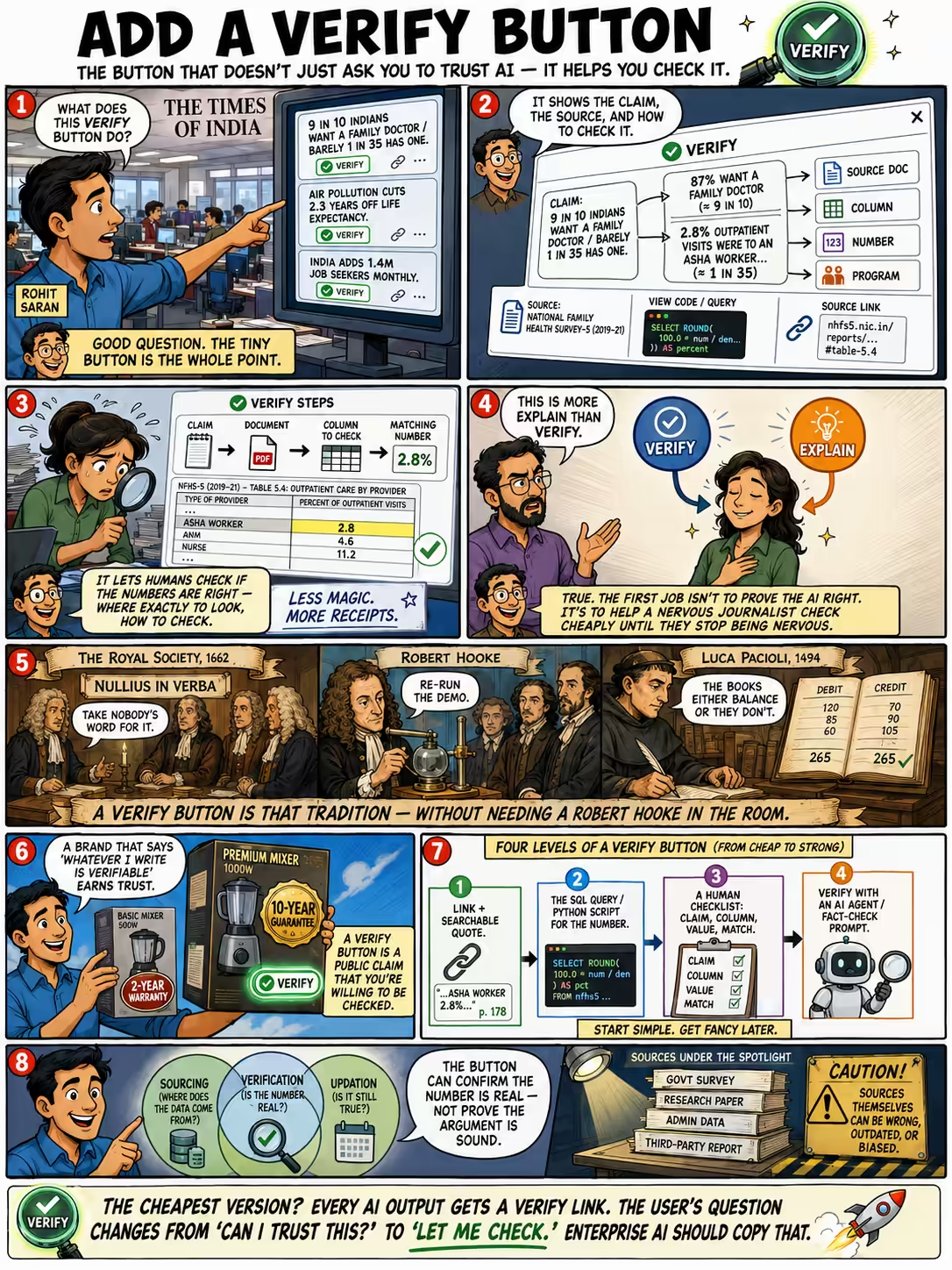
Rohit Saran looked at the Statoistics cards my AI agents are generating for The Times of India, and asked about a small button under each one. In the list of Statoistics that you had put, I saw there’s a button called ‘Verify.’ What was that meant to be or will do in future? That verify button explains the claim, mentions the sources, and shows how to check the claim. One card said “9 in 10 Indians want a family doctor and barely 1 in 35 has one”. The button breaks that down: ...

Panchayat solves the wrong problem

In Panchayat Season 1 Episode 7 Ladka Tez Hai Lekin…, at around 17:00, Pradhan asks Abhishek to solve problem 42. 42. A takes 5 days more than B to do a certain job and 9 days more than C. A and B together can do the job in the same time as C. How many days would A take to do it? (a) 16 days (b) 18 days (c) 15 days (d) 20 days The correct answer is (c) 15 days. But interestingly, ChatGPT got it wrong the first time too. It said (a) 15 days instead of (c) 15 days, and required a fact-check to correct itself. ...

How to use AI for research

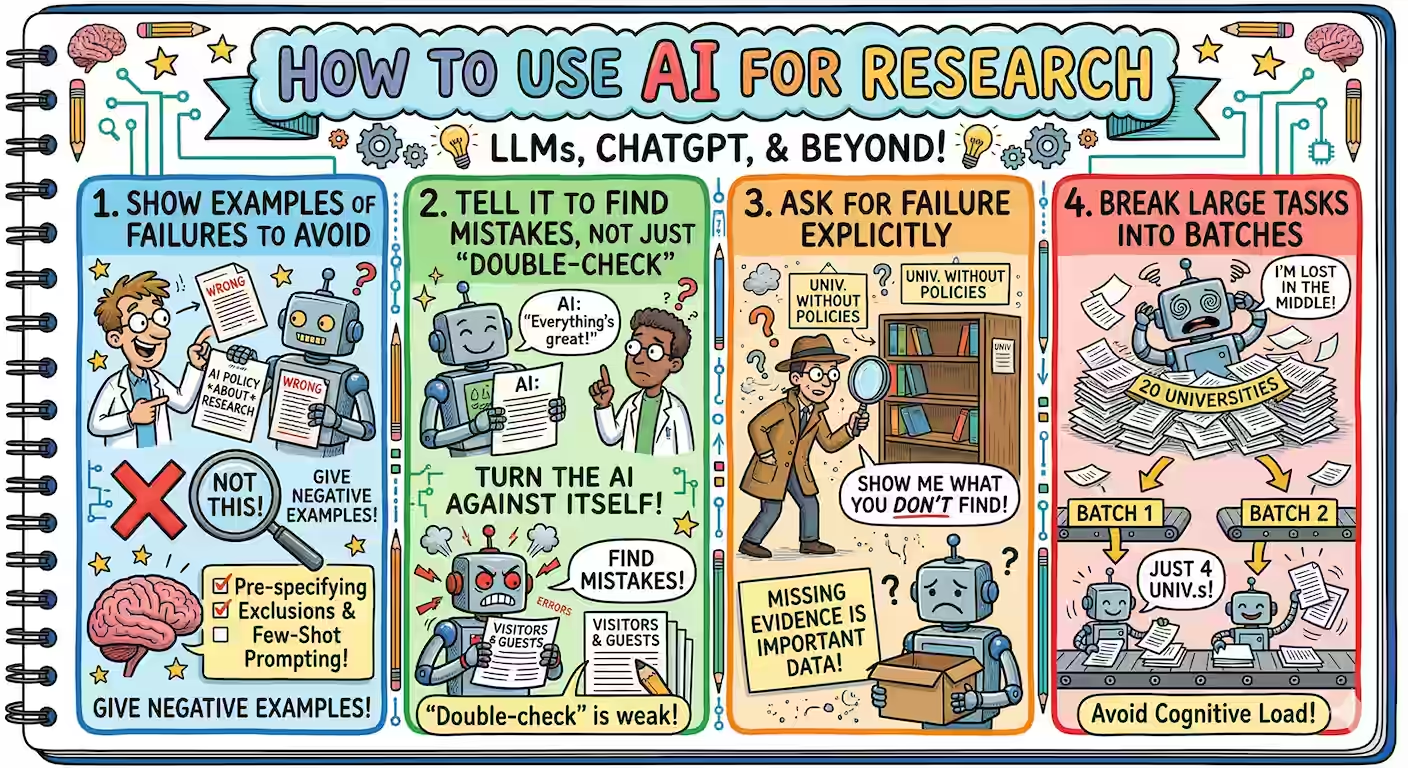
I asked ChatGPT to research universities’ AI policies. Here is the report Here are the four lessons I learned from that - about how to use AI for research. 1. Show examples of failures to avoid. Jivraj’s earlier research kept surfacing AI policies universities had researched, not written for themselves!. So I told ChatGPT to: … double-check that they ARE, in fact, about their own use of AI - not policies they’re proposing for others or are researching. ...

India data platforms

I Paid a Bribe (2010) Founded by: Janaagraha (co-founded by Swati Ramanathan & Ramesh Ramanathan) (Tracxn) Status: Ongoing as a Janaagraha initiative (current activity of the specific site varies by city/campaign; Janaagraha remains active) (janaagraha.org) Offering: Civic reporting + advocacy platform; sustained via donations/grants through Janaagraha (janaagraha.org) Financials: Janaagraha’s audited statement shows total income ₹243.46M (₹24.35 cr) for FY ending Mar 31, 2024 (janaagraha.org); FCRA statement shows donation income ₹174.38M (FY ending Mar 31, 2024) (janaagraha.org) (org-level, not IPaB-only) DataMeet (2011) Founded by: Thejesh GN and S Anand (Data{Meet}) Status: Active community (volunteer-led) (Data{Meet}) Offering: Community meetups, open-data projects; typically volunteer / partner-supported (Data{Meet}) Financials: No standardized public financial reporting (community initiative) (Data{Meet}) IndiaSpend / Spending & Policy Research Foundation (2011) Founded by: Govindraj Ethiraj (managing trustee; SPRF set up with an initial ₹10,000 investment per Oxford Academic chapter) (OUP Academic) Status: Active data journalism org (Indiaspend) Offering: Non-profit model: donations/grants; acknowledges philanthropic support (e.g., IPSMF support noted) (Indiaspend) Financials: Public exact revenues aren’t consistently published on a single page; verified datapoint: started with ₹10,000 investment (OUP Academic) SocialCops (2012) Founded by: Prukalpa Sankar and Varun Banka. (Forbes India) Status: No longer operating as the original “projects” startup; continued as a “data for social good community” while the team shifted focus to Atlan. (Forbes India) Offering: Earlier: data-intelligence projects + internal tools; later opened up tools for data teams and pointed users to Atlan. (Forbes India) Financials: Tracxn lists total funding of $320K (seed, Jul 30, 2014). (Tracxn) FactChecker.in (2014) (product under IndiaSpend) Founded by: IndiaSpend/SPRF initiative (PRS Legislative Research) Status: Active (as a fact-checking initiative associated with IndiaSpend) (PRS Legislative Research) Offering: Sustained via IndiaSpend’s non-profit funding base (Indiaspend) Financials: No separate public financials (bundled into parent org) (Indiaspend) How India Lives (2014) Founded by: Avinash Singh, N S Ramnath, John Samuel Raja Duraipandy (Tracxn profile); HIL’s own team page also lists Avinash Singh + Avinash Celestine as “Co-founder”. (Tracxn) Status: Active (site is live; products like “Gram” and “Sales Pulse” are being offered). (howindialives.com) Offering: Public-data products (e.g., Gram, Sales Pulse) + consulting/services around identifying/extracting/analyzing/visualising public data. (howindialives.com) Financials: Tracxn lists annual revenue of ₹1.92 Cr (as on Mar 31, 2022); Sales Pulse lists pricing at ₹35,400/quarter and ₹1,18,000/year (incl. taxes). (Tracxn) Data.gov.in / OGD Platform India (launched 2012) Founded by: Government of India (built/hosted by NIC, MeitY) (Data.gov.in) Status: Active (Wikipedia) Offering: Public digital infrastructure (tax-funded) (Data.gov.in) Financials: Not a commercial venture; budgeted via government programmes (no single “revenue” number) (Data.gov.in) CMIE – Consumer Pyramids Household Survey (CPHS) (running since 2014) Founded by: CMIE (The India Forum) Status: Active dataset used widely in research (The India Forum) Offering: Subscription access to microdata for institutions/researchers (The India Forum) Financials: One public datapoint on pricing: “membership subscription fee … $25,000 for one year” (example cited) (The India Forum) (CMIE’s own full financials may not be openly published like listed companies) Thurro (2016) Founded by: Karthik Ranganathan, Mrinalini Rao, Akhilesh Tilotia. (Thurro) Status: Active. (Thurro) Offering: Data/alternative-data driven “financial intelligence” (research, notebooks/analyses, data products). (Thurro) Financials: Tracxn lists annual revenue of ₹95.7L (as on Mar 31, 2024) and $0 funding. (Tracxn) Alt News (Feb 2017) Founded by: Pratik Sinha, Mohammed Zubair. (Wikipedia) Status: Active. (Wikipedia) Offering: Non-profit fact-checking; runs under Pravda Media Foundation (Section 8 company); funded via donations + grants. (Alt News) Financials: Alt News discloses at least ₹3,00,000 received in FY2017–18 from Zindabad Trust; Tracxn lists Pravda Media Foundation revenue ~₹2.18 Cr (FY ending Mar 31, 2025) (entity operating Alt News). (Alt News) OpenCity (2017) Founded by: A programme of the Oorvani Foundation, in collaboration with DataMeet. (re3data.org) Status: Active (Urban Data Portal continues to host datasets). (re3data.org) Offering: Open urban data portal consolidating city datasets for planners/researchers/citizens; civic-tech transparency + evidence-based governance use. (re3data.org) Financials: No venture-level financials publicly stated in the repository description; best understood as a nonprofit programme/civic-tech initiative. (re3data.org) SatSure (Sep 2017) Founded by: Prateep Basu, Rashmit Singh Sukhmani, Abhishek Raju (core team/founders listed in profile coverage). (YourStory.com) Status: Active. (YourStory.com) Offering: Geospatial / satellite-data analytics for agriculture, infrastructure, climate-risk and decisioning. (YourStory.com) Financials: Tracxn lists $27.7M total funding and (for the Indian legal entity) ₹9.65 Cr revenue (FY ending Mar 31, 2024). (Tracxn) Data Sutram (2018) Founded by: Rajit Bhattacharya, Aisik Paul, Ankit Das. (datasutram.com) Status: Active. (YourStory.com) Offering: AI-driven external-data intelligence for fraud/risk/compliance (RegTech), used by banks/NBFCs/fintechs. (YourStory.com) Financials: Raised $9M Series A (May 22, 2025) (mix of primary/secondary). Valuation is not disclosed publicly (some outlets report an estimated range, but the company hasn’t confirmed it). (YourStory.com) health-check.in (Apr 2019) Founded by: Launched by IndiaSpend (as a dedicated public-health reporting resource). (Indiaspend) Status: Active. (Indiaspend) Offering: Health data journalism + analysis on public health, nutrition, lifestyle diseases, health finance & governance. (HealthCheck) Financials: No separate public financials for the vertical; it’s sustained as part of IndiaSpend’s broader newsroom model. (Indiaspend) National Data & Analytics Platform – NDAP (launched May 13, 2022) Founded by: NITI Aayog (Press Information Bureau) Status: Active (National Data and Analytics Platform) Offering: Public data access + analytics/visualization tools (tax-funded) (Press Information Bureau) Financials: Not a commercial venture; no revenue (government platform) (Press Information Bureau) Factly (2014–2016) Founded by: Founded/led by Rakesh Dubbudu (origin story: started as a blog in 2014; later became Factly; fact-checking arm recognised as launched in early 2016) (factlylabs.com) Status: Active fact-checking + data stories (ifcncodeofprinciples.poynter.org) Offering: Mix of fact-checking, data journalism, and partnerships; IFCN listing describes the organisation and its work (ifcncodeofprinciples.poynter.org) Financials: Precise revenues aren’t reliably public in one canonical place; third-party “revenue estimate” sites are inconsistent, so I’m not treating them as verified financials (FACTLY) BOOM (BoomLive) (2014; current avatar since 2016) Founded by: Operated by Outcue Media Pvt Ltd; BOOM describes itself as India’s first fact-checking initiative (current avatar since Nov 2016) (BOOM) Status: Active (BOOM) Offering: BOOM says income is from social platforms, contract work, and training; also focuses on fact-checking & media literacy (BOOM) Financials: Tracxn reports Outcue Media revenue ₹12.2Cr for FY ending Mar 31, 2024 (Tracxn) (company-level) Alt News (Pravda Media Foundation, 2017) Founded by: Directors include Pratik Sinha and Mohammed Zubair (Pravda Media Foundation) (Tofler) Status: Active (Tofler) Offering: Donation-funded non-profit (Moneycontrol describes it as funded primarily by donations) (Moneycontrol) Financials: Financials vary by source: Tofler lists operating revenue “under ₹1 cr” for FY ending Mar 31, 2023 (Tofler); Tracxn reports ₹2.18Cr revenue for FY ending Mar 31, 2025 (Tracxn) CivicDataLab (2018) Founded by: Co-founders Gaurav Godhwani and Deepthi Chand Alagandula (civicdatalab.in) Status: Active (company status shown as active in corporate registries) (ZaubaCorp) Offering: Public-good data/tech/design work; typically sustained via grants, partnerships, and contracted projects (data.org) Financials: Tracxn reports revenue ~₹3.9Cr for FY ending Mar 31, 2025 (Tracxn) (company-level) FactIQ (2024). Focus on US economy but has “honorary membership” on this list Founded by: Rishabh Srivastava and Medha Basu Status: Active (FactIQ) YC-backed startup Offering: B2B data product (US “facts / signals” for teams; details vary by pitch) Financials: No public revenue disclosed. YC profile Data For India (Apr 2024) Founded by: Rukmini S Status: Active Offering: Free public data + insights + charts; sustainability model not clearly specified on the launch post Financials: No public financials disclosed on the launch post/site pages referenced How India Lives (2014) Founded by: Avinash Singh, N S Ramnath, John Samuel Raja Duraipandy (Tracxn profile); HIL’s own team page also lists Avinash Singh + Avinash Celestine as “Co-founder”. (Tracxn) Status: Active (site is live; products like “Gram” and “Sales Pulse” are being offered). (howindialives.com) Offering: Public-data products (e.g., Gram, Sales Pulse) + consulting/services around identifying/extracting/analyzing/visualising public data. (howindialives.com) Financials: Tracxn lists annual revenue of ₹1.92 Cr (as on Mar 31, 2022); Sales Pulse lists pricing at ₹35,400/quarter and ₹1,18,000/year (incl. taxes). (Tracxn) Thurro (2016) Founded by: Karthik Ranganathan, Mrinalini Rao, Akhilesh Tilotia. (Thurro) Status: Active. (Thurro) Offering: Data/alternative-data driven “financial intelligence” (research, notebooks/analyses, data products). (Thurro) Financials: Tracxn lists annual revenue of ₹95.7L (as on Mar 31, 2024) and $0 funding. (Tracxn) SocialCops (2012) Founded by: Prukalpa Sankar and Varun Banka. (Forbes India) Status: No longer operating as the original “projects” startup; continued as a “data for social good community” while the team shifted focus to Atlan. (Forbes India) Offering: Earlier: data-intelligence projects + internal tools; later opened up tools for data teams and pointed users to Atlan. (Forbes India) Financials: Tracxn lists total funding of $320K (seed, Jul 30, 2014). (Tracxn) Alt News (Feb 2017) Founded by: Pratik Sinha, Mohammed Zubair. (Wikipedia) Status: Active. (Wikipedia) Offering: Non-profit fact-checking; runs under Pravda Media Foundation (Section 8 company); funded via donations + grants. (Alt News) Financials: Alt News discloses at least ₹3,00,000 received in FY2017–18 from Zindabad Trust; Tracxn lists Pravda Media Foundation revenue ~₹2.18 Cr (FY ending Mar 31, 2025) (entity operating Alt News). (Alt News) OpenCity (2017) Founded by: A programme of the Oorvani Foundation, in collaboration with DataMeet. (re3data.org) Status: Active (Urban Data Portal continues to host datasets). (re3data.org) Offering: Open urban data portal consolidating city datasets for planners/researchers/citizens; civic-tech transparency + evidence-based governance use. (re3data.org) Financials: No venture-level financials publicly stated in the repository description; best understood as a nonprofit programme/civic-tech initiative. (re3data.org) SatSure (Sep 2017) Founded by: Prateep Basu, Rashmit Singh Sukhmani, Abhishek Raju (core team/founders listed in profile coverage). (YourStory.com) Status: Active. (YourStory.com) Offering: Geospatial / satellite-data analytics for agriculture, infrastructure, climate-risk and decisioning. (YourStory.com) Financials: Tracxn lists $27.7M total funding and (for the Indian legal entity) ₹9.65 Cr revenue (FY ending Mar 31, 2024). (Tracxn) Data Sutram (2018) Founded by: Rajit Bhattacharya, Aisik Paul, Ankit Das. (datasutram.com) Status: Active. (YourStory.com) Offering: AI-driven external-data intelligence for fraud/risk/compliance (RegTech), used by banks/NBFCs/fintechs. (YourStory.com) Financials: Raised $9M Series A (May 22, 2025) (mix of primary/secondary). Valuation is not disclosed publicly (some outlets report an estimated range, but the company hasn’t confirmed it). (YourStory.com) health-check.in (Apr 2019) Founded by: Launched by IndiaSpend (as a dedicated public-health reporting resource). (Indiaspend) Status: Active. (Indiaspend) Offering: Health data journalism + analysis on public health, nutrition, lifestyle diseases, health finance & governance. (HealthCheck) Financials: No separate public financials for the vertical; it’s sustained as part of IndiaSpend’s broader newsroom model. (Indiaspend)

Verifying Textbook Facts

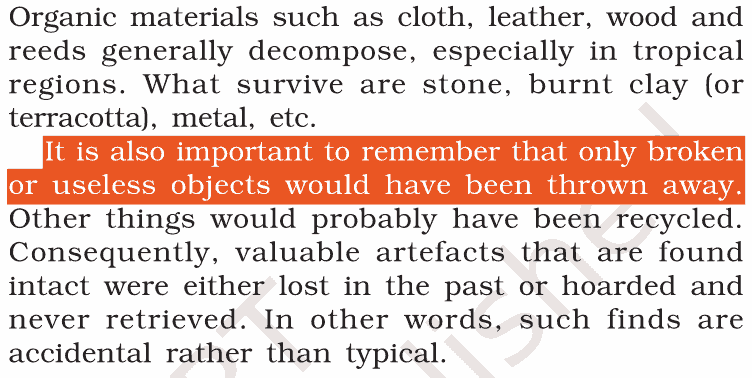
Using LLMs to find errors is fairly hallucination-proof. If they mess up, it’s just wasted effort. If they don’t, they’ve uncovered a major problem! Varun fact-checked Themes in Indian History, the official NCERT Class 12 textbook. Page-by-page, he asked Gemini to: Extract each claim. E.g. “Clay was locally available to the Harappans” on page 12. Search online for the claim. E.g. ASI site description and by Encyclopedia Britannica. Fact-check each claim. E.g. “Clay was locally available to the Harappans” is confirmed by both sources. Here is his analysis and verifier code. ...

New ways of reading books

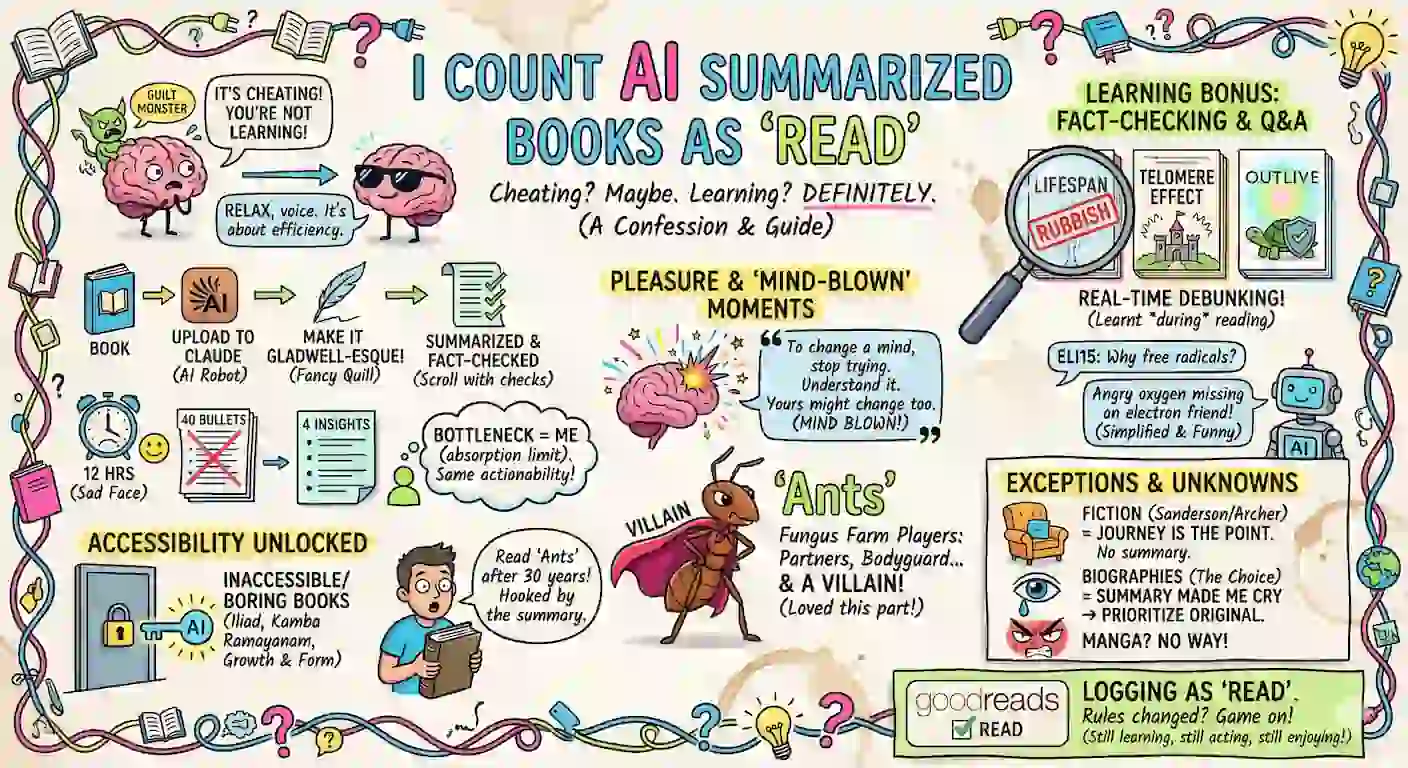
I’m using AI to read books by: Summarizing. This tells me what the books is about, the key points it makes and the main takeaways. It also helps me decide if I want to dig deeper. Fact-checking. I can find mistakes, alternate perspectives, and biases. That’s a huge win! Re-authoring. I can write it in the style of Malcolm Gladwell, Randall Munroe, Richard Feynman, or anyone else I like. Makes dense prose much more enjoyable. So far, I’ve applied this at different levels - and I’m sure there are more possibilities: ...

2025 2

I count AI summarized books as "Read"

I have this nagging feeling (maybe you do too?) that it’s cheating and I’m not really learning if it’s so easy. The same voice makes me feel guilty when using coding agents to code or ChatGPT in meetings. I’m telling that voice to relax. I upload books to Claude and ask it to “Comprehensively and engagingly summarize and fact-check, writing in Malcolm Gladwell’s style, the book …”. I can read it in an hour instead of twelve. Four bullet points instead of forty. With (this surprised me) roughly the same number of insights I actually do something with. ...

Core concepts

Distill core concepts from a topic. Version 2, 31 Mar 2026 I want to become quickly effective at [SPECIFIC TASK]. Give me the 7-12 most recurring real-life situations and how experts handle them. For each, include: 1. Trigger: "when I see ..." 2. Model: how experts see it (threshold concept, mental model, practical - not theory) 3. Traps: what it helps me avoid 4. Action: what to do/decide Use a real, concrete example for each. Then add two things: - Look-alikes: 2-3 pairs of similar situations that need opposite treatment, and how to distinguish them. - What comes only from experience - so I know the limits. Version 1 What are the core concepts, i.e. top non-intuitive well-established lessons/principles, of ... - Source comprehensively from authoritative sources. - Pick the 10 that are mentioned repeatedly, have the highest applicability and usefulness, while being non-obvious. - Fact-check each concept. Include references to authoritative sources. - Write them as bullet points. Explain each concept in a few simple sentences that are easy to understand intuitively.

2006 1

Misconceptions spread by textbooks

Misconceptions spread by textbooks. This site lists the facts, contrary to what most textbooks say about them. Facts: The ocean is blue because water is a blue substance. Not because it reflects the blue sky. The sky is blue because air is blue. Clouds actually remain aloft because they are warm inside.

2002 1

Snopes on TV

Snopes is soon to be on TV.

2001 3

The bunk stops here

A portal of urban legends. The bunk stops here.

Some rumours are true

On second thoughts, some rumours are true.

Urban legends

No updates till the weekend. I’m in Bangalore. In the meantime, remember not to trust anything that’s forwarded to you. It’s likely to be an urban legend.

2000 1

Inverness

The next stop was Inverness. I didn’t know Inverness had any history to it. It wasn’t till we got there that I learnt that the Inverness castle was where Macbeth (of Shakespearean fame) ruled from. In fact, it turns out that Macbeth was a really nice king. There was this barbarian who fought him, lost, and turned to the English for help – who of course were delighted, and they killed Macbeth. This barbarian stupidly signed a document saying that Scotland would pay tributes to England, and that’s been the source of all the trouble. ...