2026 6

Things I Learned - 21 Jun 2026

This week, I learned: It doesn’t always take time to learn or convey things. (Early trust can be built instantly, e.g. vulnerability.) At first, experts don’t know how to make skills explicit. But trainer effort could compress 10X via evals, practice loops, and feedback. Learner elapsed time would compress less. Everyone has something worth discovering, but not every conversation is worth my time right now. So, meet new people with trust, attention, and good questions. Continue if there’s emotional / intellectual stimulation (surprising, interesting, moving, connecting, energizing, challenging), else exit warmly with respect. To avoid getting overwhelmed in ultra-interesting conversations, mental closure helps. During the conversation, pause, name, reflect, and close. “Wait, you’re saying X. I should do Y. I’ll reflect/act tonight.” or “Wow, let’s sit with that for 5 seconds. You mean X. I feel Y. I’ll drop.” After the conversation, summarize: “What struck me were X1, X2. I’ll plan Y1, Y2 and drop Z1, Z2.” Then take a short break. Setting "markdown.editor.updateLinksOnPaste.enabled": false might fix the delay / freezing (infinite spinner) issue when pasting Markdown in VS Code. The bottleneck to quality of AI output has shifted from model quality to harness quality (and this is not obvious to many people). It is important, therefore, to optimize harness usage rather than prompts usage, i.e. harness engineering over context engineering. I use ug --smart-case --bool -Q --sort=rtime to interactively search for text in files. It’s like VS Code search-across-files. Here are the shortcuts I find useful: Alt-g: Glob (filter files to search in) Alt-[ or ]: Decrease or increase context (lines before / after) Alt-w: Word match toggle Alt-c: Count lines toggle Alt-u: Ungroup - show lines once even if multiple matches Using AI for health seems to have reached a tipping point. Three people have pitched an idea in this space to me in the last three days. One is a managed personal health provider who wants to tie-up with hospitals to gather data to improve AI health advice. Second is an enterpreneur who wants to enable the Indian Govt to use AI to improve public health - given the low proportion of trained doctors in public hospitals. The third is a colleague who is uploading personal health reports, fitness data, DNA data, wearable data, etc. and suggest daily habits such as fitness, nutrition, sleep, medication, etc. to optimize health. Changing the topic (e.g. asking a question) instead of answering a question is powerful. It lets you decline requests, avoid sensitive topics, ignore boring ones, learn rather than teach, and bring in your agenda - all at one shot. I need to un-practice my 40-year habit of answering questions. (This is selfish. I forgive myself.) bolt.diy seems like a browser-embeddable coding agent. That is, you can add bolt.diy to your web page and have it build apps. That might be a pretty powerful upgrade to generative UI - where pages build themselves based on the user input. Codex has a few new features in the last few months. Codex can generate images and have voice conversations. /goal sets an overall session goal to avoid getting side-tracked. /side is like Claude Code’s /btw - for a side task while the main task continues. /resume lets you switch to any previous session. /keymap debug lets you edit the keymap and inspect what keystrokes the terminal sends. @ lets you mention files, directories, skills, and plugins. Ctrl+R works, lets you pick a previous prompt. Ctrl+O copies the last answer as Markdown. Hooks are stable. PreToolUse lets you log every tool, SessionStart lets you inject repo-specific rules. MCPs with readOnlyHint can run in parallel. codex doctor diagnoses environment issues. codex remote-control lets you remotely control Codex, making it a server. Codex Python SDK is better and you can have Codex run as a back-end more smoothly. To change others’ behavior, embody (not preach) it visibly and consistently, make it easy to copy, and ask without forcing. It takes time, though. ChatGPT Governance is how groups keep promises when things (people, incentives, environment, pressure) change. A simple way to explain what governance is to someone who doesn’t understand why governance matters, and guide on when it does not matter. Forward Deployed Engineers are the next evolution of data scientists, IMHO. AI can do data science. Data scientists will likely act as the “Human As An Interface” (HaaI) to business, proactively identifying and solving problems - a space business analysts traditionally occupied. Of course, business analysts will likely do the same without needing data scientists to help. But since AI replaces data scientists more than business analysis, I expect that the % of data scientists who become FDEs will be higher than business analysts. The value of data exported from software is high. For example, your email, social posts, CRM / HRMS / ERP dumps, service tickets, purchases, notes etc. These let you create a personal / organizational digital brain. Hence proprietary solutions will make exports harder and open solutions will emerge. To live-preview any publicly accessible Excel file, you can embed or link to https://view.officeapps.live.com/op/embed.aspx?src=YOUR-URL The Codex app can now use the browser much better and faster since last week if you enable “Dev mode” OpenAI. THis uses CDP - which is more efficient than screenshots - and is something Codex CLI has been doing for many months. In Codex, Claude Code, etc. you can submit a prompt while the agent is working to steer it, i.e. after it completes a turn (e.g. a tool call) it will factor in the prompt. You can also queue it. Neither of these is available on ChatGPT or Claude.ai, though it’s such an important feature. On ChatGPT, submitting another prompt stops the previous run and the agent continues with the new prompt. By default, git uses ~/.config/git/ignore or %USERPROFILE%\git\ignore as the global .gitignore. You can override that with git config --global core.excludesFile PATH. StackOverflow

Using Codex as my OS

Increasingly, I’m using Codex (or other AI coding agents) as the “operating system” to run programs. That is, rather than directly run programs, I have the coding agent run the program. Advantage: If the program breaks, or needs a configuration change, the coding agent debugs it and fixes it. I don’t need to do anything. This is particularly useful for installation. For example: Install demucs and run it against my music folder. ...

Using Codex to improve Codex

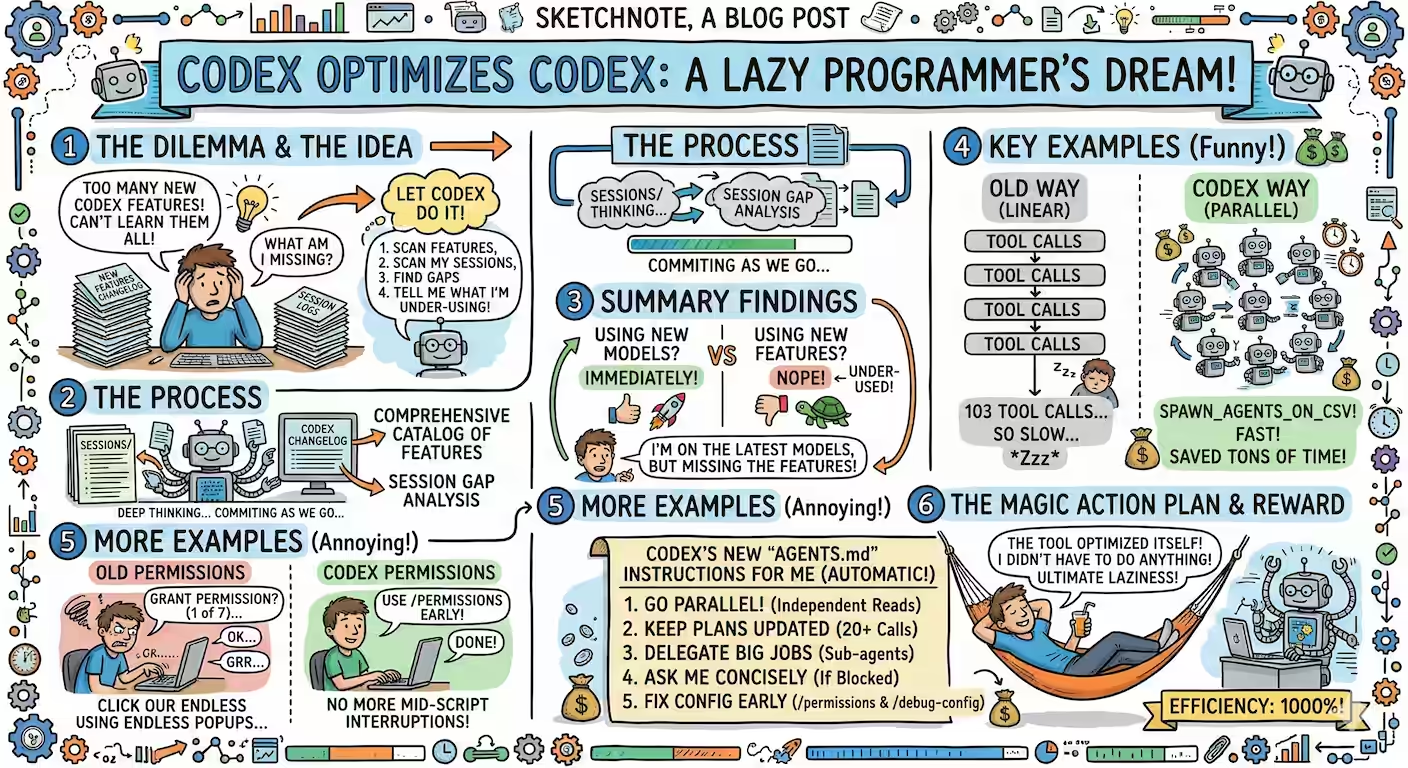
Instead of learning and applying new Codex features, I asked it to analyze my sessions and tell me what I’m under-using. I'd like you to analyze my Codex sessions and help me use Codex better. sessions/ has all my past Codex sessions. Search online for the OpenAI Codex release notes for the latest features Codex has introduced and read them - from whatever source you find them. Then, create a comprehensive catalog of Codex features. Then, analyze my sessions and see which feature I could have used but didn't and make a comprehensive list. Then summarize which features I should be using more, how, what the benefits are, and with examples from my sessions. Document these in one or more Markdown files in this directory. Write scripts as required. Commit as you go. It did a thorough job of listing all the new features and analyzing my gaps. ...

Organizing PDF receipts

One of my goals this year is to “Automate finance + tax”. Today, I took a baby step by organizing my expenses. This is my current process: STEP 1: Download PDF receipts (from OpenAI, Anthropic, Google, and other cloud/AI services) STEP 2: Organize them, so I know which receipt to upload against which expense STEP 3: Submit on SAP Concur. All steps are manual as of now. I automated STEP 2: Organize them. ...

Migrating TDS from Docsify to Hugo

This morning, I migrated my Tools in Data Science course page from Docsify to Hugo using Codex. Why? Because Docsify was great for a single term. For multiple terms, archives became complex. I still could have made it work, but it felt like time to move towards a static site generator. I don’t know how Hugo or Go work. I didn’t look at the code. I just gave Codex instructions and it did the rest. This gives me a bit more confidence that educators can start creating their own course sites without needing coding or platforms. Soon, they might not be stuck to LMSs either - they can build their own. ...

The Jamnagar Chokepoint - Data Story

Vivek published an Indian commodity export/import dataset on 31 Dec 2025. Codex and Claude increased their rate limits for the holiday season, so I had: Codex analyze the data (OpenAI models are a bit more rigorous) and create an ANALYSIS.md file. Claude create a visual story based on the analysis. (Claude narrates and visualizes better). Here is the data story. Here are the prompts used. Analyze I downloaded export-import.parquet from https://github.com/Vonter/india-export-import which has data sourced from the Indian [Foreign Trade Data Dissemination Portal](https://ftddp.dgciskol.gov.in/dgcis/principalcommditysearch.html) Each row in the dataset represents a trade entry for a single commodity, country, port, year, month, and type (import or export). - `Commodity` string: Name of the commodity - `Country` string: Name of the foreign country - `Port` string: Name of the port in India - `Year` int32: Year for the import/export activity - `Month` int32: Month for the import/export activity - `Type` category: Type of trade (Import or Export) - `Quantity` int64: Quantity of the commodity - `Unit` string: Unit for the quantity - `INR Value` int64: Value of the commodity in INR - `USD Value` int64: Value of the commodity in USD Analyze data like an investigative journalist hunting for stories that make smart readers lean forward and say "wait, really?" - Understand the Data: Identify dimensions & measures, types, granularity, ranges, completeness, distribution, trends. Map extractable features, derived metrics, and what sophisticated analyses might serve the story (statistical, geospatial, network, NLP, time series, cohort analysis, etc.). - Define What Matters: List audiences and their key questions. What problems matter? What's actually actionable? What would contradict conventional wisdom or reveal hidden patterns? - Hunt for Signal: Analyze extreme/unexpected distributions, breaks in patterns, surprising correlations. Look for stories that either confirm something suspected but never proven, or overturn something everyone assumes is true. Connect dots that seem unrelated at first glance. - Segment & Discover: Cluster/classify/segment to find unusual, extreme, high-variance groups. Where are the hidden populations? What patterns emerge when you slice the data differently? - Find Leverage Points: Hypothesize small changes yielding big effects. Look for underutilization, phase transitions, tipping points. What actions would move the needle? - Verify & Stress-Test: - **Cross-check externally**: Find evidence from the outside world that supports, refines, or contradicts your findings - **Test robustness**: Alternative model specs, thresholds, sub-samples, placebo tests - **Check for errors/bias**: Examine provenance, definitions, methodology; control for confounders, base rates, uncertainty (The Data Detective lens) - **Check for fallacies**: Correlation vs. causation, selection/survivorship Bias (what is missing?), incentives & Goodhart’s Law (is the metric gamed?), Simpson's paradox (segmentation flips trend), Occam’s Razor (simpler is more likely), inversion (try to disprove) regression to mean (extreme values naturally revert), second-order effects (beyond immediate impact), ... - **Consider limitations**: Data coverage, biases, ambiguities, and what cannot be concluded - Prioritize & Package: Select insights that are: - **High-impact** (not incremental) - meaningful effect sizes vs. base rates - **Actionable** (not impractical) - specific, implementable - **Surprising** (not obvious) - challenges assumptions, reveals hidden patterns - **Defensible** (statistically sound) - robust under scrutiny Save your findings in ANALYSIS.md with supporting datasets and code. This will be taken up by another coding agent to create reports, data stories, visualizations, dashboards, presentations, articles, blog posts, etc. Ensure that ANALYSIS.md is documented well enough so that all assets are clear, the approach, intent and implications are understandable. Visualize I downloaded export-import.parquet from https://github.com/Vonter/india-export-import which has data sourced from the Indian [Foreign Trade Data Dissemination Portal](https://ftddp.dgciskol.gov.in/dgcis/principalcommditysearch.html) Each row in the dataset represents a trade entry for a single commodity, country, port, year, month, and type (import or export). - `Commodity` string: Name of the commodity - `Country` string: Name of the foreign country - `Port` string: Name of the port in India - `Year` int32: Year for the import/export activity - `Month` int32: Month for the import/export activity - `Type` category: Type of trade (Import or Export) - `Quantity` int64: Quantity of the commodity - `Unit` string: Unit for the quantity - `INR Value` int64: Value of the commodity in INR - `USD Value` int64: Value of the commodity in USD Then I had Codex analyze it. The analysis is in ANALYSIS.md. Find the most intesting insights from ANALYSIS.md and create a data story with supporting visualizations. Write as a **Narrative-driven Data Story**. Write like Malcolm Gladwell. Think like a detective who must defend findings under scrutiny. - **Compelling hook**: Start with a human angle, tension, or mystery that draws readers in - **Story arc**: Build the narrative through discovery, revealing insights progressively - **Integrated visualizations**: Beautiful, interactive charts/maps that are revelatory and advance the story (not decorative) - **Concrete examples**: Make abstract patterns tangible through specific cases - **Evidence woven in**: Data points, statistics, and supporting details flow naturally within the prose - **"Wait, really?" moments**: Position surprising findings for maximum impact - **So what?**: Clear implications and actions embedded in the narrative - **Honest caveats**: Acknowledge limitations without undermining the story Visualize like The New York Times Interactives. Ensure that all visualizations interactive and provide revelatory insights as well as some kind of delightful experience. Follow the typography, color & theme, backgrounds, interaction patterns, and animation principles of The Verge's frontends. Generate a single page index.html + script.js.

2025 7

Things I Learned - 02 Nov 2025

This week, I learned: TVMaze API is an API for TV shows, episodes, cast, crew, etc. Useful for TV-related apps as well as learning APIs. Awesome Skills is a curated list of prompts and skills for AI coding agents. ⭐ nokode is a API server that has no code: just LLMs responding. Interestingly, it is compliant. Just expensive, slow, forgetful and unreliable compared to code. All four are improving with time, indicating that coding may be transitional. Notes from Vanya Seth’s keynote at OSAI HYD Superpowers of Gen AI to keep in mind when exploring AI coding agent use cases: Translating. Requirements to code, code to code, language to queries, standard to standard. Finding info just-in-time (in context). How does this work? What’s this error? What tools are permitted in my org? Who knows what? E.g. Atlassian Rovo queries across JIRA, Confluence, etc. Brainstorming and ideation. Product ideation. Requirements. Testing gaps. Architecture review. Exploratory / scenario testing. Summarizing and clustering. Change logs, incident management, research data, docs summary. Challenges in using AI coding agents: Adoption imbalance. Only certain roles are amplified by AI. Coding, QA, more than planning, maintenance, AI ops, etc. What’s the impact of this? ⭐ Goldratt’s ToC implies that backlogs need to fill faster. Downstream becomes a bottleneck. Technical debt piles up. ACTION: Use AI across entire value chain, from research to maintenance. Locality. enhances roles (nodes), not relationships (links). They optimize local work, not global flow. Workflow tools are missing. Coordination overhead. Context Fragmentation. Translation problems. ⭐ Expand productive roles to cover neighboring tasks. Productive developers shift left and build backlogs; shift right to reduce code review, maintenance tasks. E.g. Move maintenance/production activities into development. Security, performance, monitoring, observability, cost, infrastructure. We spend time on IDE, CI/CD, Jira, Confluence, Prod observability tools. A typical Agent Development Platform (ADP) covers evals, guardrails, workflow builder, agent builder, observability, prompt management, AI gateway (LiteLLM), MCP servers, model fine-tuning, model serving, model repository, vector stores We need ADP Agents covering delivery risk, continuous security, prod issues RCA, observability, performance, accessibility, product research, infra optiimzation, test data generation, anomaly detection, release management ACTION: Share ADP photo with Patrick. ACTION: ⭐ Centralize skills (“knowledge packs”) and MCPs and observe which gets used most. Allow people to use more. Lethal Trifecta. There’s growing demand for higher productivity with AI code assistants. But the lethal trifecta makes them an attack vector. It has access to sensitive information, exfiltrate data, and read and follow unsafe instructions. Can lead to supply chain poisoning attacks. Regulated industries cannot adopt. Technical debt growth. More productivity leads to poor code quality which will slow down future work. See Software Engineering Excellence 2025 AI induced complacency. Sunk-cost fallacy on AI-generated code hurts. ACTION: Evaluate code quality continuously to reduce technical debt. Double-down on good engineering practices. Compliance. Model residency. Self-hosting is required. Data observability gaps. Data privacy, audit trails, etc. are concerns. Token economics. $20/day happens in Thoughtworks. Token cost is subsidized. Rogue AI usage. Use of dis-allowed tools; shadow IT. ROI justification. Hard to quantify productivity gains. Adoption. AI Literacy. Tap into organizational knowledge Champions & communities of practice to support cross-pollination. Use-case driven adoption. Teams identify based on AI superpowers. AI playbook. Share what worked, what didn’t work. AI automation is likely less if a high portion of work Has legal liability (e.g. pharmacist/judge vs shop attendant/lawyer) Is subjective (e.g. perfumer/auction appraiser vs lab chemist/insurance appraiser) Needs rapid contextual decisions (e.g. detective/fireman/ER vs parking enforcer) Via ChatGPT, Claude parse-sse from Sindre Sorhus is a more standards-compliant, more likely-to-be-maintained alternative to my async-sse package. Which is better: Comment A: 1 upvote, 0 downvotes (100% positive) or Comment B: 99 upvotes, 1 downvote (99% positive)? Use Wilson’s Lower Bound which measures “What % positive am I 95% confident of?” Claude Using this, we can measure metrics for tweets, like below. ChatGPT Popularity = (5 _ WLB(reposts / views) + 2 _ WLB(likes / views)) * Decay(half-life of 72 h) Memorability = (5 _ WLB(bookmarks / views) + 4 _ WLB(replies / views)) * Decay(half-life of 36 hours) A nice visual “benchmark” of text-to-image and image editing models. Seadream 4, Gemini 2.5 Flash, and Qwen Image Edit lead. This includes examples like straightening te Tower of Pisa - which only Flux.1 and Seadream 4 do well on; or removing only the brown M&Ms - which only Qwen Image Edit manages to. Arch is a pure LLM router. It supports multiple LLMs, flexible routing and observability but not auth. From Codex docs Add custom prompts in ~/.codex/prompts/xyz.md and launch as /prompts:xyz. Optional: description: and argument-hint: in YAML front-matter. For example, create prompts to refactor, rewrite in a developer’s style, document AGENTS.md, identify re-usable code, etc. AGENTS.override.md overrides parent directory AGENTS.md. AGENTS.md appends to parent AGENTS.md. Fallback names are allowed. codex exec supports streaming JSON codex exec accepts a CODEX_API_KEY= environment variable. codex uses an OPENAI_API_KEY. You can configure which environment variables are passed to the shell Codex reads 32KB from AGENTS.md by default Things that I currently follow and don’t follow from Peter Steinberger’s excellent Just Talk To It: Prefer Codex > Claude Code. Ask for options before executing Generate & review specs collaboratively You don’t need git worktrees Prefer subscriptions over API to reduce cost Store docs with code Give examples Use voice input Use Codex Web as a mobile inbox for ideas Prefer CLI over agentic platforms Prefer CLI tools over MCP Avoid ALL-CAPS for Codex. It follows instructions well Avoid sub-agents, RAG, etc. Iterate UI live. Watch changes Use 3-8 agents in parallel on a single repo. Make small, atomic commit checkpoints. Commit only what the agent touches Add ast-grep as a pre-commit hook to block rule violations. Keep custom prompts minimal (commit, automerge, massageprs, review, …). Just “commit” reduces context Cancel long tasks and ask what’s happening Prefer Medium over High reasoning. It decides level of thinking Share screenshots Use tmux to run CLIs persistently Schedule refactor time (20%). Use jscpd, knip, oxlint, … Don’t reset context. Cold start wastes time + tokens Write tests in the same context. Yields better tests, reveals bugs. Prototype in a separate folder / PR Queue continue messages** before stepping away Ask it to “Preserve intent and add comments at tricky spots”. Future you needs the WHY On hard problems, add “take your time”, “be comprehensive”, “read all related code”, “form hypotheses”, etc. Maintain an evolving AGENTS.md with product notes, naming, API patterns, test policy, ast-grep rules, etc. Delete stale guidelines Fascinating implications from Quantifying Human-AI Synergy ChatGPT Models vary in ability to uplift humans. Don’t just use standalone model benchmarks. People vary in ability to work with AI. Don’t just measure solo skills. Reward AI collaboration ability (delegation, prompting, verification, revision, …) Train models to ask for missing Theory-of-Mind cues: goal, beliefs, constraints, audience, success test Train people by asking them to predict what the model will get right/wrong, and validate Design UI and models for synergy. UI: Surface/solicit assumptions, intent, uncertainty, constraints. Model: Infer & adapt to evolving user state. OpenRouter image generation now includes GPT-5 Image Mini. An image costs about 1 cent. Here’s the code: curl 'https://openrouter.ai/api/v1/chat/completions' \ -H "Authorization: Bearer $OPENROUTER_API_KEY" \ -H "Content-Type: application/json" \ -d '{ model: "openai/gpt-5-image-mini", messages: [{ role: "user", content: "Draw a cat" }], modalities: ["image"], image_config: { "aspect_ratio": "16:9" } }' | jq -r '.choices[0].message.images[0].image_url.url' | cut -c23- | base64 -d > cat.png
Vibe-Coding for Interesting Data Stories

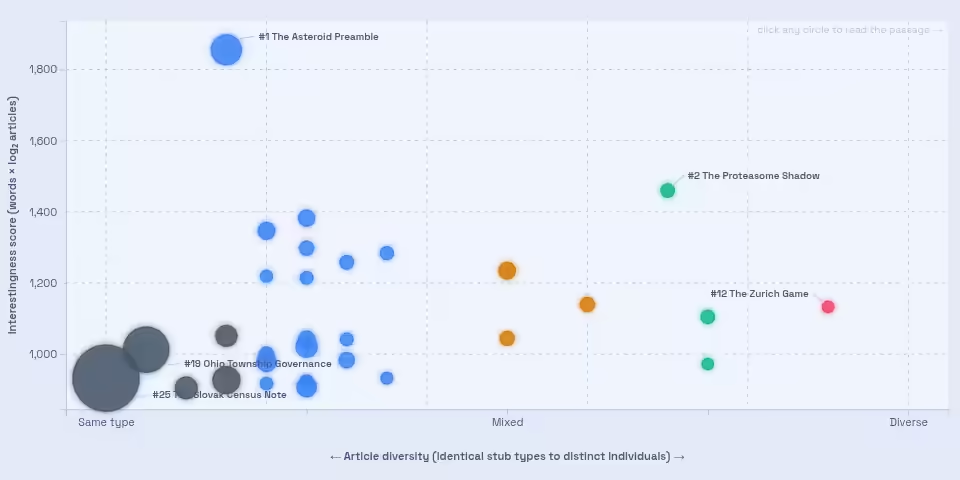
Last weekend, I fed Codex my browser history and said “explore.” It found a pattern I call rabbit holes – three ways we browse: Linear spiral - one page > next page > next. E.g. filing income tax, clicking “next” on the PyCon schedule. Hub & spoke - hub > open tabs > back to hub. E.g. exploring DHH’s Ubuntu setup, checking Firebase config. Wide survey - source > many, many pages. E.g. clearing inbox, scanning news. Then Claude Code built this lovely data story. ...

Vibe-Scraping: Write outcomes, not scrapers

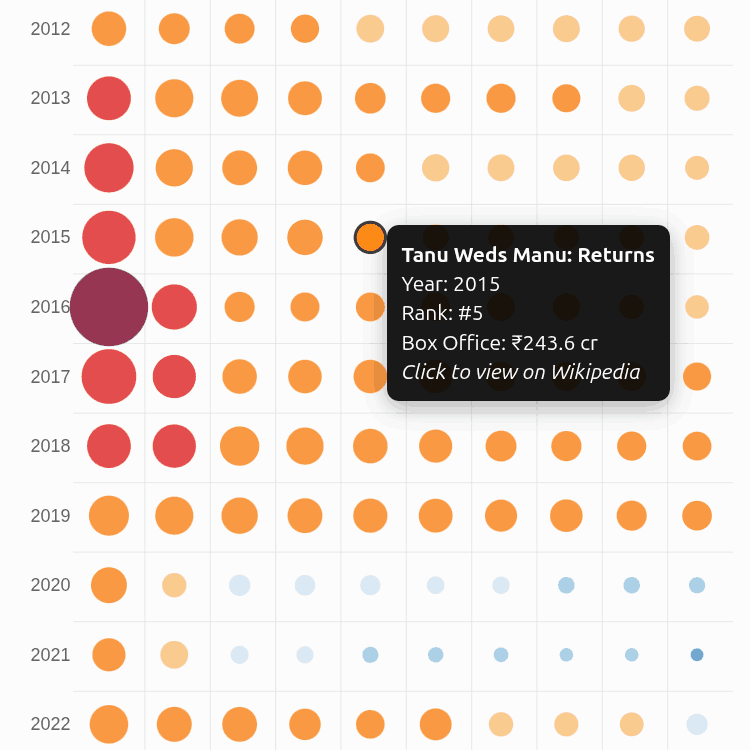
There hasn’t been a box-office explosion like Dangal in the history of Bollywood. CPI inflation-adjusted to 2024, it is the only film in the ₹3,000 Cr club. 3 Idiots (2009) is the first member of the ₹1,000 Cr club (2024-inflation-adjusted). The hot streak was 2013-2017: each year, a film crossed that bar: Dhoom 3, PK, Bajrangi Bhaijaan, Dangal, Secret Superstar. Since then, we never saw such a release except in 2023 (Jawan, Pathan). ...

GPT-5 (Codex) follows instructions exactly as given. Usually a good thing, but sometimes, it this is what happens. AGENTS.md: ALWAYS WRITE TESTS before coding. Codex: Let me begin with the tests. (Spends 5 minutes writing tests.) Anand: Stop! This is a proof of concept. We don’t need tests! AGENTS.md: Write tests before coding. Drop tests for proof-of-concepts. Codex: (Proceeds to delete all existing tests.) Anand: STOP! We need those tests! ...

Meta AI Coding: Using AI to Prompt AI

I’m “meta AI coding” – using an AI code editor to create the prompt for an AI code editor. Why? Time. The task is complex. If the LLM (or I) mess up, I don’t want re-work. Review time is a bottleneck. Cost. Codex is free on my $20 OpenAI plan. Claude Code is ~$1 per chat, so I want value. Learning. I want to see what a good prompt looks like. So, I wrote a rough prompt in prompts.md, told Codex: ...

Things I Learned - 27 Jul 2025

This week, I learned: Here are some tech community builders in India. ChatGPT Atul Chitnis (Bengaluru) – FOSS.IN and Linux Bangalore Dr. Nagarjuna G. (Mumbai) – FSF India and ILUG Bombay Rushabh Mehta (Mumbai) – FOSS United & ERPNext Community Kiran Jonnalagadda & Zainab Bawa (Bengaluru) – HasGeek Tech Conferences Kenneth Gonsalves (Nilgiris/Tamil Nadu) – Indian Python Community (deceased) Thejesh GN (Bengaluru) – DataMeet Open Data Community Varun Aggarwal (Delhi) – ML-India (Machine Learning Forum) Prashant Sahu (Pune) – Pune AI Meetup Akshay Dashrath (Bengaluru) – BlrDroid Android Group Vikrant Singh (Bangalore) – ReactJS Sankarshan Mukhopadhyay – Mozilla India and Wikimedia tech outreach Neependra Khare (Bengaluru) – Docker/Kubernetes Meetup Atul Jha (Bengaluru/Hyderabad) – OpenStack & CNCF Communities Aseem Jakhar & Ajit Hatti (Delhi/Pune) – null Open Security Community Rohit Srivastwa (Pune) – ClubHack and Hackerspaces Anubha Maneshwar (Nagpur) – GirlScript Developer Network Digital Public Infrastructure initiatives in India scale if there’s a clear use case and centralized orchestration. Prof R Srinivasan The distance between the end of the thumb and little finger, when fullet stretched, is ~9 inches. Between the thumb and pointer, when at a right angle, is ~6 inches. I checked this today - and it’s right. A useful rule of thumb for measurement - literally. Vasuki, ~1985 GitHub Sponsors Explore shows you which developers code most of your dependencies. You can sponsor them. I sponsored isaacs who maintains node-tap and sindresorhus who maintains several NodeJS packages for $50/month each. markmap looks like a promising JS-based interactive mindmap from Markdown. More interactive than Mermaid Mindmap. mind-elixir is another option that lets you edit mindmaps and serialize in its own format jsmind is yet another but docs are in Chinese elkjs seems a good option for laying out nodes in an architecture-style flow diagram ⭐ O3 seems a better data scientist than I am. Based on my Google Searches, I have 3 persona: developer, AI-builder, and India/Singapore geo-culturist. A great example of an analysis from O3 that’s better than anything I could have come up with. ChatGPT ⭐ Fast review of AI be a powerful skill and enabler. I built an Image Editing tool with Codex in ~4 hours, with 11 prompts taking 3.5 - 7.5 minutes each. 3 hours human review, 1 hour LLM coding. I’m 3X slower at reviews while AI will keep improving. ChatGPT: Faster LLM review techniques #ai-coding Auditize: citations, rationale, output screens, diffs, test results, risks, unknowns Auto validate. Evals, tests Prioritize. High z-values, big-useful-surprising areas At the VizChitra Birds of a Feature session, here’s what people said AI enables: Complementary skills enable a team of 1. Non-coders can code. Non-domain people get insights from data Solves starting trouble. It offers a first draft Generation. New ideas (reduces blind spots), scenarios, non-existent people, new data, new persona for surveys Hyper-personalization. Parts of YouTube relevant for THIS asset manager. Implication of data for me Automated scaling. Generate 1,000 images. Evaluate 1,000 assignments Saves time: debugging, research, validation, documentation, copywriting New ways of working. Loading event schedules into my calendar Qwen-Code is a fork of Gemini CLI and uses qwen3-coder – a model that can also be used with Claude Code and Cline. The model is not anywhere near as good as Claude 4 Sonnet. The app is costlier than using Claude Code directly. #ai-coding The LLM industry seems to have matured quickly. Early adopters who are open to understand the generic capabilities of LLMs through demos are somewhat saturated. The early majority have come in. They aren’t interested in generic capabilities. They’re looking for solutions that solve their specific problem. Soon the late majority will come in asking for existing solutions that have already solved their problem for many others. ChatGPT: Creating demos for majority Claude for Financial Services is an agentic version of Claude available on AWS & Google marketplaces tuned for financial services analysis. Video catbox.moe is a file hosting service that you can upload a file to without any API key. It’s an alternative to 0x0.st. Both can be used for images. Catbox retains files indefinitely and openly publishes costs - might last longer. 0x0 deletes files between 1-12 months based on size. Agents face 3 problems: compounding errors, quadratic costs, and poorly designed tools. Start with small scope & strong reviews while you solve these problems. Betting Against Agents Leadership and vision will matter more. LLMs iterate fast. They can think for longer. So tasks where people need to work longer independently than LLMs can are what humans will be needed for. That requires understanding the objective. So leadership and specifically vision transfer will become more valuable. You need to be able to tell people what to do well enough that they can work independently for weeks. Having LLMs go through engineering drawings, floor plans, etc. and understand them, find problems, etc. is an emerging use case. People are using Veo 3 to convert a floor plan into a 3D walk through too. Digital adoption is slow partly because of a skill gap. “Old-timers” are slow to let go of traditional approaches. Video recordings are used in manufacturing to evaluate quality (e.g. wafer inspection, assembly inspection, component presence) using AI. An interesting by-product of this data is that they can also measure productivity, task time. “Common sense is a specialization”. That’s something I said accidentally when seeing that some schools/colleges tend to produce more broad, sensible thinkers (e.g. Naval College @ Goa) while others produce more narrow-thinking specialists (e.g. engineering colleges). Three groups control the financial economy. To sell sustainability services, you need to have sold to one of them. via Sundeep Banks, who will sell a loan against anything they can insure, and look to insurers for long-term thought leadership. Insurers, who will insure anything they can re-insure, and re-insurers, who look at real-estate trends as a stable long-term asset REITs who own the majority of the world’s real-estate We could think of a copilot as an (agentic) LLM chat interface for an artifact. E.g. Code pilot (Claude Code. Cursor.). Data analysis copilot (Google Colab, sort-of. ChatGPT). That allows us to imagine tools that will create/edit artifacts. Here are some I’ve encountered as a demand. Documents. E.g. Docsearch, GPTs, Microsoft Copilot, Gemini Slides. E.g. Microsoft Copilot, Gemini Sheets. E.g. Microsoft Copilot, Gemini Code. E.g. Cursor, Claude Code Database. Create DB schema, ER diagrams, synthetic data, ingestion scripts, etc. Data (analysis). E.g. Datachat, Google Colab, Marimo Posters. E.g. Postgen Shell. E.g. Warp Topic modeling. E.g. classify Surveys. E.g. Personagen APIs. E.g. apiagent Drug regulatory submissions. Contracts (risk). Manufacturing SOPs. Curriculum. Data quality. Support tickets. Dashboards. IaaC / DevOps. Video campaigns. Resumes. Patents. CLI optimization for LLMs will likely emerge. More CLIs (and wrappers / hooks in the shell) will improve output and error contexts for LLMs, e.g. printing current directory, caching slow outputs, suggesting alternate commands, etc. Ref Frequent commits with linting & building seems like a good AI coding strategy, especially for Claude Code. Ref #ai-coding To keep Claude Code in line on my project, I’ve relied heavily on linters, build scripts, formatters, and git commit hooks. It’s pretty easy to get Claude Code to commit often by including it in your CLAUDE.md, but it often likes to ignore other commands like “make sure the build doesn’t fail” and “fix any failing tests”. All my projects have a .git/hooks/pre-commit script that enforces project standards. The hook works really well to keep things in line. ...

I use Codex and Jules to code while I walk. I’ve merged several PRs without careful review. This added technical debt. This weekend, I spent four hours fixing the AI generated tests and code. What mistakes did it make? Inconsistency. It flips between execCommand("copy") and clipboard.writeText(). It wavers on timeouts (50 ms vs 100 ms). It doesn’t always run/fix test cases. Missed edge cases. I switched <div> to <form>. My earlier code didn’t have a type="button", so clicks reloaded the page. It missed that. It also left scripts as plain <script> instead of <script type="module"> which was required. ...