Error logging with Google Analytics

A quick note: I blogged earlier about Javascript error logging, saying that you can wrap every function in your code (automatically) in a try{} catch{} block, and log the error message in the catch{} block.

I used to write the error message to a Perl script. But now I use Google’s event tracking.

var s = [];
for (var i in err) { s.push(i + '=' + err[i]); }
s = s.join(' ').substr(0,500)
pageTracker._trackEvent("Error", function_name, s);

The good part is that it makes error monitoring a whole lot easier. Within a day of implementing this, I managed to get a couple of errors fixed that had been pending for months.

15 years of Dilbert searchable

The Dilbert search index now carries 15 years worth of Dilbert comics — over 5,500 strips typed out. This is mainly due to the contributions of BFMartin (over 6 years worth of strips) and Paul Dorman (over 3 years worth of strips), myself (over 3 years worth of strips) and a long tail of contributors.

You can search the strips here. While you can find strips as far back as 1989, you won’t see the images earlier than 2002 because geek.nl (whose images I’m shamelessly hotlinking without permission) only holds images that far back. But once you know the date of the comic (say 1991-02-03), you can visit the Dilbert official site at dilbert.com/1991-02-03/ and see the strip.

Dilbert started around 20 years ago. So we’ve covered 75% of all the strips, and this is in just 8 months after starting this collaborative effort. A couple of lessons I learnt from this:

  1. Crowd sourcing beats going solo if you’re building content. It’s a no-brainer. There will always be only one or two people more passionate about something than you.
  2. The long tail is not very big. There will only be one or two people more passionate than something about you. Don’t expect the long tail contribution to be the significant. The value comes from being able to attract “the big fish”.

Short notes

I’m quite busy on a project right now, and don’t get time to write long articles. So for a while, I’m going to stick to short notes on interesting stuff.

  1. Peter Bregman has a very interesting piece on Why You Should Encourage Weakness. It boils down to a choice: do you focus on on improving strengths or minimising weaknesses? Conventional performance evaluations focus on the latter. I very strongly support Bregman’s view on this. The weakness isn’t why you hired the person! Unless it’s killing the organisation, just leave them to focus on their strengths.
  2. Google Analytics has a fairly interesting API that I hadn’t explored until recently. Picked up Advanced Web Metrics with Google Analytics and learnt that you can track outbound clicks, page load times, Javascript events and error logs, almost anything at all using Google Analytics. You can also mirror the logging on your local server using pageTracker._setLocalRemoteServerMode()
  3. The whole concept of a Sandbox environment seems to be picking up within Google. There’s a Checkout sandbox, an AJAX API playground, an AdWords sandbox, an AdSense API sandbox, the Mapstraction API sandbox, even an event called Developer Sandbox. (After saying Sandbox 6 times, I feel a bit like Hobbes.)

 

Organisational amnesia

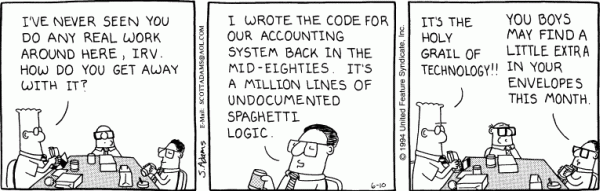
It’s amazing how much of a dependency there is on individuals writing IT systems. Reminds me of that Dilbert strip:

19940610

A few weeks ago, I was trying to figure out in what happens when there are multiple promotions. (Our client is a retailer.) I mean, if there’s a phone that costs £100 and there are 2 promotions: 10% off on phones and £10 off on phones. Do you apply the 10% off first and pay £80 or the £10 off and pay £81?

Funnily enough, the organisational answer is, “I don’t know.” The person who determined the logic is no longer with the firm. The person who wrote the code was a contractor and moved on to another project. The vendor hadn’t gotten around to documenting the code. Sure, the code’s there, and you just had to read it to figure out what it does. But no human knew what it was supposed to do.

Last week, there was a decision to rewrite some code that was 10 years old. A colleague who wasn’t quite involved in this work said, “I’m going to have to set aside 2-3 weeks for this. I wrote this stuff when I was a developer. The docs have vanished. The business owners have vanished. I’m the only one who has any clue on what it’s supposed to do.”

This week, we were trying to figure out how their store locator system works. After fiddling around with Fiddler, and seeing that it used Microsoft Virtual Earth, I was able to figure out that it identified stores near a location using a simple JSON API. But can we get the documentation around that? Nope. Tough luck. Nobody knows how it works any longer.

Personally, I don’t think this is unusual. We forget. Companies forget. But it’s usually good if what we forget is derivable. That’s how I got through my high-school physics exams: not by remembering stuff, but by being able to derive the stuff from a few principles.

Organisations can do the same. But to be able to do that, you need to have commonly understood principles. As Fred Brooks put it in The Mythical Man Month,

I contend that conceptual integrity is the most important consideration in system design. It is better to have a system omit certain anomalous features and improvements, but to reflect one set of design ideas, than to have one that contains many good but independent and uncoordinated ideas.

One of the biggest enemies of conceptual integrity is growth. Too many people too soon, and the important decisions are taken by people who’ve never had a long chat about things. There’s another reason not to grow too fast.