Recruiting smart people

Recently, I have ended up giving bits of advice to people recruiting at start-ups, and a few patterns have emerged that are worth sharing.

Before I go ahead, I should warn you that I have no qualifications whatsoever. (All consulting advice should come with this caveat, perhaps!) You might be better off reading Joel Spolsky’s Smart and Get Things Done (read). I haven’t read it myself, but from what little I see of it, the thoughts seem similar.

The key is to realise that smart people are probably 10 times as productive. OK, that may be wrong. It probably originated with Fred Brooks, and has been debated to death. But it seems fairly well accepted that the best people contribute more than they are better paid. (The best guy is probably paid twice the average, but is worth more than twice the average guy.)

This isn’t because they do more work. It’s because they solve harder problems. You can get two people to do two people’s work. You can’t solve a problem twice as hard even with twenty people.

For a startup, the problem is acute. You don’t have the luxury of being able to manage a large number of people.

Since smart people typically work for a lot less than they’re probably worth, it’s a bargain to hire smart people. You pay them twice as much, and they’ll solve problems twenty others couldn’t solve.

The problem boils down to finding smart people and getting them on board.

Finding smart people

You need to go after the smart people. They won’t come to you. Many reasons. You’re not big enough. There aren’t that many of them. They’re not in the market that much (no one lets go of them anyway).

So that just demolishes the traditional recruitment model straight away. You don’t advertise for people and filter their resumes. You find the people you want and go after them.

The good thing is, smart people cluster. They tend to know other smart people, meet up with other smart people, read the same things as other smart people, etc. That gives some useful starting points.

Matt Biddulph talks about Algorithmic recruitment with Github. The premise is that smart programmers are at the centre of the social networks in their respective areas. Just go after them. I advised a friend similarly: to look for the network (or at least the smart people) that hang out on Stack Overflow for a given topic. Last year, when I was looking for a Django developer, I scoured the Infosys internal blogs for similar networks. (Found only a few, but it sure introduced me to a lot of really smart people that I didn’t know existed!)

Conferences are another place to look for them. I tend to periodically check out Upcoming and Meetup to see who’s taking part in what, go over, meet them, and see what they do. I find it a great way of figuring out who’re the experts in a field. (I once met one of the guys who wrote TiddlyWiki, and it was immediately obvious that he was in a different league from the others that day at the Javascript Meetup.)

You can go a step further. Since smart people cluster, they form networks, and control of that network is power. So why not organise those conferences? A lot of these smart people just need a place to hang out and learn from each other. I know the Javascript Meetup was struggling to find a place to meet. Pubs don’t give you the quiet atmosphere needed to learn from each other, and it’s certainly impossible to have a talk there. The folks at Hackspace have done this really well, renting a place and equipment for people to tinker with electronics.

That’s what smart people want, mostly: a nice quiet place, good company, and perhaps pizza. Skills Matter does this beautifully. They organise free workshops every now and then. The list of people that attend these is invaluable.

Getting them on board

Once you’ve spotted a smart person, what do you offer them?

Remember – they’re probably 10 times as productive. Money is quite likely to be worth offering. If that works, great. But if you’re a startup, you probably don’t have the money. You probably could offer a stake in the firm. That might work too.

But, to quote Dan Pink: “One of the most robust findings of social science is that incentives dull the mind and hamper creativity. Yet, businesses ignore it.” Some people aren’t motivated by money. You might get better results if you didn’t pay money than if you did. (Read this story on motivation by Peter Bregman.)

Suppose you said, “I have this problem… I’ve no idea how to solve it. Would you be able to help me?” Most smart people would probably help you. For free. The feel good feeling is worth more than the transaction cost of extracting payment from you.

Or you might be championing a worthy cause – anywhere from world hunger, rural poverty or cure for cancer down to organising a scout camp. The thing about this is they are intrinsically attractive. You probably just need to open up and say “This is what I’m doing, can you help?”

The flip side of it is loss of control. Jonty told me about how Hackspace London was run: “it’s as loosely organised as possible without falling apart”. You don’t manage these people like traditional organisations. You manage them like a community of volunteers. Like parents at a school day function. Like family at a wedding. You don’t pay them. You don’t order them around either.

Part of that is the flexibility of being a startup. You can afford that loss of control. Yes, you don’t have the money. No, not everyone’s working for money. (The planet as a whole is fairly well off. Smart people particularly so.) But you might offer something interesting. Just as long as you’re willing to let go of some control in your mind…

Open source in corporates

Last month, my first application went live.

I’ve been writing code for 20 years. Not one line of my code has been officially deployed in a corporate. (Loser…)

It’s a happy feeling. Someone defined happiness as the intersection of pleasure and meaning. Writing code is pleasurable. Others using it is meaningful.

But this post isn’t quite about that. It’s about the hoops I’ve had to jump through to make this happen.

I’ve been living in a nightmare since March 2009. That was when I decided that I’d try and get corporates to use open source.

March 2009
It began with a pitch to a VC firm. They were looking to build a content management system (CMS). Normally we’d pull together slides that say we’ll deliver the moon. This time, we put together demo based on WordPress’ CMS plugins.

The meeting went fabulously well. We said, “Here’s a demo we’ve built for you. Do you like it?” The business lead (Stuart) was drooling and declared that that’s exactly what they wanted. The IT lead (another Stuart) was happy too, but warned the business users: “Just remember: this isn’t how we do development, so don’t get your hopes up that we can deliver stuff like this :-)

Time to make my point. I asked, “What’s your policy on open source software?”

The business lead went quiet. “I don’t know,” he finally said. Fair enough.

I turned to the IT lead. “Well, we don’t use it as a matter of policy… there are security concerns…” he said.

“Which web server do you use?”

”Oh, OK. I see what you mean. We use Apache. So on a case to case basis, we have exceptions. But generally we have security concerns.“

”Why? Do you believe open source software is more insecure than commercial software?“

He thought about it for a while. “Well… maybe. I don’t know.” We debated this a bit. Then we found the real issue: “It’s just that we don’t have control over the process. We don’t know enough about it to decide.”

A couple of weeks later, I tried pitching to a newspaper company. This time, it was our sales team that raised the same question. “But… isn’t open source insecure?”

I didn’t even bother pitching any open source stuff to them. But I’d learnt my lessons:

1. Demo the application. Don’t talk about it.
2. Show it to the business first, and then tackle IT.

Aside: June 2009

In June, I got another chance. I was building the website for a large retailer. The very first thing I did was ask to see the Javascript. Total mess, and filled with browser-incompatible DOM requests. So I went over to their web development team.

“Look, why don’t you guys use a Javascript library? It’ll get you cross browser compatibility and compact maintainable code at the same time.”

And, to their credit, they said, “Sure. Which library?”

I showed them this comparison of jQuery (blue), dojo, scriptaculous and mootools…

… and we agreed on jQuery. So, if nothing else, I’ve managed to get one open source library into a corporate.

July 2009

I was also looking at payments, and retailer was looking to replace their chargeback application. Since I had a week off, I built a working PCI compliant prototype on Django. This time, I applied the lessons I’d learned, and demo-ed it to the business, who were thrilled. Time to tackle IT.

I started with the architecture team. Matt on the architecture team was the most approachable. So I went over, demo-ed it, and said, “Matt, this took a week to put together. It’s based on some new technologies. Are you game to try these out?”

He was. And quite enthused about it too. So we put together a proposal for the architecture review board, proposing a new technology stack: Django / Python and MySQL. As before, I showed the demo before I talked technology. I had prepared answers to all security related questions upfront (and practically memorised section 3 of the PCI guidelines.) The clincher, though, was the business case. To build it on Java, it would cost ~1,000 person days. On Django, I’d mostly done it in 5. There was no way of justifying 1,000 person days for an application that could save, at best £100,000 a year.

So they said “Go ahead, we’re fine if operations and infrastructure are fine.”

It was time to find a Django developer in Infosys. I hunted for a couple of weeks but none was available. (Only 2 people knew Django in the first place.) So that effort got canned, and we were back to the 1,000 person day solution. (Which got canned too, later.)

But in the process, I’d learned my third lesson.

3. If you’re trying new technologies, plan on delivering it yourself.

October 2009

Another application popped up that looked like a prime candidate for introducing open source. They were using an Excel application to fraud screen orders, and wanted to make a web app out of it.

I followed the same route as before. Demo it. Show it to business first, then IT. Built it myself. I skipped Architecture, since they’d already approved the technology stack, and took it straight to Infrastructure.

“This application uses Apache as the web server, MySQL as the database, and uses PHP and Javascript for the application logic. Could we get a Linux server to host it?”

Our entire conversation lasted 30 seconds. He said, “No. We use Windows servers” (I was fine)

“… and you’ll need to chance Apache to IIS” (fine again)

“… and we don’t support PHP, so it’ll have to be Java or .NET” (I don’t know .NET or Java… but fine)

“… and we don’t support MySQL, it’ll have to be SQL Server” (fine, I guess)

“… and we don’t have DBAs available until January, so you’ll have to wait.” (definitely not good.)

So back to the drawing board on the technology stack. I needed something in Java (I know very little Java, but nothing at all in .NET) and to avoid the DBA headache, it would have to bundle in a database. I first explored key-value stores like CouchDB, Redis, etc. None of them worked on Java. The only one I found that did was Persevere, and it was a JSON data store, which fit perfectly with my plans.

By this time, I’d also learn my my fourth and most important lesson.

4. Don’t try to promote open source. Just deliver the application

I said, “This is a custom-built application that runs on Java. Could we get a Windows server to host it?”

The answer was “Yes”, and we had it the next day.

PS: December 2009

The application’s deployed and running. It has about 10,000 orders fraud screened by now.

And the lessons are well learnt. So when some came over asking if there was any image resizing solution I knew off, I said: “Sure, who’s your business sponsor?” Then I went over and said, “Let me show you this open source application called ImageMagick. It handles aspect ratios correctly, and can crop too. Doesn’t this look professional?” Then I went over to IT and said, “It’s open source, so you can change it. It has Java bindings, so you can integrate it into your environment. It can handle 8 3000×2400 images a second on my puny laptop. It’s used by your competitors. And I can build it for you if you like.”

I might just have my second open source entry into a corporate this year.

Organisational amnesia

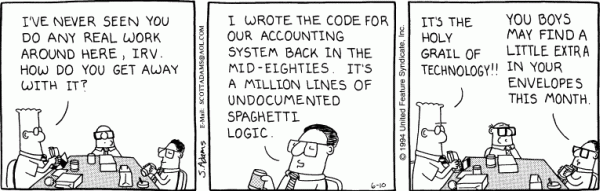
It’s amazing how much of a dependency there is on individuals writing IT systems. Reminds me of that Dilbert strip:

19940610

A few weeks ago, I was trying to figure out in what happens when there are multiple promotions. (Our client is a retailer.) I mean, if there’s a phone that costs £100 and there are 2 promotions: 10% off on phones and £10 off on phones. Do you apply the 10% off first and pay £80 or the £10 off and pay £81?

Funnily enough, the organisational answer is, “I don’t know.” The person who determined the logic is no longer with the firm. The person who wrote the code was a contractor and moved on to another project. The vendor hadn’t gotten around to documenting the code. Sure, the code’s there, and you just had to read it to figure out what it does. But no human knew what it was supposed to do.

Last week, there was a decision to rewrite some code that was 10 years old. A colleague who wasn’t quite involved in this work said, “I’m going to have to set aside 2-3 weeks for this. I wrote this stuff when I was a developer. The docs have vanished. The business owners have vanished. I’m the only one who has any clue on what it’s supposed to do.”

This week, we were trying to figure out how their store locator system works. After fiddling around with Fiddler, and seeing that it used Microsoft Virtual Earth, I was able to figure out that it identified stores near a location using a simple JSON API. But can we get the documentation around that? Nope. Tough luck. Nobody knows how it works any longer.

Personally, I don’t think this is unusual. We forget. Companies forget. But it’s usually good if what we forget is derivable. That’s how I got through my high-school physics exams: not by remembering stuff, but by being able to derive the stuff from a few principles.

Organisations can do the same. But to be able to do that, you need to have commonly understood principles. As Fred Brooks put it in The Mythical Man Month,

I contend that conceptual integrity is the most important consideration in system design. It is better to have a system omit certain anomalous features and improvements, but to reflect one set of design ideas, than to have one that contains many good but independent and uncoordinated ideas.

One of the biggest enemies of conceptual integrity is growth. Too many people too soon, and the important decisions are taken by people who’ve never had a long chat about things. There’s another reason not to grow too fast.

The courage to be honest

Some months ago, I was working with a client who wanted to set up a website with social commerce elements. (That’s Web 2.0 in fancy words.) They only seemed to have a very rough idea of what they wanted, so asked them right at the start of the meeting: "Why do you want social commerce?"

Their answer was interesting, and one that I had not expected. They said, "We want to project the image of an honest an open organisation."

Hmm. Fair enough.

So we went on with the meeting, discussing what they could do with blogs, how commenting would work, and so on. The main thing was to open up the site for the bank’s customers to talk freely.

At some point, one of the client’s team indicated that profanity and abusive comments would need to be filtered out, so moderation becomes important. "We don’t want to become liable for content that is on our site."

Fair point. While discussing that, another chipped in, saying "True. We will also need to monitor negative comments. We don’t want our site to have negative comments about our products."

A brief silence.

Many nods.

And the conversation continued.

I was too stunned to butt in immediately. But after a few minutes, I raised the point about negative comments. "You want to project the image of an honest and open organisation. If you filter out comments that say anything bad about you, how are you going to achieve that?"

They thought for a short while, and someone said: "Yes, the users will probably find out about it."

You can’t project an honest image unless you are honest. That means being honest about the good as well as the bad. Honesty is irrelevant for good news — no one lies about good news. Are you honest when delivering bad news? That requires courage.

This is worrisome. Someone saying "We don’t want negative comments" is a bit of an issue. But also worrying is their reason for why not. I had hoped that it would be "That’s not what an open an honest organisation does". Instead, it was "The users will probably find out about it."

This sort of behaviour stems from insecurity. It’s what keeps us late at work, not want to be the first to leave. It’s what makes us say "Yes" to things we would really rather say "No" to.

I remember a time when we were making slides late in the night. I finished mine quickly, and took printouts for the project leader to review. He word-smithed it on paper, I typed it back in, and took a printout again. (Yeah, he could’ve edited it himself. But…) And when all of that’s done, I’m still waiting, not wanting to "leave the team behind". I’m a team player after all.

It’s like drugs. You want to fit in. Be a team player. If the team’s doing it, you do it too.

These days, I’m the first to leave from work. Sometimes, it’s late when I leave, but I’m always the first to leave. And it hasn’t made any difference. At least not that I can tell.

A lot of the fear is in the mind, frankly.

There also was a time when I couldn’t say "No". When I left BCG, I spoke to a partner during an exit interview about how I wanted to work less hours. He thought the problem was more fundamental.

"Anand, knowing you, you’re the kind of person that will end up working hard no matter where you are. So will the move really make a difference?"

"The difference, James, is that here I’ve set up an expectation of saying ‘Yes’. I’ve gotten into the habit, and I’ve gotten others into the habit. At least in a new place, I’ll have a fresh start and set new expectations."

That’s happened, fortunately. These days, I consistently say ‘No’. With some folks, it’s easy.

"Anand, would you be able to help out with this?"

"No, sorry." (with an "please excuse me" smile on my face.)

Some people still scare me, though. (These are the aggressive Type A personalities that it is my occasional misfortune to come in contact with.) And when it does, I lie.

"Anand, we need this proposal out by Monday. Could you help out over the weekend?"

"Sorry, have plans for the weekend. I’m visiting a cousin at Brighton."

No, I don’t have a cousin at Brighton. I’m just scared to just say, "Sorry". It didn’t matter, though. The fear is real, but it still is only in your mind.

It’s the same with businesses. We’re collectively scared to admit something’s wrong with us, or that we can’t do something. I went for a meeting with a partner recently. The client mistook us for operations consultants. (We’re IT consultants.) So he asked us what operations experience we have. Our response should’ve been "None. We’re IT consultants."

Instead, our response was "Oh, we have several years of experience in the organisation. We’re this, we’re that, we’re great."

I don’t think we’d have been thought less of if we’d said "None". And we were found out in the next meeting anyway.

It’s the same about opening up to negative comments. If somebody makes a negative comment, it’s okay! Not that many people care. Hushing it up makes it worse (like for instance with BA and Virgin recently). Lying about it might work, but only for a while. The real problem with lying not that you might get caught out — it’s that you’ll get into the habit and in the long run, will get caught out.

For me, the best cure for this sort of fear is the firm belief that the world cares a lot less about us than we think. It’s okay to be a loser. No one cares but us. But it’s less okay to be a liar.

Resolving the Prisoners Dilemma

If you’re ever taken a course in Economics, and it discussed Game Theory, you may be familiar with The Prisoner’s Dilemma. Roughly, this is the problem.

Assume you possess copious quantities of some item (money, for example), and wish to obtain some amount of another item (perhaps stamps, groceries, diamonds). You arrange a mutually agreeable trade with the only dealer of that item known to you. You are both satisfied with the amounts you will be giving and getting. For some reason, though, your trade must take place in secret. Each of you agrees to leave a bag at a designated place in the forest, and to pick up the other’s bag at the other’s designated place. Suppose it is clear to both of you that the two of you will never meet or have further dealings with each other again.

Clearly, there is something for each of you to fear: namely, that the other one will leave an empty bag. Obviously, if you both leave full bags, you will both be satisfied; but equally obviously, getting something for nothing is even more satisfying. So you are tempted to leave an empty bag. In fact, you can even reason it through quite rigorously this way: "If the dealer brings a full bag, I’ll be better off having left an empty bag, because I’ll have gotten all that I wanted and given away nothing. If the dealer brings an empty bag, I’ll be better off having left an empty bag, because I’ll not have been cheated I’ll have gained nothing but lost nothing either. Thus it seems that no matte what the dealer chooses to do, I’m better off leaving an empty bag. So I’ll lease an empty bag."

The dealer, meanwhile, being in more or less the same boat (though at the other end of it), thinks analogous thoughts and comes to the parallel conclusion that it is best to leave an empty bag. And so both of you, with your impeccable (or impeccable-seeming logic), leave empty bags, and go away empty-handed. How sad, for if you had both just cooperated, you could have each gained something you wanted to have. Does logic prevent  cooperation? This is the issue of the Prisoner’s Dilemma.

There’s nothing wrong in the logic, actually. The key assumption is that it is clear to both of you that the two of you will never meet or have further dealings with each other again. If you’re never going to deal with someone again (and hence there is no question of retribution or any fallout), you really should cheat.

An aside. During my first few days at IIT, two third years were ragging me about my stance on pre-marital affairs. After trying my best at defending the moral standpoint, I finally confessed that it was only the fear of the after-effects that worried me.

"There’s this beautiful naked girl in your room," they said. "You are guaranteed no repercussions. What will you do?"

"No repercussions?"

"None whatever."

I thought for a while. "I’ll flip a coin." :-)

Anyway, the aside aside, the solution to the one-off Prisoner’s Dilemma is for both people not to cooperate. If contracts are not enforceable, we’re all better off not trading. If there are no cops, we’re individually better off stealing.

But, of course, that’s not true in the real world. Most situations are repeatable, and you do tend to meet people again. Those you cheat may even have a motivation to meet you again.

This is the iterated Prisoner’s Dilemma. Douglas Hofstadter wrote about this in the May 1983 issue of Scientific American in his Metamagical Themas column (which, by the way, is brilliant). While the Prisoner’s Dilemma has a simple solution (don’t cooperate), the iterated Prisoner’s Dilemma does not have a predetermined solution. At best, you can have a strategy. (That can be proven. If there was a predetermined solution, your opponent would know it, and could beat you. One of those cases in mathematics where you are not guaranteed a solution.)

But is it possible for cooperation to emerge in an iterated Prisoner’s Dilemma? Can it beat competitiveness?

Robert Axelrod of U.Mich conducted a computer tournament to find out. He invited strategies from game theorists and wrote them as BASIC programs. Each program would be pitted against another. Every time, it could response with either C (cooperate) or D (defect). Cooperation gets both programs 3 points. If one defects, the defector gets 5 points and the cooperator gets nothing. Both defecting gets 1 point each. Axelrod ran each program against each other many times, and added up the scores.

The program that won was called TIT FOR TAT. It was the shortest program (4 lines of BASIC code). Here’s it’s strategy:

Cooperate the first time.

Do what your opponent does thereafter.

Think about it. TIT FOR TAT starts by being nice, and stays that way, unless you defect. Then TIT FOR TAT punishes. If you repent, TIT FOR TAT forgets and forgives. Interestingly, TIT FOR TAT can never win a game. It can, at best, draw a game, but never score more points than its opponent. It goes for winning the war by losing battles.

That’s four traits:

  1. Being nice
  2. Punishing immediately
  3. Forgiving immediately
  4. Willing to lose battles

After publishing these results, and having learnt a lot about different strategies, Axelrod repeated the tournament. Four times as many entries poured in. This time from world experts on game theory. It also included an improved TIT FOR TAT called TIT FOR TWO TATS, which is an improved TIT FOR TAT that does not fall into a C – D – C – D cycle when playing against TIT FOR TAT.

TIT FOR TAT won again.

Till date, TIT FOR TAT remains an unbeaten individual strategy, and people believe it may be optimal.

(PS: By individual strategy, I mean that there are multiple programs that can team together, losing to each other and making sure that one of them wins. This sort of thing can beat TIT FOR TAT. But no individual program beats TIT FOR TAT.)


In our first term at IIMB, we played a game in our organisational behaviour class, intended to help us understand inter-departmental cooperation (or rivalry). The class was split into two ‘companies’. Each company had four divisions.

The game had 10 rounds. In each round, every division could choose to cooperate or defect. If everyone cooperated, each division made 3 points. If any division defected, it would make 5 points, while all cooperating divisions made 0 points. If all divisions defected, they would all make 1 point. The divisions were not allowed to talk to each other.

The aim was to beat the other company. (Not other divisions, within or outside the company.)

Our company started off with 3 Cs and a D, which quickly deteriorated to 1 C with 3 Ds by round 6. At round 7, it was 4 Ds.

Before round 8, we were all given a chance to have a huddle. A representative from each division would come together and talk things through. We promised to cooperate, and thereafter, it was 4 Cs to the end.

We lost the game. The other ‘company’ had started off with 1C and 3Ds, but had learned to cooperate pretty quickly, aided, in Prof N M Agrawal’s words, by "… Aparajita threatening the other divisions with her glares."


The reason there’s a Prisoner’s Dilemma is the inability to reliably communicate or enforce behaviour. Having a chat helps. Having laws that punish you helps. Having a bully threaten you helps. The thing is, you need a signal of some kind. And it needs to be an early signal, or you end up waiting till round 8 and lose the game.

If you’re ever in a situation where cooperation helps everyone, but it’s not in interest to cooperate, here’s what seems to work:

  • See if you can agree to cooperate before-hand
    1. Have a chat
    2. Find policies that punishes defectors
    3. Threaten if required
  • If not, then try to force cooperation by signaling.
    1. Be nice
    2. Punish defection immediately
    3. Forgive repentance immediately
    4. Lose battles to win the war

Less is more

The hours in consulting are pretty long. 65 hours a week used to be my norm, and that’s ignoring the travel time to and from work. So there wasn’t too much life outside of work. (I’ve come to realise, though, that what you do outside of work doesn’t change that much with more free time. What does change is that you just enjoy it more — both in and out of work.)

We have a day, once every month or two, where you take time off from whatever project and head back to the office. One such featured a session with the managers telling the consultants how to succeed. Pretty good advice, actually… but that’s not what I’m going to talk about. It’s something about the nature of that advice.

The advice had a lot of TO-DOs and suggestions. Do this. Do that. Focus more on this. Focus a lot on that. Great. Now we know what to do more of.

My question, towards the middle of the session, was: OK, so what do we do less of, then?

You can’t do more of something unless you do less of something else. In most places, it’s easy to answer this with: “Oh, you need to be more efficient.” or “Cut the idle gossip”. For us, none of these were applicable.

The question pretty much remained unanswered. And with good reason. It’s a tough question.

Later, I got involved with a proposal. I wrote a few bits of it. (One page, actually.) Others wrote a few bits of it. And then some standard appendices were added to it. Finally, it ended up as a 180-page document.

The interesting thing is, I can bet no human ever read those 180 pages end-to-end.

I know no one at our end did, because we turned it around in 1 week, and I was the last to assemble the document before sending it out.

I’m guessing no one at the client end did, because they’d have gotten 5 such documents, and had a week to shortlist down to 3.

So if we didn’t read it and they didn’t read it, why did we put it in?

I think I know why. In my IBM days, I had to make a presentation to the management on productivity. I knew nothing of management or productivity. So I put in a report that had a lot of high-sounding words (you know… value-add, leverage, etc.) that looked reasonably impressive and had no basis in fact.

I did that mostly because I was scared. Of seeming to know less. Of being wrong. You know.

(Funnily enough, the presentation was pretty well received. I don’t know if it was because they were polite or had become numb to bullshit.)

This fear is pretty common. I know how that 180-page document ended up as a 180-page document, and I’m sure you’ve seen this happening before. First, here’s a sample conversation at the client end, when they’re writing up a request for information.

Martin: So, what do I put in the RFI?

Clive: Here’s a template we used. You can use some of that. Ask Nick for the one he used last month, and Natalie for hers. Maybe you should get something from our procurement team and information security group to be on the safe side.

Martin: And how do I make the RFI out of this? (BTW, this is a “bold” question that’s rarely asked.)

Clive: Well, make sure you cover everything from all of these documents.

So the RFI asks asks:

  • if any of your 80,000 employees are a member of any one of the following 340 organisations that are considered disruptive,
  • how many employees you have in each geography, function and vertical — where the break-down provided is as per their definitions (we cook up numbers which, if you add up, totals to over 200,000)
  • how much you spent on paper-clips last fortnight, and other such intimate corporate P&L secrets

And we answer these. The answers to the above 3 questions were “No”, a table of numbers, and “We are not at liberty to divulge this information…”

Now, looking at the answers above, it still doesn’t add up to 180 pages. It’s hardly half a page. But you’ve got to take the following conversation at our end into account.

Steve: You know, we’ve got to put in some details about our methodologies in this section.

Me: I have.

Steve: Yeah, but maybe we should add more, you know, like supply chain methodologies and change management.

Me: But they’re irrelevant!

Steve: Well, can’t say that. Change management is always relevant. SCM… well, no harm putting it in. They can skip it if they don’t want to read about it.

That’s it, isn’t it? There’s no harm in doing more. I’ll just toss it in. If you don’t want to read it, skip it. I’ll just ask you to do more of these. If you can’t, skip the useless stuff.

An innocuous sounding statement: do more. I tremble whenever anyone suggests it. There’s no defence.

There’s a fundamental belief at work here. That more is better.

This is fueled by a lack of confidence. Put in high-sounding words. They look impressive. What’s missed is that experts use jargon because they understand what it means, and it conveys a lot in few words. Others follow a cargo cult science.

What we lose, though, is subtle.

Firstly, it wastes time. It wastes my time. It wastes your time. But hey, time is not all that important. (I’m not saying this sarcastically. I believe that wasting time is quite OK, really, and it’s not such a big deal.)

What’s more important is that it destroys focus. Some things in the document are important. Most others are not. In a 180-page document, I can’t find the important stuff! It actually does harm to put it in if it’s irrelevant.

That’s the tough tradeoff, really. A tangible incremental value against an intangible loss of focus. The value looks attractive when you’re less confident. The document seems completely unfocused anyway.

So what the heck, put it in.

Do more of this. And that too.


So what can you do? Quite a bit, surprisingly.

Firstly, you’ve got to believe that less is more. The response to “What’s the harm in adding…?” is “It dilutes the message”. There’s two things here. Believing it. And having the courage to say it. Trust me, you really believe it only when you say it.

Next, you’ve got to understand — really understand — before you write or speak. That requires not fooling yourself. And it requires a lot of practice. I’ve had nearly 20 years of training in fooling myself, so it’s an uphill task. Many people are worse off, never having tasted true understanding.

Third, you’ve got to be brave enough to shut up, or say “I don’t know”. Initially, this was tough for me, but I learnt from a friend. I always thought him not-so-smart, but honest. He’d ask, “But why?” and when I’d explain, he’d say, “I don’t understand it.” After two hours of trying to get him to understand, I’d realise that I was the one who never got it in the first place. After a while, I got into the habit of being very prepared before I explained anything to him.

Saying “I don’t know” doesn’t make people think less of you, I’ve found. I know a lot of people disagree with me. One of the most consistent feedbacks I’ve received in the first half of any project or firm I’ve been in is, “He should speak up.” Dammit, I don’t have anything to say! If I know something, I’ll say it. If not, I’ll shut up. Now, despite this feedback, no one’s quite objected to me. And in the second half, they’re always amazed at how much I’ve improved based on the feedback.

The feedback had nothing to do with it, of course. I just happen to know more in the second half of a project.

There’s a reason why your boss wants you to talk. It makes you appear knowledgable. In the short term, that’s good. You talk about “value” and “leverage” and people nod wisely.

In the long term, it makes you less able to say “I don’t know.” (What? This brilliant chap who knew all about value and leverage doesn’t understand our way of calculating ROI?)

It makes you less likely to ask questions.

It makes you learn less.

It makes you dumb.

On the other hand, I’ve learnt to plead ignorance up front. “Do you understand ROI?” “No.” Not even an excuse for it. Frankly, it saves time.

Sometimes, a meeting’s running late, I’m hungry, and I just nod at whatever’s said, and you lose the window of opportunity to ask. Except, I’ve learnt, there’s no such thing as a window of opportunity. If you don’t get it, ask. If they’ve said it thrice, and you still don’t get it, ask. More likely they’re not clear about it.


Postscript: This morning, I had to convert a document into a standard template. My document was 3 pages long. The template (just the headings) was 14 pages long.

Why? Because someone wants all documents in that format. Does it help them? Maybe not. But it has to be done. Standards.

Sometimes, it’s easier to give up. The smart thing is to minimise the effort on pointless work. I took 15 minutes. Beyond a point, I protect myself rather than the poor reader.

Return on effort

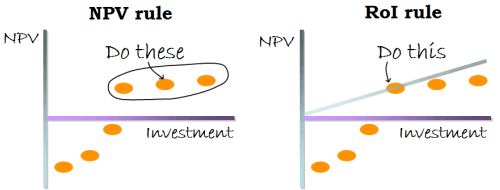
If you have a bunch of projects you could do, and want to decide which ones to take up, I was taught a rule: if a project has positive net present value, do it.

That is, find out how much money you have to put in (& when), and how much you’ll get out (& when). Adjust for money today being worth more than money tomorrow. If it makes a profit, just do it.

There are 3 aspects to this calculation, of which two are usually ignored.

  1. Time value of money. Money today is worth more than money tomorrow. People usually don’t adjust for this — either because they don’t know they should, or because they’re not sure how much to adjust by. It’s usually OK to ignore this. The difference is not often much. Your estimations of cash flow are likely to be off by more than this adjustment anyway.
  2. Cash flow projection. This is tough too. People batch these together into two groups: what you put in and what you get out.
  3. Investment and return. This is the often used part. You put in money (over time), and you get money out (over time). Do you get more than you put in? How much more?

In other words, I’ve seen Return on Investment (RoI) used far more than Net Present Value (NPV).

NPV vs ROI

In my MBA classes, I was taught that this is wrong. That you need to worry about RoI only if you’re budget-constrained. If you have enough money (and organisations can always borrow), you should do all profitable projects.

I can’t tell for sure if organisations are budget constrained or not. Departments do have budgets. But whether they stick to it or not depends on the department head’s risk aversion and political power. It often has nothing to do with projects.

But I’ve seen a bigger complaint cited more often: people don’t have time. Time is a bigger constraint than money.

This works in two ways. You don’t have staff to execute a more projects. Or you don’t have management time to pay attention to new projects.

If you’re constrained by money, it makes sense to maximise return on investment. But if you’re constrained by time, maximise return on effort.

BTW, effort is not the same as time. Outsourcing, for example, increases return on effort, but probably not return on investment. Vendors take money without taking up staff time (except a bit of management time). If you’re manpower constrained, and not money constrained, use them as much as possible. Similarly, investing in assets rather than in hiring improves return on effort.

When at BCG, there was a whole theme around this called Workonomics. Like Economics is about maximising return for money, Workonomics is about maximising return from your workforce. Powerful concept. It’s a pity I’ve never seen it applied where it’s really needed.

Economics vs Workonomics

The most important thing is: at any point, you have only one constraint. Maximise return on that constraint. If it’s money, maximise RoI. If it’s staff, maximise productivity. If it’s customers, maximise share of wallet. And so on.

Filtering vs weighting

I am selecting a CRM package for a bank. I asked my colleagues how they’d gone about it, and got 8 responses. Every single one of them had the same weighting approach: Take a huge list of criteria, assign weights, score each package, calculate a weighted-average score, pick the highest one.

As I mentioned earlier, I think weighting is a lousy method. (See Errors in multicriteria decision making.) You can’t say “I picked this package because it has X, Y and Z features, which the others don’t.” You can only say, “Oh, overall, it has the highest score…”

The scores and the weights are subjective. You spend ages arguing between a 3 and a 4. You can manipulate them very easily. And you end up having to revise the scores many times to get to the answer you want.

Since I now had an opinion, I put my foot down, and said, “Here’s what we’ll do. Let’s make a list of essential criteria. They will all be YES / NO questions. Any package that doesn’t meet any criteria is knocked off. That’s it.”

This may appear simplistic, but it isn’t. You see, at the end of the day, only a few criteria really matter. Ideally, you just pick these, and compare packages against these. Since you don’t know which these are, you make a bigger list, evaluate them all, and then realise the truth.

Sometimes, you have too many criteria. Then none of the packages make it, and you have to sacrifice some of your criteria.

Sometimes, all of them make it. Then you can choose to enforce more criteria. Or maybe not. If all of them meet your criteria, just pick the cheapest one.

Internally, we were convinced of this approach, and took it to the client. Things were fine for a week. Then, complaints started trickling in.

  1. Fear: “I’ve already used weighting in earlier package evaluations. Now, if you use filtering, it’ll make my earlier evaluations look bad…”
  2. Uncertainty: “I don’t know… what if there’s no YES / NO answer? What if we need shades of grey?”
  3. Doubt: What if it lets everything through? What if it rejects everything?

Uncertainty is the most popular objection.

“What if we need shades of gray?”

I always ask: “Any example?”

“Well, you know… it can come up.”

So I give them an example, and explain how it can be broken in to sub-questions.

“Well, yeah… but just to be on the safe side, could we have a score?”

The exercise is still going on. I haven’t seen a valid concern yet. What’s interesting is, everyone is hesitant about filtering, but no one can defend their objection.

Errors in multicriteria decision making

I talked about my approach for multicriteria decision-making, and mentioned that it was fundamentally flawed. Here’s why.

Spidergraph for Industry 1 Spidergraph for Industry 2

The charts above compared two industries. The bigger the area, the more favourable the industry. The underlying assumptions being:

  • The criteria are comparable. (Points at the same level are of comparable importance. Twice as large is twice as important.)
  • All (and only) relevant criteria have been included.

In this particular example, I know for a fact that both these assumptions are invalid. And in every case I used this methodology, the assumptions fail.

You won’t draw the criteria to scale. We used revenues and growth as two parameters, and marked each industry as high, medium or low. The scale for revenue was Rs 100 cr, Rs 500 cr and over Rs 500 cr. The scale for growth was <5%, 5-10%, >10%. We picked this scale in order to fit the range well on these graphs. Not because Rs 100 cr of revenue was worth about the same as 5% of growth. And yet, that’s the implicit trade-off this graph is asking us to make.

We also had very qualitative criteria, like “Capability” (KSF), and they were compared head-on with growth and revenue. Using qualitiative criteria is not a bad thing. But when the visual makes you trade-off capability against Rs 500 cr of revenue, I feel queasy.

You will miss important criteria. Usually, the process for identifying criteria is bad. “Think of every criteria you can” was our standard approach. In this instance, in our first iteration, we had a dozen parameters. We showed it to the client. They said, “Look, our Chairman likes these industries a lot. He doesn’t like that bunch. We’re much more likely to focus on the ones he likes.” And that’s absolutely important! We ended up adding a “Passion / vision” based on the fit with the company’s existing businesses, and that proved the deciding factor.

Another time, I built an entire model on which project to outsource based on 10 parameters. (It was everything I could think of at the time.) The one that I missed was, “When is the project starting?”. It turned out that this was the most important criteria. In fact, it was the only important criterion. If I’d simply said, all projects starting after 1-June-2006 can be outsourced, I would’ve been 90% right.

You’ll keep the irrelevant parameters. This is the worst of all. Even after we learnt which the important criteria were, we didn’t throw away the useless parameters. We never throw away hours of work, even if it’s useless. So the model keeps bloating, and the irrelevant criteria influenced the shape of the graph more than the relevant ones.

Another problem is that this methodology cannot answer questions concisely.

“Why did you knock off Industry X?”

“Oh, because on a cumulative score against revenue, growth, lifecycle, capability, passion and 10 others, it scores less than 45 points.”

A good answer should be short. For GE, it would be “You’ll never be number one.” For HP, once, it would’ve been “It’s not where we can excel technically.” For Warren Buffet, it may be “I don’t understand the business.”

After these experiences, and based on hindsight, I’ve come to believe the following about MCDM (multi-criteria decision making):

  1. Remove irrelevant criteria. Usually a few criteria make the decision. The rest don’t matter.
  2. Filtering works. You don’t optimise in MCDM. You’re trying to do well against criteria that are often not comparable. You’re better off if you filter out unacceptable levels of criteria, and treat what’s left as acceptable.
  3. Use a decision tree. Don’t compare options. This is the basis of fast and frugal heuristics. It keeps focus on the important criteria, and makes the process easy to implement / explain.

I’ll let you read up on fast and frugal heuristics. I’m convinced it’s the best way to make decisions based on multiple criteria in the scenarios I’ve worked on.

Multicriteria decision making

Decisions are usually based on multiple criteria. You have to trade off between criteria. I’ve been involved many such decisions over the last 5 years.

Example 1: A conglomerate wanted to identify industries for growth. We shortlisted 19 industries, identified 12 criteria for the attractiveness of an industry, researched each one and plotted them on spidergraphs like below.

Spidergraph for Industry 1 Spidergraph for Industry 2

The intention was that, to identify the most favourable industries, you’d just pick the ones with the largest filled area.

Example 2: Another time, we had to decide among BPO vendors. Again, we picked a bunch of criteria and compared vendors against these criteria.

Spidergraph for BPO Vendor 1 Spidergraph for BPO Vendor 2

Example 3: Once, we had to identify stakeholders’ position on a project.

Change readiness profile for Dave Change readiness profile for Uli

Those who were big on the right of the graph were for, and those who were big on the left were against.


In all the above cases, the same process was used for decision making.

  1. List criteria exhaustively
  2. Evaluate options against each criteria
  3. Assign weights to criteria (equal weights implicitly assigned above)
  4. Compare options

Having applied this methodology it several times, I am convinced this process is fundamentally flawed. See how in this post: Errors in multicriteria decision making.