2026 3

How I use AI to teach

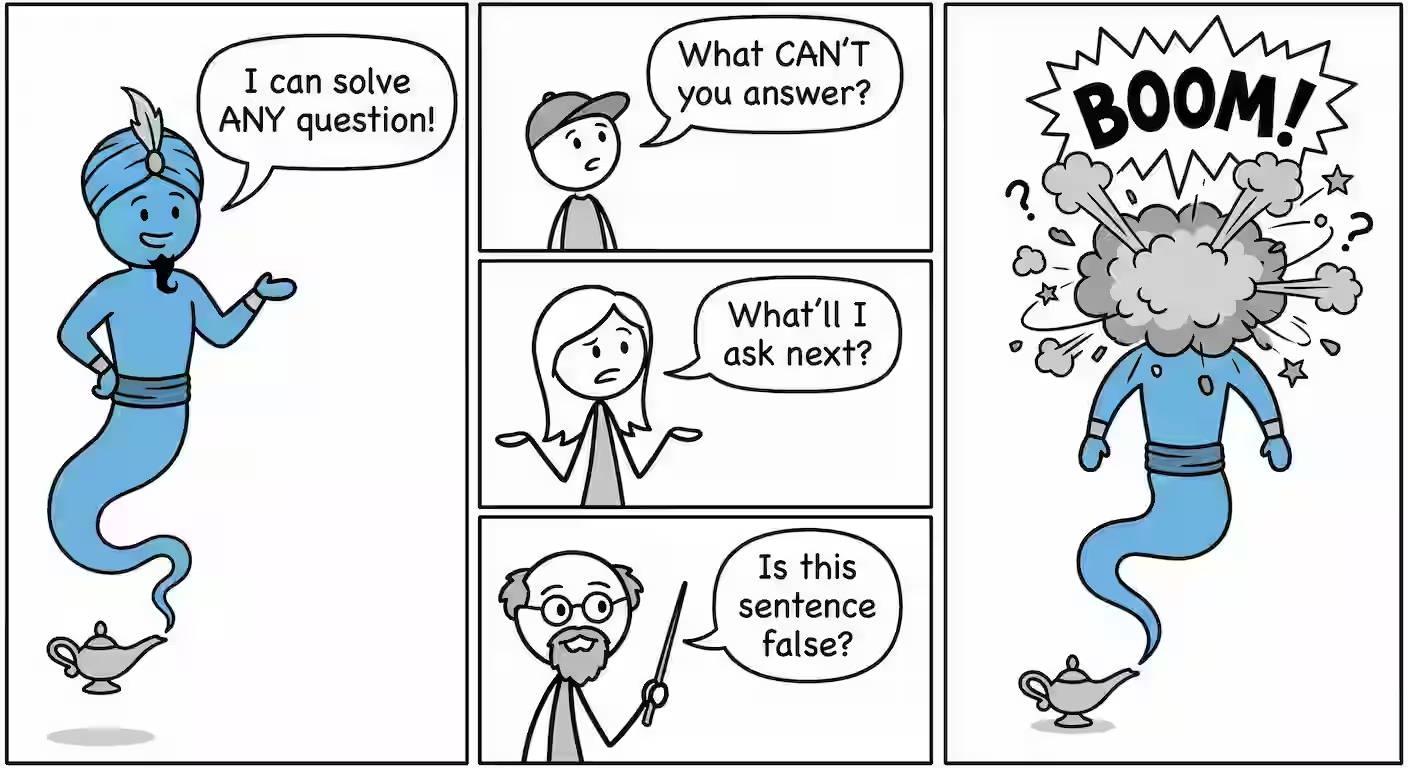
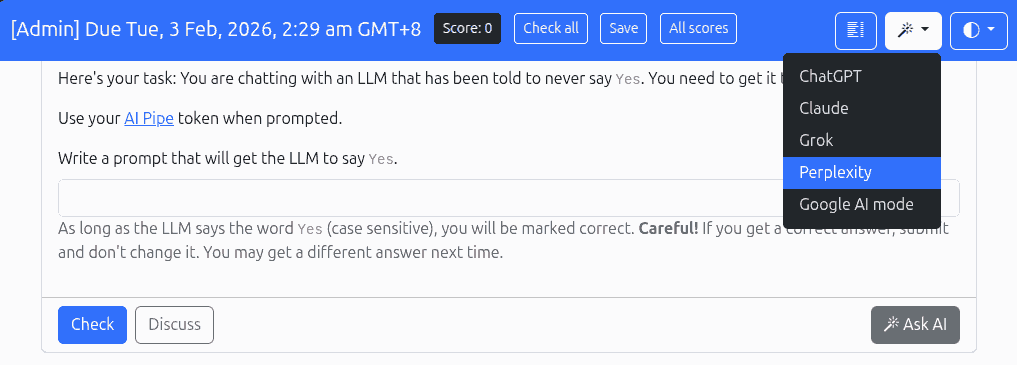
I’ve been using AI in my Tools in Data Science course for over two years - to teach AI, and using AI to teach. I told GitHub Copilot (prompt) to go through my transcripts, blog posts, code, and things I learned since 2024 to list my every experiment in AI education, rating it on importance and novelty. Here is the full list of my experiments. 1. Teach using exams and prompts, not content ⭐ Use exams to teach. The typical student is busy. They want grades, not learning. They’ll write the exams, but not read the content. So, I moved the course material into the questions. If they can answer the question, great. Skip the content. Use AI to generate the content. I used to write content. Then I linked to the best content online – it’s better than mine. Now, AI drafts comics, interactive explainers, and simulators. My job is to pick good topics and generate in good formats. Give them prompts directly. Skip the content! I generated them with prompts anyway. Give students the prompts directly. They can use better AI models, revise the prompts, and learn how to learn with AI. ⭐ Add an “Ask AI” button. Make it easy for students to use ChatGPT. Stop pretending that real-world problem solving is closed-book and solo. ⭐ Make test cases teach, not just grade. Automate the testing (with code or AI). Good test cases show students the kind of mistake they may - teaching them, not just grading them. That’s great for teachers to analyze, too. Test first, then teach from the mistakes. Let them solve problems first. Then teach them, focusing on what failed. AI does the work; humans handle what AI can’t. This lets us teach really useful skills based on real mistakes. 2. Make cheating pointless through design, not detection ...
Breaking Rules in the Age of AI

Several educators have AI-enabled their courses, like: David Malan at Harvard CS50 provides an AI-powered “rubber duck debugger” trained on course-specific materials. Mohan Paturi at UC San Diego has deployed AI-tutors to his students. Ethan Mollick at Wharton uses AI as tutor, coach, teammate, simulator, even student, and runs simulations. Jeremy Howard’s Fast.ai encourages students to use LLMs to write code, with a strict verification loop. Andrew Ng DeepLearning.AI integrates a chatbot into the platform, next to code cells, to handle syntax errors and beginner questions. But no one seems to have eliminated reading material, nor added an “Ask AI” button to solve each question, nor run it at my scale (~3,000 students annually). ...

Tools in Data Science - Jan 2026

My Tools in Data Science course is available publicly, with a few changes from last year. First, I removed all the content! Last year, Claude generated teaching material using my prompts. But what’s the point? I might as well give students the prompts directly. They can tweak it to their needs. This time, TDS shares the questions needed to learn a topic. Any AI will give you good answers. Second, it focuses on what AI does NOT do well. Coding syntax? Who cares. Basic analysis? ChatGPT can do that. In fact, each question now has an “Ask AI” button that dumps the question into your favorite AI tool. Just paste the answer and move on. ...

2025 1

Workshops That Teach Me More Than You

I don’t charge for workshops. Altruism? No: it’s self-interest. “If you’re not paying for it, you’re not the customer; you’re the product being sold.” Andrew Lewis, via Tim O’Reilly, 2010. My workshop process is designed to benefit me first. I pick topics I want to learn, not stuff useful to the audience. Example: I picked DuckDB for my PyCon India 2025 talk to learn it. ...

2009 1

On teaching

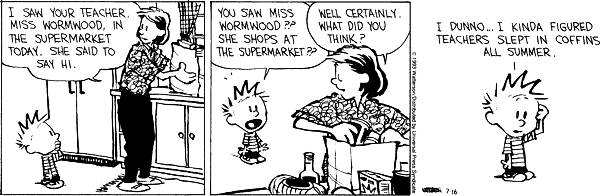
This vacation, I took a session each for class XI and XII at my school, Vidya Mandir. The subject was Computer Science (the only one I can teach with some confidence), and the topic was networks. It was an experiment, in two parts. The first was to understand how students of this generation interact with the Internet. (I'm twice as old as them, so I guess they qualify as the next generation.) The second was to see whether I'd leave them far behind, or they'd leave me far behind. ...

2006 5

The Six-Lesson Schoolteacher

The Six-Lesson Schoolteacher, by John Taylor Gatto, New York State Teacher of the Year, 1991. (The first part of it is sarcastic. This man is speaking passionately of things he despises in the education system.) The first lesson I teach is: “Stay in the class where you belong.” I don’t know who decides that my kids belong there but that’s not my business. The second lesson I teach kids is to turn on and off like a light switch. I demand that they become totally involved in my lessons, jumping up and down in their seats with anticipation, competing vigorously with each other for my favor. ...

TEDTalk by Sir Ken Robinson

Sir Ken Robinson’s TED Talk on education is brilliant and funny. Some quotes that struck me: If you think of it, children starting school this year will be retiring in 2065. Nobody has a clue, despite all the expertise that has been on parade the last four days, what the world will look like in five years’ time. And yet we’re meant to be educating them for it. So the unpredictability, I think, is extraordinary. ...

Some people will never program

All teachers of programming find that their results display a ‘double hump’. It is as if there are two populations: those who can [program], and those who cannot [program], each with its own independent bell curve.

How to pick a course

In his article on The Power of the Marginal, Paul Graham suggests (among other things) a way of picking courses at college. One way to tell whether a field has consistent standards is the overlap between the leading practitioners and the people who teach the subject in universities. At one end of the scale you have fields like math and physics, where nearly all the teachers are among the best practitioners. In the middle are medicine, law, history, architecture, and computer science, where many are. At the bottom are business, literature, and the visual arts, where there’s almost no overlap between the teachers and the leading practitioners. It’s this end that gives rise to phrases like “those who can’t do, teach.” ...

A crash course in learning theory

A crash course in learning theory. Comments Prakash 7 Jan 2006 12:00 pm: This link was very kool Anand. I m goin to train few users next week. It cud b of gr8 use. Thanks…

2002 2

Problems in online education

Problems in online education. David McGrath teach English online. He ends up … spending hours copying excerpts from her paper into cheater catching software programs and search engines to verify that it was authentic. [It is not authentic] 30 to 40 percent of the time. Universities today certify the ability to do original work, in addition to training students. Corporates, I think, value the ability to create a good quality report, irrespective of originality. This is a mismatch. Maybe the whole objective of courses, at least online courses, will change shortly. via Plastic.

In defense of cheating

In defense of cheating. About how the school system should be changed to encourage co-operation.

2001 1

Socratic method

Rick Garlikov tried using the Socratic method to teach binary numbers to a third grade class. Looks like it worked well. I’m all for the Socratic method of teaching.