2026 1

Testing Pólya heuristics on AI Math

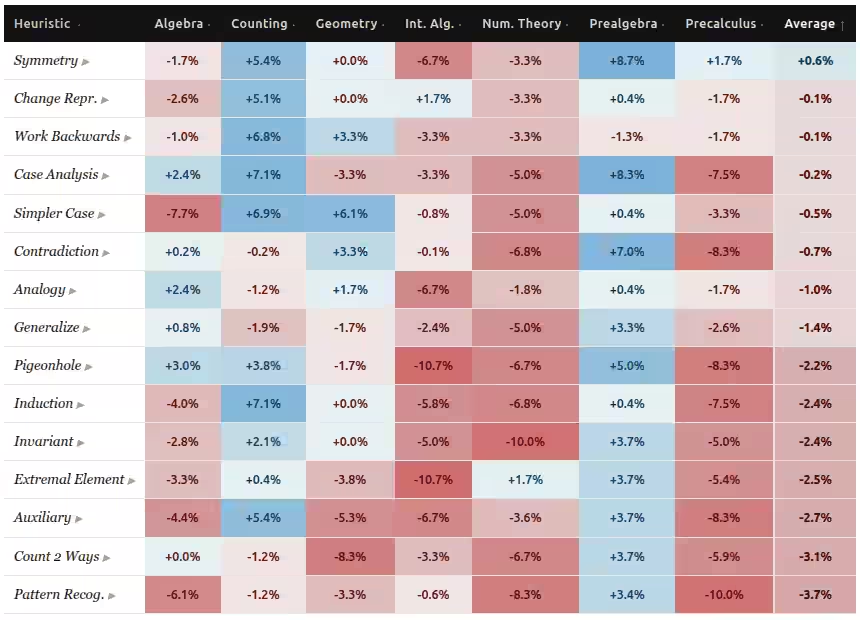
Terence Tao said, “We haven’t done many experiments … large-scale studies where we take a thousand problems and just test them.” So I told Claude: You know my style. Suggest some innovative experiments I could run. The first suggestion was cool! The Polya Audit. Polya’s How to Solve It lists 20 heuristics (work backwards, induction, analogy, etc.). Mathematicians treat these as wisdom. Nobody has ever measured which ones actually work, and on what problem types. ...
2008 1

Implicit information

From what I’ve seen, puzzles and exam questions share two un-real-worldly characteristics. Firstly, you are guaranteed that a solution exists. Secondly, you are given that all the information provided to you is relevant. (Well, not always. Some case studies I’ve seen have had their share of contrived irrelevance. But that’s often what it is, I think. People fill in the relevant stuff, and then try and distract by adding irrelevant material in the hope of making it more real-world-like. But that’s just a guess). ...

2007 1

Knowing less is better

Malcolm Gladwell argues that knowing less can be an advantage. This is based on a study in which kids in the US were asked which was a bigger city: San Antonio or San Diego. Many didn’t know. Kids in Germany were asked the same. Most knew: San Diego was bigger. Why? Because they’d heard of San Diego, but not of San Antonio. P.S: A comment mentions that the actual difference in population between these cities is only 2%. So maybe the US kids were right to be unsure… ...

2006 3

Programming theorems

Programming theorems. The likelihood of Perl being involved in a system is directly proportional to the length of time the system has been in maintenance. Every 5 minutes you spend writing code in a new language is more useful than 5 hours reading blog posts about how great the language is. Think twice before presuming that CSV is a nice little easy file format. (see Leon)

Errors in multicriteria decision making

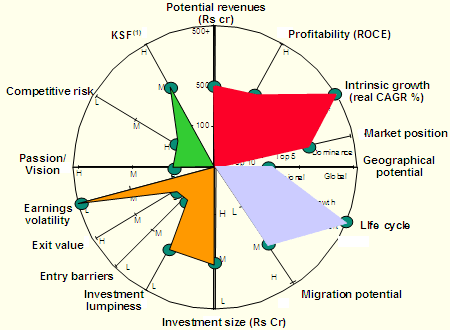
I talked about my approach for multicriteria decision-making, and mentioned that it was fundamentally flawed. Here’s why. The charts above compared two industries. The bigger the area, the more favourable the industry. The underlying assumptions being: The criteria are comparable. (Points at the same level are of comparable importance. Twice as large is twice as important.) All (and only) relevant criteria have been included. In this particular example, I know for a fact that both these assumptions are invalid. And in every case I used this methodology, the assumptions fail. ...

How to pick a course

In his article on The Power of the Marginal, Paul Graham suggests (among other things) a way of picking courses at college. One way to tell whether a field has consistent standards is the overlap between the leading practitioners and the people who teach the subject in universities. At one end of the scale you have fields like math and physics, where nearly all the teachers are among the best practitioners. In the middle are medicine, law, history, architecture, and computer science, where many are. At the bottom are business, literature, and the visual arts, where there’s almost no overlap between the teachers and the leading practitioners. It’s this end that gives rise to phrases like “those who can’t do, teach.” ...