2025 1

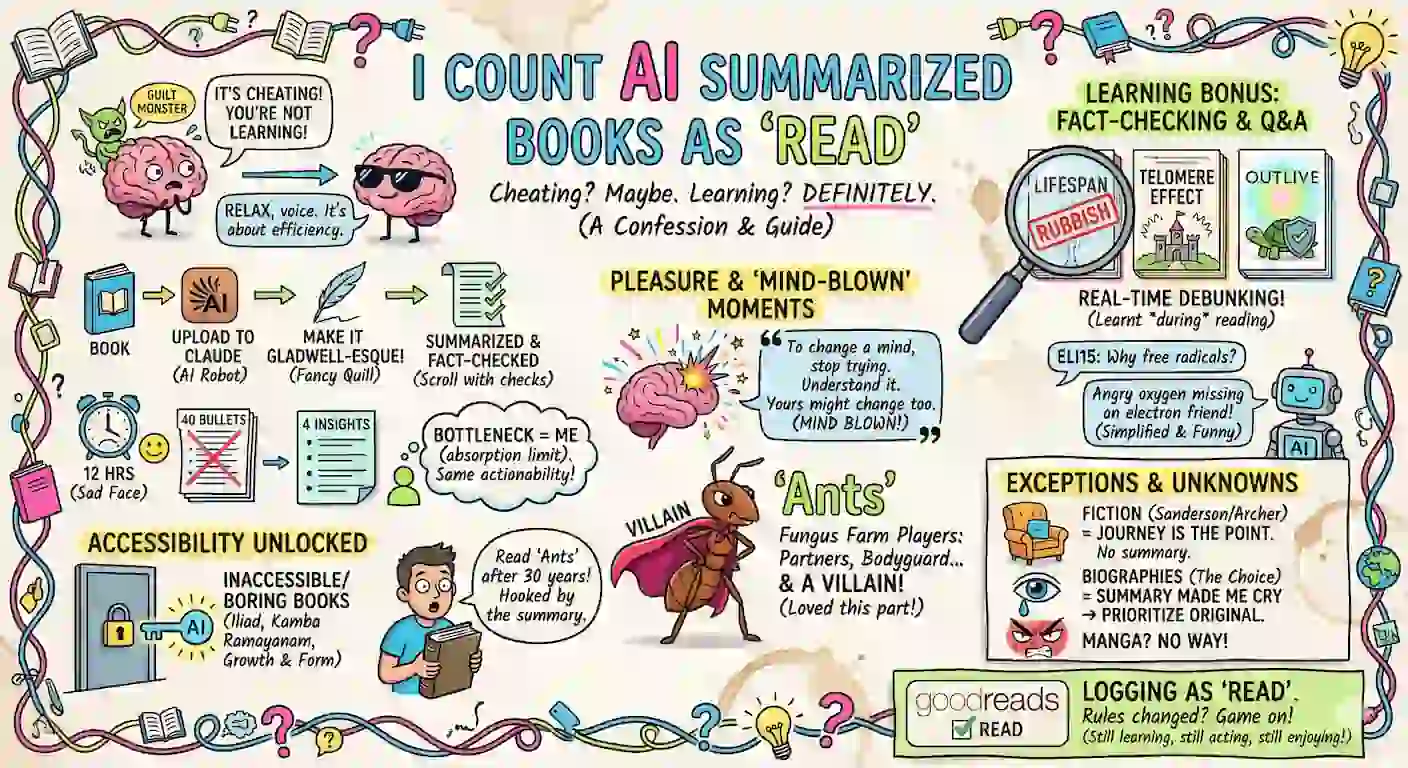
I count AI summarized books as "Read"

I have this nagging feeling (maybe you do too?) that it’s cheating and I’m not really learning if it’s so easy. The same voice makes me feel guilty when using coding agents to code or ChatGPT in meetings. I’m telling that voice to relax. I upload books to Claude and ask it to “Comprehensively and engagingly summarize and fact-check, writing in Malcolm Gladwell’s style, the book …”. I can read it in an hour instead of twelve. Four bullet points instead of forty. With (this surprised me) roughly the same number of insights I actually do something with. ...

2023 1

Picking books to read

I add book recommendations to my GoodReads – To-read list. Then I sort by rating and pick the first one I like to read. In 2023, I’m reshaping my environment. Picking books I usually won’t pick. (Read The Unknown Unknown: Bookshops and the Delight of Not Getting What You Wanted if you want to be similarly inspired.) So here are 4 approaches I’m adding to my process. Algorithmic. Sort Kaggle books based on popularity, rating, and age. Pick the top 10 (or 50) Serendipitous. Go to bookstores and libraries. Pick the most popular books Award-winning. Pick from the Pulitzer, Booker, Nobel, Hugo, and other award winners Challenges. Pick from Popsugar, Book Riot, Goodreads, The 52 Book Club, and other challenges FYI, here are algorithmic results (for books with 100+ ratings and a 4+ average on Goodreads): ...

2020 1

Books in 2020

My Goodreads 2020 Reading Challenge target is 50 books. I’m at 45/50, with little hope of getting to 50. (I managed 25/24 in 2019.) The 10 non-fiction books I read (most useful first) are below. The Lean Startup by Eric Reis. The principle of Build - Measure - Learn is useful everywhere in life too, not just in startups. Never Split The Difference by Chriss Voss. Shares principle-driven strategies to convince people. The 4 Disciplines of Execution by McChesney, Covey & Huling. Teaches how to build execution rigor in an organization. A bit long at the end, but the first section is excellent. Sprint by Jake Knapp. A detailed step-by-step guide to running product development sprints that you can follow blindly. How to Fail at Almost Everything and Still Win Big by Scott Adams. Dilbert’s author shares his strategies for life. Very readable, intelligent, and slightly provocative, but always interesting. The Five Dysfunctions of a Team by Patrick Lencioni. Written as a story (like The Goal). Talks about the 5 problems in teams and how to overcome them. The Culture Code by Daniel Coyle. Explains the elements of strong cultures - belongingness, shared vulnerability, and shared purpose. Data-Driven Storytelling by Nathalie Henry Riche et al. Shares the latest points of view on telling data stories. My team and I read these chapters as a group. Leaders Eat Last by Simon Sinek. Inspiring when I read it, but I don’t remember what it said. Deep Work by Cal Newport. Shares tactics to focus. Practical and useful. I also started, by haven’t finished these four: ...