2012 1

Correlating subjects

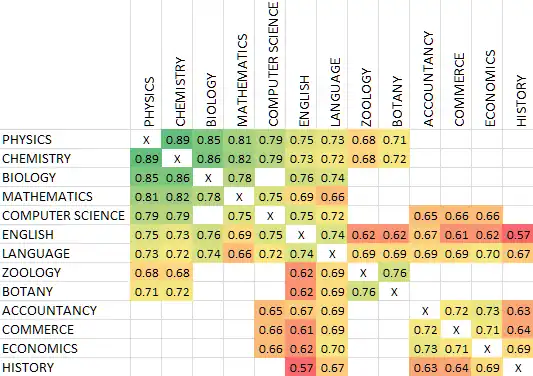
A question from Dorai get me thinking: does being good at maths help in programming? I don’t have a personal view. But since Reportbee has data on the Class 12 examination results for the last three years, we thought we could do a bit of analysis. Here’s the correlation of the scores of various subjects with Computer Science. Correlation Subject 0.79 CHEMISTRY 0.79 PHYSICS 0.75 ENGLISH 0.75 MATHEMATICS 0.72 LANGUAGE 0.67 BIOLOGY 0.66 ECONOMICS 0.66 COMMERCE 0.65 ACCOUNTANCY 0.56 HISTORY 0.52 GEOGRAPHY It almost breaks neatly into four groups. ...

2008 1

Resolving the Prisoners Dilemma

If you’re ever taken a course in Economics, and it discussed Game Theory, you may be familiar with The Prisoner’s Dilemma. Roughly, this is the problem. Assume you possess copious quantities of some item (money, for example), and wish to obtain some amount of another item (perhaps stamps, groceries, diamonds). You arrange a mutually agreeable trade with the only dealer of that item known to you. You are both satisfied with the amounts you will be giving and getting. For some reason, though, your trade must take place in secret. Each of you agrees to leave a bag at a designated place in the forest, and to pick up the other’s bag at the other’s designated place. Suppose it is clear to both of you that the two of you will never meet or have further dealings with each other again. ...

2006 3

Knuth Volume 4

The Art of Computer Programming, Volume 4 by Donald Knuth. Pre-fascicles are available for download.

Some people will never program

All teachers of programming find that their results display a ‘double hump’. It is as if there are two populations: those who can [program], and those who cannot [program], each with its own independent bell curve.

Classic texts in computer science

Classic texts in computer science. Worth reading for the sheer insight. Update: The link didn’t seem to work in Feb 2007. Here’s the list. An axiomatic basis for computer programming by C. A. R. Hoare Communicating Sequential Processes (CSP) by C. A. R. Hoare Call-by-name, call-by-value, and the lambda calculus by Gordon Plotkin Towards a theory of type structure by John C. Reynolds Definitional interpreters for higher-order programming languages by John C. Reynolds An APL Machine 1970 by Philip S. Abrams Henry Baker’s Archive of Research Papers (many classic Lisp papers) The Anatomy of a Large-Scale Hypertextual Web Search Engin by Sergey Brin and Lawrence Page No Silver Bullet: Essence and Accidents of Software Engineering by Frederic P. Brooks, Jr. A Mathematical Theory of Communication by Claude Shannon Communication Theory of Secrecy Systems by Claude Shannon Bayesian Networks without Tears by Eugene Charniak A Universal Algorithm for Sequential Data Compression by Jacob Ziv and Abraham Lempel A Relational Model of Data for Large Shared Data Banks 1970 by Edgar F. Codd Let’s Build a Compiler 1988-1995 by Jack Crenshaw Gauging Similarity via N-Grams: Language-Independent Sorting, Categorization, and Retrieval of Text by Marc Damashek Worse Is Better by Richard P. Gabriel Hints on Programming Language Design by C.A.R. Hoare Why Functional Programming Matters by John Hughes The Design of APL by Kenneth E. Iverson The Early History Of Smalltalk by Alan Kay Computer Programming as an Art by Donald E. Knuth The next 700 programming languages by Peter J. Landin Recursive Functions of Symbolic Expressions and their Computation by Machine (Part I) 1960 by John McCarthy FORTH - A Language for Interactive Computing by Charles H.Moore Teach Yourself Programming in Ten Years 2001 by Peter Norvig Parenthetically Speaking, a collection of essays from the 1990s by Kent M. Pitman The Definition and Implementation of a Computer Language based on constraints by Guy Lewis Steele Jr. Growing a Language by Guy Lewis Steele Jr. Epigrams on Programming by Alan J. Perlis The Complexity of Theorem Proving Procedures by Stephen A. Cook Steps Toward Artificial Intelligence by Marvin Minsky The Original ‘Lambda Papers’ by Guy Steele and Gerald Sussman A Method for Obtaining Digital Signatures and Public-Key Cryptosystems by R.L. Rivest, A. Shamir, and L. Adleman The UNIX Time-Sharing System by Dennis Ritchie and Ken Thompson Comments jawahar 6 Feb 2007 5:52 am: anand this link is not working !! Classic-texts-in-computer-science – maxviv 5 Jun 2016 7:15 pm (pingback): […] Classic texts in computer science […]