Change management

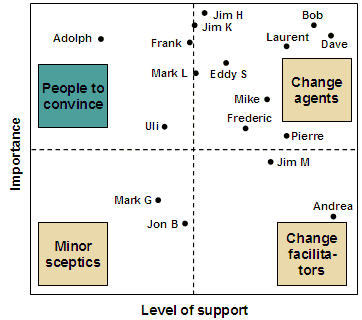
Change management can be analytic, as opposed to touchy-feely. Our client’s operating margin was falling. The bosses wanted to offshore their back office. Others weren’t convinced. To manage this change, we needed three questions answered: Who’s not convinced? Why aren’t they convinced? What’ll convince them? Who’s not convinced? We plotted the level of support and importance of key people on the stakeholder support matrix. This split people into 4 groups (below). Then we showed it around to people and had them move people around on the matrix. ...

Packaging

Packaging can make a huge difference to products. It really hit me when I saw this bottle of Heinz’s ketchup. My two big problems with normal ketchup bottles are: (a) the sauce spills to the side of the bottle and sticks to the cap, and (b) it’s tough to pour the last bits of sauce – you have to hit the bottle a lot. Now, I didn’t know I had these problems. But when I saw this bottle, it hit me. You keep the bottle upside down – so it’s easy to pour the last bits of sauce. And they way the nozzle valve is designed, the sauce doesn’t stick to the cap. Perfect! Since then, I don’t buy any other ketchup bottle. Even if I WANT ketchup, I don’t buy it unless I get this bottle. Packaging made be brand loyal. (Caveat: I’m not REALLY brand loyal. I’d buy any ketchup with this packaging. But only Heinz has it right now.) ...

Conflicting policies

A software services firm once asked us, “How come we are not able to staff projects quickly, even though we have a lot of people on the bench?” There were a bunch of reasons, but among those, we found something interesting. They were implementing two policies that were logical on their own, but disastrous together. (The bench is where programmers sit when they are not on a project.) Here’s how they work. When a project starts, the project manager requests resources (people) for the project. HR passes on matching CVs to the project manager, who approves or rejects them, in consultation with the client. ...

Demand draft fees

Once, we were looking at whether banks made money on demand drafts (DDs). DDs are costly. 90% of a bank’s costs are people-related, and it takes a fair bit of time (hence people) to process DDs. If you pay for DDs in cash, it costs even more because the teller has to count the notes. To recover this cost, banks charge a fee. The fee increases with the size of the DD. A DD for Rs 10,000 may cost Rs 50, while one for Rs 100,000 may cost Rs 200. ...

Channel economics

We were working with the financing subsidiary of a conglomerate. They had two divisions that gave loans for buying vehicles (mostly trucks, but also cars). One division used the direct channel. They had direct marketing agents (DMAs) who were paid a commission for getting the contract, and the division collected the monthly installments. The other used the dealer channel. The dealers would get the contract as well as collect the installments. ...

ATM breakeven

Banks install ATMs to lower their branch costs, and to attract new customers. When working out the economics of ATMs, we found that lowering branch costs alone could not be a viable reason to install an ATM. The bank argued as follows: “Every time someone withdraws money from an ATM, they avoid going to the branch. With enough people going to the ATM, I can afford not to increase my branch size, and that saves me money. Since it costs me Rs 20 every time a person withdraws cash (in terms of salary, rent, etc.) and an ATM costs about Rs 2,200 a day, I’ll break even if there are 110 cash withdrawals from the ATM.” ...

Market emergence - prepaid phones

Reliance Infocomm, after launching their prepaid business in India, introduced an new scheme. Pay Rs 4,300, and get a mobile phone PLUS prepaid vouchers worth Rs 4,300. Effectively, you’re getting a mobile phone for free. The scheme made good financial sense for Reliance. With a million subscribers to this scheme, they could recover Rs 430 cr of their upfront capital investment and retire their debt. Besides, the Rs 4,300 would have normally been bought over a period of around three years by prepaid subscribers, making its present value around Rs 3,600, at an interest rate of 12%. Add to that the reduction in distribution cost due to bulk selling, and possibility of non-usage, etc… the economics might work out. ...

Market emergence - fan bartering

Over my last few years as a consultant, I’ve seen many interesting ways in which markets have emerged where they shouldn’t have, creating havoc in pricing and scarcity. Fixed prices fluctuate, free goods acquire a value, and non-tradeable goods are traded. I’ll share a few of these examples over the next few weeks. Once, a fan manufacturer asked us, We did an analysis and found that our wholesalers’ margins fluctuate. How could that happen, when we are fixing their buying and selling prices? ...