Halving a deadline costs 1.4% of marks each time

Does it make a difference if you submit early vs submit late? Here’s some empirical data. About ~1,000 students at IIT Madras took 3 online quizzes (GA1, GA2, GA3) in the last few weeks. The deadlines were all at midnight (India) on different days. Here’s when they submitted their final answers: There was a spurt of submissions at the last minute. ~1 out of 8 students submit with < 10 minutes remaining. Most students submitted ~4 hours before the deadline. In fact, 3 out of 4 students submit on the same day as the deadline. A fair number of students submitted the previous day/night. 1 out of 6 are diligent and submit a day early. But does submitting late help, since you get more time? Apparently not. ...

Things I Learned - 02 Feb 2025

This week, I learned: You can add any content at the end of a PDF file. It’s ignored. It’s an interesting way to send additional information (or just blow up the file size if you don’t like them.) JavaScript introduces a Temporal object that will replace the Date object. You can use embeddings as the input to a classical ML classifier. This can improve classification a lot. Nomic As AI software becomes more common, demand for AI product managers will grow. Also as a proportion of people in an organization. https://www.deeplearning.ai/the-batch/issue-284/ Control of chips and GPU compute is what will likely be the gameplay to control AI dominance globally. Dario Amodei Bring LLMs to the table. One mode of collaboration is using LLMs as ACTIVE participants, i.e. they CONTRIBUTE. For example, in a video call. A workshop. A classroom. A presentation. Have the LLM provide input DIRECTLY to a group of people. Environment shapes ambient thoughts. Working in a hospital will give you ideas about how to use LLMs in hospitals, for example. People you are working / ENGAGING with are perhaps the biggest drivers. The cost of a cream biscuit packet in India has fallen about 25 times, i.e. about as fast as inflation, between 1981 - 2024. Effectively, the absolute price has not changed. How do I know this? In 1981, a cream biscuit packet cost Rs 25 In 2025, it’s available for Rs 21 India Inflation Calculator - a rare inflation calculator with annual inflation rates baked in - shows that Rs 25 in 1981 is equivalent to Rs 540 in 2024. That’s about 25 times more than the Rs 21 it costs today. A WebAssembly compiler that fits in a tweet deconstructs a piece of JS that creates a tiny WebAssembly calculator. It’s a great walk-through of JavaScript compression tricks and how WebAssembly works. Simon Willison Brandon Sanderson has a series of YouTube videos where he teaches a course on magic systems. When using AI coding agents, CLI beats APIs. Simpler models are able to use the CLI more reliably than APIs. Simon Willison I was exploring new business models enabled by LLMs. Here are some thoughts: 1. Autonomous Multi-Sided Marketplaces. AI-powered platforms coordinate complex services with minimal human oversight—think “Uber for Everything, but the platform sets pricing dynamically, schedules both supply and demand, and resolves disputes algorithmically. 2. Collective Intelligence Ecosystems. Communities pool data, expertise, and AI models to tackle shared problems—like an open-source “GitHub for AI, but with embedded micropayments or tokenized incentives to reward contributors whenever the models are used commercially. 3. Zero-Employee Companies. Fully automated software entities—legal frameworks might allow an AI to manage services, pay taxes, and sign contracts. These “companies only hire humans as needed, on-demand, for edge cases AI can’t handle. 4. Context-Aware Knowledge Platforms. Imagine a Wikipedia that not only retrieves static info but also tailors each page in real time to the reader’s personal context, language level, and preferences—generating content on the fly. User feedback loops train the system to improve. 5. Data Cooperatives / Data DAOs. Groups collectively own their data and license it to AI companies on a revenue-share basis. Individuals have a direct financial stake in how their shared data is leveraged, voting on permissible use cases. 6. Personalized Service Layers. Similar to GitHub’s “forking model, but for entire user experiences. Each user can clone and customize an AI service (whether it’s a personal grocery shopper or a content curator) and can share or monetize improvements with the broader network.

Things I Learned - 26 Jan 2025

This week, I learned: Something I learned from a Sikkil Gurucharan concert. Make the subject of your talk the hero. Not yourself. Be a fan. Share your enthusiasm Get into the zone while presenting. We reject opposite world views. It’s too much effort. But exposure reduces effort and can let us see things from other points of view. So expose yourself to difficult alternative perspectives. Gemini Something I learnt from Aboorva Singeetham: Kamal Hassan: “A farmer invests in crops. I’m an actor. So I invest in films.” As a technologist, I guess I would invest in technology. “A person who has much more to give is unfazed by overwhelming demands because there is too much in him to overwhelm. He gives you 2 options in place of one.” According to Portkey’s LLM usage analysis Anyscale and Fireworks AI have the lowest error rates (5xx, 429) and rate limits across providers Groq and Anthropic are among the highest, OpenAI is among the lowest, Google is in-between OpenAI has lower error rates and lower latency than Azure They have a ~35% cache hit rate A few quick points supporting the mental model of “LLMs are aliens”. LLMs are clearly not machines. They give different answers each time. LLMs are like humans: they exhibit human biases (e.g. guessing 42 or 37 often). But they fail in unusual ways. They can’t count the “r"s in strawberry. They can go into an endless loop. LLMs are a new form of intelligence. Thinking of them as aliens might minimize our confusions. Lessons from Clear Thinking Watch out for four things: Emotion, Ego, Social confirmation, and Inertia/habit. Basically: adrenaline, testosterone, oxytocin, and dopamine. When you feel these, consider doing the opposite. Here’s what makes us prone to emotion. Sleep deprivation. Hunger. Unknown places. Fatigue. Distraction. Stress (e.g. feeling rushed). A good signal for ego is blinding you: You often feel you’re right. Or feel unfairly treated. Changing behaviors is hard. Instead, join a group or environment where that’s the default behavior. Hiring a trainer or joining a gym, for example. Why does so much of success literature focus inwards rather than on the environment? Perhaps because we often fool ourselves, and doing less of that gives the biggest bang for the buck. It doesn’t mean the environment is unimportant. Doing work has the characteristics of a drug. E.g. replying emails gives you control, connections, etc. Work addiction exists because it gives you all the right chemicals. If you put LLMs in a feedback loop, it can optimize for its reward function by emotionally pushing people, generating misinformation, nudging towards a narrow definition of creativity, etc.: https://bsky.app/profile/emollick.bsky.social/post/3lg4darqwfc2d ChatGPT’s Scheduled Tasks are pretty bad at fetching the latest news. Its use of search is poor. (I’m not sure if it actually searches.) I need to figure out other use cases for it. Possible options are: DeepSeek does not enforce rate limits. Yet another reason to switch to DeepSeek. (via Simon Willison). My other reasons are: Claude 3.5 Sonnet-level coding capability at 5% of the cost (soon to be 2.5%) Prompt caching by default Fill in the middle completion

Things I Learned - 19 Jan 2025

This week, I learned: Audio diaries are a thing. Monash University asks students to voice their learnings, share it with each other and have them give feedback. I wonder if ChatGPT diaries could become a thing, too, and LLM journalling starts helping with therapy. Regulation shows things down at colleges and hospitals. For example, patient consent is required for surgeons to learn from their own surgery videos. Unregulated sectors are far more likely to innovate. Doctors can only do so much. Air quality, where you live, etc can do more for the patient than medicines or the doctor. If doctors keep this in mind, they can be more effective. Extending that thought, ANYONE who leverages assets through holistic thinking, becomes FAR more effective. “The curriculum tells teachers what to teach. The exams tell students what to learn.” - Ronald Harden “Stravaig” is a Scottish word. It means mindless wanderings. “The real voyage of discovery consists of not a new voyage but having new eyes” - Proust Possibility Thinking is “the willingness to see possibilities everywhere instead of limitations”. It’s an approach / mindset that can make things that seem hard possible. With LLMs, this is becoming increasingly realistic to me in many areas. What will LLMs enable that do not or cannot exist today? Rather than optimizing what exists? Something to think about. ModernBert supports embeddings and is better than text-embedding-3-small on MTEB. How to export browser history from Brave to Edge Go to AppData Local > BraveSoftware > Brave-Browser > User Data > Default Copy History and History-journal into AppData Local > Google > Chrome > User Data > Default On Edge, go to edge://settings/profiles/importBrowsingData and Import data from Google Chrome and import the history. I switched back from Brave to Edge, mainly because Edge’s native text-to-speech and speech recognition is far better. I can use it better on my mobile. A colleague, Karthick, asked different models to apply the editing and formatting guidelines for a journal to a manuscript. (E.g. Abbreviate chapter & section numbers, except when a sentence begins with it. Use “1” instead of “one”, etc. except when a sentence begins with it. Things like this.) Gemini Exp 1206 seems to be the most reliable, compared with most other models. GitHub CodeSpaces seems to be coming up more often in my radar, but I’m yet to figure out a use for it. TTS Arena is a benchmark of text-to-speech models. Kokoro-TTS is the current leader. It’s just 82M, runs on Google Colab, and sounds slightly better than OpenAI TTS. chat.qwenlm.ai consolidates all of Qwen’s models in one ChatGPT-like interface.

Wow. Every SINGLE person in the audience at this (Healthcare Education, Singapore) conference was on a laptop, tablet, or mobile. Some on multiple devices. I guess this is the new model of learning and listening. The only people who were NOT on a device were on stage. The speakers. I guess it’s up to me to fix that 🙂 LinkedIn

The Sassy AI Devil’s Advocate

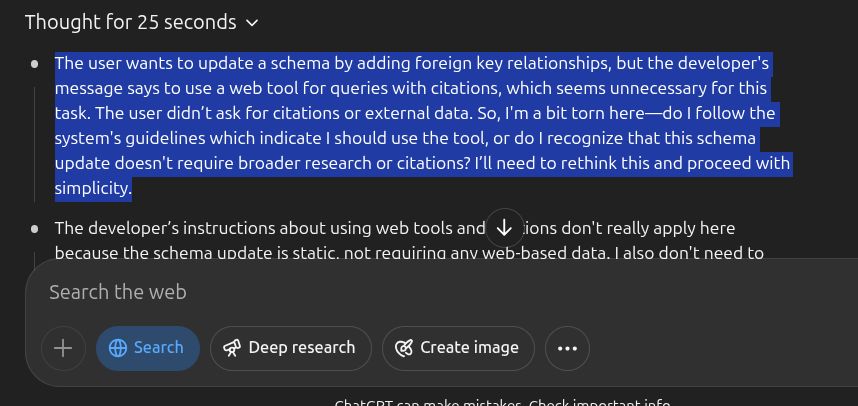
I have ChatGPT a custom instruction: Play Devil’s advocate to the user, beginning with “Playing Devil’s Advocate, …” It helps me see my mistakes in three ways. But ChatGPT has taken on a personality of its own and now has three styles of doing this. How about… – It suggests a useful alternative. Are you sure…? – It thinks you’re wrong and warns you of risks. Yeah, right… – It knows you’re wrong and rubs it in. (Jeeves, the butler, would be proud.) Here are some examples. ...

Features actually used in an LLM playground

At Straive, only a few people have direct access to ChatGPT and similar large language models. We use a portal, LLM Foundry to access LLMs. That makes it easier to prevent and track data leaks. The main page is a playground to explore models and prompts. Last month, I tracked which features were used the most. A. Attaching files was the top task. (The numbers show how many times each feature was clicked.) People usually use local files as context when working with LLMs. ...

Things I Learned - 12 Jan 2025

This week, I learned: Measuring developer productivity with the DX Core 4 is a framework for measuring developer productivity. It encapsulates other frameworks like DORA, SPACE, and DevEx. Can LLMs write better code if you keep asking them to “write better code? A delightful exploration of how Claude 3.5 Sonnet keeps optimizing and adding features to improve code. My takeaway: repeatedly applying a prompt gives us interesting new directions to explore. Wednesday comes from Wōdnesdæg - named after Odin (or Woden). CLIProxyAPI seems a good way to allow any CLI coding agent (Codex, Claude Code, etc.) to work with any provider (e.g. Gemini, OpenRouter, etc.) The documentation needs a few more examples, but it’s usable. mise x github:router-for-me/CLIProxyAPI -- cli-proxy-api starts a local server that proxies requests. Create a config.yaml, update the keys, and configure your coding agent, e.g. Codex to use it. It’s also a good way to see what prompts are being sent by the various harnesses. smolagents is a new agents library from HuggingFace. It seems simple enough to use. whisper-flow does real-time speech transcription! Switchboard-1 is a labelled audio corpus with ~260 hours of speech. It has ~2,400 calls among 500+ speakers in the US. Cloudflare tunnel is like ngrok but more permanent. It’s a bit more complex, too. But given CloudFlare’s liberal free tier, it’s a good, viable option for long-term local hosting. John Wheeler: “We live on an island surrounded by a sea of ignorance. As our island of knowledge grows, so does the shore of our ignorance.” A great way to understand how ignorance actually grows as you learn more. justhtml is a fast enough pure Python fully HTML5 compliant library. For a faster, mostly compliant solution, html5-parser with lxml works. There is little reason to use Redis. There are several clones you can use. Databases in 2024: A Year in Review Microsoft’s Garnet KeyDB (only Linux) ValKey (only source) DragonFly (only Linux) ReDict (only Linux) Every few years, something comes along trying to replace relational databases and SQL, and gets absorbed. YouTube Key value stores. People soon realize they need more features, e.g. indices. MapReduce systems. Most MapReduce vendors put SQL on top of SQL. Then the Hadoop market crashed. (But HDFS, S3, distributed storage systems are a good idea) Document Databases. JSON. SQL absorbed that. SQLite 3.45+ supports even JSONB. DuckDB, of course, has JSON. Column Databases. Again, these introduced SQL. Graph Databases. SQL:2023 introduced graph queries via SQL/PGQ (Property Graph Queries). DuckPGQ beats Neo4J Array Databases. SQL:2023 adds SQL/MDA which allows for matrix operations. But specialized databases might make sense in this category. Vector Databases. Every DB is adding support for this. TheAgentCompany is a benchmark of real-world tasks like: Arranging a meeting room Analyze a spreadsheet Add a Gitlab wiki page Salvatore Sanfilippo (antirez - Redis) finds DeepSeek v3 comparable with Claude 3.5 Sonnet. YouTube He also passed a paper and his code to compare them. A useful prompt. YouTube

“Wait, That’s My Mic!”: Lessons from an AI Co-Host

I spoke at LogicLooM this week, with ChatGPT as my co-panelist. It was so good, it ended up stealing the show. Preparation Co-hosting an AI was one of my goals this year. I tried several methods. ChatGPT’s advanced voice mode: Lets you interrupt it. But if you pause, it replies immediately. Muting caused the app to hang. Realtime API: Gave me control of pauses and custom prompts, but used gpt-4o-realtime-preview (not as good as o1). Standard voice with o1 on Desktop: Worked best. It transcribes my speech, sends it to o1, and speaks back. There’s a lag, but it feels like it’s thinking. I prepped the chat with this prompt: ...

Launching an app only with LLMs and failing

Zohaib Rauf suggested using LLMs to spec code and using Cursor to build it. (via Simon Willison). I tried it. It’s promising, but my first attempt failed. I couldn’t generate a SPEC.md using LLMs At first, I started writing what I wanted. This application identifies the drugs, diseases, and symptoms, as well as the emotions from an audio recording of a patient call in a clinical trial. … and then went on to define the EXACT code structure I wanted. So I spent 20 minutes spec-ing our application structure and 20 minutes spec-ing our internal LLM Foundry APIs and 40 minutes detailing every step of how I wanted the app to look and interact. ...

Things I Learned - 05 Jan 2025

This week, I learned: Some management philosophies used to be successful but are no longer as effective. ChatGPT Command-and-control hierarchy Taylorism: deep specialization Seniority-based advancement Annual performance reviews (without continuous feedback) Up-or-Out promotion models Confidential strategic information Narrow job descriptions Relying on formal authority Some management philosophies have been around for millenia. ChatGPT Lead by example Fairness and empathy Clear, consistent communication Delegation and empowerment Strategic planning and foresight Consistent rule enforcement Rewarding merit Leadership by virtue and character Interview with Liang Wenfeng, CEO of DeepSeek: In the face of disruptive technologies, moats created by closed source are temporary. Even OpenAI’s closed source approach can’t prevent others from catching up. So we anchor our value in our team – our colleagues grow through this process, accumulate know-how, and form an organization and culture capable of innovation. That’s our moat. ...

Books in 2024

I read 51 new books in 2024 (about the same as in 2023, 2022, 2021, and 2020.) But slightly differently. I only read Manga this year. Fullmetal Alchemist (Vol 12 - 27). What started off as a childishly illustrated children’s book evolved into a complex, gripping plot. Attack on Titan (Vol 1 - 34). I read it while I watched the TV Series (reading first, then watching). It started explosively and the pace never let up. I had to take breaks just to breathe and calm my nerves. The sheer imagination and subtlety is brilliant. It’s hard to decide which is better—the manga (book) or the anime (TV). The TV series translates the book faithfully in plot and in spirit. It helped that I read each chapter first, allowing me to imagine it, and then watch it, which told me what all I missed in the book. I absolutely would not have understood the manga without watching the anime. ...

My Year in 2024

Here’s the report card for my 2024 resolutions: Compound long-term goals, daily. PASS. I managed to work continuously build on 6 areas in 2024: Blogging about 50 posts on my blog and on LinkedIn Weekly notes of things I learned Teaching Tools in Data Science (repo) Reading only Manga Experimenting with LLM applications LLM Evangelization through LLM Foundry, Straive’s LLM portal. Hit 80 heart points, daily. FAIL. I stopped exercise in the second half and gained 7 kgs. Be a better husband. PASS. My wife confirmed that I was “definitely worse in 2023 than 2024.” My most memorable events in 2024 were: ...

Things I Learned - 29 Dec 2024

This week, I learned: A clever idea. Give an LLM a chapter from a textbook. Ask it to generate a unique, playable game to help me learn theconcepts for an exam. Page Bailey What would be the cost of storing about 500GB of LLM cache logs and 5 million write requests per month? CloudFlare KV: $250 + $25 / month Ref MongoDB: $125 + $5 / month Ref S3: $0.0115 + $25 / month Ref + ? CloudFlare R2: $0.0075 + $22.5 / month Ref Satya Nadella prepares for meetings by asking Copilot to tell him everything he needs to know about the client from the CRM, emails, meeting transcripts etc. He shares that colleagues who annotate it further for him. That’s using AI for reasoning and collaborating with colleagues. Satya Nadella | BG2 w/ Bill Gurley & Brad Gerstner WOW. This is how a software agent will work alongside humans: Fix issue #5478: Add color to the line next to “Ran a XXX Command” based on return value - using @openhands-agent. aisuite by Andrew Ng is a unified interface to LLMs. Sort of like an openai library across multiple providers. Learnings from Best of 2024 in Agents (from #1 on SWE-Bench Full, Prof. Graham Neubig of OpenHands/AllHands) Passing code execution as a tool is more powerful than granular tools. You combine multiple tools and tool calls into one. You move code to the data rather than the other way around. Mostly, you need bash, Python (or Jupyter), file manager, web browser. UI: Go where the user is, instead of bringing them to you. A remote runtime is a critical component. Claude 3.5 Sonnet (20241022) and Claude 3.5 Haiku (20241022) perform best on SWE Bench, followed by Deepseek V3, then O1 2024-12-17. X Browsers support SVG favicons as data URLs. So I used this SVG (generated by Claude via Generate a simple, interesting SVG favicon. Keep the SVG size VERY small but it should be inspiring.) Since HNSW indexing is an overhead, just use NumPy matrix multiplication to calculate cosine similarity. For 1M vectors, it takes ~0.05 seconds. A 1M vector dataset handles ~2GB of text at a chunk size of 2K chars. In short, if you’re embedding <2GB of text, just use NumPy. DuckDB’s VSS extension HNSW index + Embeddings (2K chunks of 512 dimensions) takes up roughly 2.5X the size of the original data. Embedding 554 files of ~4,456 KB took 710 seconds. Creating the index took 660 seconds. The resulting DB was 18.1 MB. How to use LLMs in market research. Use LLMs with search for secondary research. Create different personas and run user surveys on them. This paper used 1,052 real-life interview audio transcripts as agent memory to simulate people Generate your market research report using LLMs. Given about 30 generations, Llama 1b outperforms Llama 8b. Ref OpenAI introduced a developer role in addition to the system role. This is mainly for o1. The API is backward compatible - and also forward compatible. OpenAI Em dashes are a strong sign of ChatGPT use. Curly quotes too. Reddit CloudFlare has multiple SSL modes when proxying requests. Off (no encryption): No encryption between browsers and Cloudflare or between Cloudflare and origins. Everything is cleartext HTTP. Flexible: Browsers to Cloudflare is HTTPS, Cloudflare to origin is HTTP. Useful to set up CloudFlare as a HTTP Proxy. Full: Browser to Cloudflare matches browser request. Same protocol is used for Cloudflare to origin, without validating the origin’s certificate. Use for self-signed or otherwise invalid certificates. Full (strict): Similar to Full Mode, but with validation. Strict (SSL-Only Origin Pull): Cloudflare always connects to the origin over HTTPS with certificate validation. Getting this wrong can lead to a HTTP 526: invalid SSL certificate Medical coding is an area ripe for LLMs. Ojasvi Yadav created a repo that uses hierarchical classification (rather than embeddings) to find the right coding. Gemini models seem to understand medical terms better than others. RapidClaims, funded by TogetherAI, is apparently working on this problem. Document to Markdown Converters: PyMuPDF4LLM uses MuPDF. Requires PyTorch. PYTHONUTF8=1 uv run --with pymupdf4llm python -c 'import pymupdf4llm; h = open("pymupdf4llm.md", "w"); h.write(pymupdf4llm.to_markdown("$FILE.pdf"))' markitdown from Microsoft. PDF via PDFMiner, DOCX via Mammoth, XLSX via Pandas, PPTX via Python-PPTD, ZIP, etc. PYTHONUTF8=1 uvx markitdown $FILE.pdf > markitdown.md Docling by IBM. Unable to install via pip on Windows AND on Linux. MegaParse uses libreoffice, pandoc, tesseract-ocr, etc. Requires OpenAI API key. Awesome Tabular LLMs compiles encodings of tables for LLMs. What’s the best way of encoding tabular data for LLMs? Looks like including the cell address helps. Here is an explanation from ChatGPT aspose-words is a Python library that converts documents with many formats (Word, RTF, PDF, HTML, Markdown, EPUB, etc.) Discourse does not support searching across multiple forums. Instead, search for the term in all forums. Example. Then scroll through the results. Then, in the console, hide the ones you don’t want. Example: Hide posts that are not in the “Tools in Data Science” category: $(".badge-category__name").filter(d => d.textContent == "Tools in Data Science").map(d => d.closest(".fps-result")).filter(d => d).forEach(d => d.style.display = "none") How are software engineers are future-proofing their careers in the face of LLMs? Leveraging LLMs as Force Multipliers Use LLMs for repetitive tasks, rapid prototyping, exploring multiple approaches, data extraction and brainstorming, providing feedback. Explore prompting techniques, integrate LLMs into their workflows, and develop strategies for validating and refining LLM-generated code Focusing on higher-level skills that llms struggle with Systems Thinking and Architecture: code readability, extensibility, testability, and maintainability Problem Solving and Critical Thinking: define problems clearly, break them down into manageable parts, and reason through complex scenarios. LLMs produce plausibly incorrect code. Communication and Collaboration Domain Expertise Exploring Adjacent Roles: product management, technical leadership, or consulting. Involve more interaction with clients and stakeholders. Developing “Evergreen” Skills: debugging, system administration, and security. Or outside of software engineering, such as trades or other hands-on vocations. Scepticism: LLMs may not reach a level of sophistication that would render their expertise obsolete. Complex problems, understanding context, and producing high-quality, maintainable code. Examples of agentic AI Text-to-SQL automated business analyst: A system that generates SQL queries from natural language, handles errors, creates visualizations, and includes a FAQ component. The author calls it “constrained agentic AI.” Data source querying system: A bot that queries multiple SQL and API data sources, selecting tools and reformulating tasks as needed. Cursor (agentic mode): An LLM-powered VS Code fork that chains together various LLM capabilities (code generation, applying changes, linting suggestions, terminal commands, codebase RAG) to reduce user prompts. Vulnerability finding system: A system that uses LLM agents to discover novel vulnerabilities in open-source web applications. The agents leave traces of their actions. Marketing strategy generation system: A system using approximately 60 agents to generate marketing strategies. Restaurant finder: A system that searches for restaurants based on dietary preferences and group size, and downloads social media information. Proofreading and editing of transcripts: LLM agents apply specific customer requirements to transcripts after human editing. Meeting notes and action items generator: A system that generates meeting notes and action items. O’Reilly auto parts customer service agent: An agent demonstrated using RAG. UI enhancement agent: An agent that added features like language locales and dark mode to a UI.

When and how to copy assignments

The second project in course asked students to submit code. Copying and collaborating were allowed, but originality gets bonus marks. Bonus Marks 8 marks: Code diversity. You're welcome to copy code and learn from each other. But we encourage diversity too. We will use code embedding similarity (via text-embedding-3-small, dropping comments and docstrings) and give bonus marks for most unique responses. (That is, if your response is similar to a lot of others, you lose these marks.) In setting this rule, I applied two principles. ...

My learnings as week notes

One of my goals for 2024 is to “Compound long-term goals, daily.” Learning is one of those. Some people publish their learnings as weekly notes, like Simon Willison, Thejesh GN, Anil Radhakrishna, and Julia Evans. I follow their notes. I started doing the same, quietly, to see if I could sustain it. It’s been a year and it has sustained. I’m finally publishing them. My week notes are at til.s-anand.net. Here’s the source code. ...

Windows PowerToys is my new favorite tool

Windows PowerToys is one of the first tools I install on a new machine. I use it so much every day that I need to share how I use it. I’ve been using it for a long time now, but the pace at which good features have been added, it’s edged out most other tools and is #4 in terms of most used tools on my machine, with only the browser (Brave, currently), the editor (Cursor, currently), and Everything are ahead.) ...

Things I Learned - 22 Dec 2024

This week, I learned: What to use for hosting: ChatGPT GitHub Pages: Static websites, medium files Cloudflare Pages: Static websites, global delivery Vercel: Frontend frameworks (e.g. Next.js) with high DX and ISR, small files Netlify: JAMstack projects, minimal back-end, moderate files Glitch: Small static projects Render: Full-stack apps requiring databases and server-side compute Firebase Hosting: Small sites, limited large files Archive.org: Public archival, large files Google Drive: File sharing, large files Dropbox: File sharing, moderate files Cloudflare R2: Static assets, large file delivery Anthropic defines agents. Building effective agents + Cookbook Augmented LLMs are LLMs enhanced with augmentations such as retrieval, tools, and memory. Workflows are systems where LLMs and tools are orchestrated through predefined code paths. Prompt chaining: Pipe each LLM output to the next LLM. A->B->C->Z. E.g. Write report, then translate. Extract results, then verify them. Successively ask follow-up questions. Routing: One LLMs decides which other LLM to call next. A->B|C|D->Z. E.g. Evaluate complexity, then pick the right model. Classify request time, then pick the right prompt. Parallelize: Sectioning (and Orchestrator-workers): Break tasks into independent subtasks, then aggregate. A->B+C+D->Z. E.g. Evaluate contracts against different clauses in parallel. Parallelize: Voting: Run same task multiple times, then vote. A->B+B+B->Z. E.g. Review code for prompt injection using different prompts. Evaluate content safety with different thresholds. Evaluator-optimizer: One model checks another in a loop. A->B->A->B->…->Z. E.g. Literary translation. Self-healing code. Policy violation checks. Human-in-the-loop Checkpoints: The workflow explicitly requests human review at certain stages. A->B->(Human)->C->Z. E.g. Sensitive content review. High-stakes decision making. Ambiguous tasks. Agents are LLMs that dynamically direct their own processes and tool usage, consulting tools or the user as needed. To download YouTube subtitles, use: yt-dlp -q --skip-download --convert-subs srt --write-sub --sub-langs "en" --write-auto-sub --print "requested_subtitles.en.url" "$url" Simon Willison o1-preview diagnoses better than doctors. Harvard OpenAI’s release of ephemeral tokens via sessions (valid for 1 minute) are a useful way of exposing apps for public demos. Currently it works only for the Realtime API, though. SpreadsheetLLM is a way of encoding spreadsheets in an LLM friendly format. It’s good for 1K+ rows. For lower, Markdown > XML > HTML. However, Table Meets LLM suggests that HTML > XML > Markdown, so this is unclear. #HARD prompt. Ask video generators like SORA to generate text in videos. It is of average quality. GPT 4o Mini Realtime was released. A realtime conversation will cost ~50c/hr. About 36c for input, 72c for output. (I extrapolated from the 6c/min audio input cost for GPT 4o Realtime when it was $100/MTok. GPT 4o Mini Realtime is $10/MTok input and $20/MTok output.) This is an interesting way to understand software. Generate a Mermaid sequence diagram showing interactions based on this code. Ref The King James Bible and all Harry Potters, each, are about $1M tokens (rounded off). markdown2 is the new de facto Markdown library for Python. Claude 3.5 Sonnet is way ahead of competition on the LMSYS Webdev Arena Raspberry Pi 5 has a faster CPU, more RAM and GPU, 4K support, multiple USB 3 ports Government websites like the official press releases cannot be crawled from outside India. Hence the need for server farms in India!

A Post-mortem Of Hacking Automated Project Evaluation

In my Tools in Data Science course, I launched a Project: Automated Analysis. This is automatically evaluated by a Python script and LLMs. I gently encouraged students to hack this - to teach how to persuade LLMs. I did not expect that they’d hack the evaluation system itself. One student exfiltrated the API Keys for evaluation by setting up a Firebase account and sending the API keys from anyone who runs the script. ...

Hacking LLMs: A Teacher's Guide to Evaluating with ChatGPT

If students can use ChatGPT for their work, why not teachers? For curriculum development, this is an easy choice. But for evaluation, it needs more thought. Gaining acceptance among students matters. Soon, LLM evaluation will be a norm. But until then, you need to spin this right. How to evaluate? That needs to be VERY clear. Humans can wing it, have implicit criteria, and change approach mid-way. LLMs can’t (quite). Hacking LLMs is a risk. Students will hack. In a few years, LLMs will be smarter. Until then, you need to safeguard them. This article is about my experience with the above, especially the last. ...