We can make better decisions sub-consciously
A neurological experiment indicates that we can make better decisions sub-consciously, even if we can’t explain why.
A neurological experiment indicates that we can make better decisions sub-consciously, even if we can’t explain why.
Forbes: netizens don’t value privacy all that much. The average surfer that I meet does not know about privacy, and does not worry too much when explained either.
We keep hearing about India’s and Hindu’s peaceful history. But if India’s poor treatment of Buddhism is anything to go by, we’re no better than any others. Guess we were lucky to have Gandhi and a non-overthrowable British Government. Otherwise, we’d have gone to war as well.
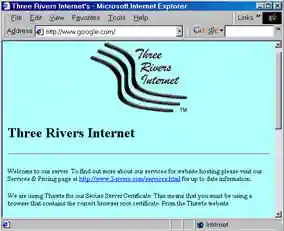
Today, I couldn’t access Google. When I tried, I got this site instead.
Bottomquark’s review of distributed computing projects. What’s striking is that there are commercial distributed projects – where companies pay for the use of your idle time. That’s a powerful concept. Instead of buying computers from a vendor, or even computing time from a vendor, these projects are buying computing time retail. The reason I guess this works is the dis-aggregation of computing time. When I buy a computer, I need its use for about 12 hours a day. But I’m paying for its availability 24 hours a day. Since I have that spare power, I can sell it as long as there’s a liquid market for such power. ...
Remember the Oracle of Google? Looks like it’s a lot more versatile than I thought. I asked it who coined the word “robot”. And the Oracle picked the right answer despite a mis-spelling!. (The answer is Karl Capek)
distributed.net cracked RC5-64. RC5-64 is an encryption algorithm developed by RSA. It took 4 years. It looks long. But the big deal is, the algorithm therefore can’t be used for long-term security. More importantly, it’s becoming practical to use distributed computing on a massive scale.
Get an idea of how much trouble copyright is generating for Google. via LinuxJournal
Open source should not be forced by governments, argues the Initiative for Software Choice. Their argument (which open source proponents agree with) is that software should be chosen on merit. But the argument is also self-serving, as the initiative is funded by software companies.
I found this site on neuroscience (for kids). Nice. Has lots of brain games (no – not smart ones – more like testing your reaction time, etc.) Actually I was reading up on neuroscience because of this article on how neuroscience helped figure out the meaning behind a Zen garden. via missing matter
Fortune, on the business model of The Rolling Stones.
This Economist article talks about the problems with patent laws. A recent report by the Commission on Intellectual Property Rights says: the interests of the “producer” dominate in the evolution of IP policy, and those of the ultimate consumer are either not heard or heeded.
Stupid US laws. I’m sure this Indiana law is quite popular: Bathing is prohibited during the winter. via kuro5hin
Mickey Kapoor owns a restaurant in the US, opposite to Pappadeaux’s restaurant. Every time Pappadeaux puts up a signboard, Mickey puts up a pun-board in retort. Hilarious. via Mala
The Guardian on the parallels between the Roman and the American empires.
Joshua, in an insightful article, talks of the tradeoff between reciprocal links and quality.
Miss Universe dethroned for either being pregnant, or married. She says she’s neither, and prefers to keep the (rather valuable) tiara.
Interesting Economist article by Drucker about The Near Future. The usual stuff about megatrends, which is, as always, a good read.
Nostalgia. Remember when Microsoft was more evil than Satan himself?
More nostalgia. John Keogh patented the wheel. via Ig Nobel Prizes