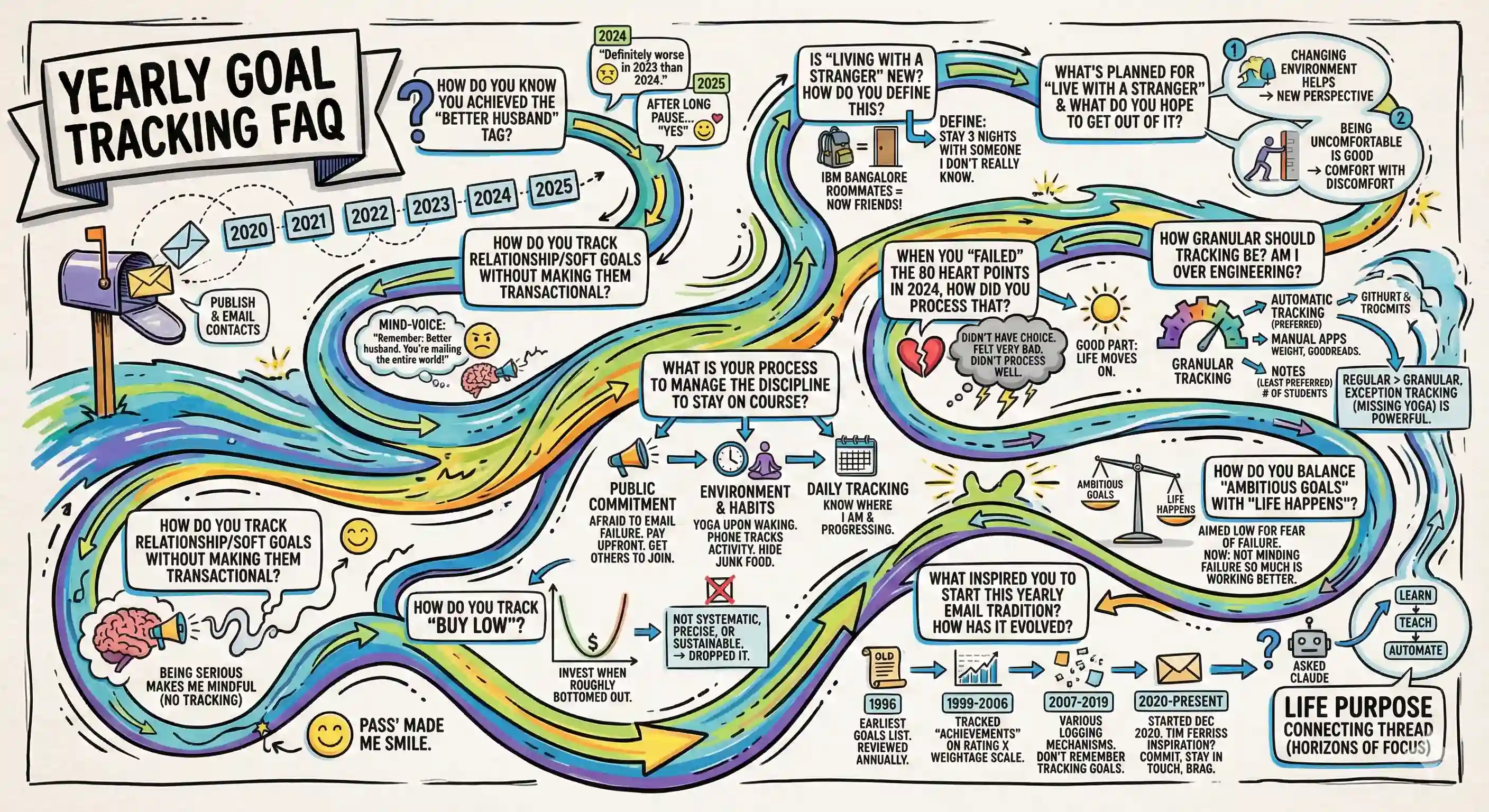
I track my yearly goals by publishing and emailing them to my contacts:
Here are questions people have asked about my goal tracking.
How do you know that you have achieved the Better Husband tag?
In 2024, she said that I was “definitely worse in 2023 than 2024.”
In 2025, after a long pause, she finally declared “Yes”. 🙂
Your “Better husband - PASS” made me smile. How do you track relationship/soft goals without making them feel transactional?
In this case, I don’t track. But being serious about my goal makes me mindful. (E.g. during an argument, my mind-voice says, “Remember: Better husband. You’re mailing the entire world!”)
Is living with a stranger something you have never done before? Roommates, staying at hostels, etc.? How are you defining this?
Good point. I had roommates only when I was at IBM in Bangalore. They are such good friends that I forgot they were once strangers!
If I invite myself to stay for 3 nights with someone I don’t really know, I’ll count it.
What do you have planned for Live with a Stranger and what do you hope to get out of it?
- Changing environment helps. I hope to get a new perspective
- Being uncomfortable is good. It pushes boundaries. I hope to get comfortable with discomfort.
How do you track “buy low”?
By “Buy low” I mean make investmented when it roughly bottomed out. I check if I bought approximately at the bottom of a U curve.
It’s not a systematic behavior, nor a precise metric, nor a sustainable approach. So I dropped it.
What is your process to manage the discipline to stay on course?
- Public commitment helps. E.g. I’m afraid to email everyone I know that I failed a goal. I pay upfront for courses. I get others to join me - harder to skip, then.
- Environment & habits help. Yoga as soon as I wake up, phone automatically tracks activity, hiding junk food, etc.
- Daily tracking helps. I know where I am and whether I’m progressing.
When you “failed” the 80 heart points in 2024, how did you process that? Did you adjust mid-year or accept and move on to 2025?
I didn’t have a choice. I felt very bad (and still feed a bit bad), so I didn’t process it well, I guess. The good part is, whether we process things well or not, live moves on.
How granular should tracking be? I’m building a Git repository with daily logs, XP points, Python scripts for reports… Am I over engineering this? (Probably yes, but tell me anyway!)
I track granularly. I prefer automatic tracking (e.g. GitHub for commits, Google Fit for heart points) over manual apps (e.g. weight on Google Fit, books on GoodReads) over notes (e.g. # of students).
- Regular tracking feels more important than granular tracking.
- Exception tracking seems powerful, e.g. track days when I miss Yoga. (That never happened, since I was conscious.)
How do you balance “ambitious goals” with “life happens”? Is it okay to explicitly plan for lower standards during chaos (my Q2), or is that pre-planning failure?
I’ve always aimed low - for fear of failure. I tried ambition… but not minding failure so much is working better for me.
What inspired you to start this yearly email tradition? How has it evolved over the years?
I started emailing goals in Dec 2020. Inspired by Tim Ferriss, maybe? It was a way to commit myself, stay in touch, and brag a bit.
- My earliest goals list is from 1996. I reviewed those annually.
- From 1999 - 2006, I tracked “achievements” on a Rating x Weightage = Points scale without goals.
- From 2007 - 2019, I tried various logging mechanisms but don’t remember tracking goals.
- From 2020 onwards, I use this email tradition.
What is the year on year short term to long term thread that connects these decisions to your life purpose? Horizons of Focus
I don’t know, so I asked Claude - and agree with its synthesis: Learn, Teach, then Automate.