As AI marches along, another role at risk is the data engineer / database administrator.
(Data scientists are already feeling the heat.)
A common task for data engineers is to analyze SQL queries - to optimize and standardize.
Pavan used Antigravity to analyze 1,500 SQL queries and found:
- 30% of queries are purely headcount / volume related. Much more than revenue (25%) or engagement (15%). That’s sign of a tactical culture.
- 70% of the queries are about What happened yesterday? rather than What will happen tomorrow? - again, tactical culture.
As a next step, he built a “Middle Layer” - intermediate tables that standardize and optimize queries. Instead of 50 fragile tables, the user can query just 3 robust tables that cover 98% of the SQL queries.
For example:
- A
net_revenuefield that standardizes net revenue after adjustments, i.e.SUM(face_value - discount), which is used in 58% of queries. That ensures that Finance (which used to see the GAAP Revenue) and Sales (which used to see the Booked Revenue) are now aligned. - A
tickets_soldfield that standardizes distinct count of tickets sold, used in 85% of queries, and is a slow computation.
NOTE: Season ticket buyers often bought merchandise as guests (for convenience). Marketing saw these as new customers and spammed them - annoying VIP customers. This standardization created an identity graph - so they can offer discounts instead.
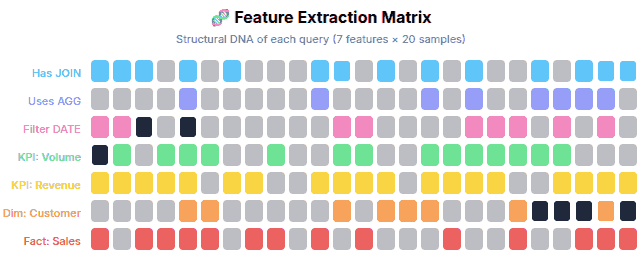
The process, which Antigravity figured out mostly by itself, was to parse the SQL into an abstract syntax tree (AST), extract a set of features, map them into clusters (archetypes), and analyze them to create the middle layer tables.
SQL queries can reveal organizational culture and misalignment - which is cool! But also:
- This took a few hours.
- Pavan has no data engineering experience.
RIP, Data Engineers.