If you have a bunch of projects you could do, and want to decide which ones to take up, I was taught a rule: if a project has positive net present value, do it.
That is, find out how much money you have to put in (& when), and how much you’ll get out (& when). Adjust for money today being worth more than money tomorrow. If it makes a profit, just do it.
There are 3 aspects to this calculation, of which two are usually ignored.
- Time value of money. Money today is worth more than money tomorrow. People usually don’t adjust for this – either because they don’t know they should, or because they’re not sure how much to adjust by. It’s usually OK to ignore this. The difference is not often much. Your estimations of cash flow are likely to be off by more than this adjustment anyway.
- Cash flow projection. This is tough too. People batch these together into two groups: what you put in and what you get out.
- Investment and return. This is the often used part. You put in money (over time), and you get money out (over time). Do you get more than you put in? How much more?
In other words, I’ve seen Return on Investment (RoI) used far more than Net Present Value (NPV).
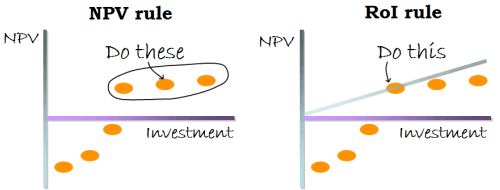
In my MBA classes, I was taught that this is wrong. That you need to worry about RoI only if you’re budget-constrained. If you have enough money (and organisations can always borrow), you should do all profitable projects.
I can’t tell for sure if organisations are budget constrained or not. Departments do have budgets. But whether they stick to it or not depends on the department head’s risk aversion and political power. It often has nothing to do with projects.
But I’ve seen a bigger complaint cited more often: people don’t have time. Time is a bigger constraint than money.
This works in two ways. You don’t have staff to execute a more projects. Or you don’t have management time to pay attention to new projects.
If you’re constrained by money, it makes sense to maximise return on investment. But if you’re constrained by time, maximise return on effort.
BTW, effort is not the same as time. Outsourcing, for example, increases return on effort, but probably not return on investment. Vendors take money without taking up staff time (except a bit of management time). If you’re manpower constrained, and not money constrained, use them as much as possible. Similarly, investing in assets rather than in hiring improves return on effort.
When at BCG, there was a whole theme around this called Workonomics. Like Economics is about maximising return for money, Workonomics is about maximising return from your workforce. Powerful concept. It’s a pity I’ve never seen it applied where it’s really needed.
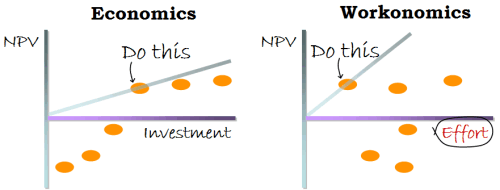
The most important thing is: at any point, you have only one constraint. Maximise return on that constraint. If it’s money, maximise RoI. If it’s staff, maximise productivity. If it’s customers, maximise share of wallet. And so on.
Comments