Jaidev’s The Bridge of Asses reminded me of my first coding bridge.
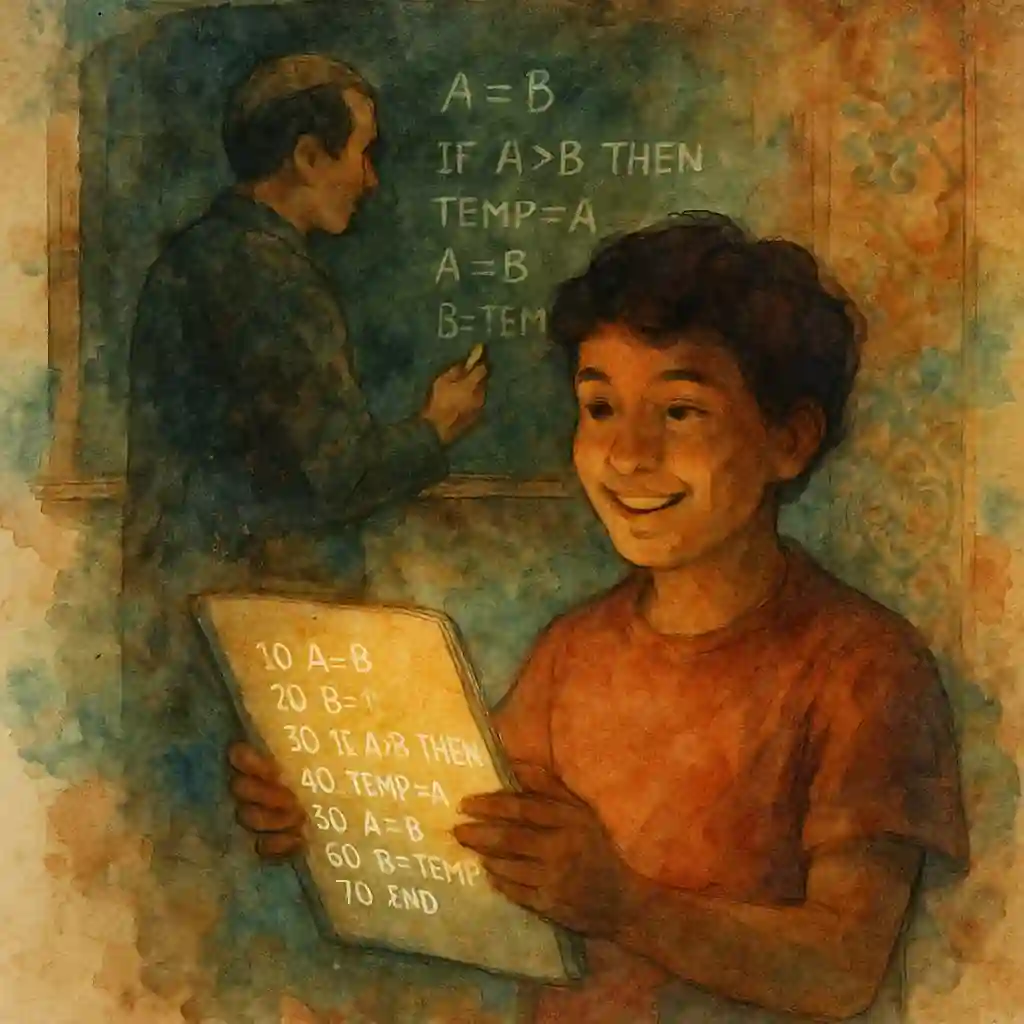
It was 1986. I’d completed class 6 and was in a summer coding camp at school. M Kothandaraman (“MK Sir”) was teaching us how to swap variables in BASIC on the BBC Micro.
This code prints the first name in alphabetical order (“Alice”):
10 A = "Bob"
20 B = "Alice"
30 IF A > B THEN
40   TEMP = A
50   A = B
60   B = TEMP
70 END
80 PRINT A
The homework was to print all details of the first alphabetical name:
10 A = "Bob"   : ASEX = "M" : AAGE = 30
20 B = "Alice" : BSEX = "F" : BAGE = 20
After a few hours and a headache, I came up with:
30 IF A > B THEN
40    TEMP = A : TEMPSEX = ASEX : TEMPAGE = AAGE
50    A = B    : ASEX = BSEX    : AAGE = BAGE
60    B = TEMP : BSEX = TEMPSEX : BAGE = TEMPAGE
70 END
80 PRINT A, ASEX, AAGE
After 39 years, I still remember the code. I also remember the moment when MK Sir asked if anyone had solved it. My hand went up – the only one in a group of 15. I stood, opened my ruled notebook, recited the code. He nodded and wrote it on the blackboard for all to see.
There’s a thrill in solving a hard problem. It’s bigger if you’re the only student who solved it. I was so inspired that I’ve coded almost every day since then.
Today, I’m a teacher. Sometimes only one student solves a tough problem I set (e.g. the first student who hacked my exam). Those moments are delightful!
Teachers measure themselves by how much students learn (e.g. better scores). Another measure is how many they inspire. Problems that only one student solves may be a sign of inspiration.
With apologies to other students, I will be adding more such hard problems in my course.
PS: One other thing delights people as much: success at vibe-coding. The look on the facilities manager’s face, after vibe-coding an empty-room detection app, was priceless. I’ll use that more to inspire non-developers.