Developing taste & judgement are an essential skill in the AI era. # #
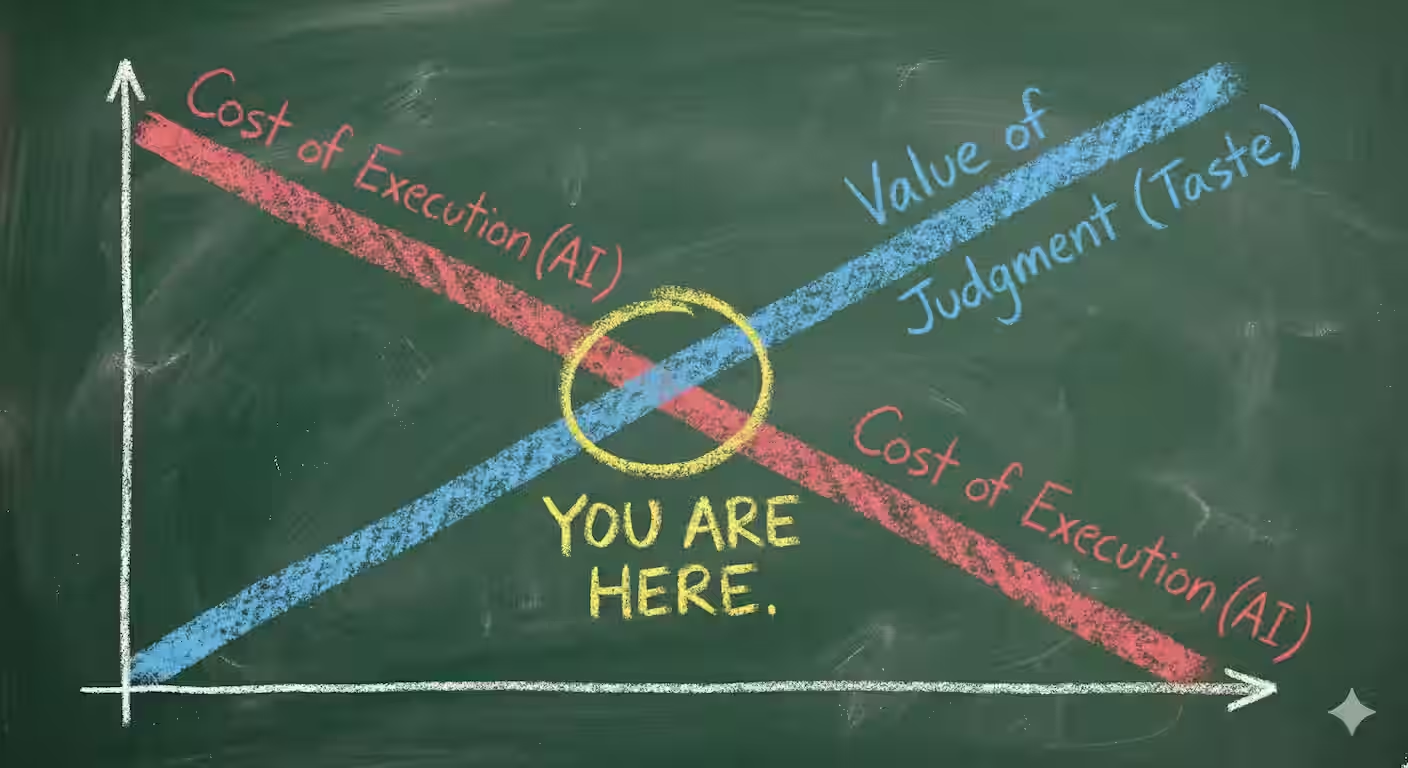
But taste is different from knowledge and takes more time.
- Gaining knowledge is a software upgrade. It strengthens existing synapses. It’s fast, reversible, no new “cables” required.
- Taste is a hardware upgrade. It destroys inefficient pathways, grows neurons for new pathways, and wraps axons with myelin speeding up signals 100x. (London cab drivers literally have a larger hippocampus.) Taste takes time.
How we acquire taste depends on the environment.
- In kind environments (with clear, immediate, accurate feedback, like sports, surgery) is easier. Practice at the edge of competence. #
- In wicked environments (investing, hiring, politics, strategy) confidence can be misleading. So, audit prediction reasoning: write your predictions with reason. Months later, if you were right for the wrong reasons, treat it as failure.
Practices that help:
- Taste requires complexity and understanding #. So, when bored, complicate; when confused, study by copying, comparing, asking why, and prototyping a vocabulary. # #
- Argument Mapping: create granular mind-maps of arguments, find hidden assumptions, and evaluate evidence.
- Watch experts: watch experts at work, guess their next moves, explain your reasoning, and copy but with extra constraints.
- Perceptual Learning: learning by comparing examples and prototyping a vocabulary.
- Brain Trust: have peers critique your work against a goal at early stages (to focus on core, not polish).
- Mindfulness: to reduce sunk-costs and other biases/blindspots. Helps with post-mortems.
- Communities of Practice: find where experts in your field hang out, curate ruthlessly, and absorb the vocabulary.
- Project-Based Learning: solve a real problem you have, fail + learn + iterate, with other people.
Ancient wisdom (Stoicism, Buddhism, Confucianism, etc.) broadly aligns, but there are a few differences.
- Slow vs fast. Ancient wisdom suggests that judgement must develop slowly. Science is optimistic about acceleration, e.g. perceptual learning, simulation, etc.
- Moralility. Ancient wisdom anchors judgement in morality. Science is more agnostic.
Sometimes “taste” is just “elitism”. That’s not going away, and offers another way to develop taste: via “club membership”.
AI, like most automation, erodes skills. This has happened in the past and we deal with it differently.
- Autopilots eroded flying skills - which is dangerous. So we enforce flight simulators. Same for surgical knots (robotic surgery), celestial navigation (navy), manual dosing (nurses).
- Spreadsheets eroded calculation skills. We leveled-up from sums to strategy. Same for CAD, electronic trading, spell-check.
- Photography eroded painting skills. We switched value to impressionism, cubism, etc. Same for vinyl records, luxury watches, craft coffee.
- GPS eroded navigation skills. We accepted this and don’t care much. Same for phone numbers, spelling, mental maths.
Think about how the skill we lose will evolve. Then enforce, level-up, switch, or accept accordingly.
Source: I used Claude Deep Research and asked Gemini to interpret it.
23 Mar 2026. Taste may not matter as much as I thought. I see AI learning & acquiring good taste in code (e.g. architecture) and art (e.g. writing, visual design). Accountability may be more important.