How to convert APR to interest rate

If you don’t know your interest rate (IRR), but only have your APR, there is a way of figuring out the actual interest rate on Excel. For this, you need to know your EMI (monthly payment), duration of the loan (number of months) and principal (amount you borrowed). Let’s assume your EMI is 2,000 and you are paying over 5 years (60 months) on a loan of 100,000. Use Excel’s RATE function. In this example: ...

Difference between interest rate and APR

When I moved to the UK, I was surprised to see mortgages advertised for 4.9%. ICICI Bank's HiSAVE account was offering 5.15% interest on savings. So if I borrowed at 4.9% and invested at 5.15%, I can make money for nothing! The catch, of course, is that the mortgage was 4.9% APR. Annual Percentage Rate is the total interest you pay on the initial amount you borrow, divided by the number of years. This has nothing to do with the Internal Rate of Return, or the regular interest rate we know of. ...

How to calculate principal repayment

Answer: use the CUMPRINC function in Excel Say you take a 10-year lease for 100,000 at an interest rate (IRR) of 10%, paid annually. The installment for this lease is 16,275. You can calculate this using the PMT function in Excel: PMT(10%, 10, 100000) = -16275 You've made 5 payments over 5 years. At this point, if you decide you want to repay the full lease, how much do you have to repay? In other words, what's the principal outstanding after 5 years? ...

Absolutely convergent series

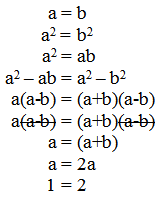
I’ve seen many proofs that 1=2. Here’s a classic. The (not-so-subtle) error in the above proof is that we’re cancelling (a-b) on both sides, when (a-b) equals zero. That is, we’re dividing by zero on both sides. That completely invalidates the equality. Another proof uses the fact that the square root of a number can be both positive or negative. ...

Calculating IRR

Recently, I was helping a bank define Basel 2 requirements. For every dollar a bank lends, at least 8 cents should come from its own pocket, and the rest from its depositors. But a risky $1 loan may be like a $1.5 loan, whereas a $1 Government loan may be like a $0.5 loan. This is the "risk-weighted asset" (RWA) value. Basel 2 says 8% of risk-weighted assets should come from the bank's pocket. ...