Google AI Tools List

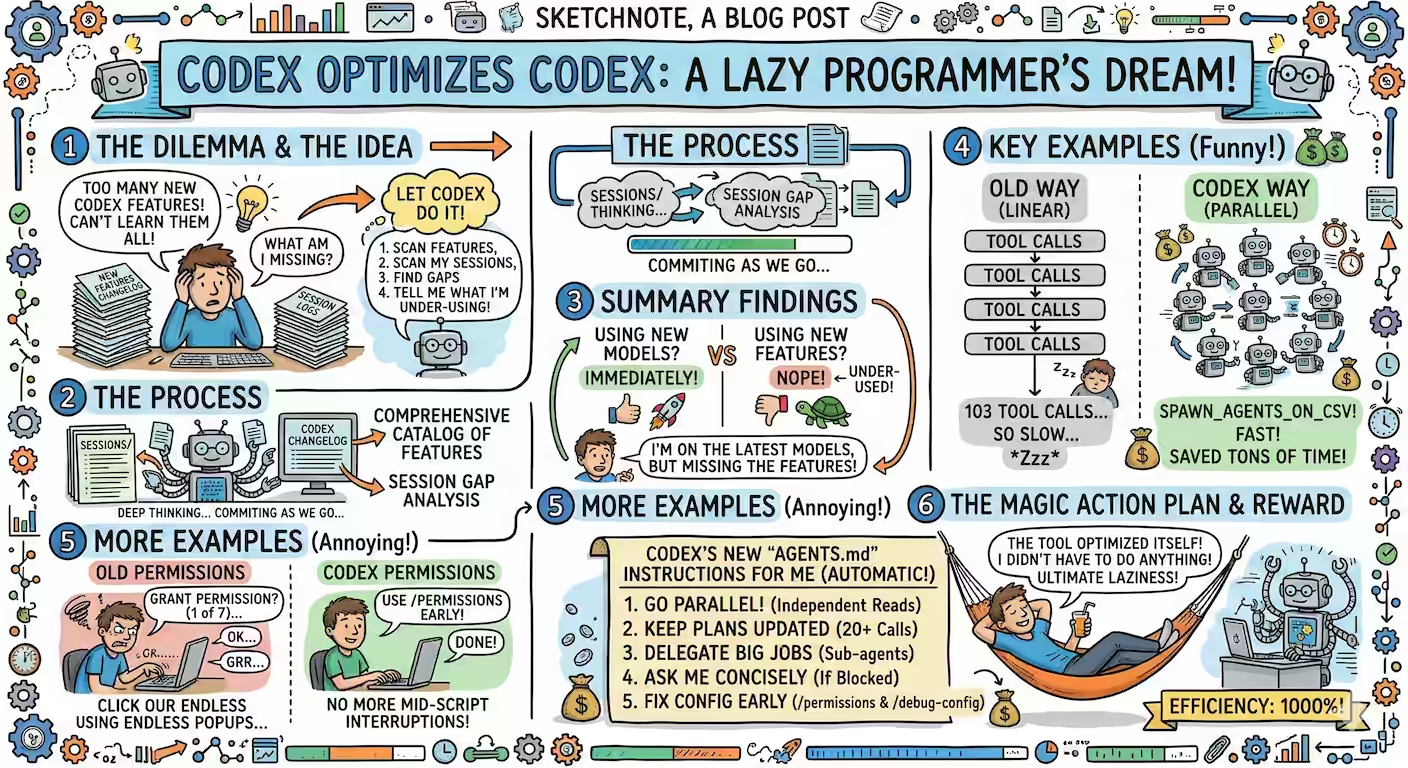
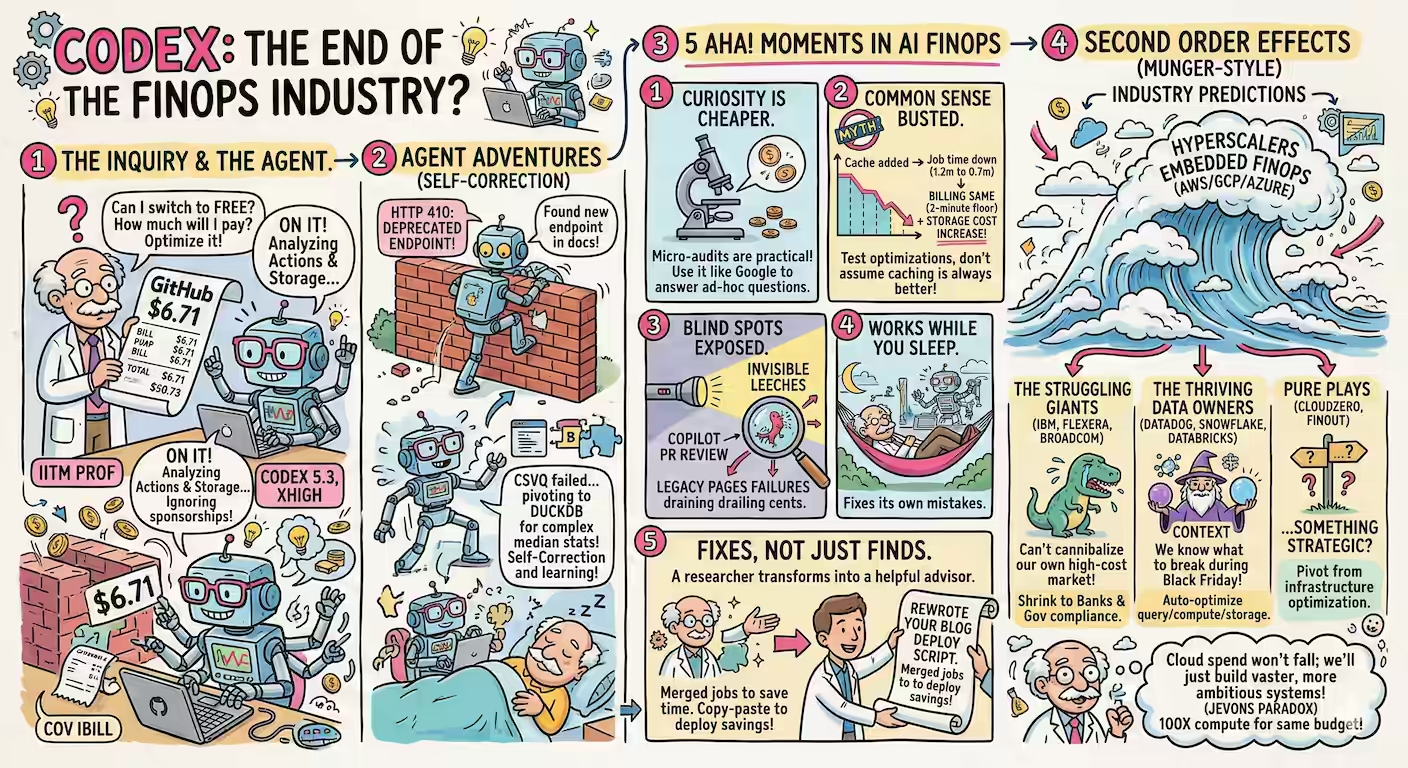
Google has released a huge number of AI tools. Not all are useful, but some are quite powerful. Here’s a list of the tools ChatGPT could find. 🟢 = I find it good. 🟡 = Not too impressive. 🔴 = Avoid. Assistants, research, and knowledge work 🟢 Gemini is Google’s main AI assistant app. Use it as a meeting-prep copilot: paste the agenda + last email thread, ask for “3 likely objections + crisp rebuttals + 5 questions that sound like I did my homework.” 🟢 Gemini Deep Research is Gemini’s agentic research mode that browses many sources (optionally your Gmail/Drive/Chat) and produces multi-page reports. Use it to build a client brief with citations (market, competitors, risks), then reuse it for outreach or a deck outline. 🟢 Gemini Canvas turns ideas (and Deep Research reports) into shareable artifacts like web pages, quizzes, and simple apps. Use it to convert a research report into an interactive explainer page your team can share internally. 🟢 Gemini Agent is an experimental “do multi-step tasks for me” feature that can use connected apps (Gmail/Calendar/Drive/Keep/Tasks, plus Maps/YouTube). Use it to plan a week of customer check-ins: “find stalled deals, draft follow-ups, propose times, and create calendar holds-show me before sending.” 🟢 NotebookLM is a source-grounded research notebook: it answers from your uploaded sources and can generate Audio Overviews. Use it to turn a messy folder of PDFs into a decision memo + an “AI podcast” you can listen to while walking. 🟡 Pinpoint (Journalist Studio) helps explore huge collections of docs/audio/images with entity extraction and search. Use it for internal investigations / audit trails: upload contracts + emails, then trace every mention of a vendor and its linked people/locations. 🟢 Google AI Mode exposes experimental Search experiences (including AI Mode where available). Use it for rapid competitive scans: run the same query set weekly and track what changed in the AI-generated summaries vs links. Project Mariner is a Google Labs “agentic” prototype aimed at taking actions on your behalf in a supervised way. Use it to prototype a real workflow (e.g., “collect pricing from 20 vendor pages into a table”) before you invest in automating it properly. Workspace and “AI inside Google apps” 🟢 Google Workspace with Gemini brings Gemini into Gmail/Docs/Sheets/Drive, etc. Use it to turn a weekly leadership email into: (1) action items per owner, (2) a draft reply, and (3) a one-slide summary for your staff meeting. Google Vids is Workspace’s AI-assisted video creation tool. Use it to convert a project update doc into a 2-3 minute narrated update video for stakeholders who don’t read long emails. Gemini for Education packages Gemini for teaching/learning contexts. Use it to generate differentiated practice: same concept, three difficulty levels + a rubric + common misconceptions. Build: developer + agent platforms 🟢 Google AI Studio is the fast path to prototyping with Gemini models and tools. Use it to build a “contract red-flagger”: upload a contract, extract clauses into structured JSON, and generate a risk report you can paste into your workflow. Firebase Studio is a browser-based “full-stack AI workspace” with agents, unifying Project IDX into Firebase. Use it to ship a real internal tool (auth + UI + backend) without local setup, then deploy with Firebase/Cloud Run. 🟢 Jules is an autonomous coding agent that connects to your GitHub repo and works through larger tasks on its own. E.g. give it “upgrade dependencies, fix the failing tests, and open a PR with a clear changelog,” then review it like a teammate’s PR instead of doing the grind yourself. Jules Tools (CLI) is a command-line interface for running and monitoring Jules from your terminal or CI. E.g. pipe a TODO list into “one task per session,” auto-run nightly maintenance (lint/format/test fixes), and have it open PRs you can batch-review in the morning Jules API lets you programmatically trigger Jules from other systems. E.g. when a build fails, your pipeline can call the API with logs + stack trace, have Jules propose a fix + tests, and post a PR link back into Slack/Linear for human approval Project IDX > Firebase Studio is the transition site if you used IDX. Use it to keep your existing workspaces but move to the newer Studio flows (agents + Gemini assistance). Genkit is an open-source framework for building AI-powered apps (workflows, tool use, structured output) across providers. Use it to productionize an agentic workflow (RAG + tools + eval) with a local debugging UI before deployment. Stax is Google’s evaluation platform for LLM apps (prompts, models, and end-to-end behaviors), built to replace “vibe testing” with repeatable scoring. E.g. codify your product’s rubric (tone, factuality, refusal correctness, latency), run it against every prompt/model change, and block releases when key metrics regress SynthID is DeepMind’s watermarking approach for identifying AI-generated/altered content. E.g. in an org that publishes lots of content, watermark what your tools generate and use detection as part of provenance checks before external release SynthID Text is the developer-facing tooling/docs for watermarking and detecting LLM-generated text. E.g. watermark outbound “AI-assisted” customer emails and automatically route them for review if they’re about regulated topics Responsible Generative AI Toolkit is Google’s “safeguards” hub: watermarking, safety classifiers, and guidance to reduce abuse and failure modes. E.g. wrap your app with layered defenses (input filtering + output moderation + policy tests) so one jailbreak prompt doesn’t become a security incident Vertex AI Agent Builder is Google Cloud’s platform to build, deploy, and govern enterprise agents grounded in enterprise data. Use it to build a customer-support agent that can read policy docs, query BigQuery, and write safe responses with guardrails. Gemini Code Assist is Gemini in your IDE (and beyond) with chat, completions, and agentic help. Use it for large refactors: ask it to migrate a module, generate tests, and propose PR-ready diffs with explanations. PAIR Tools is Google’s hub of practical tools for understanding/debugging ML behavior (especially interpretability and fairness). E.g. before launch, run “slice analysis + counterfactual edits + feature sensitivity” to find where the model breaks on real user subgroups LIT (Learning Interpretability Tool) is an interactive UI for probing models on text/image/tabular data. E.g. debug prompt brittleness by comparing outputs across controlled perturbations (tense, style, sensitive attributes) and visualizing salience/attribution to see what the model is actually using What-If Tool is a minimal-coding tool to probe model predictions and fairness. E.g. manually edit a single example into multiple “what-if” counterfactuals and see which feature flips the decision, then turn that into a targeted data collection plan Facets helps you explore and visualize datasets to catch skew, outliers, and leakage early. E.g. audit a training set for missingness and subgroup imbalance, then fix data before you waste time “tuning your way out” of a data problem 🟡 Gemini CLI brings Gemini into the terminal with file ops, shell commands, and search grounding. Use it as a repo-native “ops copilot”: “scan logs, find the regression, propose the patch, run tests, and summarize.” 🟡 Antigravity (DeepMind) is positioned as an agentic development environment. Use it when you want multiple agents running tasks in parallel (debugging, refactoring, writing tests) while you supervise. Gemini for Google Cloud is Gemini embedded across many Google Cloud products. Use it for cloud incident triage: summarize logs, hypothesize root cause, and generate the Terraform/IaC fix. Create: media, design, marketing, and “labs” tools Google Labs is the hub for many experiments (Mixboard, Opal, CC, Learn Your Way, Doppl, etc.). Use it as your “what’s new” page-many tools show up here before they become mainstream. 🟡 Opal builds, edits, and shares AI mini-apps from natural language (with a workflow editor). Use it to create a repeatable analyst tool (e.g., “take a company name > pull recent news > summarize risks > draft outreach”). 🟡 Mixboard is an AI concepting canvas/board for exploring and refining ideas. Use it to run a structured ideation sprint: generate 20 variants, cluster them, then turn the top 3 into crisp one-pagers. Pomelli is a Labs marketing/brand tool that can infer brand identity and generate on-brand campaign assets. Use it to produce a month of consistent social posts from your website + a few product photos. 🟡 Stitch turns prompts/sketches into UI designs and code. Use it to go from a rough wireframe to React/Tailwind starter code you can hand to an engineer the same day. 🟡 Flow is a Labs tool aimed at AI video/story production workflows (built around Google’s gen-media stack). Use it to create a pitch sizzle reel quickly: consistent characters + scenes + a simple timeline. Whisk is a Labs image tool focused on controllable remixing (subject/scene/style style workflows). Use it for fast, art-directable moodboards when text prompting is too loose. ImageFX is Google Labs’ image-generation playground. Use it to iterate brand-safe visual directions quickly (e.g., generate 30 “hero image” variants, pick 3, then refine). VideoFX is the Labs surface for generative video (Veo-powered). Use it to prototype short looping video backgrounds for product pages or events. MusicFX is the Labs music generation tool. Use it to generate royalty-free stems (intro/outro/ambient) for podcasts or product videos. Doppl is a Labs try-on style experiment/app. Use it to sanity-check creative wardrobe ideas before you buy, or to mock up “virtual merch” looks for a campaign. 🟢 Gemini Storybook creates illustrated stories. Use it to generate custom reading material for a specific learner’s interests (and adjust reading level/style). TextFX is a Labs-style writing creativity tool (wordplay, transformations, constraints). Use it to generate 10 distinct “hooks” for the same idea before you write the real piece. GenType is a Labs experiment for AI-generated alphabets/type. Use it to create a distinctive event identity (custom letterforms) without hiring a type designer for a one-off. Science, security, and “serious AI” AlphaFold Server provides AlphaFold structure prediction as a web service. Use it to test protein/ligand interaction hypotheses before spending lab time or compute on deeper simulations. Google Threat Intelligence uses Gemini to help analyze threats and triage signals. Use it to turn a noisy alert stream into a prioritized, explainable threat narrative your SOC can act on. Models 🟡 Gemma is DeepMind’s family of lightweight open models built from the same tech lineage as Gemini. E.g. run a small, controlled model inside your VPC for narrow tasks (classification, extraction, safety filtering) when sending data to hosted LLMs is undesirable 🟡 Model Garden is Vertex AI’s catalog to discover, test, customize, and deploy models from Google and partners. E.g. shortlist 3 candidate models, run the same eval set, then deploy the winner behind one standardized platform with enterprise controls Vertex AI Studio is the Google Cloud console surface for prototyping and testing genAI (prompts, model customization) in a governed environment. E.g. keep “prompt versions + test sets + pass/fail criteria” together so experiments become auditable artifacts, not scattered chats Model Explorer helps you visually inspect model graphs so you can debug conversion/quantization and performance issues. E.g. compare two quantization strategies and pinpoint exactly which ops caused a latency spike or accuracy drop before you deploy Google AI Edge is the umbrella for building on-device AI (mobile/web) with ready-to-use APIs across vision, audio, text, and genAI. E.g. ship an offline, privacy-preserving feature (document classification or on-device summarization) so latency and data exposure don’t depend on the network Google AI Edge Portal benchmarks LiteRT models across many real devices so you don’t guess performance from one phone. E.g. test the same model on a spread of target devices and pick the smallest model/config that consistently hits your FPS/latency target TensorFlow Playground is an interactive sandbox for understanding neural networks. E.g. use it to teach or debug intuitions—show how regularization, feature interactions, or class imbalance changes decision boundaries in minutes Teachable Machine lets anyone train simple image/sound/pose models in the browser and export them. E.g. prototype an accessibility feature (custom gesture or sound trigger) fast, then export the model to a small web demo your stakeholders can try Directories (“where to discover the rest”) Google DeepMind Products & Models (Gemini, Veo, Astra, Genie, etc.)-best “canonical list” of what exists. Google Labs Experiments directory-browse by category (develop/create/learn) to catch smaller experiments you didn’t know to search for. Experiments with Google is a gallery of interactive demos (many AI) that’s great for prompt/data literacy and workshop “aha” moments. E.g. curate 5 experiments as a hands-on “AI intuition lab” for your team so they learn failure modes by playing, not by reading docs

Chrome Enterprise Premium access

Straive turned on Chrome Enterprise Premium on my browser. This means: No extensions or DevTools. No downloading, copying, or printing (of work stuff). No incognito mode. Every page, text pasted, file attached, is sent to the admin. Since Edge is my primary browser, I now open Chrome for office work only when needed. So, my guess is: I’ll check mail/chat less frequently. I’ll have fewer client documents to review. I’ll have fewer demos I can build. This might make me more productive - though it’s probably not what was intended.

Verifying Textbook Facts

Using LLMs to find errors is fairly hallucination-proof. If they mess up, it’s just wasted effort. If they don’t, they’ve uncovered a major problem! Varun fact-checked Themes in Indian History, the official NCERT Class 12 textbook. Page-by-page, he asked Gemini to: Extract each claim. E.g. “Clay was locally available to the Harappans” on page 12. Search online for the claim. E.g. ASI site description and by Encyclopedia Britannica. Fact-check each claim. E.g. “Clay was locally available to the Harappans” is confirmed by both sources. Here is his analysis and verifier code. ...

AWS PartyRock

I tried vibe-code a CSV to colored HTML table converter using this prompt. Create a tool that can convert pasted tables into colored HTML tables. Allow the user to paste a CSV or tab-delimited or pipe-delimited table. … Create an HTML table that has minimal styling. … Add a button to copy just the HTML to the clipboard. Codex built this. Which is perfect. AWS Partyrock built this. Which is a joke, because it didn’t write the code to do the conversion. It uses an LLM every time. ...

The meaning of life

As a teenager, I asked my mother “What is the aim of life?” She said, “To be happy and to make others happy.” This was my gospel for a decade. It made sense. It even aligned with my name (Anand = happiness). In my twenties, I was confused that happiness has tradeoffs, like: Long term (study hard) vs short term (party hard) Self (e.g. save diligently) vs others (gift generously) Getting what we like (e.g. favorite food, ambitiousness) vs liking what we get (e.g. any food, gratitude, lower standards) Outcome (e.g. wealth) vs process (e.g. enjoying work) By my thirties, I felt happiness is the intersection of pleasure and meaning. So I tried to be aware of and balance both. ...

Gemini copies images almost perfectly

Summary: Nano Banana Pro is much better than recent models at copying images without errors. That lets us do a few useful things, like: Pre-process images for OCR, improving text recognition by cleaning up artifacts while preserving text shapes exactly. Convert textbook raster diagrams into clean vector-like images that vectorizers can process easily. Create in-betweens for cartoon animations Copy torn, stained 1950s survey maps into pristine, high-contrast replicas with boundary lines preserved pixel-perfectly. Redraw sewage map blueprints or refinery blueprints into clean schematics, separating the “pipes” from the “background noise”. … and more! GPT Image 1.5 has a good reputation for drawing exactly what you tell it to. ...

Gemini Scraper

Gemini lets you copy individual responses as Markdown, but not an entire conversation. That’s useful if you want to save the chat for later, pass it to another LLM, or publish it. So I built a bookmarklet that scrapes the entire conversation as Markdown and copies it to the clipboard. SETUP: Drag the bookmarklet to your bookmarks bar. USAGE: On a Gemini chat page, click the bookmarklet. It copies the chat as Markdown. ...

Learnings from building Babbage Insight

Here’s a great post by Karthik Shashidhar on why they shut down Babbage Insight, and the learnings from the experience. (I’m reproducing in full here since LinkedIn is hostile to content.) I added ⭐ to points I found most interesting. As the more perceptive of you would have figured out by now, we are shutting Babbage Insight . When I told this to one of my old friends, his immediate reaction was “so what were your learnings from this experience?”. And so I decided to write this. ...

LinkedIn is hostile to content

It’s incredible how hostile LinkedIn is for reading / writing content. Posts containing links to external websites (like my blog) get significantly less reach. That’s why you see links in comments, not the post! You can’t copy content from posts on their mobile app. You can’t even easily select the entire article on the web app! Selecting a part, and then shift-clicking elsewhere (which works almost everywhere) doesn’t work. Also, the copied text isn’t clean. It’s filled with hidden text (e.g. “Skip to search”), duplicated text (e.g. author name repeated), and other junk. It’s hard to export content. For example, the export feature does not include the original links in your articles, nor the links to images you posted! It’s hard to scrape content. LinkedIn actively tries to prevent scraping, and their TOS prohibits it. No formatting. You have to embed unicode characters. Search is terrible. You can’t search for posts by keyword, date, or author easily. No public posting - so you need to log in to read anything. ...

Baba Is You

I have this feeling that the skills we need for the AI era might be found in video games. (Actually, no. I just want an excuse to play games. Self-improvement is a bonus.) I asked the usual LLMs (Claude, Gemini, ChatGPT): What are mobile phone games that have been consistently proven to be educational, instructive or skill/mental muscle building on the one hand, and also entertaining, engaging and popular on the other? ...

Can AI Replace Human Paper Reviewers?

Stanford ran a conference called Agents for Science. It’s a conference for AI-authored papers, peer reviewed by AI. They ran three different AI systems on every paper submitted, alongside some human reviewers. The details of each of the 315 papers and review are available on OpenReview. I asked Codex to scrape the data, ChatGPT to analyze it, and Claude to render it as slides. The results are interesting! I think they’re also a reasonably good summary of the current state of using AI for peer review. ...

The Periodic Table by Primo Levi and Randall Munroe

I read The Periodic Table by Primo Levi, written in Randall Munroe’s style. Here is the conversation. I began with the prompt: Rewrite the first chapter Primo Levi’s The Periodic table in the style of Randall Munroe. Same content, but as if Primo Levi had written it in Randall Munroe’s style. After that, for each chapter, I prompted: Continue! Same depth, same style. ...

NPTEL Applied Vibe Coding Workshop

For those who missed my Applied Vibe Coding Workshop at NPTEL, here’s the video: You can also: Read this summary of the talk Read the transcript Or, here are the three dozen lessons from the workshop: Definition: Vibe coding is building apps by talking to a computer instead of typing thousands of lines of code. Foundational Mindset Lessons “In a workshop, you do the work” - Learning happens through doing, not watching. “If I say something and AI says something, trust it, don’t trust me” - For factual information, defer to AI over human intuition. “Don’t ever be stuck anywhere because you have something that can give you the answer to almost any question” - AI eliminates traditional blockers. “Imagination becomes the bottleneck” - Execution is cheap; knowing what to build is the constraint. “Doing becomes less important than knowing what to do” - Strategic thinking outweighs tactical execution. “You don’t have to settle for one option. You can have 20 options” - AI makes parallel exploration cheap. Practical Vibe Coding Lessons Success metric: “Aim for 10 applications in a 1-2 hour workshop” - Volume and iteration over perfection. The subscription vs. platform distinction: “Your subscriptions provide the brains to write code, but don’t give you tools to host and turn it into a live working app instantly.” Add documentation for users: First-time users need visual guides or onboarding flows. Error fixing success rate: “About one in three times” fixing errors works. “If it doesn’t work twice, start again-sometimes the same prompt in a different tab works.” Planning mode before complex builds: “Do some research. Find out what kind of application along this theme can be really useful and why. Give me three or four options.” Ask “Do I need an app, or can the chatbot do it?” - Sometimes direct AI conversation beats building an app. Local HTML files work: “Just give me a single HTML file… opening it in my browser should work” - No deployment infrastructure needed. “The skill we are learning is how to learn” - Specific tool knowledge is temporary; meta-learning is permanent. Vibe Analysis Lessons “The most interesting data sets are our own data” - Personal data beats sample datasets. Accessible personal datasets: WhatsApp chat exports Netflix viewing history (Account > Viewing Activity > Download All) Local file inventory (ls -R or equivalent) Bank/credit card statements Screen time data (screenshot > AI digitization) ChatGPT’s hidden built-in tools: FFmpeg (audio/video), ImageMagick (images), Poppler (PDFs) “Code as art form” - Algorithmic art (Mandelbrot, fractals, Conway’s Game of Life) can be AI-generated and run automatically. “Data stories vs dashboards”: “A dashboard is basically when we don’t know what we want.” Direct questions get better answers than open-ended visualization. Prompting Wisdom Analysis prompt framework: “Analyze data like an investigative journalist” - find surprising insights that make people say “Wait, really?” Cross-check prompt: “Check with real world. Check if you’ve made a mistake. Check for bias. Check for common mistakes humans make.” Visualization prompt: “Write as a narrative-driven data story. Write like Malcolm Gladwell. Draw like the New York Times data visualization team.” “20 years of experience” - Effective prompts require domain expertise condensed into instructions. Security & Governance Simon Willison’s “Lethal Trifecta”: Private data + External communication + Untrusted content = Security risk. Pick any two, never all three. “What constitutes untrusted content is very broad” - Downloaded PDFs, copy-pasted content, even AI-generated text may contain hidden instructions. Same governance as human code: “If you know what a lead developer would do to check junior developer code, do that.” Treat AI like an intern: “The way I treat AI is exactly the way I treat an intern or junior developer.” Business & Career Implications “Social skills have a higher uplift on salary than math or engineering skills” - Research finding from mid-80s/90s onward. Differentiation challenge: “If you can vibe code, anyone can vibe code. The differentiation will come from the stuff you are NOT vibe coding.” “The highest ROI investment I’ve made in life is paying $20 for ChatGPT or Claude” - Worth more than 30 Netflix subscriptions in utility. Where Vibe Coding Fails Failure axes: “Large” and “not easy for software to do” - Complexity increases failure rates. Local LLMs (Ollama, etc.): “Possible but not as fast or capable. Useful offline, but doesn’t match online experience yet.” Final Takeaways “Practice vibe coding every day for one month” - Habit formation requires forced daily practice. “Learn to give up” - When something fails repeatedly, start fresh rather than debugging endlessly. “Share what you vibe coded” - Teaching others cements your own learning. “We learn best when we teach.” Tool knowledge is temporary: “This field moves so fast, by the time somebody comes up with a MOOC, it’s outdated.”

Finding open source bugs with Ty

Astral released Ty (Beta) last month. As a prototyper, I don’t type check much - it slows me down. But the few apps I shipped to production had bugs type checking could have caught. Plus, LLMs don’t get slowed by type checking. So I decided to check if Ty can spot real bugs in real code. I asked ChatGPT: Run ty (Astral’s new type checker) on a few popular Python packages’ source code, list the errors Ty reports (most of which may be false positives), and identify at least a few that are genuine bugs, not false positives. Write sample code or test case to demonstrate the bug. ...

Mapping The Red Headed League

Mapping The Red Headed League is a fascinating reconstruction of the actual places mentioned (or hinted at) by Arthur Conan Doyle’s The Red Headed League by Aman Bhargava. We cross-reference railway timetables, scrutinize Victorian newspaper reports and historical incidents, scour government records, analyze meteorological data, and, in my specific case, pore over Ordnance Survey maps to make the pieces fit. What struck me is how little London has changed, how much old data is available, and what love it takes to reconstruct such a journey! ...

Self-discover LLM capabilities

Q: “How do we learn what we can do with AI agents?” Me: “Ask them!” I mean, they are probably aware of their abilities. They can search online for how other people are using them. They have access to tools (connect to GMail, write & run code, etc.) which they’re aware of, and even if not, can try out. Asking them seems a useful way of figuring out how to use them. ...

Creating data stories in different styles

TL;DR: Don’t ask AI agents for one output. Ask for a dozen, each in the style of an expert. Share what works best. AI agents build apps, analyze data, and visualize it surprisingly well, these days. We used to tell LLMs exactly what to do. If you’re an expert, this is still useful. An expert analyst can do better analyses than an AI agent. An expert designer or data visualizer can tell an AI agent exactly how to design it. ...

No response required

I asked Gemini 3 Pro to: Suggest short words that mean innovation, exploration, research, etc. Spark: A small but significant beginning. Lab: Short for laboratory; implies experimentation. … (long and pretty good list) I went with "Labs". Thanks. No response required. THINKING… Assessing User Response I’ve carefully considered the user’s latest input, recognizing their selection of “Labs” and their appreciative, but brief, response. I’m focusing on parsing the meaning of “No response required” to determine if further interaction is needed. The information should help me to understand future similar responses. ...

Humans have taught LLMs well

Human LLM Bullshitting: Humans confidently assert wrong information, from flat-earth beliefs to misremembered historical “facts” and fake news that spread through sheer conviction Hallucination: LLMs generate plausible but factually incorrect content, stating falsehoods with the same fluency as facts People-Pleasing: Humans optimize for social harmony at the expense of honesty, nodding along with the boss’s bad idea or validating a friend’s flawed logic to avoid conflict Sycophancy: LLMs trained with human feedback tell users what they want to hear, even confirming obviously wrong statements to avoid disagreement Zoning Out: Humans lose focus during the middle of meetings, remembering the opening and closing but losing the substance sandwiched between Lost in the Middle: LLMs perform well when key information appears at the start or end of input but miss crucial details positioned in the middle Overconfidence: Humans often feel most certain precisely when they’re least informed—a pattern psychologists have documented extensively in studies of overconfidence Poor Calibration: LLMs express high confidence even when wrong, with stated certainty poorly correlated with actual accuracy Trees for the Forest: Humans can understand each step of a tax form yet still get the final number catastrophically wrong, failing to chain simple steps into complex inference Compositional Reasoning Failure: LLMs fail multi-hop reasoning tasks even when they can answer each component question individually First Impressions: Humans remember the first and last candidates interviewed while the middle blurs together, judging by position rather than merit Position Bias: LLMs systematically favor content based on position—preferring first or last items in lists regardless of quality Tip-of-the-Tongue: Humans can recite the alphabet forward but stumble backward, or remember the route to a destination but get lost returning Reversal Curse: LLMs trained on “A is B” cannot infer “B is A”—knowing Tom Cruise’s mother is Mary Lee Pfeiffer but failing to answer who her son is Framing Effects: Humans give different answers depending on whether a procedure is framed as “90% survival rate” versus “10% mortality rate,” despite identical meaning Prompt Sensitivity: LLMs produce dramatically different outputs from minor, semantically irrelevant changes to prompt wording Rambling: Humans conflate length with thoroughness, trusting the thicker report and the longer meeting over concise alternatives Verbosity Bias: LLMs produce unnecessarily verbose responses and, when evaluating text, systematically prefer longer outputs regardless of quality Armchair Expertise: Humans hold forth on subjects they barely understand at dinner parties rather than simply saying “I don’t know” Knowledge Boundary Blindness: LLMs lack reliable awareness of what they know, generating confident fabrications rather than admitting ignorance Groupthink: Humans pass down cognitive biases through culture and education, with students absorbing their teachers’ bad habits Bias Amplification: LLMs exhibit amplified human cognitive biases including omission bias and framing effects, concentrating systematic errors from their training data Self-Serving Bias: Humans rate their own work more generously than external judges would, finding their own prose clearer and arguments more compelling Self-Enhancement Bias: LLMs favor outputs from themselves or similar models when evaluating responses Via Claude ...

Yearly Goal Tracking FAQ

I track my yearly goals by publishing and emailing them to my contacts: My year in 2020 My year in 2021 My year in 2022 My year in 2023 My year in 2024 My year in 2025 Here are questions people have asked about my goal tracking. How do you know that you have achieved the Better Husband tag? In 2024, she said that I was “definitely worse in 2023 than 2024.” ...