NPTEL Applied Vibe Coding Workshop
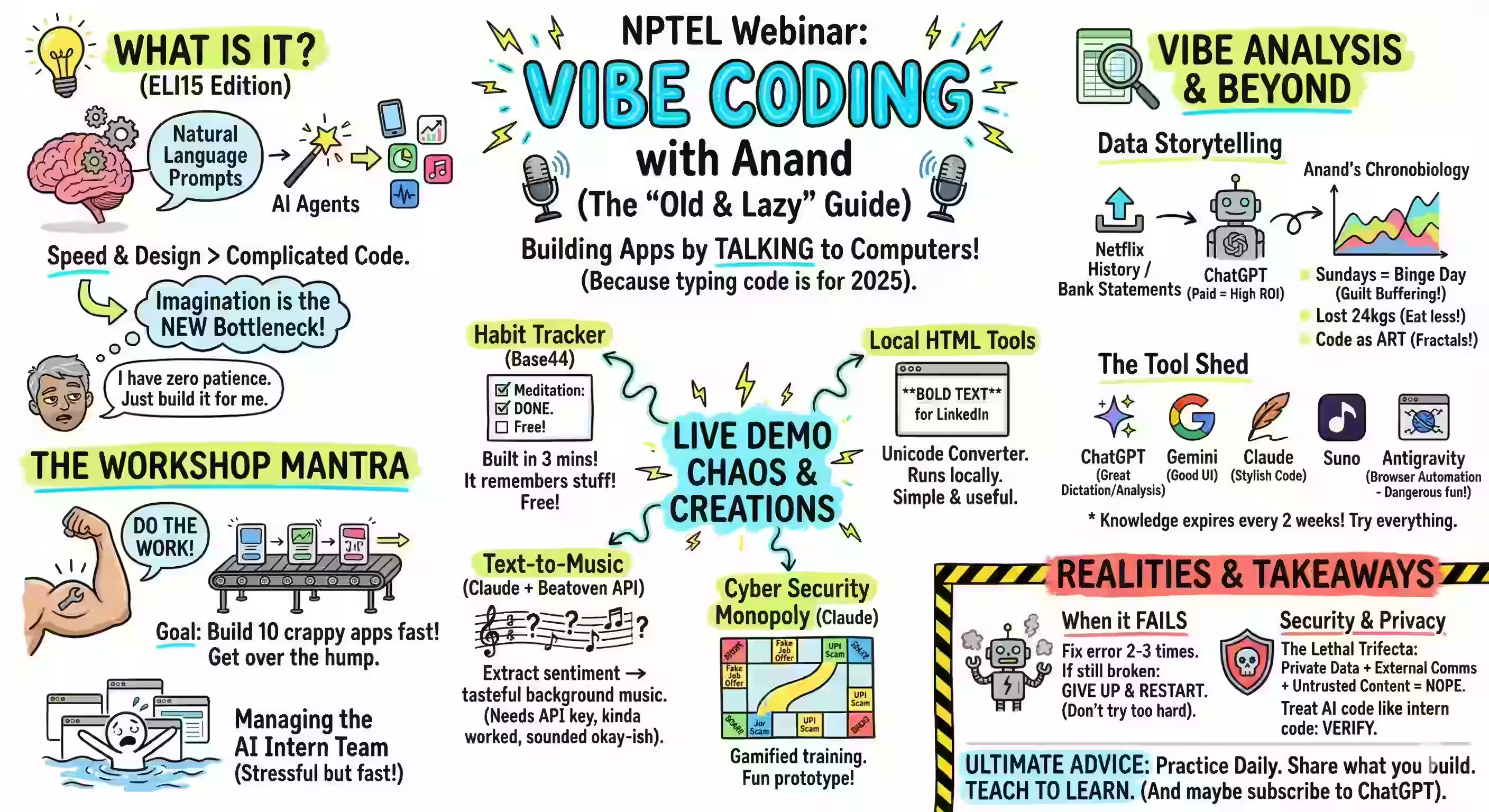
For those who missed my Applied Vibe Coding Workshop at NPTEL, here’s the video: You can also: Read this summary of the talk Read the transcript Or, here are the three dozen lessons from the workshop: Definition: Vibe coding is building apps by talking to a computer instead of typing thousands of lines of code. Foundational Mindset Lessons “In a workshop, you do the work” - Learning happens through doing, not watching. “If I say something and AI says something, trust it, don’t trust me” - For factual information, defer to AI over human intuition. “Don’t ever be stuck anywhere because you have something that can give you the answer to almost any question” - AI eliminates traditional blockers. “Imagination becomes the bottleneck” - Execution is cheap; knowing what to build is the constraint. “Doing becomes less important than knowing what to do” - Strategic thinking outweighs tactical execution. “You don’t have to settle for one option. You can have 20 options” - AI makes parallel exploration cheap. Practical Vibe Coding Lessons Success metric: “Aim for 10 applications in a 1-2 hour workshop” - Volume and iteration over perfection. The subscription vs. platform distinction: “Your subscriptions provide the brains to write code, but don’t give you tools to host and turn it into a live working app instantly.” Add documentation for users: First-time users need visual guides or onboarding flows. Error fixing success rate: “About one in three times” fixing errors works. “If it doesn’t work twice, start again-sometimes the same prompt in a different tab works.” Planning mode before complex builds: “Do some research. Find out what kind of application along this theme can be really useful and why. Give me three or four options.” Ask “Do I need an app, or can the chatbot do it?” - Sometimes direct AI conversation beats building an app. Local HTML files work: “Just give me a single HTML file… opening it in my browser should work” - No deployment infrastructure needed. “The skill we are learning is how to learn” - Specific tool knowledge is temporary; meta-learning is permanent. Vibe Analysis Lessons “The most interesting data sets are our own data” - Personal data beats sample datasets. Accessible personal datasets: WhatsApp chat exports Netflix viewing history (Account > Viewing Activity > Download All) Local file inventory (ls -R or equivalent) Bank/credit card statements Screen time data (screenshot > AI digitization) ChatGPT’s hidden built-in tools: FFmpeg (audio/video), ImageMagick (images), Poppler (PDFs) “Code as art form” - Algorithmic art (Mandelbrot, fractals, Conway’s Game of Life) can be AI-generated and run automatically. “Data stories vs dashboards”: “A dashboard is basically when we don’t know what we want.” Direct questions get better answers than open-ended visualization. Prompting Wisdom Analysis prompt framework: “Analyze data like an investigative journalist” - find surprising insights that make people say “Wait, really?” Cross-check prompt: “Check with real world. Check if you’ve made a mistake. Check for bias. Check for common mistakes humans make.” Visualization prompt: “Write as a narrative-driven data story. Write like Malcolm Gladwell. Draw like the New York Times data visualization team.” “20 years of experience” - Effective prompts require domain expertise condensed into instructions. Security & Governance Simon Willison’s “Lethal Trifecta”: Private data + External communication + Untrusted content = Security risk. Pick any two, never all three. “What constitutes untrusted content is very broad” - Downloaded PDFs, copy-pasted content, even AI-generated text may contain hidden instructions. Same governance as human code: “If you know what a lead developer would do to check junior developer code, do that.” Treat AI like an intern: “The way I treat AI is exactly the way I treat an intern or junior developer.” Business & Career Implications “Social skills have a higher uplift on salary than math or engineering skills” - Research finding from mid-80s/90s onward. Differentiation challenge: “If you can vibe code, anyone can vibe code. The differentiation will come from the stuff you are NOT vibe coding.” “The highest ROI investment I’ve made in life is paying $20 for ChatGPT or Claude” - Worth more than 30 Netflix subscriptions in utility. Where Vibe Coding Fails Failure axes: “Large” and “not easy for software to do” - Complexity increases failure rates. Local LLMs (Ollama, etc.): “Possible but not as fast or capable. Useful offline, but doesn’t match online experience yet.” Final Takeaways “Practice vibe coding every day for one month” - Habit formation requires forced daily practice. “Learn to give up” - When something fails repeatedly, start fresh rather than debugging endlessly. “Share what you vibe coded” - Teaching others cements your own learning. “We learn best when we teach.” Tool knowledge is temporary: “This field moves so fast, by the time somebody comes up with a MOOC, it’s outdated.”