I asked Claude: “What are the most effective and impactful ways you can help me?” One of its ideas was to ask it:
What are the three questions this field has not resolved, where the disagreement is substantive and not just semantic? Who represents each position most forcefully?"
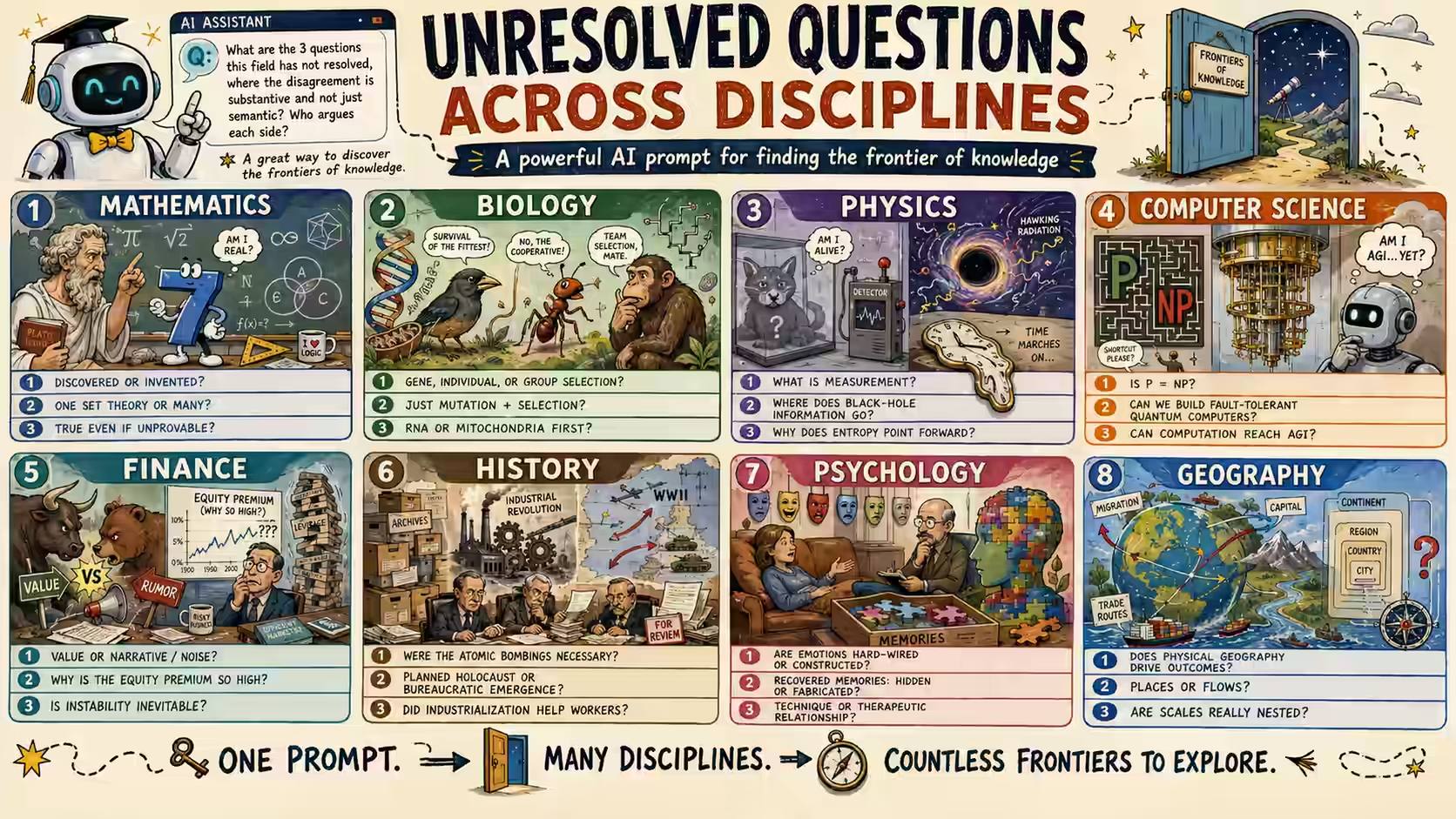
So I posed this question about several subjects. This is a great way to discover the frontiers of knowledge in a field.
- Mathematics
- Are mathematical objects (numbers, sets, complex numbers) real, independent of human minds? Or useful fiction? Do we discover or invent them?
- Is there one true set theory or a multiverse of equally valid set theories, e.g. where the continuum hypothesis is true vs false?
- Are theorems true or false, even if we can’t prove them?
- Biology
- Does natural selection operate at a gene, individual, or group level?
- Does evolution proceed through gene mutation + selection, or do we need to add epigenetics, niche construction, and developmental bias?
- Which came first - RNA or mitochondria?
- Physics
- What actually happens when a quantum system is measured?
- When a black hole evaporates, is the information about what fell in preserved (and how) in the Hawking radiation, or destroyed?
- Why does the universe have a strong entropy increase toward the future but not the past?
- Computer science
- Is P really equal to NP?
- Can fault-tolerant quantum computers actually be built?
- Can we really achieve AGI with computation?
- Finance
- Do asset prices track underlying value or market narrative / noise?
- Why is the historical US equity premium (~6%) so high that it implies a ~30–40x risk aversion?
- Is financial instability inevitable in capitalism, or is it due to external shocks?
- Psychology
- Are emotions hard-wired (hence discovered) or constructed from more primitive ingredients?
- Does trauma hide the memory that we recover later, or are these recovered pieces fabricated?
- In psychotherapy, do specific techniques work? Or is it just the relationship?
- History
- Were the atomic bombings of Japan militarily necessary?
- Was the Holocaust planned from the start, or did it emerge from bureaucratic chaos?
- Did the Industrial Revolution raise or lower living standards for ordinary workers?
- Geography
- Does physical geography cause big changes to human outcomes in the long run?
- Are places about a geographic location or about the flow of capital, people, and power that flow through?
- Are local, regional, national, … really nested ways of organizing society, or an ineffective way of thinking about geography?