Bertie meets Jeeves
The first time Bertie meets Jeeves. via RobotWisdom
The first time Bertie meets Jeeves. via RobotWisdom
John Ashmead offers a view of quantum mechanics in which the collapse of the wave function can be done away with. Given that the world is emphatically quantum mechanical, there should be no separate domain of competence for classical physics. All classical results should ultimately be explicated in quantum terms. I was long hoping this was the case.
US is the biggest threat to world peace?! A Time survey. via kuro5hin
Now IBM offers supercomputing on demand. Pricing is unclear, but Big Blue is clearly positioning itself as the computer utility house of the 21st century.
Kazaa is next. Even though it’s not based in the US, Kazaa has been ruled to be subject to US laws. No matter what the outcome, Kazaa is going to be in trouble. Well, time to move on to the next P2P software.
Obesity reduces lifespan. An obese 20-year-old man may have his life expectancy cut by as many as 13 years compared with normal-weight people.
The real face of Jesus. Jesus, it turns out, looked like a peasant, bearded and green-brown eyed. At least, if forensic anthropology is to be believed. via Nilesh
Article on 64-bit processors. Interesting description of the PC industry pecking order: Microsoft > Intel > HP / Dell. Keeping that in mind does help predict a lot of the PC’s future. via RobotWisdom
The Future of the Book from Xerox PARC is an interesting paper I picked up from The Social Life of Information by Brown and Duguid.
Top 10 books of the millenium. Notables: Rise and Fall of the Roman Empire.
A photographic history of Vajpayee from Rediff, to commemorate his 78th birthday.
Jakob Nielsen’s top 10 web design mistakes of 2002. Fortunately, I was committing only one of them – fixed font sizes. Now rectified.
2002 in pictures – links on MetaFilter.
Reckoners: an e-book on the history of early electronic computers. via RobotWisdom
Interesting article on The Economist on the value of a cluttered desk. … the assumption that filers can find stuff more quickly is wrong. Filers, they say, “are less likely to access a given piece of data, and more likely to acquire extraneous data…” (There’s a “Clean your desk” initiative at BCG Mumbai going on right now.)
Determinism, Chaos and Quantum Mechanics [PDF]. Interesting 30-pager by Jean Bricmont. He begins by differentiating predictability from determinism, and proceeds to explain how chaos theory supports determinism by enhancing predictability. As an interesting aside, Bricmont’s article points out that there are 2 kinds of probabilities. Objective probability is where I know that if I toss a fair coin enough times, it’ll turn up heads 50% of the time. Subjective probability is where I think there’s a 10% chance it’ll rain tomorrow, and I don’t care to repeat the event. The former is an informed statement about a system. The latter is our best guess about an event. The former number is a constant, if we’ve done the calculations right. The latter number can change as our knowledge of the event increases. ...
A Nike ID story. An e-mail correspondence between Jonah and Nike about creating a personalised ID called “sweatshop”.
While I thought that every cell in the human body had identical genetic make-up, it turns out that brain cells could have gained or lost some chromosomes. Now, that’s a pretty big discovery. via missing matter
Very interesting article on Google on Wired. One interesting point the article raises towards the end is this: “As a private company, Google has one master: users. As a public company, there are shareholders to worry about.” And the interests of these may not be aligned. Shareholders may want more ad revenues. Users do not want ads. Shareholders may want paid placements. Users do not. Once Google IPOs, I suspect its quality will fall.
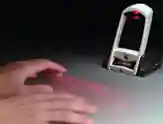
Cool picture of a virtual keyboard. The article talks about a purely optical keyboard. You move your fingers, and the “keyboard” detects what you’re typing. Now, if optics are that advanced, they should be able to figure out what I’m writing and put that on the computer. So I won’t need a digital pad – I’ll just write on paper. Or even better, project the screen! Then I’ll just carry a little 1" x 1" x 1" box that’ll project a virtual screen that I can draw / write on.